De Moivre's Theorem in Reverse
Finding Roots of Complex Numbers Year 13 Mathematics Using Radians and the Argand Plane
Recap: De Moivre's Theorem
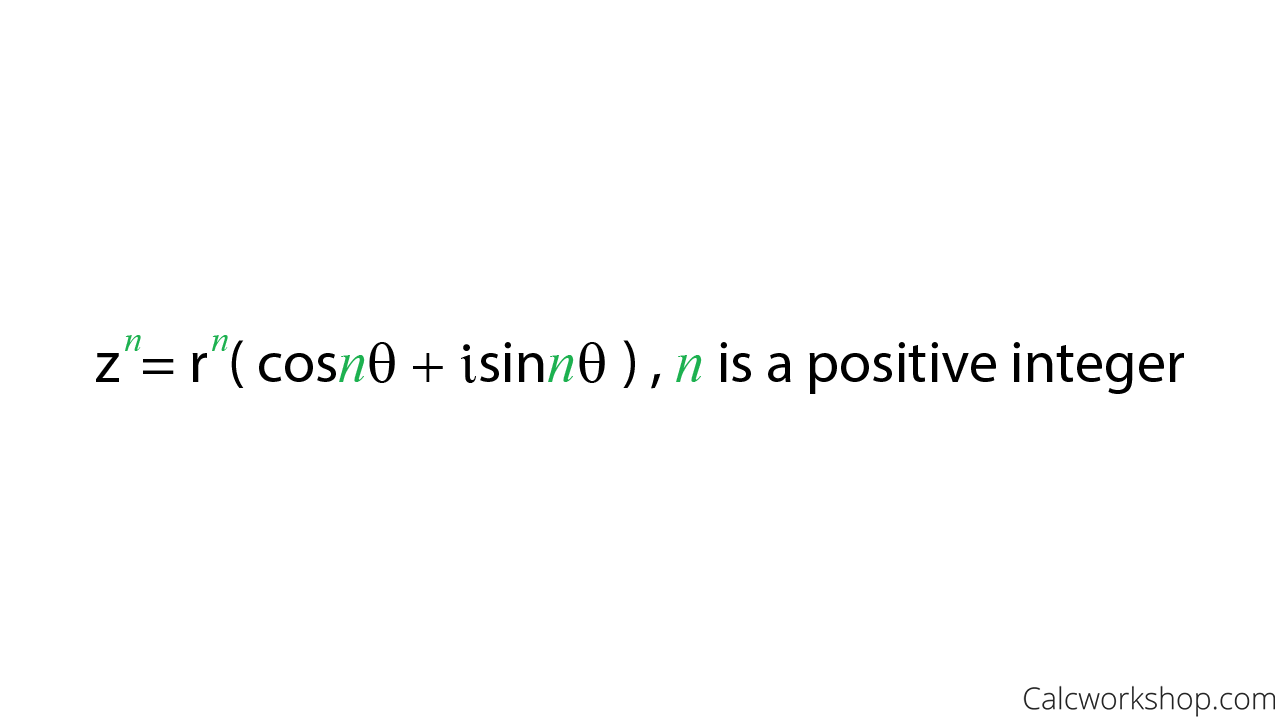
For a complex number z = r(cos θ + i sin θ) z^n = r^n(cos(nθ) + i sin(nθ)) This allows us to raise complex numbers to any power But what about finding roots?

The Reverse Problem
If z^n = w, how do we find all possible values of z? This is where De Moivre's Theorem in reverse comes in! We need to find the nth roots of w
De Moivre's Theorem in Reverse
If w = r(cos θ + i sin θ) Then the nth roots of w are: z_k = r^(1/n)[cos((θ + 2πk)/n) + i sin((θ + 2πk)/n)] where k = 0, 1, 2, ..., n-1

Why Multiple Roots?
{"left":"Complex numbers have rotational symmetry\nAdding 2π to an angle gives the same point","right":"But when we divide by n, we get different roots\nEach root is separated by 2π/n radians"}
Example 1: Square Roots of 4i
Find the square roots of 4i Step 1: Convert to polar form 4i = 4(cos(π/2) + i sin(π/2)) Step 2: Apply the formula with n = 2

Visualizing the Square Roots of 4i
Example 2: Cube Roots of 8
Find the cube roots of 8 8 = 8(cos(0) + i sin(0)) Using n = 3, k = 0, 1, 2 Calculate each root and plot on Argand plane
Pattern Recognition: nth Roots
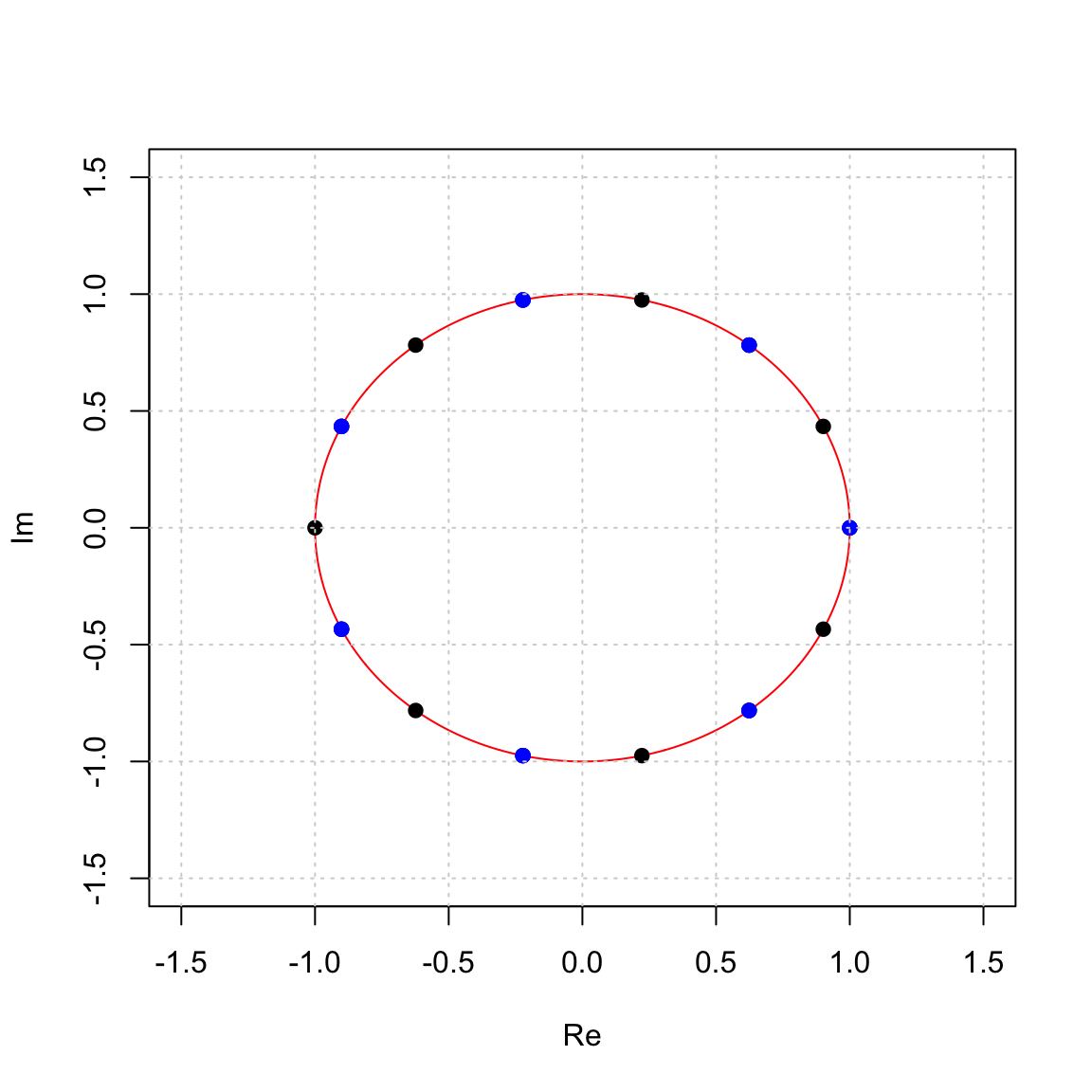
All nth roots lie on a circle of radius r^(1/n) They are evenly spaced by 2π/n radians They form a regular n-sided polygon One root is always at angle θ/n

Key Insight
"The nth roots of any complex number form a regular n-sided polygon on the Argand plane, revealing the deep geometric structure underlying complex arithmetic."