
Writing Strong PPDAC Math Conclusions
Year 11 Mathematics Statistical Investigation Skills New Zealand Curriculum Level 6

What is PPDAC?
Problem - Define the statistical question Plan - Design data collection methods Data - Collect and organize information Analysis - Examine patterns and trends Conclusion - Answer the original question

Why are Conclusions Important?
Think about a recent investigation you completed What made your conclusion strong or weak? How did you connect your findings back to the original problem?

Key Components of Strong Conclusions
Direct answer to the original problem Evidence from your analysis Acknowledgment of limitations Suggestions for further investigation Clear, non-technical language

Weak vs Strong Conclusion Examples
{"left":"The data shows some interesting patterns and trends that could be explored further in future studies\nBased on our analysis of 150 survey responses, students who study for more than 2 hours daily score an average of 15% higher on mathematics tests, though our sample was limited to one school","right":"There were lots of numbers and they seemed to support our hypothesis about the relationship\nOur investigation of study time versus test scores reveals a moderate positive correlation (r=0.67), suggesting that increased study time is associated with better performance, though other factors like teaching quality and home environment likely also influence results"}

Conclusion Writing Framework
Use the AREA framework: A - Answer the original question directly R - Reference specific evidence from your analysis E - Explain any limitations or assumptions A - Acknowledge areas for further investigation

Language and Tone Guidelines
Use confident but cautious language Avoid absolute statements like 'proves' or 'definitely' Include phrases like 'suggests', 'indicates', 'appears to show' Write for your intended audience Support claims with specific numerical evidence
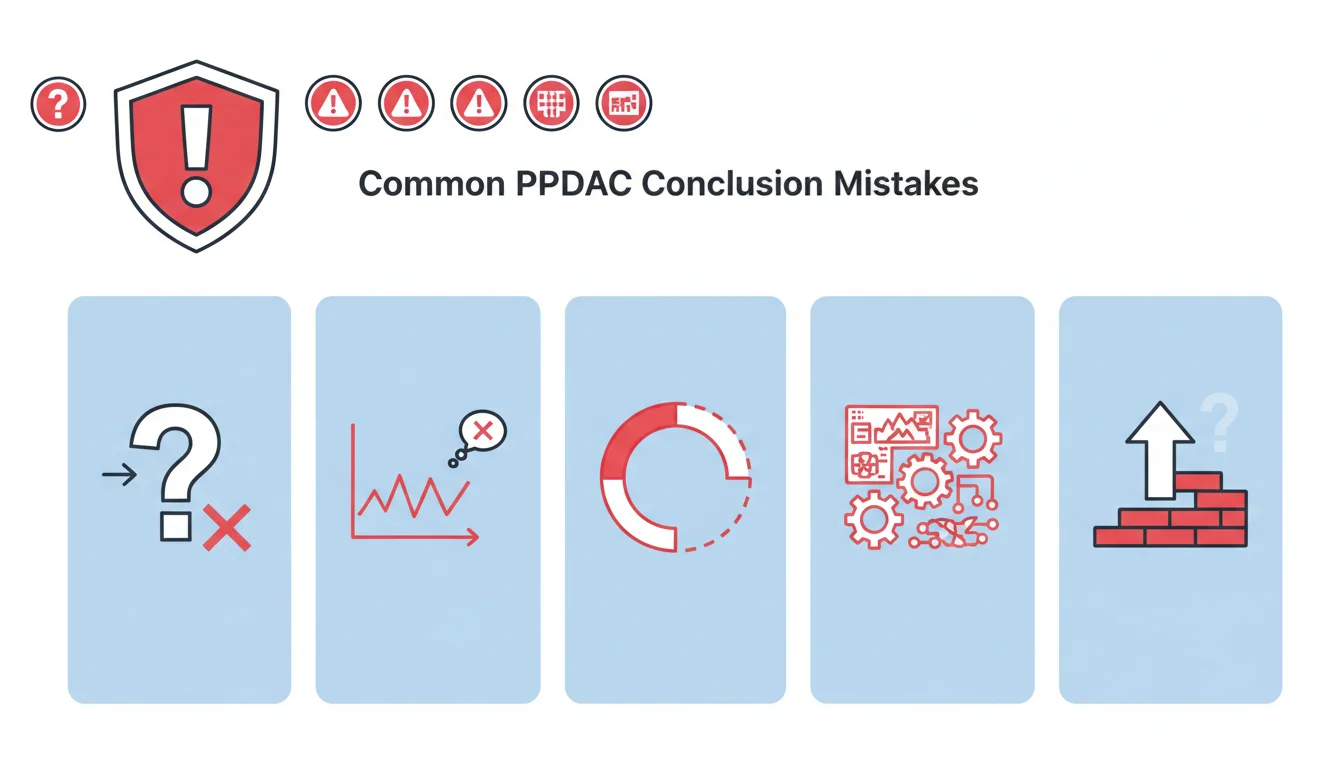
Common Conclusion Mistakes to Avoid

Practice Exercise
Work in pairs with the provided investigation scenario Write a conclusion using the AREA framework Original question: 'Do Year 11 students prefer online or face-to-face learning?' You have survey data from 200 students showing 65% prefer face-to-face Include limitations and suggestions for further research

Summary and Next Steps
Strong conclusions answer the original question directly Support claims with specific evidence from analysis Acknowledge limitations and suggest future research Use appropriate statistical language Practice the AREA framework in your next investigation