Social SciencesFreePrintable

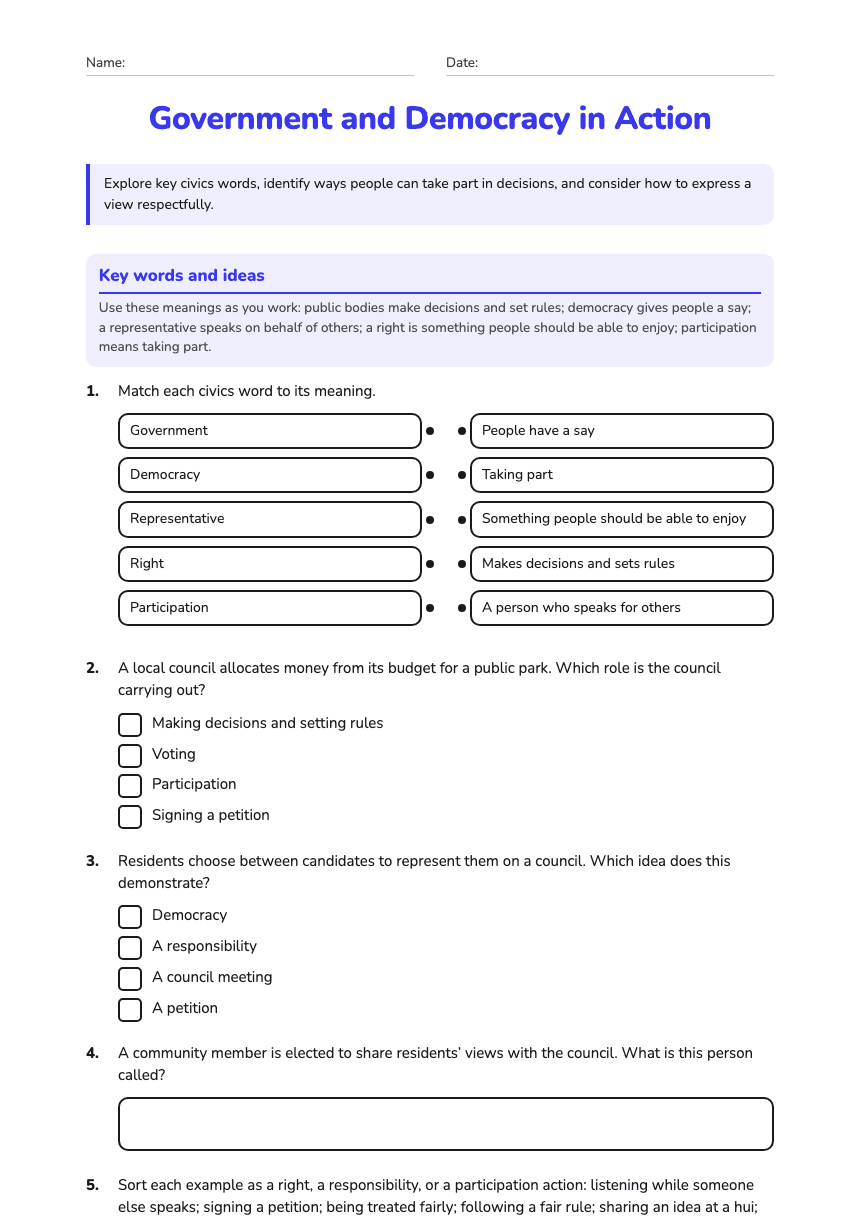
Government and Democracy in Action

A free social sciences worksheet ready for your classroom. Open in Kuraplan to grab the print-ready PDF, customize it for your students, or generate a fresh version in seconds.
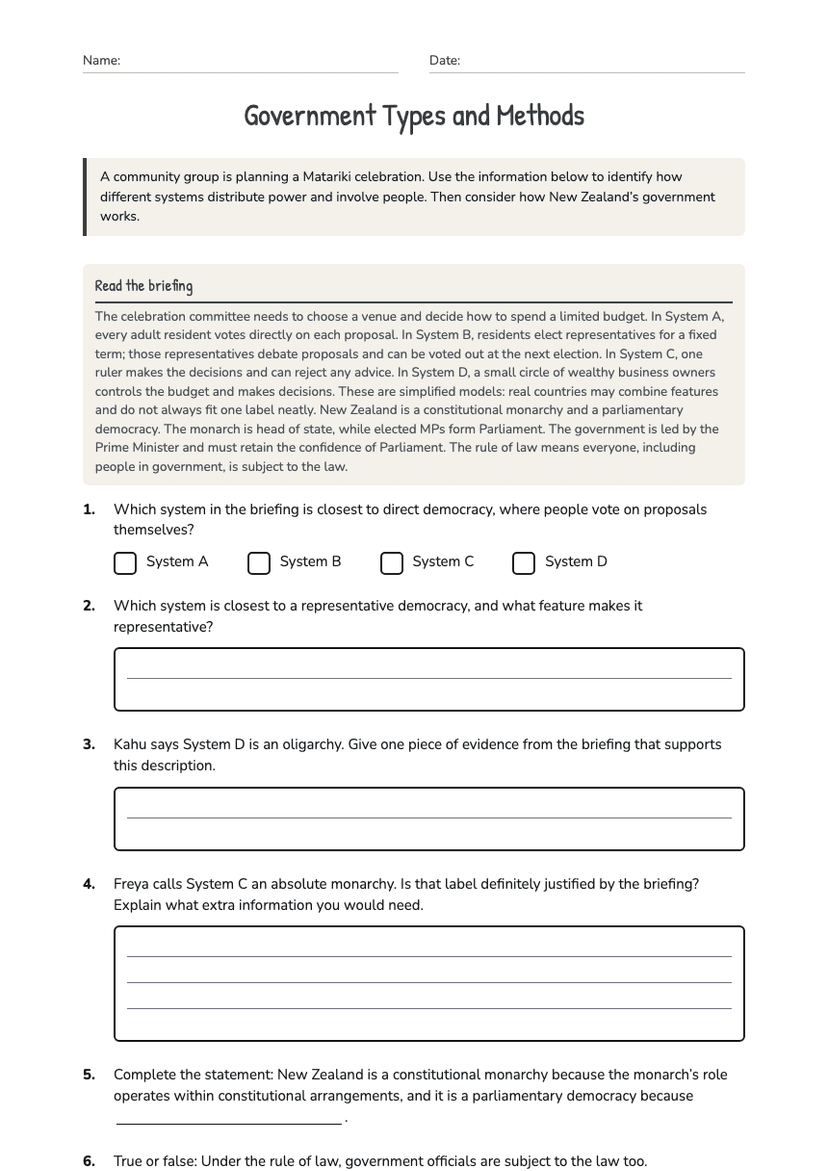
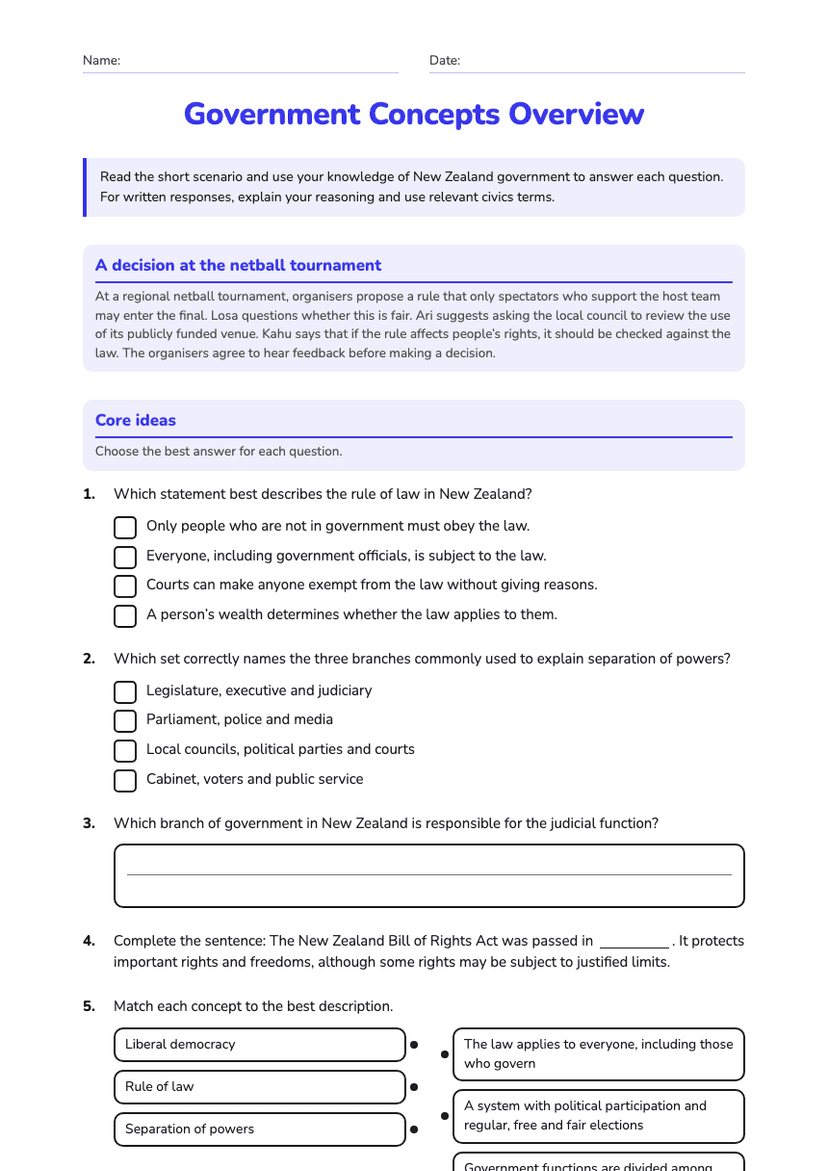
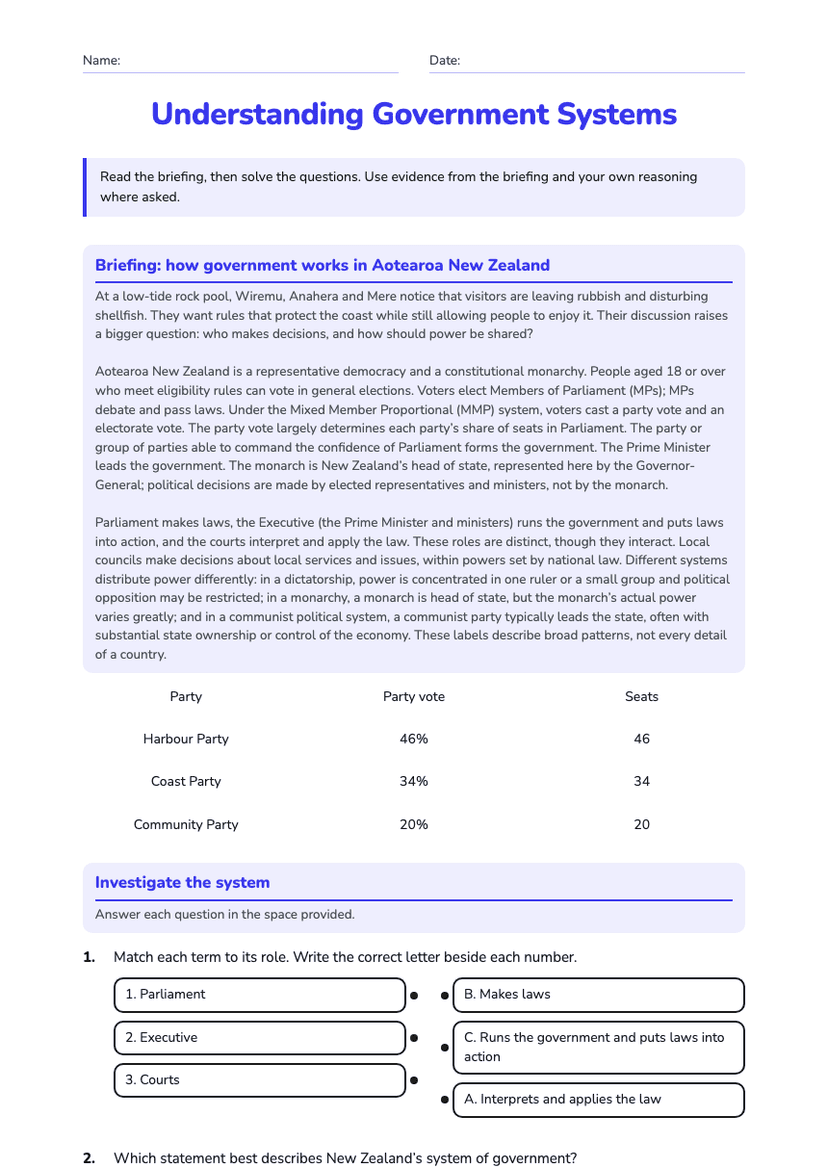
Government and Democracy in Action worksheet preview

Government and Democracy in Action

Worksheet illustration

📚 Part 1: Learn the Words

WALT: We Are Learning To understand simple words about government and democracy.

Success criteria:

• I can match a word to a picture or meaning.

• I can sort a right, a responsibility and an action.

• I can use a word from the word bank.

Read and say

👥 Government makes rules and decisions for a place.

🗳️ Democracy means people have a say.

🧑 Representative is a person who speaks for other people.

Right is something people should have.

🙋 Participation means taking part.

Teacher support: Read each sentence aloud. Learners may point to the icon, repeat the words, or act them out.

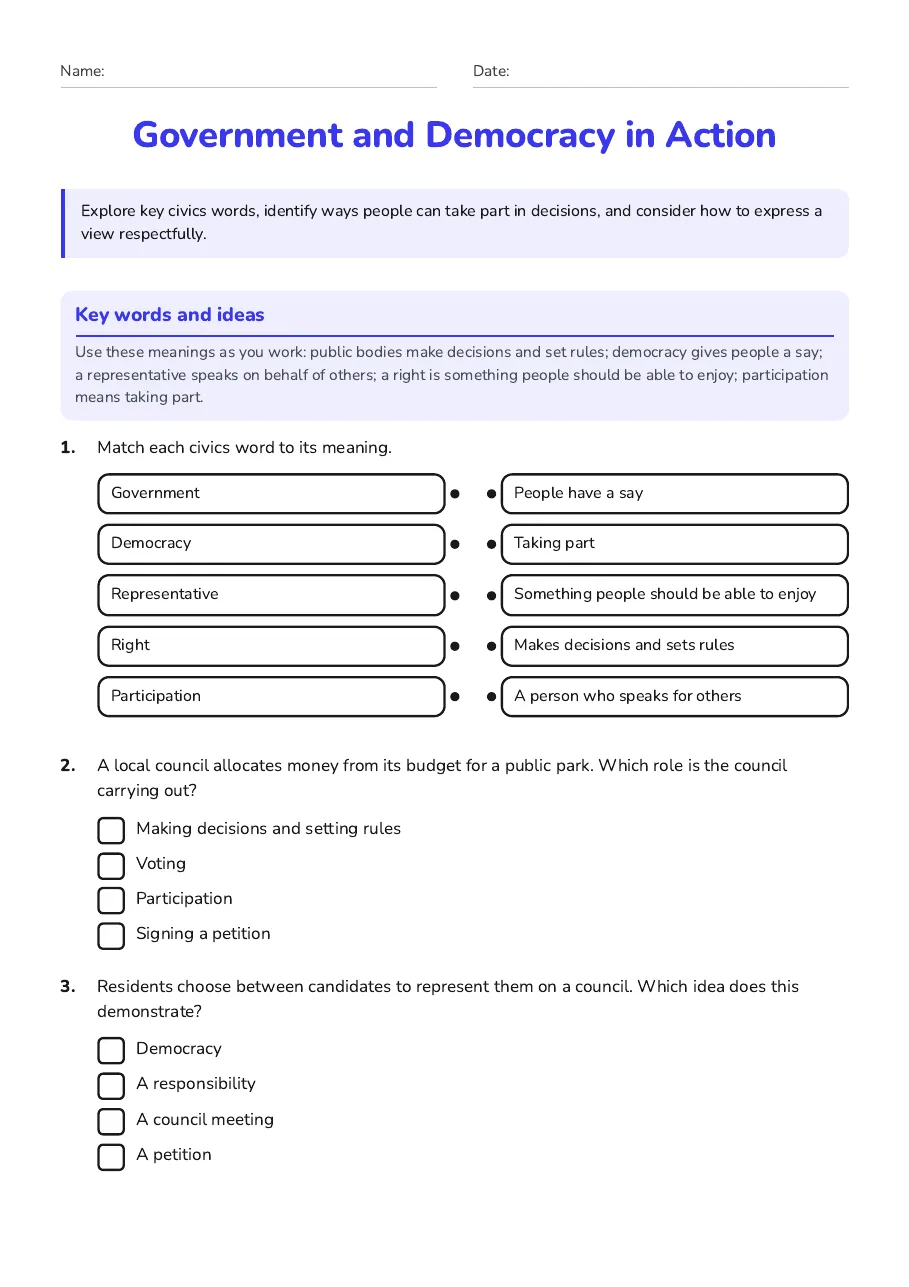
1. Match the word to the meaning. Write the letter.
1. Government _____
2. Democracy _____
3. Representative _____
4. Right _____
5. Participation _____
A. Taking part
B. A person who speaks for others
C. Something people should have
D. Makes rules and decisions
E. People have a say
2. Circle the best word.

a. A council makes decisions about parks. This is government / voting.

b. People choose a leader. This is democracy / rubbish.

c. A person speaks for a group. This person is a representative / playground.

d. People can share an idea. This is a right / road.

3. Sort the actions. Write R for right, C for responsibility, or A for participation action.

Use the word bank: right • responsibility • action

a. Listening to another person: ________

b. Signing a petition: ________

c. Being treated fairly: ________

d. Following a fair rule: ________

e. Speaking at a hui: ________

f. Volunteering: ________

Word bank: government, democracy, vote, council, right, responsibility, action, representative, hui, petition.

Say or write: “People can take part by __________.”

Dyslexia-friendly option: Read with a partner. Cover the other words while reading. Use a ruler or finger under each line. Learners may answer by pointing, speaking or drawing.

✏️ Part 2: Democracy in Action

WALT: We Are Learning To show how people can have a say.

Success criteria:

• I can choose a fair action.

• I can use a simple sentence frame.

• I can listen and take turns.

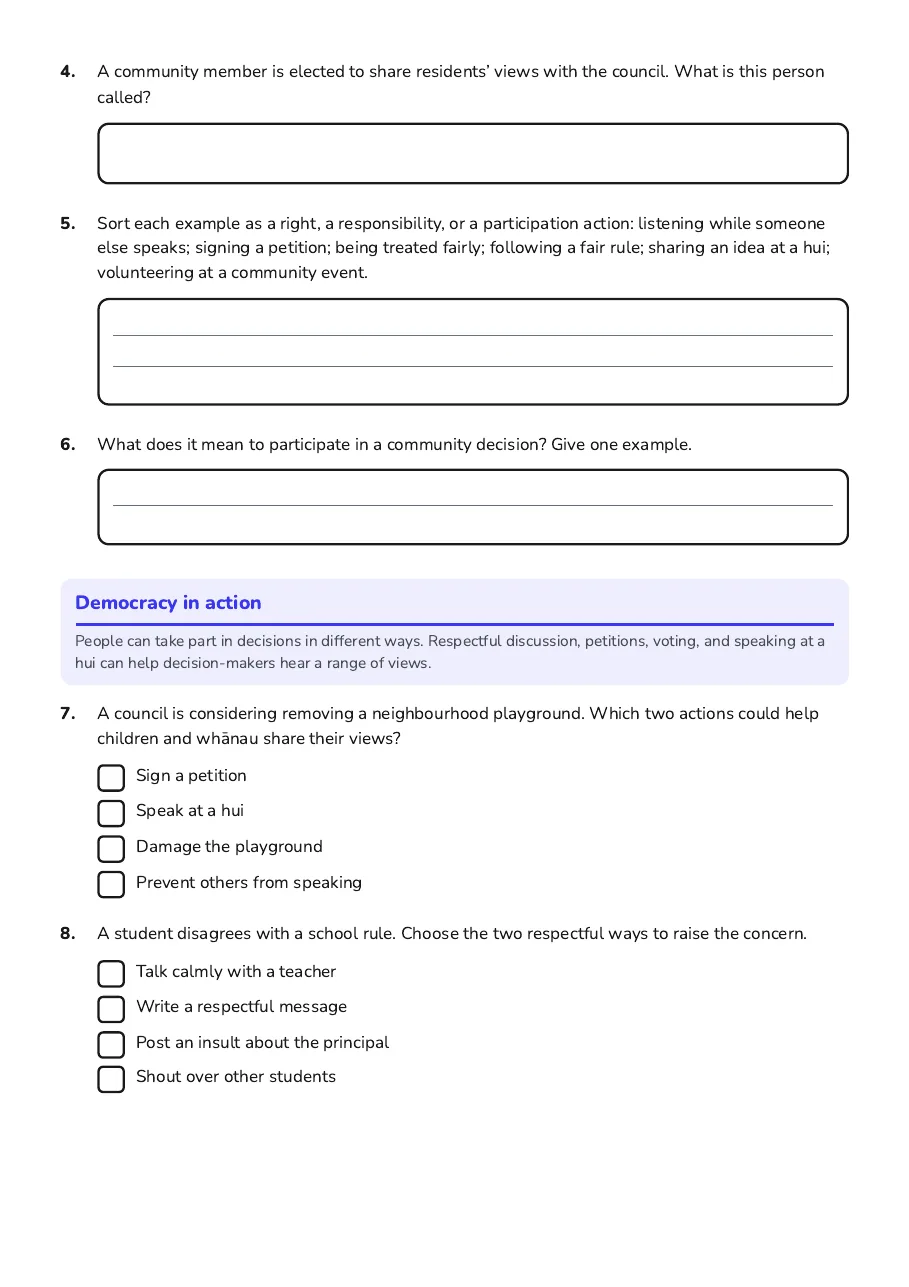
4. The council may take away a playground. What can children and whānau do? Tick two.

☐ Sign a petition

☐ Speak at a hui

☐ Listen and share ideas

☐ Break the playground

5. A student does not like a school rule. Circle the fair response.

😡 Insult the principal online

💬 Talk calmly to the teacher

✉️ Write a respectful message

Sentence frame: “A fair response is __________ because __________.”

6. A youth council asks young people about a park. Why?

Circle two answers.

☐ Young people can share ideas.

☐ The council can hear their views.

☐ Nobody can speak.

☐ Only one person decides.

Have your say

Choose one issue. Draw it or write one word.

🏫 school rule    🌳 park    🚮 rubbish    🛣️ road

7. My issue is:
8. Choose one action. Tick one.

☐ Talk to a teacher

☐ Write to the council

☐ Sign a petition

☐ Speak at a hui

☐ Volunteer

Sentence frame: “I can __________. This can help __________.”

Hands-on activity: In a small group, use role cards for “student”, “whānau”, “councillor” and “teacher”. Take turns sharing one idea about the issue.

Differentiation: Beginners can point to an action and repeat the sentence frame. Developing learners can add a reason. Confident learners can say whose view may be different.

Teacher prompt: Model first. Use real objects such as a paper ballot, a petition sheet or a council picture. Allow wait time, partner talk and home-language support.

✅ Part 3: Check What You Know

WALT: We Are Learning To show what democracy means.

Success criteria:

• I can choose the meaning of democracy.

• I can name one way to take part.

• I can use a democracy word.

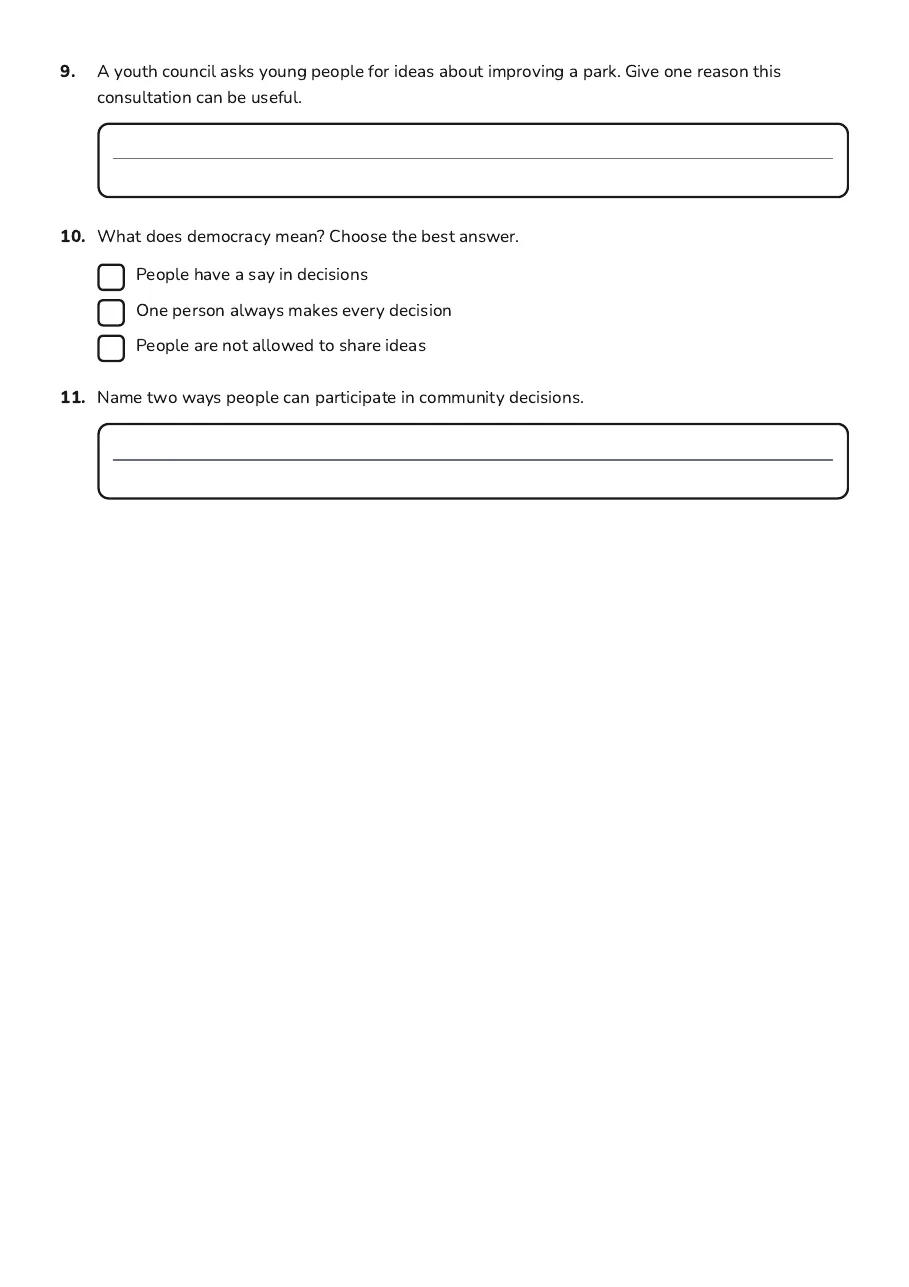
9. What is democracy? Circle one.

☐ People have a say.

☐ One person always decides.

☐ Nobody can share ideas.

10. How can people take part? Tick two.

☐ Vote

☐ Sign a petition

☐ Speak at a hui

☐ Ignore everyone

11. Finish the sentence.

“People can take part by __________.”

Teacher answer guide

1. 1–D, 2–E, 3–B, 4–C, 5–A.

2. a government, b democracy, c representative, d right.

3. a–C, b–A, c–R, d–C, e–A, f–A.

4. Any two of: sign a petition, speak at a hui, listen and share ideas.

5. Talk calmly to the teacher or write a respectful message. Accept a simple reason about respect or fairness.

6. Young people can share ideas; the council can hear their views.

7–8. Answers will vary. Accept a clear issue and a suitable action.

9. People have a say.

10. Any two of: vote, sign a petition, speak at a hui.

11. Accept vote, petition, hui, volunteering, talking to a councillor or another suitable action.

Accessibility note: Read questions aloud. Use icons, gestures and real objects. Accept oral answers, pointing, matching, drawing or scribing. Provide a quiet space, a reading ruler and extra processing time.

About This Worksheet

Free in Kuraplan

Sign up free, grab the PDF, and customize it for your class.

Print-Ready

Formatted for standard paper. Clean layout, easy to read.

AI-Generated

Created with Kuraplan's AI, designed for real classroom use.

For Teachers & Parents

Use in classrooms, for homework, tutoring, or homeschool.

Need a custom version of this worksheet?

Kuraplan's AI generates custom worksheets in seconds — differentiated for every learner, aligned to your curriculum.

Generate Custom Worksheets — Free
No credit card Curriculum-aligned Under 60 seconds