Social SciencesFreePrintable

Introduction to History

A free social sciences worksheet ready for your classroom. Open in Kuraplan to grab the print-ready PDF, customize it for your students, or generate a fresh version in seconds.
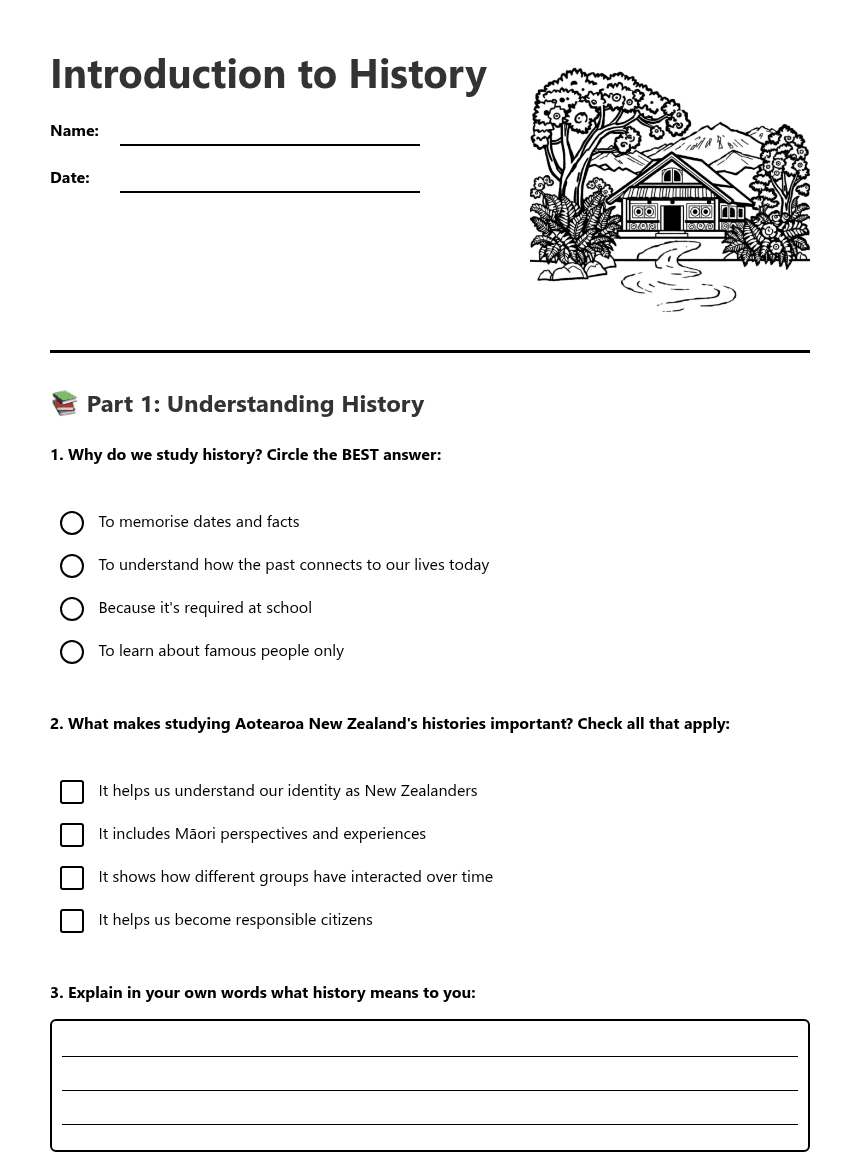
Introduction to History worksheet preview
Introduction to History

Introduction to History

Historical timeline illustration

📚 Part 1: Understanding History

1. Why do we study history? Circle the BEST answer:

To memorise dates and facts

To understand how the past connects to our lives today

Because it's required at school

To learn about famous people only

2. What makes studying Aotearoa New Zealand's histories important? Check all that apply:

It helps us understand our identity as New Zealanders

It includes Māori perspectives and experiences

It shows how different groups have interacted over time

It helps us become responsible citizens

3. Explain in your own words what history means to you:

🔍 Part 2: Historical Concepts

4. Match each historical concept with its correct definition:
1. Primary Source
2. Secondary Source
3. Evidence
4. Perspective
A. Information that supports or proves something about the past
B. A particular way of viewing or understanding events
C. Created by someone who experienced the event firsthand
D. Created by someone who did not witness the event directly
5. Fill in the blanks about historical inquiry:

Historians use _____________ to investigate the past. They look at different _____________ to get a complete picture of what happened. When studying events, historians consider how things stayed the same (____________) and how they changed over time.

6. Circle whether each item is a PRIMARY or SECONDARY source:

a) A diary written by a Māori chief in 1840: PRIMARY / SECONDARY

b) A textbook about the New Zealand Wars: PRIMARY / SECONDARY

c) A photograph of the 1918 flu pandemic: PRIMARY / SECONDARY

d) A documentary about early European settlers: PRIMARY / SECONDARY

📅 Part 3: Timeline Activity

7. Create a simple timeline of your own life. Include at least 4 important events and draw symbols to represent them:
8. Why are timelines useful for historians? Give two reasons:
9. Put these New Zealand historical events in chronological order (1-4):

_____ Women gain the right to vote (1893)

_____ Signing of Te Tiriti o Waitangi (1840)

_____ New Zealand becomes a dominion (1907)

_____ First Māori settlement (around 1300 CE)

🤝 Part 4: Key Competencies and Citizenship

10. How can studying history help develop these key competencies? Match each competency with an example:
1. Thinking
2. Using language and symbols
3. Relating to others
4. Participating and contributing
A. Understanding different cultural perspectives
B. Analysing historical evidence critically
C. Reading historical documents and maps
D. Engaging in class discussions about the past
11. How can learning history help you be a responsible citizen? Write your thoughts:
12. What are you most excited to learn about in our History unit? Set a personal learning goal:

🌟 Part 5: Class Charter Values

13. For our History class charter, which values are most important? Check your top 3:

Respect for different viewpoints

Open and honest inquiry

Active listening

Cultural sensitivity

Collaborative learning

Critical thinking

14. Write one commitment you will make to help create a positive learning environment in our History class:

About This Worksheet

Free in Kuraplan

Sign up free, grab the PDF, and customize it for your class.

Print-Ready

Formatted for standard paper. Clean layout, easy to read.

AI-Generated

Created with Kuraplan's AI, designed for real classroom use.

For Teachers & Parents

Use in classrooms, for homework, tutoring, or homeschool.

Need a custom version of this worksheet?

Kuraplan's AI generates custom worksheets in seconds — differentiated for every learner, aligned to your curriculum.

Generate Custom Worksheets — Free
No credit card Curriculum-aligned Under 60 seconds