TL;DR: Phonemic awareness is an auditory-only skill that develops during the ages 4 to 6 window, while phonics connects sounds to written letters and should begin in kindergarten and continue through at least 3rd grade, with benefits extending into 4th and 5th grade. In practice, phonemic awareness is the foundation. If students can’t hear and work with sounds in spoken words, phonics instruction often turns into guessing, memorizing, or frustration.
If you're in a K to 3 classroom, you've probably heard both terms used as if they mean the same thing. A teammate says a child needs more phonics. A screener flags weak phonemic awareness. A curriculum lesson mixes oral sound work, letter cards, and decodable words into one block, and by the end of the day it all blurs together.
That confusion is common, and it matters more than most teachers realize. The difference between phonics and phonemic awareness changes what you put in your lesson plan, what materials you pull, what you listen for during small group, and how you assess whether a student is making progress.
Untangling the Terms for Better Reading Instruction
The fastest way to clear this up is simple. Phonemic awareness is about sounds in spoken words. Phonics is about connecting those sounds to print. One happens with ears and speech. The other requires eyes too.
I see teachers get tripped up when an activity looks literacy-rich but doesn't match the skill they're trying to teach. If a student is moving magnetic letters to make sat, that's phonics. If the student is saying the sounds in sat without seeing any letters, that's phonemic awareness. Same word. Different instructional target.
That distinction saves time because it keeps you from solving the wrong problem. A child who can't blend spoken sounds may not need more worksheets. A child who can orally segment map just fine but can't read map on the page may not need another round of oral games. They may need clearer sound-letter mapping.
Why the distinction changes instruction
When teachers understand the difference between phonics and phonemic awareness, lesson planning gets cleaner. You stop asking children to do print tasks when the goal is listening. You stop calling every sound activity "phonics." You also get better at noticing why a student is stuck.
A practical way to think about it is this:
- If letters are involved, you're teaching or assessing phonics.
- If no letters are involved, you're working on phonemic awareness.
- If a child can do one but not the other, your next step should match the missing skill.
Teachers don't need more reading buzzwords. They need a reliable way to choose the right activity for the right student.
For teachers working with younger learners, especially pre-K and kindergarten, a helpful companion read is this guide to teaching preschool reading skills. It does a good job of grounding early literacy in day-to-day practice instead of abstract theory.
Understanding Phonemic Awareness The "Ears Only" Skill
Phonemic awareness is the ability to hear and work with the smallest sounds in spoken words. No print. No letter cards. No writing. If students can do the task with their eyes closed, you're probably in phonemic awareness territory.
Research establishes that phonemic awareness develops between ages 4 and 6, which makes it a narrow but important instructional window. When instruction starts during that window and is taught explicitly, it supports later reading success, as explained in this overview of phonemic awareness and phonics development.

What students actually do in phonemic awareness
The distinction often causes significant classroom confusion. Phonemic awareness isn't one skill. It's a set of oral sound tasks that get more demanding over time.
Some common examples:
- Sound isolation: "What's the first sound in dog?"
- Blending: "/c/ /a/ /t/. What word?"
- Segmenting: "Tell me the sounds in ship."
- Deletion: "Say boat without /b/."
- Substitution: "Change the /c/ in cat to /b/."
Those tasks all train students to notice and manipulate sounds. That's the whole job. You're building a student who can hear that bat and bag start the same, that sun has three sounds, and that changing one sound changes the word.
What works in real classrooms
The best phonemic awareness practice is brief, direct, and oral. It doesn't need fancy materials. In fact, adding too many visuals too early can muddy the goal.
Useful classroom moves include:
- Keep it short. A few focused minutes works better than stretching oral practice until students drift.
- Model first. Say the sounds yourself before asking students to respond.
- Use continuous sounds when possible. They're easier for children to hear and blend.
- Go from easier to harder. Isolation and blending usually feel more accessible than deletion and substitution.
- Watch for over-scaffolding. If students only succeed when you mouth exaggerated sounds or add hand motions for every step, they may not own the skill yet.
Practical rule: If students must look at letters to complete the task, it is no longer pure phonemic awareness.
One mistake I see often is turning phonemic awareness into seatwork. A worksheet where children circle pictures with the same beginning sound can support discussion, but the actual skill still has to be assessed orally. If the child can mark a paper but can't tell you the sounds, you haven't really measured phonemic awareness.
If you want examples of how to sequence these oral tasks, this guide on how to teach phonemic awareness is a useful planning reference.
Understanding Phonics The "Eyes and Ears" Connection
Phonics is where spoken sounds meet print. Students learn that letters and letter combinations represent sounds, and they use that knowledge to read and spell words. This is the code-based side of reading instruction.
In practice, phonics means students are working with grapheme-phoneme correspondences. They see a letter or letter pattern, connect it to a sound, and apply that knowledge to decode or encode words. The letter m represents /m/. The letters sh represent /sh/. That's phonics.
What phonics looks like in instruction
Phonics requires print. If students are reading a word list, building words with letter tiles, spelling a dictated word, or reading a decodable sentence, they're doing phonics work.
That print connection is why phonics can feel much more concrete to teachers. There are visible materials, visible products, and visible errors. You can look at a student's whiteboard and quickly see whether they mapped sounds to letters accurately.
Phonics instruction should begin in kindergarten and continue through at least 3rd grade, with evidence that phonics word study remains beneficial in 4th and 5th grade too. That creates a 5 to 6 year instructional span, as outlined in this explanation of phonics and phonemic awareness across grade levels.
What works and what does not
Strong phonics instruction is explicit and cumulative. Students need a clear sequence, repeated practice, and real opportunities to apply what they've learned in connected text.
What usually works:
- Direct teaching of sound-letter correspondences
- Word building with immediate feedback
- Decodable reading tied to taught patterns
- Dictation for spelling and sound mapping
- Review built into every lesson
What usually doesn't work well:
- Random phonics worksheets with no sequence
- Asking students to memorize whole word lists without decoding
- Giving texts that don't match the phonics pattern taught
- Assuming letter naming equals decoding skill
A student can know letter names and still struggle badly with phonics. Knowing the alphabet is not the same as mapping sounds to print.
Another common issue is pacing. Some programs move so fast that students never get enough practice. Others stay too long on isolated drills and don't transfer learning into real reading. The sweet spot is explicit teaching followed by reading and spelling application.
Teachers who want grade-specific examples can look at 2nd grade phonics routines and lesson ideas. Even if you teach a different grade, it helps to see how phonics develops beyond the earliest lessons.
A Detailed Comparison of Phonics vs Phonemic Awareness
Here is the comparison teachers usually need in one place. If you remember nothing else, remember this: phonemic awareness is sound work without print, and phonics is sound work with print.
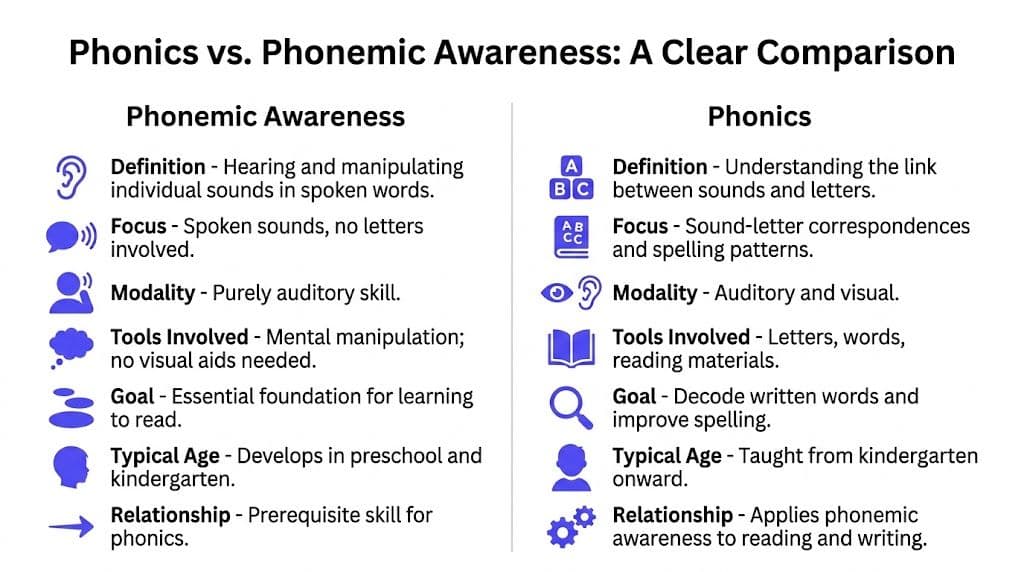
| Criterion | Phonemic Awareness | Phonics |
|---|---|---|
| Modality | Auditory and oral only | Visual and auditory |
| Core task | Hearing, blending, segmenting, deleting, or changing sounds in spoken words | Connecting letters to sounds to read and spell words |
| Print involved | No | Yes |
| Primary goal | Help students hear and manipulate phonemes | Help students decode and encode written language |
| Typical materials | Teacher voice, student response, oral games, counters without letters | Letter tiles, sound cards, word lists, decodable texts, whiteboards |
| Assessment format | Oral response | Print-based reading and spelling tasks |
| Common mistake | Turning it into worksheets | Treating it like memorization instead of mapping |
The modality difference isn't just academic terminology. It directly affects assessment. Phonemic awareness is exclusively auditory and oral, so it must be assessed through oral responses. Phonics combines visual and auditory information, so it should be assessed through print tasks such as decoding words or spelling, as described in this explanation of assessment differences between phonics and phonemic awareness.
How to identify the skill in seconds
Teachers often ask, "How do I know what I'm really teaching?" Use this quick filter.
Ask what the child must attend to
If the child has to listen to the sounds in a spoken word, that's phonemic awareness.
If the child has to look at letters and match them to sounds, that's phonics.
If an activity can be done in the dark, it's phonemic awareness. If students need to see letters, it's phonics.
Ask what materials are on the table
No materials, or just chips and boxes for counting sounds? Usually phonemic awareness.
Magnetic letters, word cards, whiteboards, decodable books? That's phonics.
Ask what success looks like
A phonemic awareness success sounds like this: the student says /m/ /a/ /p/ when you say map.
A phonics success looks like this: the student reads map from print or spells it with the correct letters.
The classroom trade-offs teachers run into
Real instruction can get messy. Oral sound work can feel less satisfying because there's nothing to collect. No worksheet. No product for a folder. No neat page to send home. That often leads schools to underteach phonemic awareness even when students need it.
Phonics has the opposite problem. Because it produces visible work, teachers can assign plenty of it without checking whether the underlying sound awareness is solid. Students may complete pages and still guess when they read.
A clean planning rule is to match the bottleneck:
- Can hear sounds but can't map them to print? Increase explicit phonics.
- Can work with letters but can't isolate or blend sounds orally? Strengthen phonemic awareness.
- Can do neither consistently? Teach them in connected sequence, but don't blur the target of each part.
Bottom line: The difference between phonics and phonemic awareness isn't about terminology. It's about choosing the right task, with the right materials, for the skill you're trying to build.
Classroom Strategies and Activity Examples
The easiest way to apply the difference between phonics and phonemic awareness is to separate activities by what students need to use. For phonemic awareness, they use their ears and voices. For phonics, they use their eyes as well.
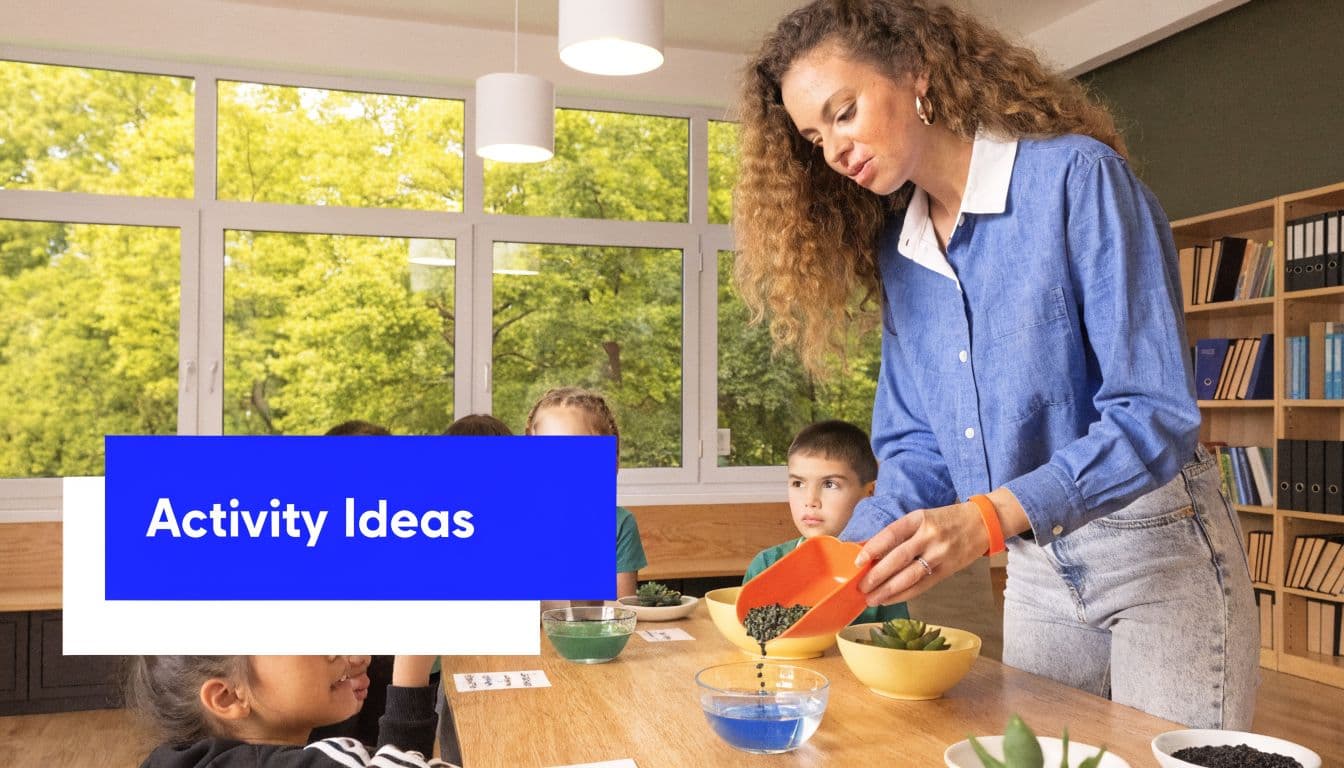
Phonemic awareness activities that stay oral
These are the activities I reach for when students need stronger sound processing before or alongside print.
Oral blending
Say the sounds with a slight pause: /s/ /u/ /n/. Students say the word. Keep it brisk. If you drag the sounds too far apart, many children lose the blend.Robot talk
Tell students you're going to talk like a robot and they have to solve the word. "Get your /c/ /oa/ /t/." This works well during transitions because it costs almost no prep time.First sound hunt
Ask, "Who can think of a word that starts with /m/?" Keep it oral. Don't let students scan the room for printed labels if your target is pure sound work.Sound counting with tokens
Students push a token for each sound they hear in a spoken word. No letters. Just counters or chips. This helps children separate sound units without introducing spelling issues too early.Delete or switch a sound
"Say smile without /s/." "Change the /h/ in hat to /m/." These tasks are harder, so use them after students are comfortable with blending and segmenting.
A small but useful crossover support is using audio tools for repeated oral practice. Teachers who use voice recordings with students may get ideas from this article on voice notes in language learning, especially for modeling and replaying pronunciation tasks.
Phonics activities that connect sound to print
Once students are ready to map sounds to letters, keep the print connection explicit.
Word building with letter tiles
Say a word. Students build it. Then change one sound and rebuild. This is one of the fastest ways to show how a single phoneme change affects the whole word in print.Dictation on whiteboards
Dictate a sound, then a word, then a short sentence using taught patterns. You learn a lot from what students spell independently.Decodable sentence reading
Use short sentences that match the phonics pattern you taught. If the text asks students to solve patterns you haven't taught, the lesson turns into guessing.Sound card drills
Show a grapheme. Students say the sound. Reverse it sometimes by saying the sound and asking students to identify the spelling pattern they know.
After you've taught a pattern, it helps to give students a quick print-based follow-up. This letter sounds and blending worksheet is the kind of practice that works best after direct instruction, not in place of it.
Here’s a short classroom demonstration that pairs well with these routines:
Time-saving planning moves
The daily grind is real. Teachers don't need thirty more Pinterest activities. They need a few reliable routines they can repeat with different words.
A workable split looks like this:
- Start with a short oral warm-up if students still need sound work.
- Teach one print-based phonics focus clearly.
- Apply it in reading and spelling the same day.
- Reuse the routine with new words instead of reinventing your lesson format.
If you're using planning tools, this is one place where a platform like Kuraplan can be practical. It can help teachers turn a lesson objective into worksheets, visuals, and aligned activities without spending extra time formatting everything by hand.
How to Assess Student Progress in Both Skills
Assessment gets much easier once you stop measuring both skills the same way. Phonemic awareness needs oral assessment. Phonics needs print-based assessment. If the method doesn't match the skill, the data will mislead you.
How to assess phonemic awareness
Keep it quick and oral. You can do a lot of this in small group, during centers, or while calling students one by one.
Try prompts like:
- Beginning sound: "What sound do you hear at the start of fish?"
- Blending: "/r/ /u/ /g/. What word?"
- Segmenting: "Tell me the sounds in lap."
- Deletion: "Say stop without /s/."
- Substitution: "Change the /p/ in pan to /f/."
What you're watching for is not just correctness. Listen for hesitation, guessing, and whether the child depends on your facial cues or repeated modeling.
How to assess phonics
Phonics needs print in front of the student. Otherwise you're not measuring the sound-letter connection.
Useful options include:
- Reading a list of taught words
- Reading short decodable sentences
- Spelling words with taught patterns
- Building dictated words with letters
- Reading unfamiliar but decodable words to check transfer
A student may look secure in a whole-group lesson and still fall apart when reading independently. That's why I like quick one-on-one checks. You hear whether the student is decoding or just remembering familiar words.
Assessment should mirror instruction. Oral sound skills get oral checks. Print skills get print tasks.
A simple rubric teachers can actually use
You don't need a giant spreadsheet to track this. A short rubric is often enough.
Phonemic awareness rubric
| Level | What it looks like |
|---|---|
| Beginning | Needs heavy prompting to identify or manipulate sounds orally |
| Developing | Completes easier tasks like isolation or blending, but struggles with segmenting or changing sounds |
| Secure | Responds accurately and independently across oral sound tasks |
Phonics rubric
| Level | What it looks like |
|---|---|
| Beginning | Has limited control of taught sound-letter correspondences in reading or spelling |
| Developing | Applies taught patterns in simple words but makes inconsistent errors in connected practice |
| Secure | Reads and spells words with taught patterns accurately and with growing automaticity |
What teachers often misread
A neat worksheet can hide weak decoding. A lively oral response in circle time can hide the fact that a student still can't map sounds to letters. That's why I don't rely on one type of evidence.
Use a short mix of checks across the week. Listen to oral responses. Watch students read. Watch them spell. The more closely those pieces line up, the more confident you can be that the student is really moving forward.
Integrating Both Skills into Your Lesson Planning
The most efficient early literacy lessons don't treat phonemic awareness and phonics as rivals. They treat them as connected but distinct. Students hear the sounds, then map the sounds to print, then apply that learning in reading and spelling.
That sequence matters because it keeps the cognitive load manageable. If a student is trying to notice sounds, remember letter shapes, track print, and read a sentence all at once, the weakest part of the chain usually breaks first. Clean lesson design reduces that overload.
A practical lesson flow
For a typical K or 1 classroom, a simple structure works well:
Warm-up with oral sound work
Keep it short and targeted. Blend, segment, or isolate sounds depending on what students need.Teach one phonics focus
Introduce the sound-letter correspondence or pattern clearly. Model it. Say it. Read it. Build it.Move into application
Students read words, spell words, and use the pattern in a brief decodable text or sentence.Close with a quick check
One oral response and one print response tell you a lot.
This kind of planning also helps with differentiation. One group may need more oral blending before the phonics lesson clicks. Another may be ready for more advanced print work even if they no longer need much standalone phonemic awareness practice.
What cohesive planning looks like over time
Across the week, think in progression rather than isolated activities. If Monday's oral work focuses on hearing the first sound, Tuesday's phonics lesson can connect that sound to the grapheme. Later in the week, students can read and spell words with that pattern.
That kind of sequencing is where planning tools can help. Kuraplan is built for standards-aligned lesson and unit planning, and it can generate sequential lessons, worksheets, visuals, and assessment rubrics tied to the objective you're teaching. For teachers trying to keep oral and print skills aligned across a busy week, that kind of structure can cut down on planning drift.
The strongest reading lessons don't ask, "Did I do something with sounds today?" They ask, "Did today's task match the exact skill my students needed?"
Frequently Asked Questions about Early Reading Skills
Can you teach phonics and phonemic awareness at the same time
Yes, but not as one blurry activity. In the same lesson block, you might begin with a short oral task, then shift into print. That's different from mixing the target so much that students and teacher both lose track of the goal.
A useful test is whether you can name the purpose of each part in one sentence. If you can't, the lesson probably needs tightening.
What should I do if a student has strong phonemic awareness but still struggles with phonics
That usually points to a mapping problem, not a listening problem. The student may hear sounds accurately but still need clearer instruction in grapheme-phoneme correspondences, more guided decoding practice, or more controlled text tied to taught patterns.
In small group, reduce distractions and make the print work explicit. Don't assume oral strength will automatically transfer.
What if a student can do phonics drills but struggles with oral sound tasks
This happens more than people expect. Some students learn to recognize patterns in print but are shaky when asked to manipulate sounds without letters. When that happens, add brief oral warm-ups back into instruction. Don't overload them, but don't ignore the gap.
That weakness often shows up later in spelling or in flexible decoding of unfamiliar words.
Is phonological awareness the same as phonemic awareness
No. Phonemic awareness is narrower. It deals with individual phonemes. Phonological awareness is the broader umbrella that includes larger sound units like rhyme and syllables as well.
A child who can clap syllables or recognize rhyme isn't automatically ready for advanced phoneme manipulation. Those are related skills, but they aren't interchangeable.
Do older students ever still need work in these areas
Yes. If a student in upper elementary is still weak in decoding, it makes sense to check both phonics and underlying sound skills. The instruction will look more age-respectful, but the core issue can still be there.
Older students usually benefit from direct, efficient routines rather than activities that feel babyish. Keep the task clear, keep the language straightforward, and avoid dressing up weak foundational instruction as something else.
If you're trying to build cleaner reading lessons without spending your prep period juggling templates, Kuraplan can help you create standards-aligned lesson plans, worksheets, visuals, and rubrics in one place so your phonemic awareness and phonics instruction stay aligned from objective to assessment.