You’re probably looking at a school calendar, a stack of standards, a cabinet that may or may not have usable paint left, and a question that feels bigger than it should: What am I teaching all year?
That feeling is normal. Building an elementary art curriculum from scratch can feel less like planning and more like standing in the middle of the room with scissors in one hand and twelve browser tabs open. The problem isn’t that you lack ideas. It’s that ideas alone don’t make a curriculum. A good curriculum has shape, sequence, repetition, room for surprise, and enough flexibility to survive fire drills, assemblies, short classes, and supply shortages.
What helps is treating curriculum design like studio work. You don’t start with every detail resolved. You start with a framework, test it, revise it, and keep the parts that work with real children in front of you.
That work matters. Arts education is not a decorative extra. Low-income students with high arts participation are twice as likely to graduate college as their peers with no arts education, and students who take four years of arts and music classes score an average of over 150 points higher on the SAT than students taking one-half year or less, according to DoSomething’s summary of arts education findings. If you teach elementary, you’re helping lay that foundation long before those older-student outcomes show up.
An elementary art curriculum also does something test data alone never captures well. It gives children a place to solve problems without one right answer, practice persistence, make decisions, talk about meaning, and see themselves as capable makers. That’s why the strongest curriculum plans don’t ask, “What project should we do in October?” They ask, “What kind of artist do I want students to become by May?”
The Blank Canvas and Why Your Art Curriculum Matters

The first year I had to map an entire elementary art curriculum, I made the same mistake a lot of teachers make. I started by hunting for projects. Pumpkin prints for fall. Snowflake resist in winter. Self-portraits in January. Clay in spring, maybe. It looked organized on paper, but it didn’t add up to much. Students made things, but skills didn’t build cleanly from one grade to the next, and assessment was fuzzy because the work wasn’t anchored to a larger plan.
That’s the shift that changes everything. You are not filling slots in a calendar. You are designing a learning journey.
Start with the student, not the project
A project-first curriculum usually creates three problems:
- Skills get scattered. Students practice painting one month and collage the next, but they don’t revisit ideas enough to grow.
- Standards feel bolted on. You can usually find a standard after the fact, but that’s different from planning with one in mind.
- Classroom management gets harder. When lessons don’t connect, students don’t build routines around how your room works.
A student-centered curriculum works backward from growth. By the end of elementary school, students should know how to generate ideas, experiment with materials, talk about their choices, revise work, and connect art to their lives and communities. That means your curriculum needs repetition with variation. Students should revisit drawing, color, composition, observation, storytelling, and reflection across multiple years, not as one-off events.
Practical rule: If a lesson is fun but doesn’t build on prior learning or prepare students for later work, it’s an activity, not curriculum.
Why this work carries real weight
In elementary school, art often reaches children at the exact stage when they’re deciding whether they’re “good” at school. Art can widen that definition. A child who struggles to write a paragraph may tell a clear visual story. A child who avoids speaking during whole-group discussion may explain a sculpture choice with confidence. A child who needs movement may thrive in printmaking, painting, weaving, or collaborative work.
That doesn’t make art a service subject. It makes it a full subject with its own knowledge, habits, and language. A strong elementary art curriculum respects that. It teaches techniques and concepts, but it also teaches students how to think and work like artists.
The framework is what saves you
You do not need a year’s worth of perfect projects before school starts. You need a structure sturdy enough to hold your decisions.
That structure usually includes:
- A year-long scope and sequence
- A clear plan for units and individual lessons
- Built-in differentiation
- Assessment that tracks process as well as product
Once those pieces are in place, planning gets lighter. You stop reinventing every week. You can swap a materials list, shorten a process, or change an artist connection without losing the thread of the curriculum.
That’s what makes curriculum work feel less administrative and more creative. The frame gives you freedom.
Mapping Your Masterpiece The Year-Long Scope and Sequence
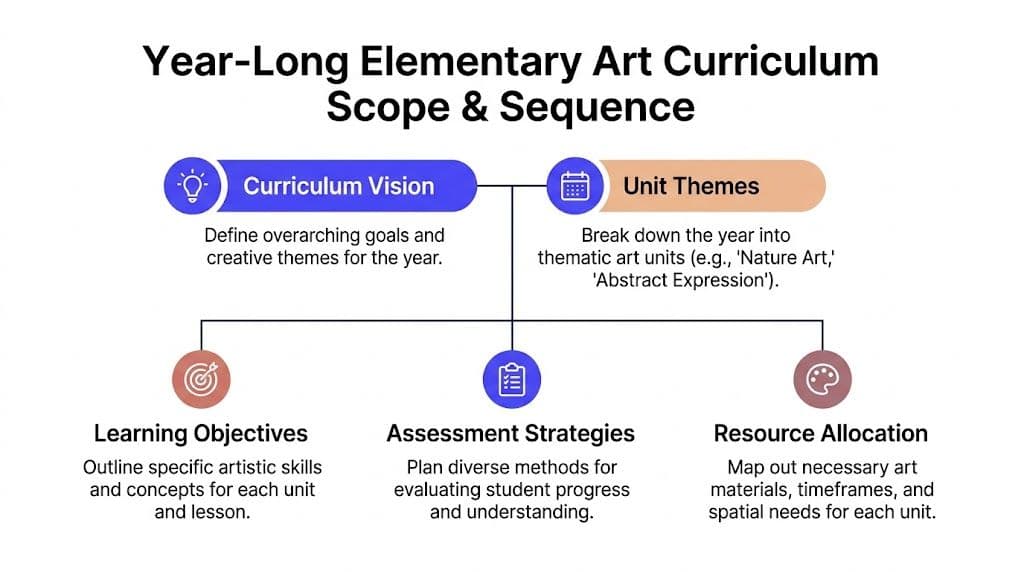
A year-long plan sounds intimidating until you stop treating it like a giant spreadsheet and start treating it like architecture. Your scope and sequence is the map of what students will learn, when they’ll learn it, and how those experiences build over time.
Choose a few big ideas that can carry the year
The easiest way to get unstuck is to stop planning by month and start planning by big idea. Good elementary art curriculum themes are broad enough to revisit in different ways across grade levels.
A few that hold up well:
Identity
Self-portraits, family symbols, personal storytelling, name designCommunity
Local landmarks, collaborative murals, neighborhood maps, public artNature and environment
Observation drawing, texture studies, recycled sculpture, land artStorytelling
Sequential art, puppets, illustration, collage narrativesChange and experimentation
Abstract work, mixed media, process art, printmaking variations
The point isn’t to be clever. The point is to choose themes that help students connect artmaking to something larger than “today we are making a thing.”
Anchor those themes to standards early
Many art teachers often overcomplicate things or skip the step entirely. Don’t wait until report card season to ask how the work lines up. Build your year with standards in the room from the beginning.
Despite resource challenges, 75 percent of art teachers follow their state standards, and more than half adhere to the National Core Arts Standards. However, in 28 percent of elementary schools, visual arts is taught exclusively by classroom teachers who may lack formal art training, making a clear, standards-aligned curriculum even more critical, according to the NCES report on arts instruction in elementary schools.
That matters for two reasons. First, standards protect art from becoming random crafts. Second, they help you explain your curriculum to administrators and families in language schools recognize.
If you’ve never mapped standards across a full year, it helps to borrow planning habits from outside education. A solid content strategy starts with core goals, organizes themes, and then aligns individual pieces to those goals. Curriculum planning works the same way. Your lessons make more sense when they serve a larger arc.
A strong scope and sequence should answer one question quickly: “Why are students doing this lesson now, and what will it prepare them to do next?”
Build vertical alignment, not grade-level islands
The biggest curriculum mistake in elementary art is treating every grade as a separate world. Kindergarten doesn’t need a “cute” curriculum while fifth grade gets the “serious” one. Every grade should be part of a progression.
Here’s a simple way to think about it:
| Grade band | Student focus | Teacher priority |
|---|---|---|
| K to 1 | Exploration, routines, naming materials, basic art behaviors | Keep processes simple and repeat room procedures often |
| 2 to 3 | Skill building, observation, choice within structure, visual vocabulary | Add technique instruction and short reflection |
| 4 to 5 | Intentionality, revision, personal voice, deeper critique | Increase independence and complexity without losing clarity |
If first graders practice identifying line and shape through guided drawing and collage, third graders can use those ideas to organize a narrative composition, and fifth graders can use them intentionally to communicate mood or emphasis. Same language. More sophistication.
Plan the year in broad strokes first
Before writing a single full lesson, sketch the year at unit level. Keep it rough. You’re looking for balance, not perfection.
Try this order:
- List available teaching weeks. Subtract likely interruptions.
- Choose unit themes for each grade.
- Assign core media so students get variety across the year.
- Mark recurring concepts such as line, shape, color, texture, composition, and reflection.
- Note assessment moments where you’ll collect evidence of growth.
If you want a planning model, this explanation of scope and sequence in education is useful because it frames sequence as intentional progression rather than just pacing.
Leave space for reality
The strongest year plans are never packed edge to edge. You need room for drying time, reteaching, school events, and classes that need an extra day.
Build flex into the plan in practical ways:
- Use evergreen mini-lessons. Keep a few drawing, collage, or sketchbook lessons ready for short weeks.
- Group supplies by unit family. If paint access falls apart, you can shift to drawing or printmaking without derailing the theme.
- Repeat structures across grades. If students know your critique routine or cleanup routine, you gain time all year.
That’s also where planning tools can help. If you’re sorting standards, outlining a sequence, or trying to build grade-level progression without spending your whole weekend on tabs and documents, Kuraplan can map standards, generate unit structures, and organize year-long planning from a prompt. Used well, it acts more like a planning partner than a shortcut.
Bringing Big Ideas to Life With Unit and Lesson Plans
A year map is necessary, but it won’t save your Tuesday afternoon class by itself. Students experience curriculum through units and daily lessons. That’s where the broad plan either becomes meaningful or collapses into “today we’re gluing things.”
Use a lesson structure you can repeat without getting bored
You don’t need a fancy template. You need one that’s clear enough to use every week and flexible enough to fit different media.
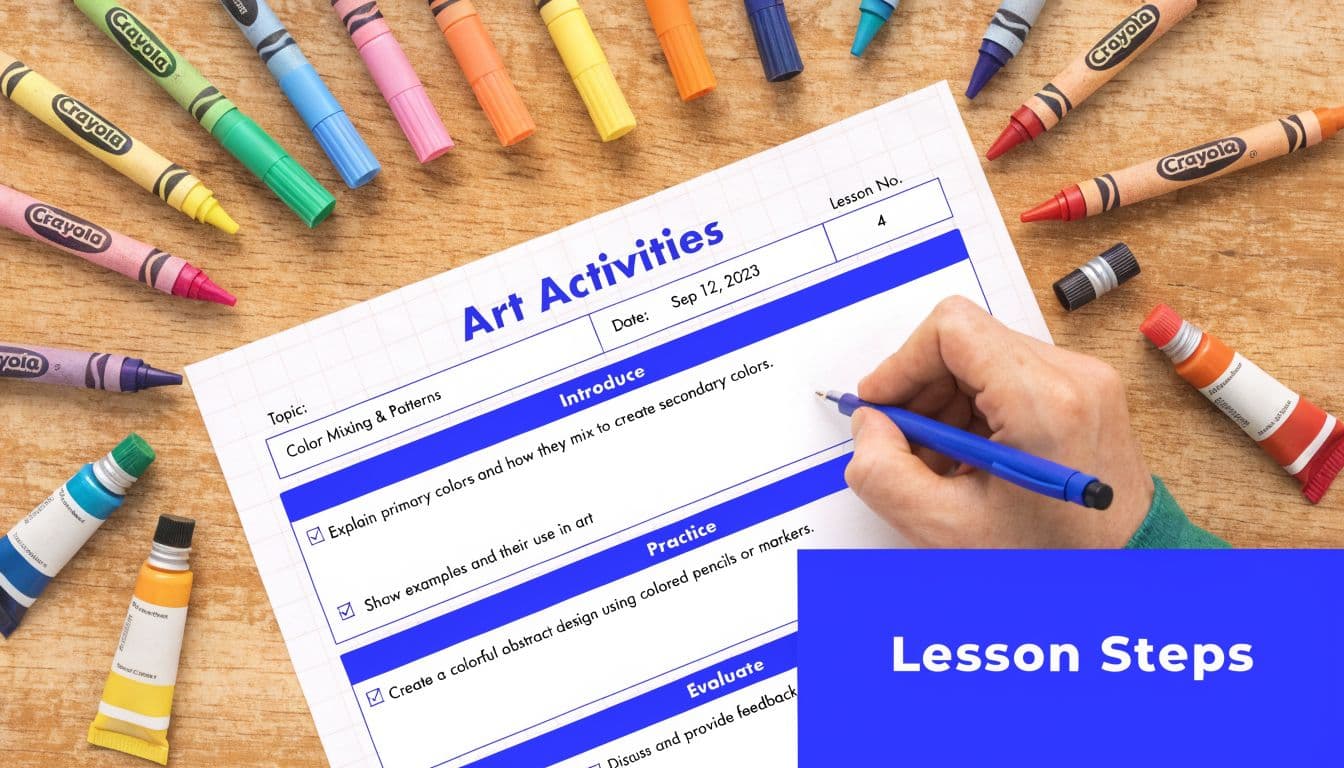
A practical lesson plan usually includes:
Learning objective
Keep it teacher-facing and specific.Student-friendly “I can” statement
Example: “I can use warm and cool colors to show mood.”Essential question
Example: “How do artists tell stories without words?”Materials
Mini-lesson
Guided practice
Independent work
Closure or reflection
Assessment evidence
That structure works because it creates rhythm. Students know there will be a short teach piece, some supported practice, time to work, and a way to reflect. You don’t have to explain the class format from scratch every time.
Write units around one clear job
A good unit has a central job. It might be helping students tell stories visually, build observational drawing habits, or learn how artists use materials to express ideas. Once you know the job, every lesson inside the unit has a role.
Here’s an example.
Storytelling unit across grade levels
The theme is the same, but the expectations shift.
First grade
Self-portrait collage with background details that show a favorite activity or placeSecond grade
Sequential drawings showing beginning, middle, and endThird grade
Illustrated folk tale scenes with foreground and background choicesFourth grade
Clay character or puppet design tied to a written story ideaFifth grade
Mixed media narrative panel using symbolism and text
That’s curriculum. The big idea holds. The media can change. The concepts build.
Choice-based teaching works when the room is organized for it
Some teachers hear Choice-Based Art Education and picture chaos. It can be chaotic if students are given freedom without structure. It works much better when choice is taught as a routine.
In a CBAE model, teachers typically provide 4-6 themed centers, teach mini-lessons, and then allocate 80% of class time to open studio work. This student-centered approach has been linked to higher standardized test scores, attributed to sustained engagement that fosters skills transferable to other academic subjects, as described in this overview of choice-based art education practices.
That doesn’t mean every elementary art curriculum needs to become a full studio-choice model. But most art rooms benefit from borrowing parts of it.
What usually works in real classrooms
Limited choices at first
Give students a menu, not an infinite field. Two or three material paths are easier than a fully open room.Mini-lessons that teach one transferable skill
Show how to create texture, attach paper cleanly, mix tints, or plan a composition. Then let students apply it in their own work.Centers with visual instructions
If students can reread the steps from a card or poster, you answer fewer repeated questions.Reflection built into cleanup
A quick partner share or exit prompt helps students name what they tried.
When choice-based teaching fails, it usually isn’t because students had too much freedom. It’s because the routines, material access, or expectations weren’t taught explicitly enough.
Keep your demonstrations short and useful
Elementary students do not need a twenty-minute teacher performance. They need a clear entry point. Demonstrate the part that is likely to block them, then let them begin.
For example, in a printmaking lesson, show:
- How to draw a simple bold design
- How to transfer or incise it safely
- How to ink or apply color cleanly
- How to pull the print
Then stop. Let them work. You can circulate to teach the next layer as needed.
A lot of teachers also benefit from explicitly planning creative variation. If you want students to move beyond copying, this collection of techniques for creativity offers prompts and ideation moves that adapt well to art planning, especially when a project starts feeling too template-heavy.
Make room for tools that reduce planning drag
The planning drag in art isn’t just the ideas. It’s the formatting, standards lookup, wording of objectives, worksheet creation, and adaptation for different grades. That’s where digital planning tools earn their keep.
If you’re building units from a prompt and want a starting structure, this guide on planning a unit is a useful planning reference. It helps you think through sequence, outputs, and assessment before you get lost in project details.
Later in the unit, showing another teacher’s pacing can also help. This video is a useful example of how an art lesson can be broken into manageable classroom moves.
A simple test for every lesson
Before you teach any lesson in your elementary art curriculum, ask:
- Does this lesson teach a skill, concept, or habit, not just produce a product?
- Can students explain what they are learning in simple language?
- Is the demo short enough that they’ll still have work time?
- Do I know what evidence of learning I’m looking for?
If the answer to those questions is yes, the lesson has a strong chance of working. If not, simplify before you teach it. Simplifying usually improves art lessons. It rarely weakens them.
Reaching Every Artist With Smart Differentiation Strategies
Differentiation in the art room is not an add-on for paperwork. It’s part of what makes the curriculum fair. If the same lesson works only for students who process language quickly, have steady fine motor control, already know the vocabulary, and can tolerate ambiguity, then the lesson isn’t as strong as it looks.

There is also a larger equity issue behind this. There is a significant and underserved demand for practical guidance on implementing arts education equitably, particularly in systemically under-resourced public schools. This equity gap highlights the need for curriculum strategies that work within real-world resource limitations to ensure all students benefit, as noted by P.S. ARTS.
Low floor, high ceiling is the right target
The best elementary art curriculum doesn’t create one “easy version” and one “hard version.” It creates tasks with a low floor and high ceiling. Everyone can enter. No one hits an artificial cap too early.
A collage lesson is a good example. Every student can arrange and glue shapes. Some students may focus on identifying basic shapes and colors. Others may build layered compositions, symbolic imagery, or more intentional spatial relationships. Same lesson family. Different depth.
The highest-impact adjustments are usually simple
You do not need to rewrite every lesson from scratch for every learner. Start with the supports that remove the most friction.
Supports that help immediately
Visual vocabulary cards
Put key words where students can see them with images, not just text. This helps multilingual learners and students who need repetition.Step cards with drawings or photos
A child who misses one verbal direction can still re-enter the task independently.Material choices with different motor demands
Thick markers, larger paper, adaptive scissors, glue sponges, or pre-cut shapes can make the same lesson accessible without changing the learning goal.Sentence starters for reflection
“I chose ___ because…” gives students language for critique and self-assessment.Extension prompts for fast finishers
Ask students to revise composition, add a second version, or explain their artistic decision-making instead of handing them busywork.
Classroom reminder: Students don’t all need the same path to reach the same concept.
Differentiate by process, not only by product
A common mistake is changing the final expectation but keeping the process rigid. In art, process flexibility matters even more.
For one printmaking lesson, for example:
| Need | Helpful adjustment |
|---|---|
| Student needs language support | Provide picture directions and modeled oral rehearsal |
| Student needs motor support | Use larger tools, simpler shapes, or partner-assisted transfer |
| Student needs extra challenge | Require variation across prints and written reflection on design choices |
| Student needs reduced overwhelm | Limit color choices and provide a clearly sequenced checklist |
Notice that the artistic idea stays intact. The path changes.
Under-resourced schools need realistic planning
Differentiation also has to be honest about context. If your school has limited supplies, no sink near the classroom, or classes that rotate quickly, your curriculum has to respect those conditions. Equity planning isn’t pretending every room has the same capacity. It’s choosing strategies that still preserve rigor.
That often means:
- Rotating a few dependable materials all year
- Designing lessons that can scale up or down
- Reusing visual supports across units
- Building routines students can follow with less direct teacher intervention
Teachers often waste energy trying to imitate an idealized art room they don’t have. Build the curriculum for the room you’re in.
Making Learning Visible Through Authentic Assessment
Assessment in art gets easier when you stop trying to grade taste. You are not evaluating whether you personally like the artwork. You are evaluating evidence of learning.
That distinction matters because many teachers and administrators struggle to explain what students learned in an integrated or process-heavy art lesson. Teachers and administrators often struggle to document and communicate learning outcomes when arts are integrated with other subjects. There is a critical need for assessment frameworks, like rubrics and data templates, that can demonstrate the arts' impact on core subject mastery and justify its place in the curriculum, according to the ABC Curriculum discussion of assessment needs in arts-integrated learning.
Grade the process you can observe
If you only grade the finished piece, students get one message: appearance matters most. That misses too much of what happens in the art room.
A stronger assessment system tracks things like:
- Idea development
- Use of technique
- Willingness to revise
- Craftsmanship
- Reflection and vocabulary
- Ability to explain choices
That gives students multiple ways to show growth, especially if their final piece doesn’t fully match what they imagined.
Build rubrics with plain language
Rubrics work best when they are short, specific, and visible before students start.
A simple rubric might include four criteria:
| Criteria | What you’re looking for |
|---|---|
| Craftsmanship | Student used materials with care and followed studio routines |
| Use of concept | Student applied the targeted idea, such as texture, contrast, or composition |
| Creative decisions | Student made choices rather than only copying a model |
| Process and reflection | Student stayed engaged, revised when needed, and described their work clearly |
You can score these in whatever system your school requires, but the wording should stay understandable to children and families.
Good art assessment answers, “What did the student understand and try?” not just “How polished is the result?”
Use more than one kind of evidence
Authentic assessment gets stronger when it collects learning from more than one moment.
Useful evidence sources
- Teacher observation notes during work time
- Student self-reflection on choices and challenges
- Peer critique using “I notice” and “I wonder”
- Portfolios that show growth across the year
- Quick exit prompts tied to vocabulary or artistic intention
This is one reason portfolios matter so much in an elementary art curriculum. A single project can be misleading. A body of work tells the actual story.
Make assessment manageable enough to keep doing it
If your system takes too long, you won’t use it consistently. The best assessment tools are the ones you can maintain in October, January, and May.
That usually means:
- one concise rubric instead of a giant checklist
- one reflection prompt instead of a full paragraph every time
- one class recording sheet you can reuse
- one portfolio routine students understand
If you want a useful framework for this approach, the idea of authentic assessment is a helpful lens because it focuses on students applying skills in meaningful contexts rather than producing one isolated score.
Assessment should help you teach better. If it only creates paperwork, trim it down.
Putting It All Together and Reclaiming Your Time
A solid elementary art curriculum doesn’t begin with a perfect binder. It begins with a few dependable decisions made well.
You choose the big ideas that matter. You map them across the year in a scope and sequence. You turn those into units with clear jobs and lessons with repeatable structures. You adapt the work so more students can enter it successfully. Then you assess learning in ways that reflect what happens in the art room.
That framework gives you consistency without making your teaching rigid. It also makes revision easier. If one lesson flops, you can fix the lesson without throwing out the whole unit. If one unit feels too long, you can shorten it and keep the larger progression intact. That’s what durable curriculum feels like. It bends without breaking.
The other part of reclaiming time is accepting that not every part of planning deserves equal energy. Your expertise belongs in selecting themes, responding to students, modeling technique, and shaping the culture of your room. It does not need to be spent rewriting the same objective format for the tenth time or manually rebuilding rubrics and worksheets from scratch.
The best planning systems protect your attention for the work only a teacher can do. Whether you use your own templates, a team planning folder, or an AI-supported workflow, the question is simple: does this reduce friction without flattening your professional judgment?
If the answer is yes, keep it.
A strong curriculum won’t make every class easy. There will still be paint spills, short periods, tired groups, and lessons that looked better in your head. But with a clear structure in place, those moments stop feeling like proof that you’re behind. They just become part of the teaching.
And that’s a much better place to build from.
If you want help turning ideas into usable plans, Kuraplan is worth a look. It’s built for K-12 teachers who need standards-aligned lesson and unit plans, rubrics, worksheets, and visuals without spending hours formatting everything by hand. For art teachers, that can mean less time wrestling with planning documents and more time refining projects, supporting students, and teaching.