You hand out a logos pathos ethos worksheet. Students circle a few examples, maybe get most of them right, and then their own persuasive writing still sounds flat. That’s the classroom problem most of us are trying to solve.
The issue usually isn’t the vocabulary. Students can memorize logos, pathos, and ethos well enough. The problem is transfer. They can label an appeal in isolation, but they can’t yet use those appeals with purpose in a paragraph, speech, ad, or argument.
What works better is a sequence. Start with recognition in familiar media. Move into guided analysis of a short text. Differentiate the task before students hit frustration. Then end with a creative product that requires intentional rhetorical choices. That’s where a worksheet becomes useful instead of disposable.
Beyond the Definition Your Guide to Actually Teaching Persuasion
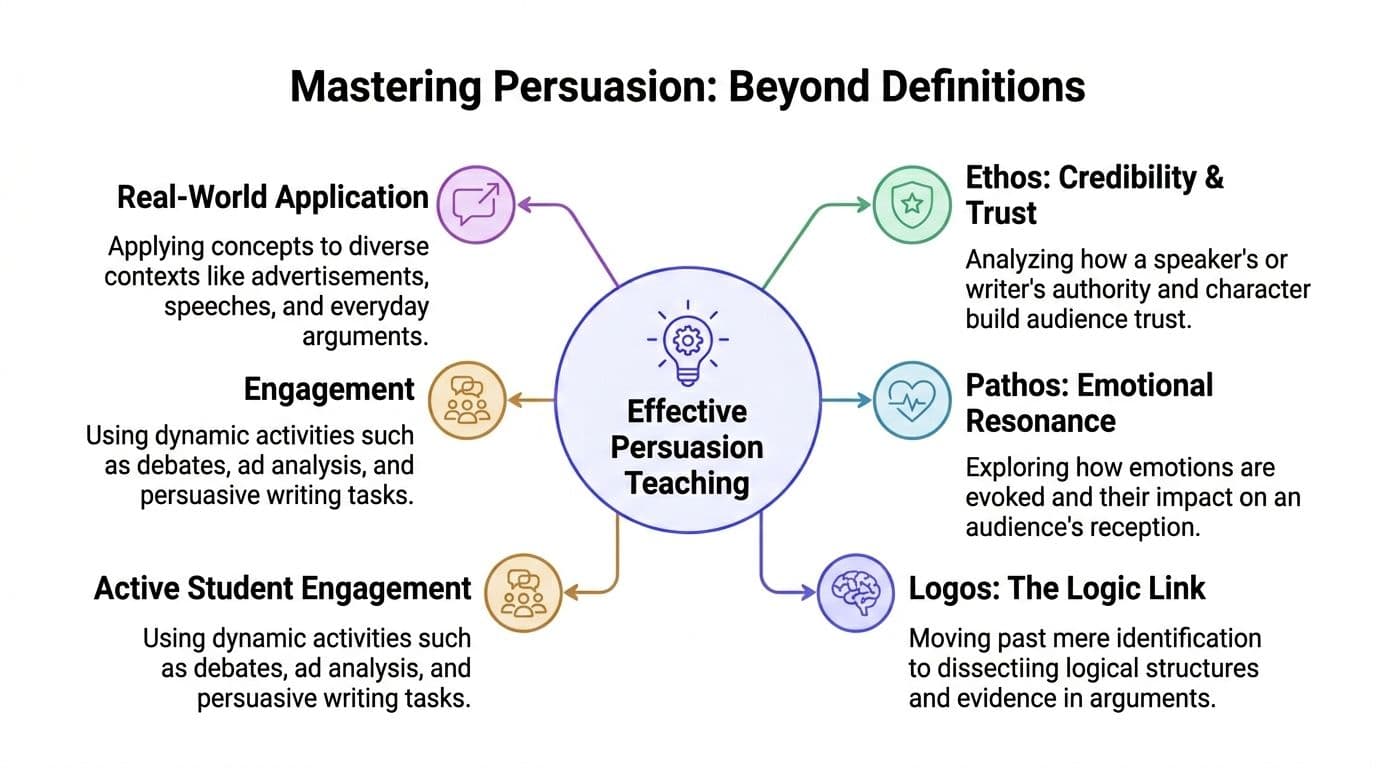
Most students meet rhetorical appeals as three terms on a slide. That’s too abstract. Persuasion becomes easier to teach when students see the appeals as parts of a working system rather than isolated definitions.
Logos, ethos, and pathos come from Aristotle’s persuasion framework. Logos appeals to reason through factual data, ethos builds credibility and competence, and pathos evokes emotion. Educational materials built around these appeals consistently treat them as the core of persuasive instruction, and when students combine all three in their writing, the writing becomes more convincing, as described in this overview of logos, ethos, and pathos resources.
Use the rhetorical triangle early
I don’t start with a big packet. I start with the rhetorical triangle.
Students need three questions in front of them:
- Who is speaking
- Who is the audience
- What is the speaker trying to make that audience think, feel, or do
That shift matters because students often treat appeals like labels instead of choices. A writer doesn’t add pathos because the assignment says so. A writer uses pathos because the audience needs to care. A writer uses logos because the claim needs support. A writer uses ethos because people trust arguments more when the speaker sounds informed, fair, and credible.
Practical rule: If students can’t name the audience, they usually can’t explain the appeal.
What a good worksheet actually does
A useful logos pathos ethos worksheet shouldn’t stop at “identify the appeal.” It should help students answer four classroom-level questions:
- What appeal is being used
- What words or details create it
- Why the writer used it there
- How it affects that specific audience
That fourth question is the one many worksheets miss. Students may spot a sad anecdote and correctly call it pathos, but if they can’t explain why the anecdote appears before the statistic or after the expert quote, they haven’t really analyzed the rhetoric.
A better lesson sequence turns the worksheet into scaffolding. Early tasks keep the stakes low. Middle tasks add precision. Final tasks require students to make rhetorical decisions for themselves. Once you teach it that way, persuasion stops feeling like test prep vocabulary and starts feeling like a real writing tool.
Hook Them with a Low-Stakes Warm-Up Activity
Students understand advertising before they understand rhetoric. That’s the easiest entry point.
Instead of opening with definitions, put two or three short ads in front of them. Use a sentimental ad, a facts-heavy ad, and one that leans on authority or reputation. Keep it brief. You want instinctive reactions, not overthinking.

The warm-up sheet I’d hand out
Give students a half-page response sheet with simple prompts like these:
| Prompt | Student task |
|---|---|
| What do you notice first? | Write one visual or verbal detail |
| What does this ad want you to do? | Name the action or belief |
| What makes it convincing? | Point to a word, image, or claim |
| How does it make you feel? | Describe the reaction |
| What makes the message seem believable? | Note any expertise, reputation, or trust cue |
Notice that none of those prompts use the terms logos, pathos, or ethos yet. That’s intentional. Students usually have better instincts than vocabulary at the start.
Why this works better than a lecture
A low-stakes ad analysis lowers the fear level immediately. Students can talk about what they noticed without worrying about getting the terminology wrong. That matters for reluctant writers and for students who shut down when the first task looks academic.
After individual notes, put students in pairs and ask them to compare answers. Then bring the class back together and sort their observations into categories on the board:
- Evidence and reasoning
- Emotion
- Credibility and trust
Once those categories are visible, introduce the formal terms. Students usually connect them quickly because they’ve already done the thinking.
Students don’t need the vocabulary first. They need a reason for the vocabulary.
Keep the warm-up short and concrete
This opener works best when it stays tight. If it drags, students start treating it like a scavenger hunt. Aim for quick viewing, quick writing, and a brisk discussion.
A few moves help:
- Pick short texts: A slogan, a print ad, or a brief commercial clip works better than a long campaign video.
- Limit the writing load: Short answers keep the focus on noticing.
- Ask for proof: “What in the ad made you say that?” keeps discussion anchored in the text.
- Save edge cases for later: Don’t start with examples where appeals overlap in complicated ways.
The point is recognition. Students should leave the warm-up feeling that persuasion is everywhere and that they already know more about it than they thought.
Build Deep Understanding with Guided Practice
Once students can spot appeals in ads, move them into a more demanding text. A short speech excerpt works well. So does a compact editorial paragraph. The text needs enough substance for analysis, but not so much that students get lost before they start marking.
The worksheet becomes more structured. Students need help seeing how appeals work together inside a real argument.

A structured rhetoric sequence has shown strong classroom results. In one documented approach, students began with a quiz, moved into phrase identification with 7-10 examples, reached up to 91% success on identifying pathos, then used color-coding in media analysis with 82% efficacy. That same structured practice improved persuasive writing scores by 25-30% in evaluated trials, according to the worksheet methodology summary on Studocu.
A guided practice routine that holds up
I’d build the middle lesson in three passes.
First read for gist
Students read or listen without annotating. They should know the central claim before they start hunting for appeals.Second read for color-coding
Assign one color to each appeal. Students mark phrases, not whole paragraphs. That keeps their attention on craft.Third read for analysis
Students answer short questions about placement, effect, and audience.
If you want a ready-made companion activity for this stage, a persuasive writing techniques worksheet fits naturally after the initial annotation.
The questions worth asking
A good guided worksheet asks more than “Which appeal is this?” Try prompts like these:
- Why place this emotional example before the claim?
- What makes this sentence sound credible?
- How does this statistic change the tone of the argument?
- Which audience would respond most strongly to this passage?
- Where do two appeals work together in the same sentence?
Those questions slow students down in a good way. They start noticing sequence and purpose, not just labels.
Modeling move: Think aloud through one paragraph and name your reasoning out loud. Students need to hear what analytical thinking sounds like.
A sample answer key approach
Avoid answer keys that only list appeal labels. Give students a sample explanation instead.
| Text feature | Likely appeal | Strong explanation |
|---|---|---|
| Expert testimony | Ethos | The writer borrows credibility from a knowledgeable source so the audience sees the claim as informed rather than opinion-based. |
| Personal story | Pathos | The story gives the issue a human face, which can make the audience care before they evaluate evidence. |
| Numerical evidence | Logos | The statistic gives the argument a logical foundation and makes the claim sound supported. |
That kind of answer key does two jobs. It checks understanding, and it implicitly teaches students how to write about rhetoric in complete thoughts.
Differentiate Your Lesson for Every Student
Most logos pathos ethos worksheet materials assume one path for everyone. That’s a problem. Some students still need help noticing obvious emotional language, while others are ready to evaluate whether an argument uses emotion ethically or leans too hard on credibility without support.
That gap isn’t minor. Existing worksheet collections often don’t offer differentiated supports for struggling writers, multilingual learners, or advanced students, and they rarely connect the work to grade-level expectations, as noted in this discussion of gaps in ethos, pathos, and logos worksheets. If the worksheet is the same for everyone, the lesson usually rewards the students who already understand rhetorical analysis and loses the ones who need the scaffolding most.
What to change for students who need support
Students who struggle don’t need a watered-down lesson. They need a narrower entry point.
Here are the adjustments that help most:
- Reduce the field: Give one short paragraph instead of a full-page text.
- Pre-highlight one example: Ask students to explain why it works before they identify others.
- Use sentence frames: “This is pathos because the writer uses ___ to make the audience feel ___.”
- Focus on one appeal at a time: Start with pathos or logos before asking students to sort all three.
- Add visual cues: Icons for heart, shield, and brain can help younger students and multilingual learners.
A lot of failed rhetoric lessons fail because the first independent task asks students to do too much at once. Reading comprehension, vocabulary, analysis, and writing all pile up in a single worksheet.
How to extend for advanced students
Advanced students need complexity, not just more items.
Try these extensions:
- Ask them to compare the same appeal across two texts.
- Have them revise a weak paragraph by strengthening one appeal without overpowering the others.
- Let them evaluate whether a pathos-heavy argument is fair, manipulative, or effective.
- Ask them to identify where ethos is implied rather than directly stated.
That work moves them from recognition into judgment. It also mirrors the kind of rhetorical thinking we want in upper-grade writing.
The strongest students don’t need another matching exercise. They need a reason to make a rhetorical decision and defend it.
A simple tiering model
If you want one lesson with flexible entry points, this structure works:
| Group | Text support | Task |
|---|---|---|
| Foundational | Short excerpt with visual cues | Identify one appeal and explain effect |
| On-level | Grade-level text | Color-code and answer analysis questions |
| Advanced | Two related texts | Compare rhetorical choices and evaluate effectiveness |
This kind of differentiation keeps the class on the same core concept while making the task doable for each student. It also makes collaboration more realistic because students can still discuss the same big ideas, even if their texts or prompts vary.
Assess Learning with a Creative Application Project
If students only identify appeals, you don’t really know whether they can use them. The clearest assessment is creation.
A strong capstone is simple: students create a persuasive artifact. That might be a print ad, a speech, a campaign poster, or a short pitch for a school issue. The format matters less than the decision-making. They need to use logos, pathos, and ethos on purpose and explain why each choice fits their audience.
This is also the point where many teachers want a more polished final product. If students are turning speeches or ad pitches into short videos, Remotion Claude for Education is a relevant option for converting script-based classroom work into presentation-ready media.
Project prompt that produces real evidence
Keep the directions tight:
Create a persuasive ad or short speech for a product, cause, or school initiative. Use all three rhetorical appeals. Then write a short reflection explaining where you used each appeal and why it fits your audience.
That reflection matters. Without it, students can fake understanding by adding random emotional language or an unsupported statistic-like sentence. The reflection forces intentionality.
A companion task like persuasive writing and debate practice can work well during drafting or peer review.
Rubric for Persuasive Advertisement Project
| Criteria | 4 (Exemplary) | 3 (Proficient) | 2 (Developing) | 1 (Beginning) |
|---|---|---|---|---|
| Use of logos | Logical support is clear, relevant, and strengthens the argument | Logical support is present and mostly relevant | Some attempt at reasoning, but support is weak or unclear | Little or no logical support |
| Use of pathos | Emotional appeal is purposeful and fits the audience well | Emotional appeal is clear and mostly appropriate | Emotional language is present but uneven or forced | Emotional appeal is missing or ineffective |
| Use of ethos | Credibility is established clearly through trustworthy language or evidence | Credibility is present but not fully developed | Some attempt at credibility, but it feels vague | No clear sense of credibility |
| Balance of appeals | Appeals work together smoothly and support one another | More than one appeal works effectively together | Appeals appear separately with limited integration | Appeals feel random or disconnected |
| Audience awareness | Choices are clearly tailored to a specific audience | Audience is identifiable and mostly considered | Audience is broad or inconsistently addressed | No clear audience awareness |
| Reflection | Student explains rhetorical choices precisely and thoughtfully | Student explains most choices clearly | Reflection is partial or general | Reflection is missing or superficial |
What to watch for while grading
The common weak submission isn’t the one that misses a definition. It’s the one that includes all three appeals mechanically.
Watch for these patterns:
- Pathos overload: The piece tries to make the audience feel something but gives no believable support.
- Fake ethos: The student writes “experts agree” without creating any real credibility.
- Checklist writing: One sentence for each appeal, with no overall strategy.
A good project feels coherent. Students should sound like they know who they’re persuading and why each appeal belongs there.
Create Your Differentiated Worksheets in Minutes with Kuraplan
Planning the full sequence manually takes time. You need a warm-up sheet, a guided analysis page, differentiated versions for multiple groups, and a final rubric. That’s exactly the kind of work that tends to get cut down to one generic worksheet when the week gets busy.
Modern AI worksheet platforms now generate customized rhetoric materials, and these tools are used widely enough to be described as standard supports in current practice. One overview notes that AI-powered platforms trusted by 1,000+ schools and 30,000+ teachers can generate customized ethos, pathos, and logos worksheets aligned to standards and learner needs, according to English Worksheets Land’s rhetoric resource page.
Where Kuraplan saves the most time
The biggest win isn’t just worksheet generation. It’s coherence.
If you build this lesson sequence in Kuraplan’s worksheet generation tools, you can create materials that belong together:
- Warm-up page: Ad-based first impressions prompts
- Guided practice sheet: Color-coding plus short analysis questions
- Support version: Sentence starters and reduced text load
- Extension version: Comparative rhetoric prompts
- Project rubric: Criteria aligned to the final creative task
That’s a different level of planning from downloading random worksheets that weren’t built for your students, your text, or your objective.
Prompting it well makes the difference
The quality of the output depends on the prompt. Be specific.
Try prompts like these:
- Create a logos pathos ethos worksheet for grade 8 using short advertisement slogans
- Generate a rhetorical appeals analysis sheet for a school-appropriate speech excerpt
- Make two versions of this worksheet, one with sentence frames and one with higher-order comparison questions
- Build a rubric for a persuasive poster using logos, pathos, and ethos
Short, concrete prompts usually produce better classroom materials than broad ones.
For a quick walkthrough, this demo is useful:
What matters most is that you’re no longer formatting from scratch every time you reteach persuasion. You can spend your energy adjusting the thinking, the text choice, and the discussion instead of rebuilding the handout.
If you want to turn this lesson sequence into ready-to-use materials without spending your prep period formatting documents, Kuraplan is worth trying. It can help you generate a logos pathos ethos worksheet for different grade levels, build differentiated versions for support and extension, and create matching rubrics and visuals so the whole persuasion unit feels connected instead of pieced together.