Let's be real: teaching these past few years has been a marathon. We're seeing more anxiety, less focus, and bigger emotional reactions in the classroom than ever before. It’s not just you. The truth is, academic learning can't happen when a student's emotional world is in chaos. If a kid is overwhelmed, they can't learn fractions. If they don't know how to handle conflict, group projects become a nightmare. This is where targeted social emotional learning activities come in.
These aren't just 'fluffy' extras to squeeze in when you have five minutes. They are the foundational tools our students need to navigate their world, build healthy relationships, and become resilient, focused learners. To get the full picture, it helps to have a solid understanding of emotional intelligence itself, which is the bedrock for these skills. Think of SEL as the essential prep work that makes every other lesson stick.
In this guide, I'm cutting through the noise to give you 10 practical, field-tested social emotional learning activities you can actually use tomorrow. I'll break down each activity with clear steps, material lists, and tips for different grade levels. My goal is to give you a go-to playbook for building a more supportive, responsive classroom, one manageable activity at a time.
1. Mindfulness and Deep Breathing Exercises
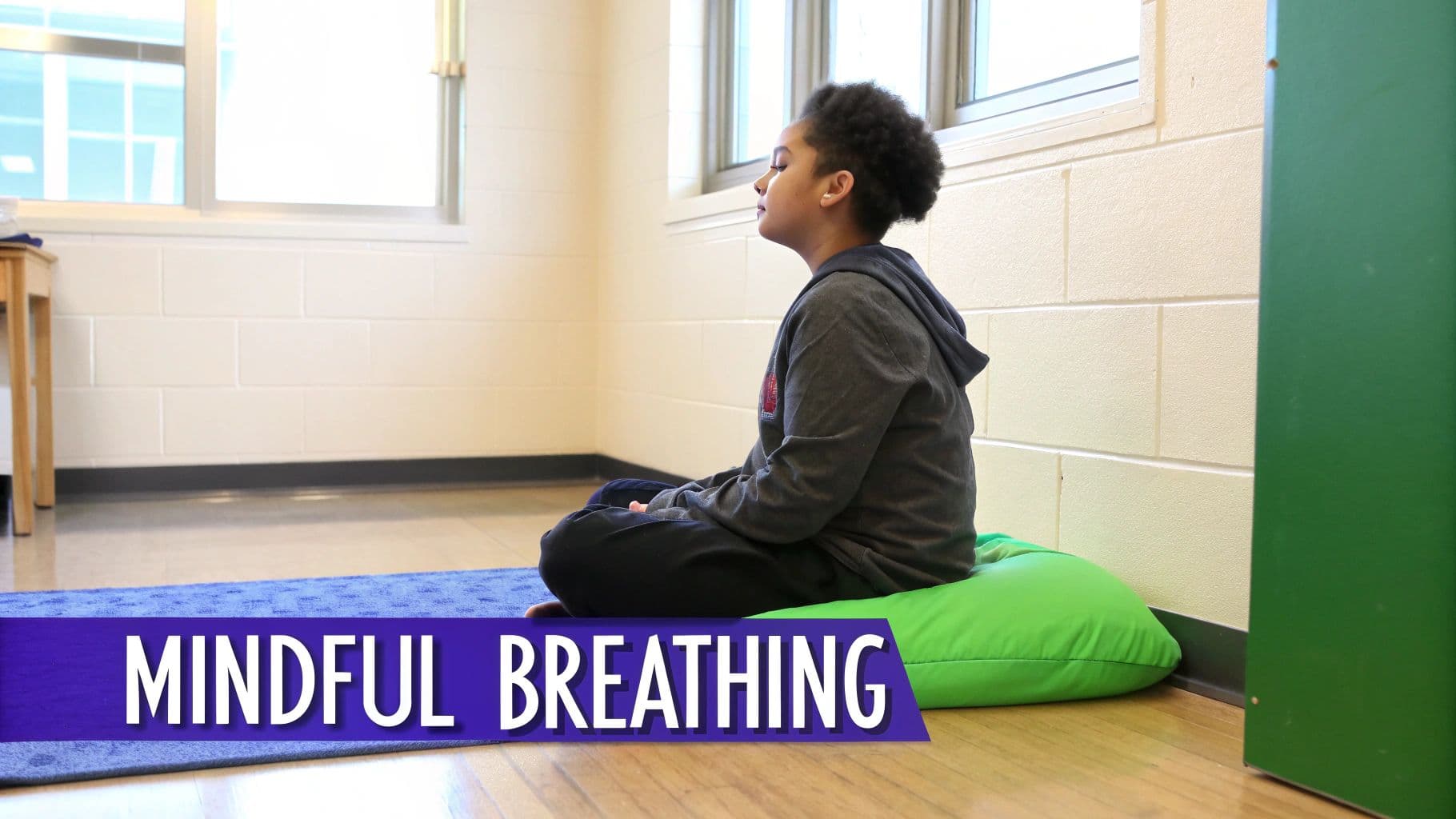
Mindfulness and deep breathing exercises are simple, structured practices that teach students to anchor themselves in the present moment. By focusing on the physical sensation of their breath and body, students learn to quiet the mental chatter, regulate their emotional responses, and dial down feelings of anxiety or stress. These are foundational social emotional learning activities because they build the core skill of self-regulation—a must-have for both academic focus and personal well-being.
Why It Works
These practices activate the body's natural "rest and digest" response (the parasympathetic nervous system), which counteracts the fight-or-flight feeling of stress. Regular practice literally strengthens the parts of the brain associated with focus and emotional control, making it easier for students to find their calm when faced with a challenge.
How to Implement This Activity
- Box Breathing: A simple technique that's easy to remember. Guide students to inhale for a count of four, hold for four, exhale for four, and hold again for four. Draw a square in the air or on the board to help them follow along.
- Belly Breathing: Have students place one hand on their chest and one on their belly. Tell them to breathe in slowly through their nose, feeling their belly expand like a balloon, and then exhale slowly as it deflates. This ensures they're taking truly deep, calming breaths.
- Mindful Bell: Use a chime or a bell to signal a transition. Ask students to listen silently until the sound completely fades away. This simple practice brings the whole class to a shared point of focus in under a minute.
Teacher Tip: Consistency is everything. Weaving a two-minute breathing exercise into your morning routine or after recess makes it a normal part of the day. Soon, it'll be a tool students turn to on their own. For more ideas, exploring effective relaxation techniques for stress relief can give you even more tools for your classroom toolkit.
2. Emotion Check-In and Feelings Identification
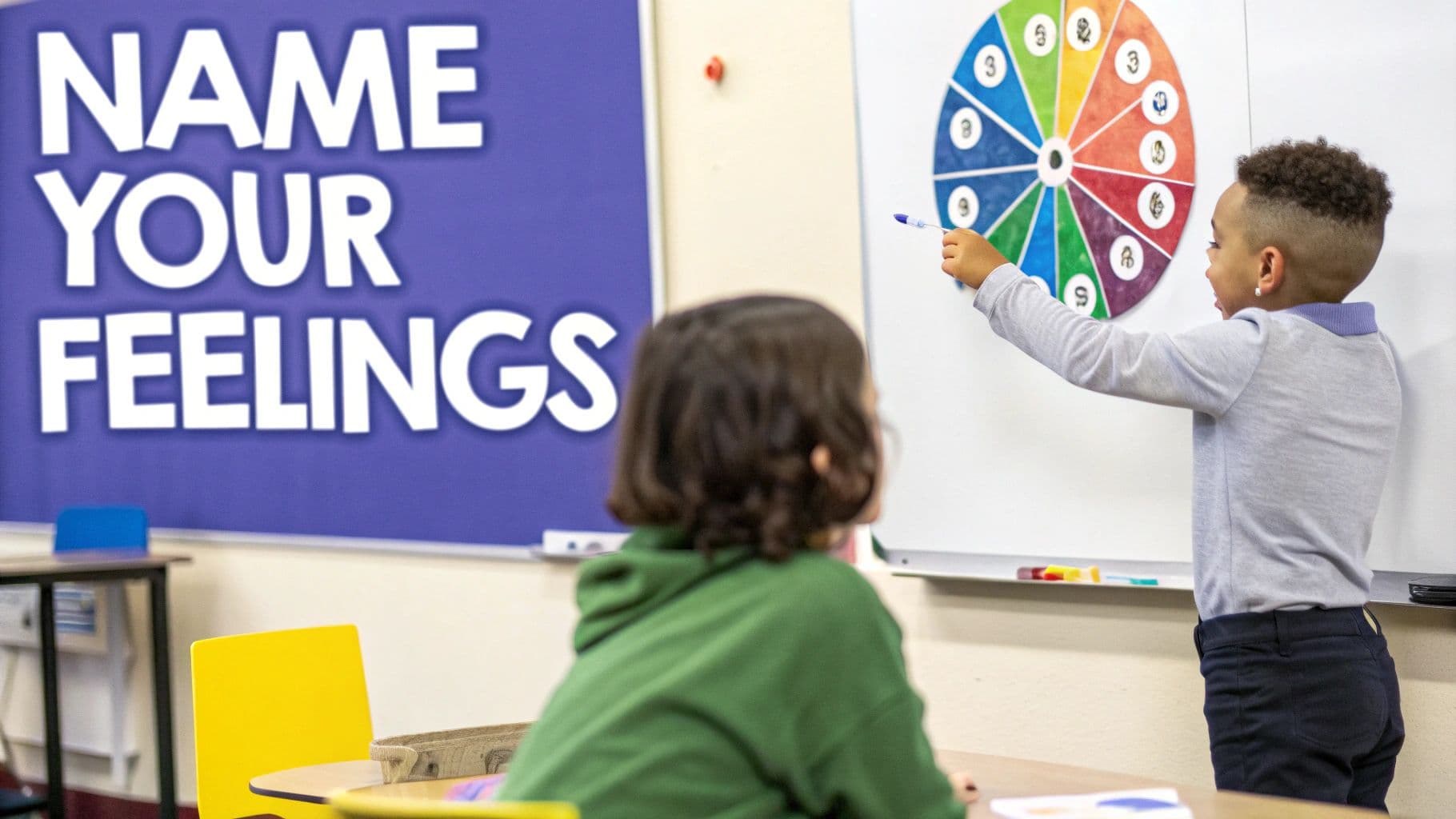
An emotion check-in is a quick, structured routine where students identify, name, and share how they're feeling. This is a bedrock social emotional learning activity because it builds emotional literacy—the ability to know what you're feeling and give it a name. Using tools like feelings wheels or simple prompts, students develop an awareness of their internal state, which is the first step toward managing it.
Why It Works
Psychologists call it "name it to tame it." Simply putting a label on an emotion helps externalize it, reduces its intensity, and gives students a sense of control. Regular check-ins also create a classroom culture where it's safe to have feelings, signaling to students that their emotional world is valid and important.
How to Implement This Activity
- Feelings Wheel/Chart: Display a visual chart with different emotion words and corresponding faces. During morning meeting, students can point to or name the feeling that best fits their state.
- Digital Check-In: For older students, a simple Google Form offers a private way to check in. Ask them to rate their energy level or select a feeling from a list. This gives you valuable insight while respecting their privacy.
- "Rose, Bud, Thorn": This is a classic for a reason. Students share a "rose" (a success), a "bud" (something they're looking forward to), and a "thorn" (a challenge). It structures the conversation around a full range of experiences, not just the good stuff.
Teacher Tip: Don't assume students have the vocabulary. Explicitly teach feeling words, starting with the basics (happy, sad, mad) and gradually adding more nuanced words (frustrated, content, anxious). Pairing these check-ins with lessons on managing difficult thoughts and feelings helps students move from simply knowing how they feel to knowing what to do about it.
3. Gratitude, Appreciation, and Reflective Journaling
Gratitude and reflective journaling are social emotional learning activities designed to shift students' focus toward the positive and help them process their experiences. By intentionally taking time to notice and appreciate people, events, or small moments, students cultivate a more optimistic outlook. When paired with writing, these practices help them sort through emotions, understand their own learning process, and build the self-awareness needed for resilience.
Why It Works
Our brains have a natural negativity bias—it's a survival thing. Gratitude practices actively counteract that by strengthening the neural pathways associated with positive emotions. When students regularly write about what they're thankful for or reflect on their day, they develop a more balanced emotional perspective and a greater sense of connection.
How to Implement This Activity
- Gratitude Journals: Dedicate a few minutes each day or week for students to write down three specific things they are grateful for. Guide them with prompts like, "What's something beautiful you saw today?" or "Who did something kind for you?"
- Appreciation Circles: During a morning meeting, have students share something they appreciate about a classmate or a part of their day. This is a powerful and simple way to build a positive classroom culture.
- Reflective Learning Logs: At the end of a lesson, ask students to journal about their learning. Use prompts like, "What was most challenging today, and how did you handle it?" or "What are you most proud of learning this week?" to build metacognition.
Teacher Tip: Model this yourself. Share something you're grateful for or a reflection on your own learning. This makes it feel authentic. And remember, these are for reflection, not grammar practice. If you need a steady stream of fresh and engaging prompts, an AI tool like Kuraplan can be a lifesaver for generating ideas tailored to your students.
4. Cooperative Learning and Peer Collaboration Activities
Cooperative learning isn't just "group work." It's intentionally structured small-group activities where students need each other to succeed. Through things like jigsaw discussions and think-pair-share, students actively practice critical social skills: communication, empathy, perspective-taking, and conflict resolution. These social emotional learning activities are amazing because they embed SEL practice right into your academic content.
Why It Works
This approach turns learning into a team sport. Students have to negotiate roles, listen to different viewpoints, and give constructive feedback—all skills they'll need for the rest of their lives. The shared responsibility builds a sense of community and mutual respect, which means fewer classroom conflicts and a better learning environment for everyone.
How to Implement This Activity
- Think-Pair-Share: Pose a challenging question. Give students a minute to think on their own, then have them discuss their ideas with a partner. Finally, ask pairs to share their combined thinking with the class. This simple structure ensures everyone has a voice.
- Jigsaw: Divide a topic into smaller chunks. Each student in a "home group" becomes an "expert" on one chunk by meeting with experts from other groups. They then return to their home groups to teach their piece to their teammates, putting the puzzle together.
- Numbered Heads Together: In small groups, students number off (1, 2, 3, 4). You ask a question, and the group works together to make sure everyone knows the answer. You then call a number randomly, and only the student with that number can answer for the group.
Teacher Tip: Don't just throw them in the deep end. Explicitly teach and model what good collaboration looks like. Use role cards (e.g., Facilitator, Scribe, Timekeeper) to give everyone a clear job. Afterwards, debrief the process, not just the answer. Ask, "How well did we listen to each other?" This reinforces the skills needed for building healthy and respectful relationships.
5. Problem-Solving and Conflict Resolution Circles
Problem-solving and conflict resolution circles are structured conversations where students come together to discuss challenges, repair harm, and make decisions as a group. Using principles from restorative practices, these circles teach vital skills like communication, empathy, and accountability. Students learn to listen to different perspectives and work together to find solutions, building a strong sense of community along the way.
Why It Works
This process goes beyond punishment by focusing on understanding and fixing the problem. Circles give every student an equal voice, which builds trust and psychological safety. When kids feel heard and respected, they're more willing to take responsibility for their actions and invest in making the classroom a better place for everyone.
How to Implement This Activity
- Establish Circle Norms: Before you start, create agreements with the class. Norms like "speak from the heart," "listen with respect," and "what's said in the circle stays in the circle" are key for building trust.
- Use a Talking Piece: This is a designated object that gets passed around. Only the person holding the object can speak. This simple tool ensures everyone gets a turn without being interrupted and promotes better listening.
- Ask Open-Ended Questions: Guide the discussion with questions that encourage reflection, not blame. Try things like, "What happened?", "Who has been affected, and how?", and "What needs to happen to make things right?".
Teacher Tip: Start small. Begin the year with low-stakes community-building circles to share weekend news or celebrate successes. This builds comfort and trust with the format, so when a real conflict arises, the tool is already familiar and effective. Using a tool like Kuraplan can help you generate prompts and circle agendas tailored to your students' specific needs.
6. Character Strengths and Growth Mindset Development
Character strengths and growth mindset activities teach students to see their abilities as something they can grow and to leverage their unique personal qualities for success. Drawing from the work of Carol Dweck and the VIA Institute on Character, these social emotional learning activities help students understand that intelligence and skills can be developed through effort and strategy. By identifying their own strengths like creativity, perseverance, and kindness, students build self-awareness and resilience.
Why It Works
This approach gets right to a student’s core beliefs about themselves. By celebrating effort over just being "smart" and reframing mistakes as a normal part of learning, we foster a powerful sense of self-efficacy. Students with a growth mindset are more likely to stick with hard problems, seek out challenges, and actually use feedback, setting them up for a lifetime of learning.
How to Implement This Activity
- Introduce "The Power of Yet": This is a simple but transformative language shift. When a student says, "I can't do this," guide them to add the word "yet." "I can't do this yet" reframes a dead-end statement into one of future possibility.
- Create a "Celebrate Mistakes" Board: Dedicate a space where you and your students can post examples of mistakes you've made and what you learned from them. This destigmatizes errors and turns them into valuable learning moments.
- Strength Spotting: Get specific with your praise. Instead of just "Good job," say, "I noticed you used your strength of perseverance when you kept working on that tough math problem." This helps students see and name their own best qualities.
Teacher Tip: The best way to teach a growth mindset is to model one. Talk about your own struggles and learning processes. Share something you found difficult and the strategies you used to figure it out. Your authenticity makes the concept real and shows students that everyone, even the teacher, is a learner.
7. Perspective-Taking and Empathy-Building Activities
Perspective-taking and empathy-building exercises are structured social emotional learning activities designed to help students understand and share the feelings of others. By using literature, role-play, and real-world stories, students learn to step outside their own experiences and see the world from another's point of view. This practice is foundational for developing empathy, which reduces conflict, challenges bias, and builds a more inclusive classroom.
Why It Works
These activities challenge our natural tendency to only see things from our own perspective. When students actively consider another person's motivations, history, and feelings, they build the neural pathways for social connection. This makes them better collaborators, more thoughtful friends, and more engaged citizens. It’s the core of what we call social awareness.
How to Implement This Activity
- Character Shoe Swap: After reading a story or watching a film, ask students to "step into a character's shoes" and write or discuss a situation from that character's perspective. Sentence starters like, "If I were [character], I would feel... because..." can be really helpful.
- Fishbowl Discussions: Choose a complex topic with multiple viewpoints. A small group of students sits in an inner circle (the "fishbowl") to discuss it, while everyone else observes and listens. This structure forces deep listening before jumping in to respond.
- Community Storytellers: Invite guest speakers from diverse backgrounds, cultures, or professions to share their experiences with the class. Hearing real stories from real people is one of the most powerful ways to build empathy and challenge stereotypes.
Teacher Tip: A safe and respectful classroom is non-negotiable for these activities. Establish clear norms for discussion to ensure all voices are heard and valued. When you choose books or speakers, prioritize authentic voices over one-dimensional stereotypes to foster genuine understanding.
8. Positive Behavior Recognition and Celebration
Positive behavior recognition is about intentionally catching students being good. Instead of just correcting negative behavior, this approach builds a positive classroom culture by highlighting when students demonstrate desired social and emotional skills. These social emotional learning activities are powerful because they make prosocial behaviors visible and valued, encouraging a community where everyone feels seen and motivated to contribute.
Why It Works
This strategy taps into the basic human need to be recognized and belong. Specific, authentic praise reinforces the brain pathways for that behavior, making it more likely to happen again. By focusing on effort and character—not just getting the right answer—it fosters a growth mindset and builds intrinsic motivation.
How to Implement This Activity
- Specific, Labeled Praise: Go beyond "good job." Instead, say, "I saw how you patiently waited your turn and listened to your partner’s idea. That showed great respect and self-control." This names the specific SEL skill being used.
- Peer-to-Peer Recognition: Create a "Shout-Out" board or have a dedicated time in morning meeting for students to acknowledge each other. Provide sentence stems like, "I want to give a shout-out to [Student] for..." to guide them.
- Character Trait Certificates: Design simple certificates for things like empathy, perseverance, or responsibility. Awarding these in class meetings celebrates the individual and teaches the whole class what those values look like in action. You can even use tools like Kuraplan to quickly generate customized, visually appealing certificate templates.
Teacher Tip: Make sure your recognition is equitable. Celebrate a wide range of contributions, not just those from the loudest or highest-achieving students. The goal is to build every student's sense of value by catching them doing something right.
9. Self-Advocacy and Boundary-Setting Skills
Self-advocacy and boundary-setting are crucial social emotional learning activities that empower students to understand, articulate, and honor their own needs. This means teaching them how to identify their feelings, make respectful requests, say "no" when necessary, and ask for help. These skills are especially vital for students with learning differences, but they are essential for everyone.
Why It Works
This practice builds student agency and self-respect. By learning to communicate their needs effectively, students reduce their own frustration and anxiety, build healthier friendships, and develop a stronger sense of self-worth. This foundation of assertiveness is critical for their personal safety and success long after they leave your classroom.
How to Implement This Activity
- Scripting and Role-Playing: Give students the words. Provide sentence starters like, "I need help with...," "Can I please have a quiet space?" or "I feel uncomfortable when..." Then, practice using these scripts in low-stakes role-play scenarios. Need ideas for scenarios? Kuraplan can generate diverse and grade-appropriate situations for your students to practice with.
- "My Needs" Profile: Have students create a personal profile outlining their learning preferences, triggers, and what helps them succeed. This can be a private document they share with their teachers to help them advocate for themselves.
- Boundary Circles: Use a visual activity where students draw three concentric circles around a figure of themselves. They can label the circles "My Personal Space," "Friends & Family," and "Everyone Else" to discuss what kinds of interaction and sharing feel right for each level.
Teacher Tip: The best way to teach this is to model it. Openly state your own needs and boundaries. For example, "I need a quiet moment to organize my thoughts before we move on," or "I can't answer that right now, but I will get back to you." This shows students that everyone has needs and limits, and it's okay to state them.
10. Arts-Based and Creative Expression Activities
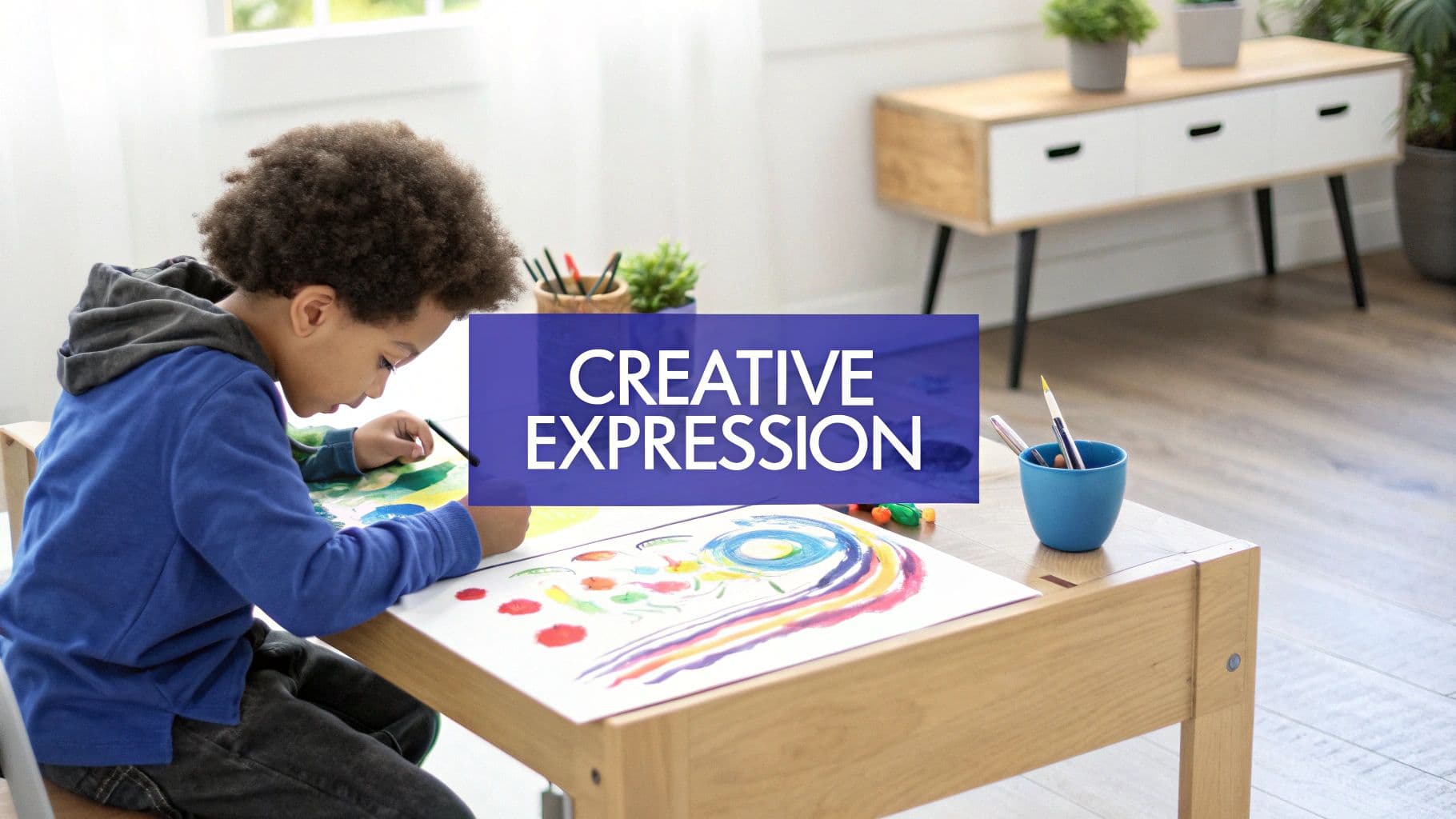
Arts-based activities use things like drawing, music, movement, and drama to help students process experiences and express feelings that are hard to put into words. These social emotional learning activities provide a non-verbal outlet, allowing students to explore their inner world in a safe, constructive way. It’s a powerful way to build self-awareness without having to say a single word.
Why It Works
Creative expression can bypass the analytical part of the brain that sometimes censors our emotions. Drawing, making music, or acting can lower inhibitions and tap into feelings stored non-verbally, making it an incredible tool for processing complex situations or even trauma. The act of creating something tangible that represents their internal state can be incredibly validating for students.
How to Implement This Activity
- Emotion Sculptures: Give students clay or pipe cleaners and ask them to create a sculpture of a feeling, like "joy," "frustration," or "calm." This helps them externalize and examine emotions from a new perspective.
- Soundtrack of My Day: Have students choose a song (or just create a few sounds) that represents how their day is going. This musical check-in allows for quick emotional expression and can be a great conversation starter.
- Role-Play Scenarios: Present a common social problem, like a disagreement with a friend. Have students act out different ways to resolve the conflict. This lets them practice relationship skills and empathy in a low-stakes, playful way.
Teacher Tip: The goal is expression, not a masterpiece. Make it clear that all creative work is valued and there is no "right" or "wrong" way to do it. Offering a choice of materials and letting students pick their medium can significantly increase their comfort level and engagement.
Comparison of 10 SEL Activities
| Practice | 🔄 Implementation complexity | ⚡ Resource requirements | 📊 Expected outcomes | 💡 Ideal use cases | ⭐ Key advantages |
|---|---|---|---|---|---|
| Mindfulness and Deep Breathing Exercises | Low — short scripted routines, minimal training | Low — no equipment; 2–5 mins/session | Improved attention, reduced anxiety; measurable emotional regulation | Transitions, pre-tests, moments of classroom stress | Immediate calming effect; scalable and low-cost |
| Emotion Check-In and Feelings Identification | Low–Moderate — setup of tools and follow-up needed | Low — posters, clipboards or digital forms | Greater emotional literacy; classroom climate data | Morning meetings, daily/weekly check-ins, SEL screening | Builds vocabulary; early warning signs for support |
| Gratitude, Appreciation, and Reflective Journaling | Low — routine establishment and facilitation | Low — paper/digital journals, prompts | Increased well-being, resilience, metacognition over time | Reflection routines, social-emotional growth lessons | Shifts focus to strengths; creates growth records |
| Cooperative Learning and Peer Collaboration Activities | Moderate — requires explicit instruction and structures | Moderate — time for planning, role cards, grouping | Improved social skills and academic outcomes when structured | Group projects, jigsaws, peer tutoring, formative tasks | Strengthens teamwork, inclusion, and academic engagement |
| Problem-Solving and Conflict Resolution Circles | High — skilled facilitation and agreed protocols required | Moderate — time-intensive; trained facilitators | Restorative outcomes: repaired relationships, reduced referrals | Restorative practice, complex conflicts, community healing | Addresses root causes; builds accountability and empathy |
| Character Strengths and Growth Mindset Development | Moderate — consistent language and reinforcement needed | Low — assessments, lesson materials, role models | Increased resilience, persistence, improved academic risk-taking | Feedback cycles, goal-setting, perseverance lessons | Boosts self-efficacy; reduces perfectionism when authentic |
| Perspective-Taking and Empathy-Building Activities | Moderate–High — careful facilitation to avoid stereotyping | Moderate — diverse texts, guest speakers, structured protocols | Reduced bias, stronger empathy and cultural competence | Literature discussions, role-plays, service learning | Fosters inclusion and critical thinking about viewpoints |
| Positive Behavior Recognition and Celebration | Low–Moderate — design of equitable recognition systems | Low — certificates, token systems, public displays | Higher intrinsic motivation and positive classroom climate | Daily reinforcement, peer-nomination, class meetings | Reinforces desired behaviors; increases sense of belonging |
| Self-Advocacy and Boundary-Setting Skills | Moderate — explicit instruction and safe practice needed | Low–Moderate — scripts, role-plays, supportive adults | Greater student agency, independence, better access to supports | Students with accommodations, transitions, social skills work | Empowers voice; supports accommodations and safety |
| Arts-Based and Creative Expression Activities | Moderate — facilitation for nonverbal processing and safety | Moderate–High — space, materials, time for creation | Emotional processing, engagement, access for nonverbal learners | Trauma-informed practice, expressive work, alternative assessment | Reaches students who struggle verbally; supports integration of emotion and learning |
Putting It All Together: Your Next Steps for a Thriving Classroom
Okay, we've covered a lot of ground, from quiet breathing exercises to dynamic group problem-solving. It can feel like a lot, but please don't think you need to do all ten of these by next week. The real magic of SEL is in the small, consistent, and intentional practices you weave into the fabric of your classroom every day.
The most important takeaway is this: start where you are, with what you have. The most effective SEL is authentic SEL. Choose one activity that resonates with you and addresses a real need you see in your students. Maybe that’s a two-minute deep breathing exercise after a chaotic lunch break, or a simple "Feelings Check-In" chart that becomes a morning ritual. Consistency turns these small actions into powerful routines that build a foundation of safety and trust.
From Activities to a Classroom Culture
When you start embedding these practices, you'll see a shift. The activities are the tools, but the outcome is a change in your classroom's atmosphere.
- Proactive vs. Reactive: You’ll find yourself spending less time putting out fires and more time teaching. When students have the tools to identify their emotions and communicate their needs, many common conflicts fizzle out before they escalate.
- Academic Enablement: Remember, SEL isn't separate from academics; it's the foundation for them. A student who can manage frustration, collaborate with a partner, and approach challenges with a growth mindset is a student who is ready to learn. Investing in SEL is a direct investment in your students' academic potential.
- Building Resilient Humans: Beyond test scores, our real job is to help shape capable, kind, and resilient human beings. The social emotional learning activities in this guide give students the lifelong skills they need to navigate complex relationships, advocate for themselves, and make a positive impact on their communities.
Your Actionable Path Forward
Feeling inspired but a little overwhelmed? Here’s a simple, three-step plan:
- Reflect and Identify: Think about your students. What's their biggest collective challenge right now? Managing big emotions? Working together? Bouncing back from mistakes? Pinpoint one specific area of need.
- Select One Strategy: Look back through the list and choose one activity that directly addresses that need. If frustration is high, start with Growth Mindset. If peer conflicts are draining your energy, try Conflict Resolution Circles.
- Commit to Consistency: Plan to implement this one activity at the same time for the next two weeks. It could be five minutes every morning or ten minutes every Friday. The key is making it a predictable part of your routine.
Planning and differentiating high-quality SEL instruction takes time we often don't have. This is where modern tools can be a game-changer. Instead of starting from scratch, an AI-powered platform like Kuraplan can help you generate age-appropriate lesson plans, create custom worksheets like emotion wheels, and find the right vocabulary for your grade level. It’s about working smarter, not harder, to bring these essential skills to your students.
Ultimately, embracing SEL is about nurturing the whole child. It's knowing that our students' emotional well-being is completely tied to their ability to learn and thrive. You have the power to create a classroom where every student feels seen, supported, and ready for whatever comes next.
Ready to save time and supercharge your SEL planning? Kuraplan is an AI-powered lesson planner designed to help educators like you instantly generate customized social emotional learning activities, worksheets, and instructional materials. Visit Kuraplan to see how you can create high-quality, differentiated SEL content in minutes, not hours.