
Bars and Lagoons Formation Interactive
Understanding Coastal Landforms Year 8 Geography Interactive Learning Journey

What Do You Already Know?
Look at the image and discuss: What coastal features can you identify? How do you think these landforms were created? Share your ideas with a partner

Key Vocabulary
Bar: A ridge of sand or shingle across a bay Lagoon: A shallow body of water separated from the sea Spit: A narrow ridge of sand extending into water Longshore drift: Movement of sediment along the coast

Multiple Choice Challenge
Question 1: What causes longshore drift? A) Tidal forces only B) Wind and wave action C) Underwater currents D) Gravitational pull Discuss your answer with your group!
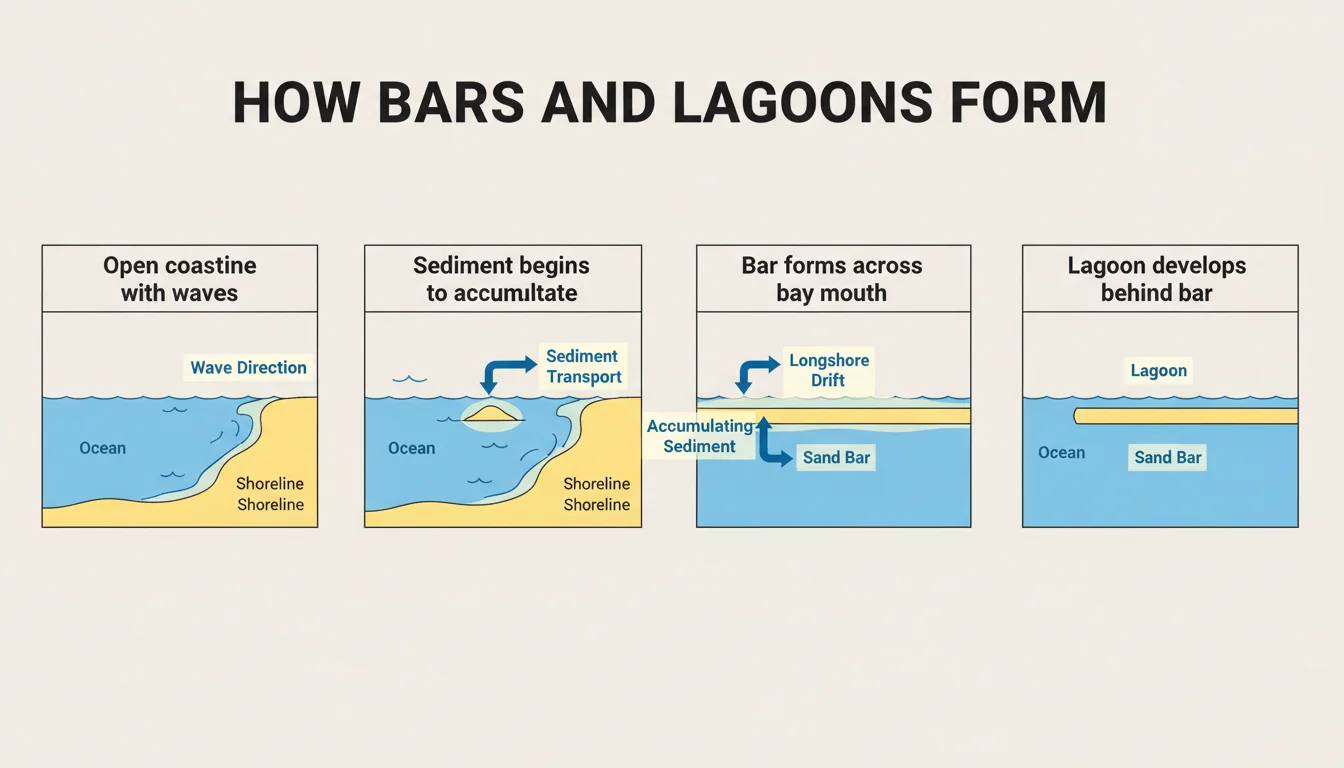
Formation Process Timeline

Checkbox Activity: Formation Factors
Which factors contribute to bar formation? ☐ Strong wave action ☐ Available sediment supply ☐ Volcanic activity ☐ Sheltered bay or inlet ☐ Consistent wind direction ☐ Deep ocean trenches Tick ALL correct answers!
Bars vs Lagoons: Key Differences
{"left":"Bars are made of sand, shingle, or pebbles\nBars form across bay mouths\nBars are created by wave action\nBars can be submerged or exposed","right":"Lagoons are bodies of shallow water\nLagoons form behind protective barriers\nLagoons have brackish or salt water\nLagoons support unique ecosystems"}

Case Study Analysis
Examine this real example: How did longshore drift create this landform? What evidence can you see of sediment transport? Predict what might happen in 100 years
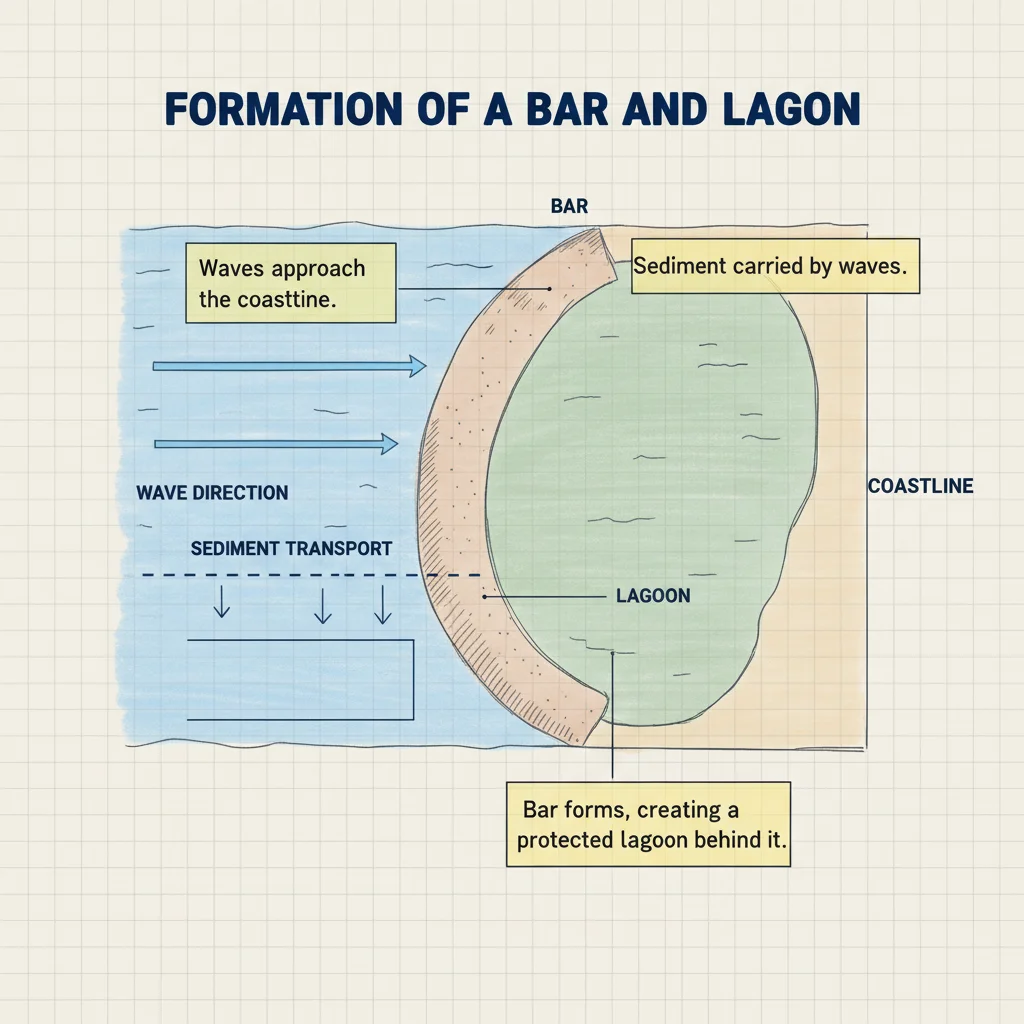
Draw and Label Challenge
In your notebooks, draw a simple diagram showing: 1. A coastal bay with incoming waves 2. Sediment being transported by longshore drift 3. A bar forming across the bay mouth 4. A lagoon developing behind the bar Include arrows showing water and sediment movement! You have 8 minutes - be creative!

Key Learning Summary
Bars and lagoons are formed by the continuous action of waves and longshore drift, creating some of our most beautiful and ecologically important coastal environments. - Understanding these processes helps us protect and manage our coastlines