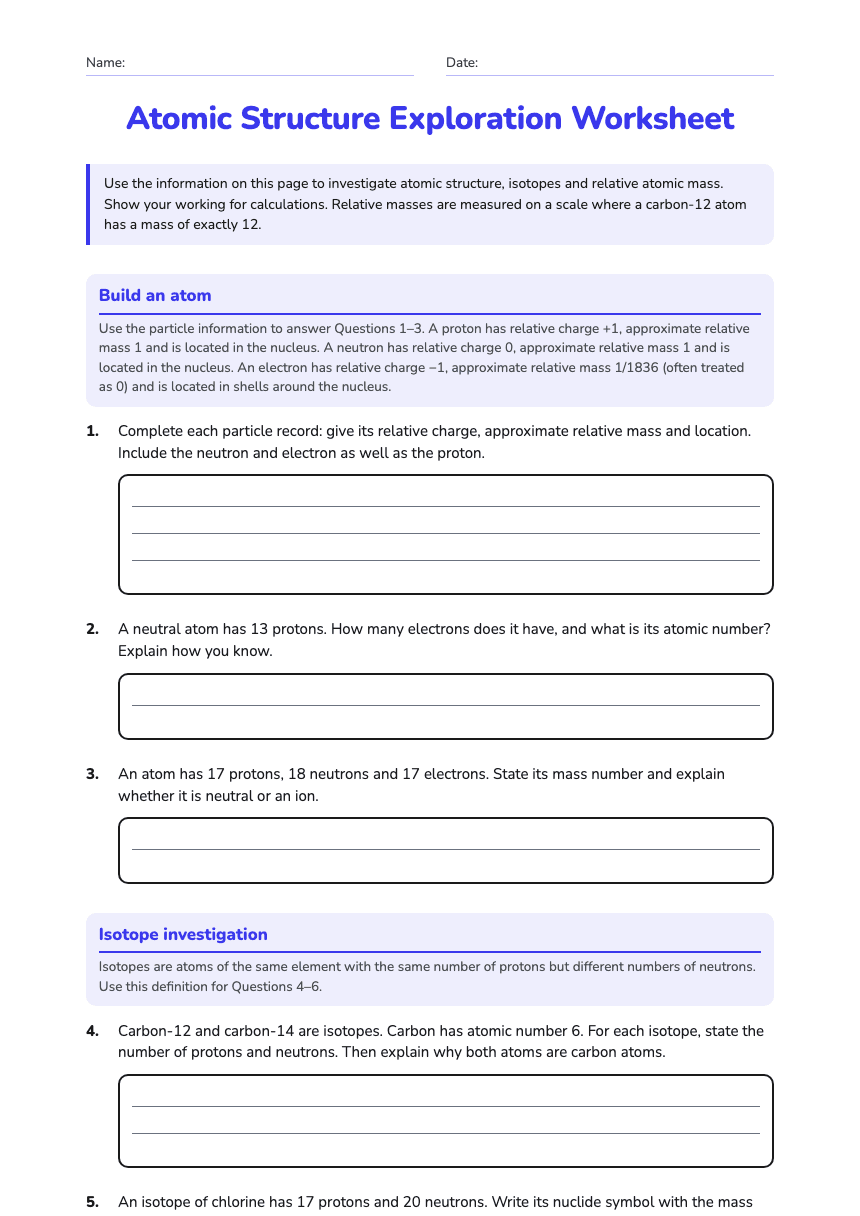
Atomic Structure Exploration Worksheet
A free science worksheet ready for your classroom. Open in Kuraplan to grab the print-ready PDF, customize it for your students, or generate a fresh version in seconds.
Atomic Structure Exploration Worksheet
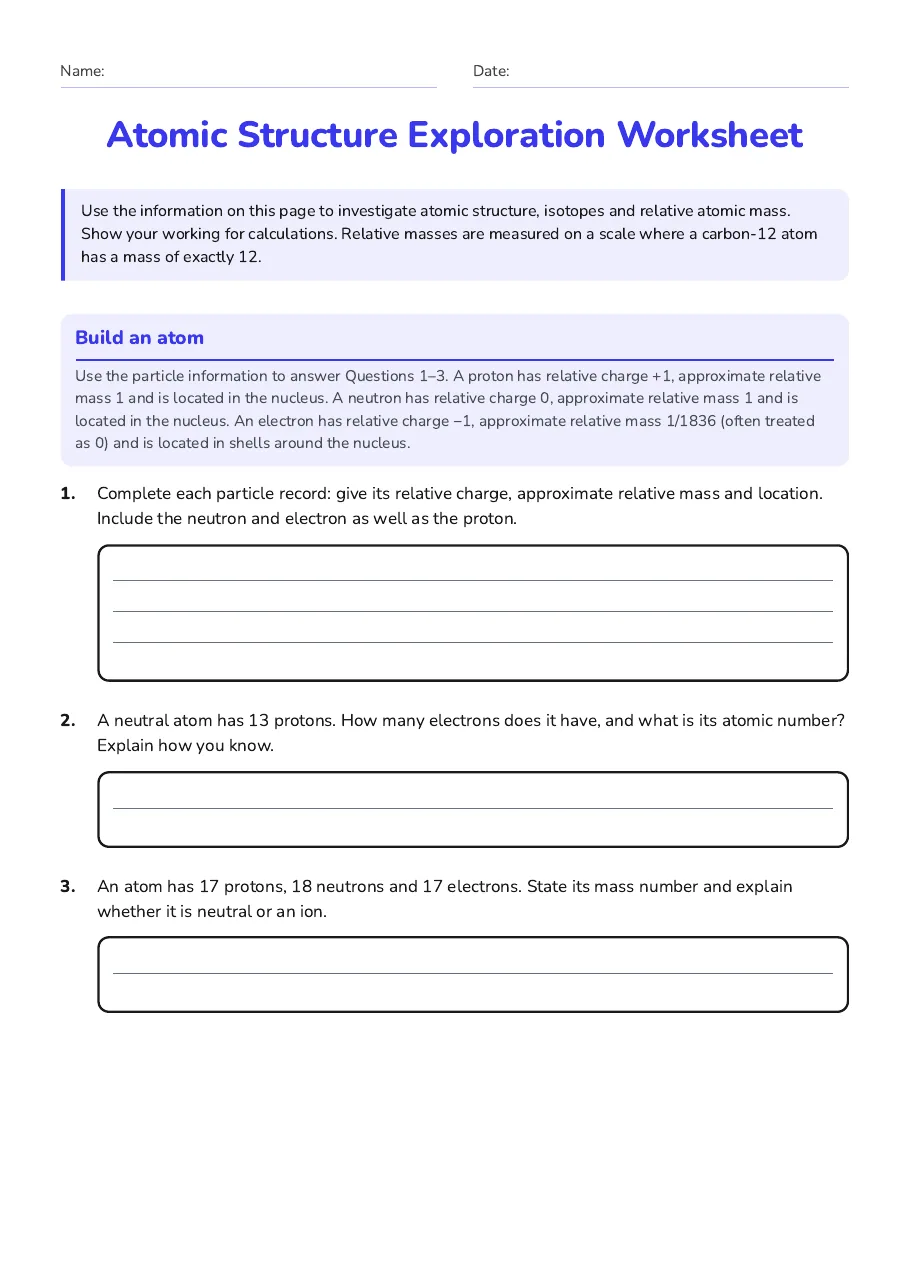
Build an atom
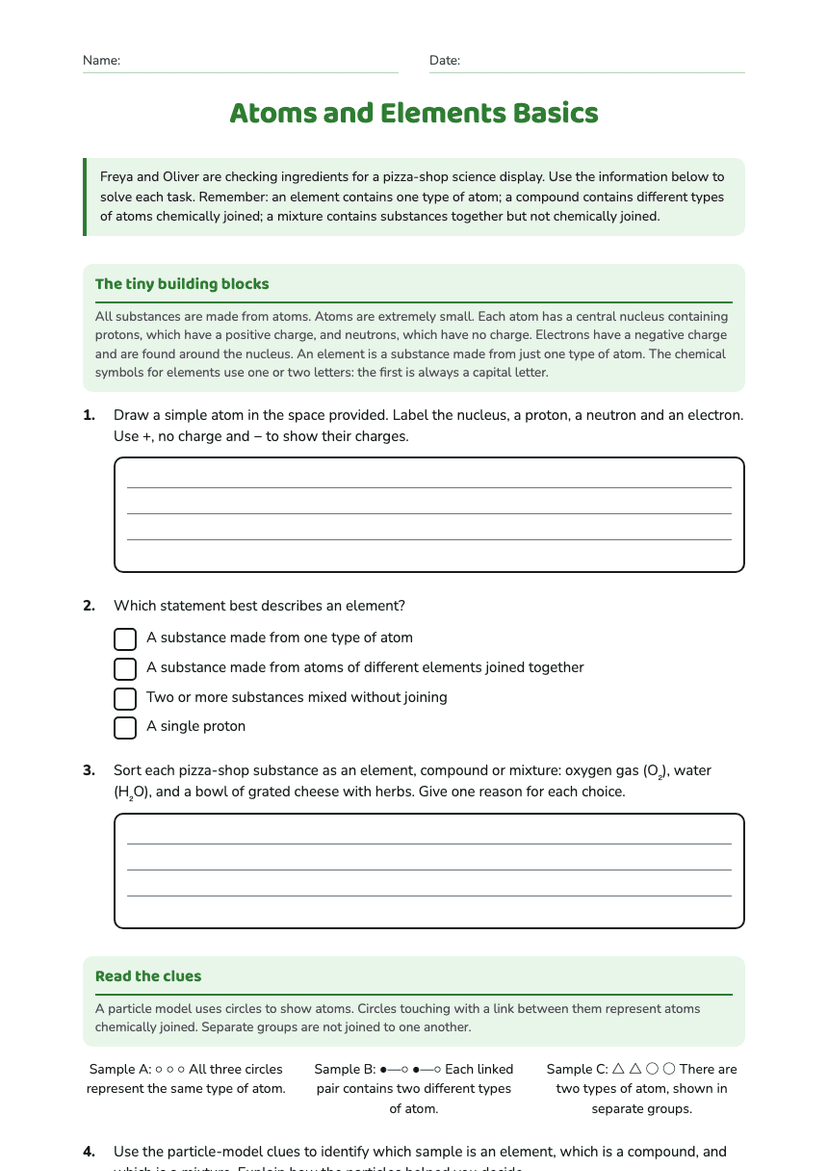
Use the particle information to answer Questions 1–3. A proton has relative charge +1, approximate relative mass 1 and is located in the nucleus. A neutron has relative charge 0, approximate relative mass 1 and is located in the nucleus. An electron has relative charge −1, approximate relative mass 1/1836 (often treated as 0) and is located in shells around the nucleus.
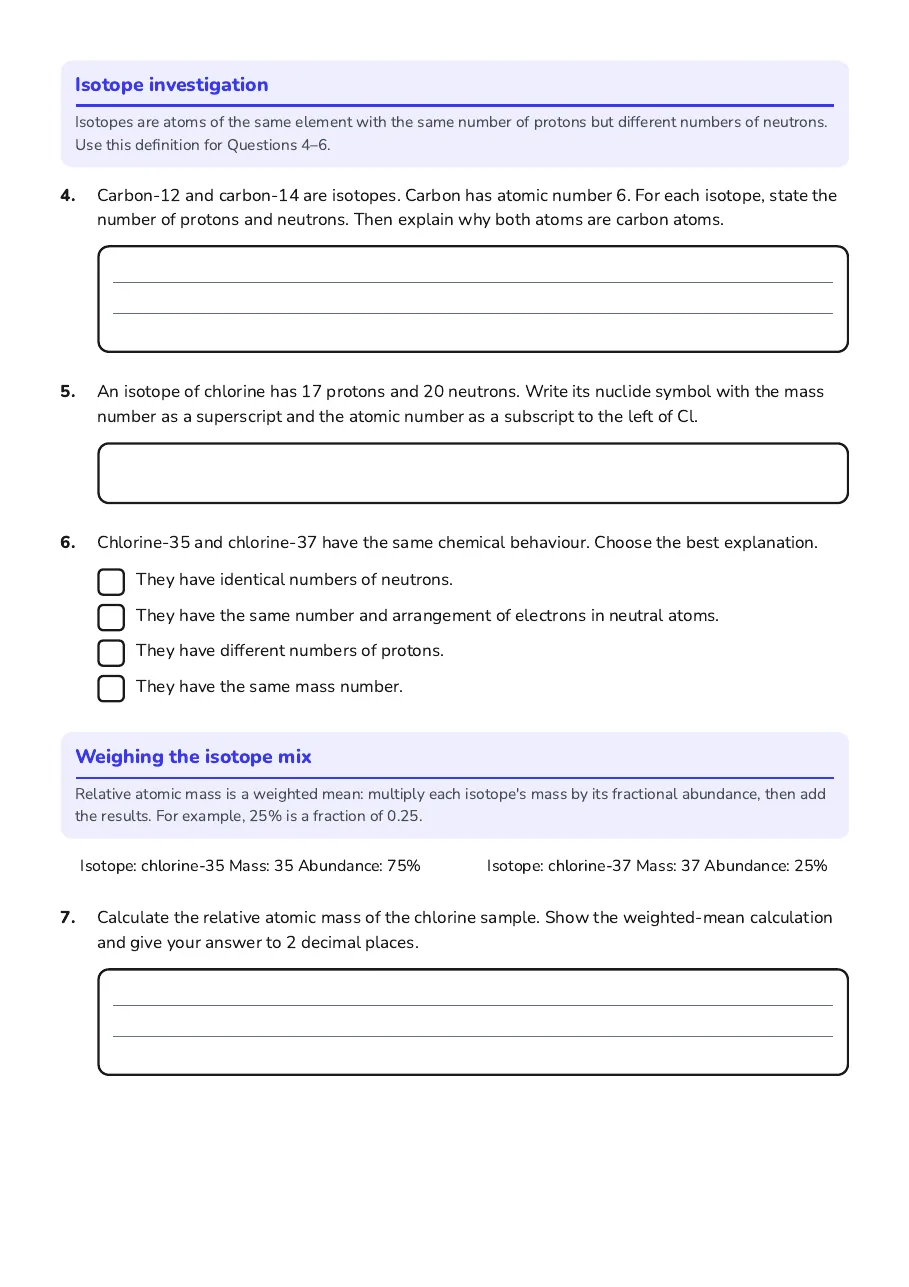
Isotope investigation
Isotopes are atoms of the same element with the same number of protons but different numbers of neutrons. Use this definition for Questions 4–6.
- They have identical numbers of neutrons.
- They have the same number and arrangement of electrons in neutral atoms.
- They have different numbers of protons.
- They have the same mass number.
Weighing the isotope mix
Relative atomic mass is a weighted mean: multiply each isotope's mass by its fractional abundance, then add the results. For example, 25% is a fraction of 0.25.
Isotope: chlorine-35 Mass: 35 Abundance: 75%
Isotope: chlorine-37 Mass: 37 Abundance: 25%
3 printable pages
Page 1
Page 2
Page 3
About This Worksheet
Free in Kuraplan
Sign up free, grab the PDF, and customize it for your class.
Print-Ready
Formatted for standard paper. Clean layout, easy to read.
AI-Generated
Created with Kuraplan's AI, designed for real classroom use.
For Teachers & Parents
Use in classrooms, for homework, tutoring, or homeschool.
Need a custom version of this worksheet?
Kuraplan's AI generates custom worksheets in seconds — differentiated for every learner, aligned to your curriculum.
Generate Custom Worksheets — Free