Cell Biology and Bioenergetics Revision Worksheet
A free science worksheet ready for your classroom. Open in Kuraplan to grab the print-ready PDF, customize it for your students, or generate a fresh version in seconds.
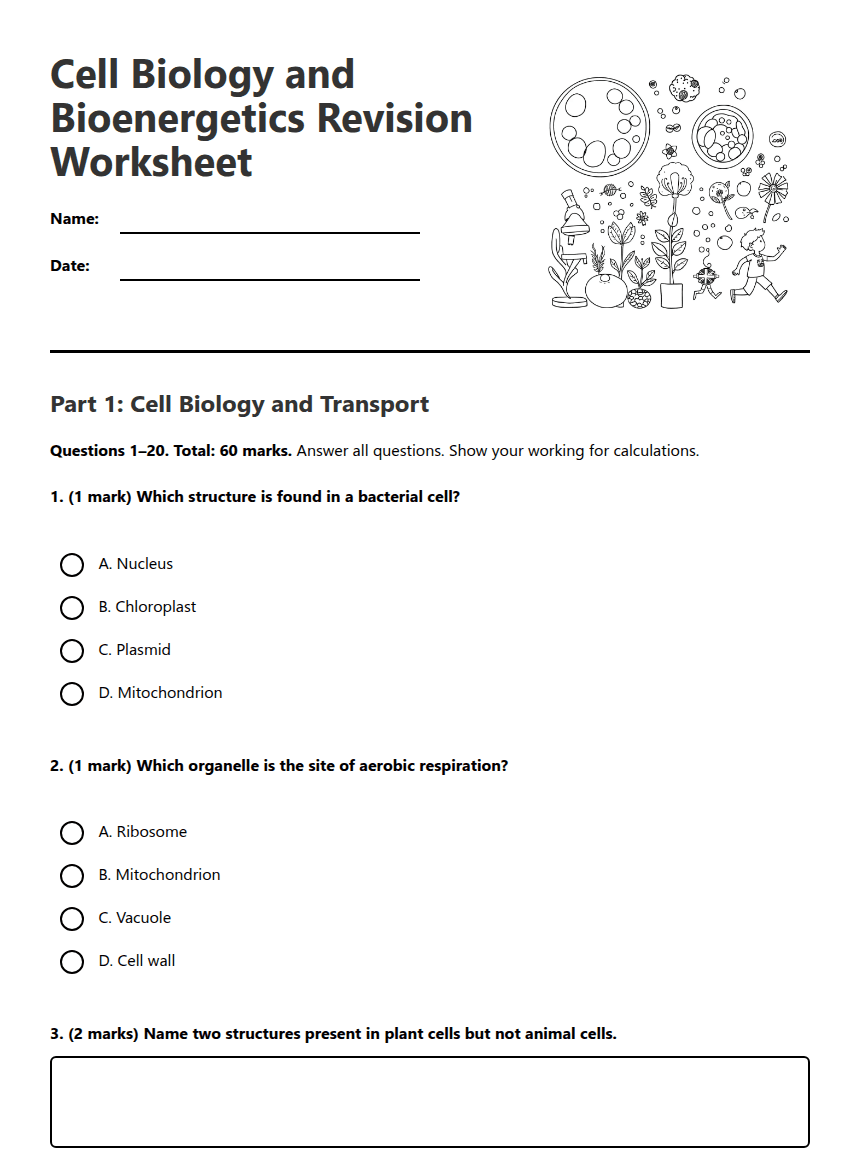
Cell Biology and Bioenergetics Revision Worksheet
Part 1: Cell Biology and Transport
Questions 1–20. Total: 60 marks. Answer all questions. Show your working for calculations.
Part 2: Cell Division, Photosynthesis and Respiration
Answer Section: Mark-Scheme-Style Answers
1. C, plasmid.
2. B, mitochondrion.
3. Any two from cell wall, chloroplasts and permanent vacuole. (1 mark each)
4. Award up to 2 marks for a suitable adaptation and linked function, for example: tail/flagellum helps it swim towards the egg; many mitochondria provide energy for movement; acrosome contains enzymes to digest the egg cell membrane.
5. C, they can differentiate into other cell types.
6. Magnification = image size ÷ actual size. 36 ÷ 0.12 = ×300. (3 marks)
7. Diffusion is the net movement of particles from high to low concentration. Osmosis is the net movement of water through a partially permeable membrane from a dilute solution to a more concentrated solution. Active transport moves substances against the concentration gradient using energy from respiration. (1 mark each)
8. Approximately 0.35 mol/dm³. The percentage change is positive at 0.2 mol/dm³ and negative at 0.4 mol/dm³, so zero change lies between these values. (3 marks)
9. Cell grows → DNA replicates → nucleus divides → cytoplasm and cell membrane divide. (2 marks)
10. Uses include treating blood disorders, replacing damaged tissue or researching diseases and medicines. A risk is rejection, uncontrolled cell division or tumour formation. (1 mark for each valid use, 1 mark for a valid risk)
11. Carbon dioxide + water → glucose + oxygen. It takes place in the chloroplasts. (3 marks)
12. Independent variable: distance from lamp/light intensity. Dependent variable: oxygen bubbles per minute/rate of photosynthesis. Control variables may include pondweed species and length, carbon dioxide concentration, temperature or volume of water. Improvement: repeat and calculate a mean, count oxygen volume instead of bubbles, or allow the plant to acclimatise. (4 marks)
13. A limiting factor is a factor that, when in short supply, limits the rate of photosynthesis. Increasing light intensity increases the rate because more light energy is available. The rate eventually becomes constant when another factor, such as carbon dioxide concentration or temperature, becomes limiting. (4 marks)
14. To destarch the plant by using up stored starch in respiration. This ensures that any starch detected was produced during the investigation by photosynthesis. (3 marks)
15. Aerobic respiration uses glucose and oxygen and produces carbon dioxide and water. It releases more energy. Anaerobic respiration in muscles does not use oxygen, produces lactic acid and releases less energy. (4 marks)
16. Faster breathing increases oxygen intake and removes carbon dioxide. A faster heart rate increases blood flow to muscles, delivering more oxygen and glucose for aerobic respiration and removing waste products. (3 marks)
17. During vigorous exercise, the oxygen supply may be insufficient, so muscles respire anaerobically and lactic acid builds up. Oxygen debt is the extra oxygen needed after exercise to remove the lactic acid. Increased breathing and heart rate supply this oxygen; the liver converts lactic acid into carbon dioxide and water. (4 marks)
18. Any three from growth, active transport, movement, building larger molecules, cell division, temperature regulation or keeping organs functioning. (1 mark each)
19. Carbon dioxide is limiting between 0.02% and 0.08%, so increasing its concentration increases the rate. Above 0.08%, another factor becomes limiting, so the rate stays constant. (4 marks)
20. Large surface area provides more light and allows efficient gas exchange. Thin leaves give a short diffusion distance. Palisade cells contain many chloroplasts to absorb light. Stomata allow carbon dioxide in and oxygen out. Veins transport water in the xylem and sugars away in the phloem. (4 marks)
About This Worksheet
Free in Kuraplan
Sign up free, grab the PDF, and customize it for your class.
Print-Ready
Formatted for standard paper. Clean layout, easy to read.
AI-Generated
Created with Kuraplan's AI, designed for real classroom use.
For Teachers & Parents
Use in classrooms, for homework, tutoring, or homeschool.
Need a custom version of this worksheet?
Kuraplan's AI generates custom worksheets in seconds — differentiated for every learner, aligned to your curriculum.
Generate Custom Worksheets — Free