ScienceFreePrintable
Imaginary Ecosystem Design
A free science worksheet ready for your classroom. Open in Kuraplan to grab the print-ready PDF, customize it for your students, or generate a fresh version in seconds.
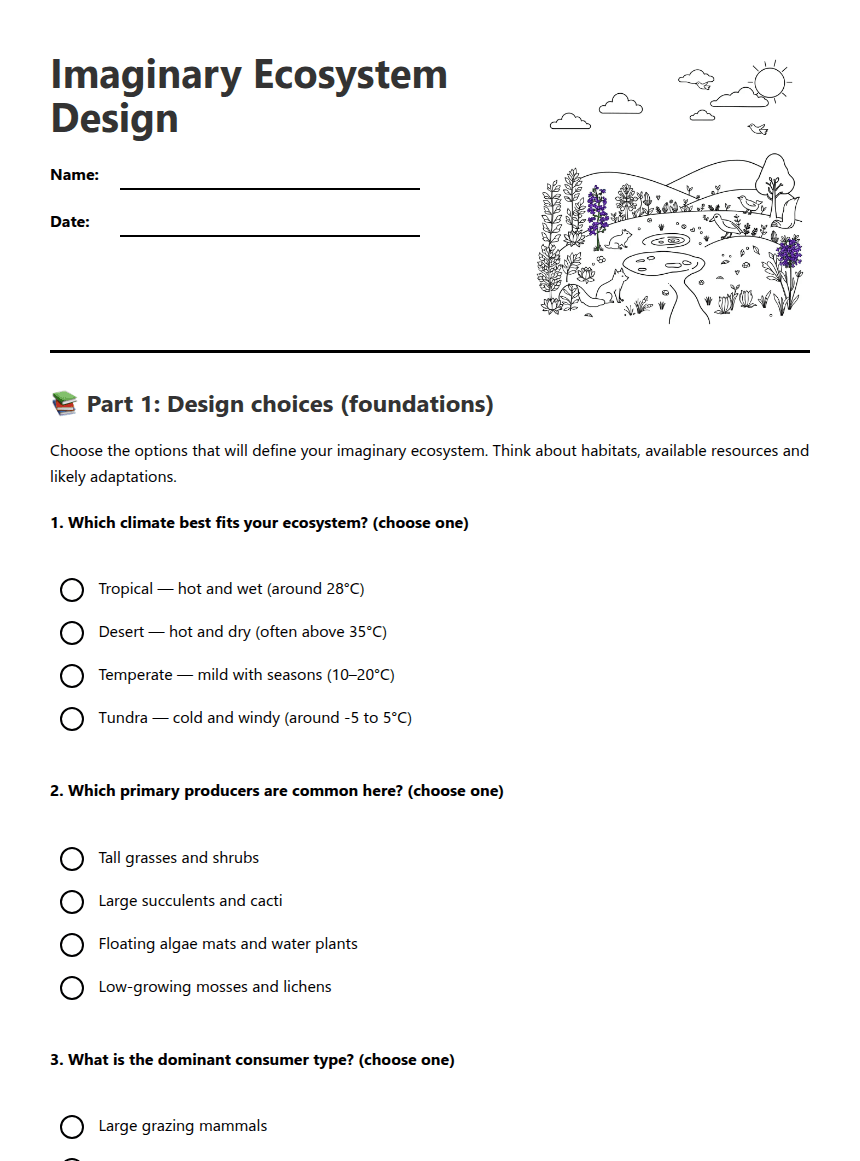
Imaginary Ecosystem Design
📚 Part 1: Design choices (foundations)
Choose the options that will define your imaginary ecosystem. Think about habitats, available resources and likely adaptations.
1. Which climate best fits your ecosystem? (choose one)
Tropical — hot and wet (around 28°C)
Desert — hot and dry (often above 35°C)
Temperate — mild with seasons (10–20°C)
Tundra — cold and windy (around -5 to 5°C)
2. Which primary producers are common here? (choose one)
Tall grasses and shrubs
Large succulents and cacti
Floating algae mats and water plants
Low-growing mosses and lichens
3. What is the dominant consumer type? (choose one)
Large grazing mammals
Small insectivorous animals
Flying predators (birds/bats)
Giant herbivorous insects
4. Main water source for your ecosystem? (choose one)
Year-round river or lake
Seasonal rainfall and ponds
Underground springs / aquifer
Frequent fog or dew as moisture
5. Which adaptations will be important in your ecosystem? (tick any that apply)
Water storage (e.g. fat, succulent tissues)
Camouflage or disruptive colour patterns
Insulating coverings (fur, feathers, blubber)
Wings or gliding for travel
Climbing or burrowing ability
✏️ Part 2: Explain and link to science
6. Give your ecosystem a name:
7. Describe the climate in one clear sentence (include temperature and water availability):
8. Write a simple food chain of three organisms from your design (producer → consumer → top consumer) and explain briefly how energy moves between them:
9. Choose one animal in your ecosystem. Describe one adaptation it has and explain how that adaptation helps it survive:
10. List two potential threats to your ecosystem and one action to protect it (link to conservation ideas from habitats and adaptations):
🎨 Part 3: Creative activity
11. Draw and label a sketch of your ecosystem. Include at least: one producer, two consumers, and a water source. Label adaptations you used.
12. Reflection — In 3–4 sentences explain how your chosen climate, organisms and adaptations work together to keep the ecosystem balanced (mention competition, predation or resource limits):
About This Worksheet
Free in Kuraplan
Sign up free, grab the PDF, and customize it for your class.
Print-Ready
Formatted for standard paper. Clean layout, easy to read.
AI-Generated
Created with Kuraplan's AI, designed for real classroom use.
For Teachers & Parents
Use in classrooms, for homework, tutoring, or homeschool.
Need a custom version of this worksheet?
Kuraplan's AI generates custom worksheets in seconds — differentiated for every learner, aligned to your curriculum.
Generate Custom Worksheets — Free No credit card Curriculum-aligned Under 60 seconds
More Science Worksheets
Year 11
Nitrogen Cycle Worksheets
Free
Year 2
Animal Habitats and Adaptations
Free
Year 11
Biotic and Abiotic Factors
Free
Year 8
Food Chains Worksheet
Free
Year 9
Rainforest vs Desert Comparison
Free
Year 7
Ecosystem Explorer Worksheet
Free
Year 11
Interactive Ecosystem Mapping
Free
Year 10