ScienceFreePrintable

Molecular Structure Exploration

A free science worksheet ready for your classroom. Open in Kuraplan to grab the print-ready PDF, customize it for your students, or generate a fresh version in seconds.
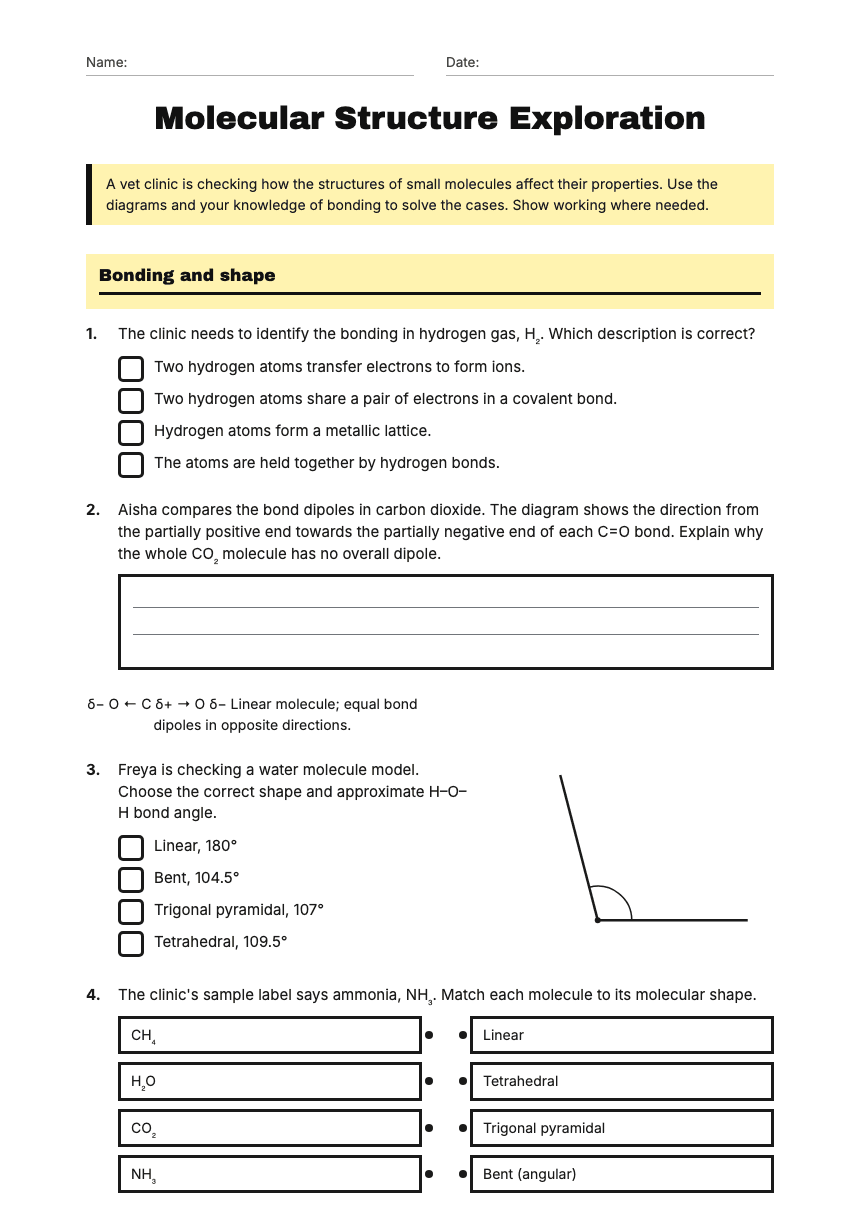
Molecular Structure Exploration worksheet preview
Name:Date:

Molecular Structure Exploration

A vet clinic is checking how the structures of small molecules affect their properties. Use the diagrams and your knowledge of bonding to solve the cases. Show working where needed.

Bonding and shape

1.The clinic needs to identify the bonding in hydrogen gas, H₂. Which description is correct?
  • Two hydrogen atoms transfer electrons to form ions.
  • Two hydrogen atoms share a pair of electrons in a covalent bond.
  • Hydrogen atoms form a metallic lattice.
  • The atoms are held together by hydrogen bonds.
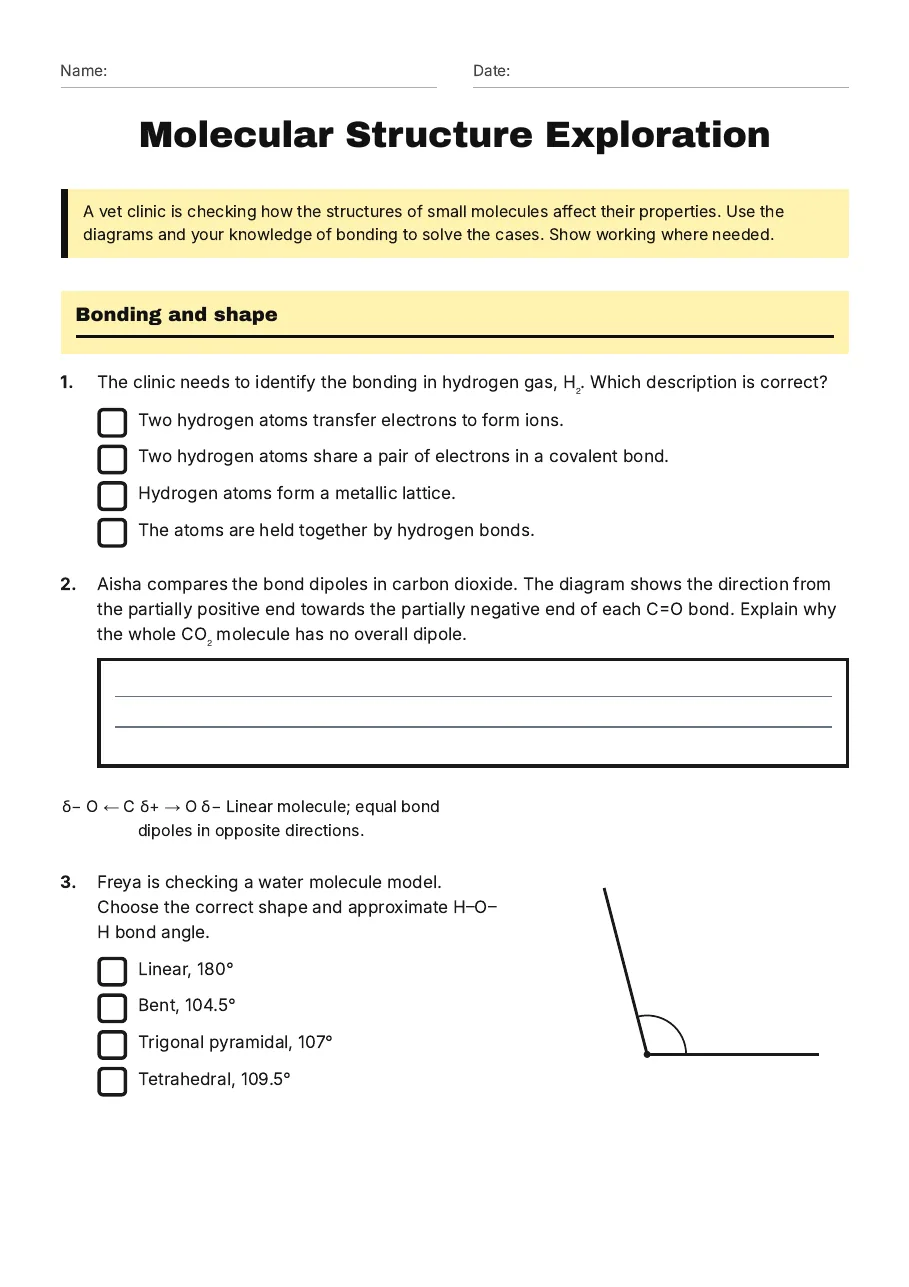
2.Aisha compares the bond dipoles in carbon dioxide. The diagram shows the direction from the partially positive end towards the partially negative end of each C=O bond. Explain why the whole CO₂ molecule has no overall dipole.

δ− O ← C δ+ → O δ− Linear molecule; equal bond dipoles in opposite directions.

3.Freya is checking a water molecule model. Choose the correct shape and approximate H–O–H bond angle.
  • Linear, 180°
  • Bent, 104.5°
  • Trigonal pyramidal, 107°
  • Tetrahedral, 109.5°
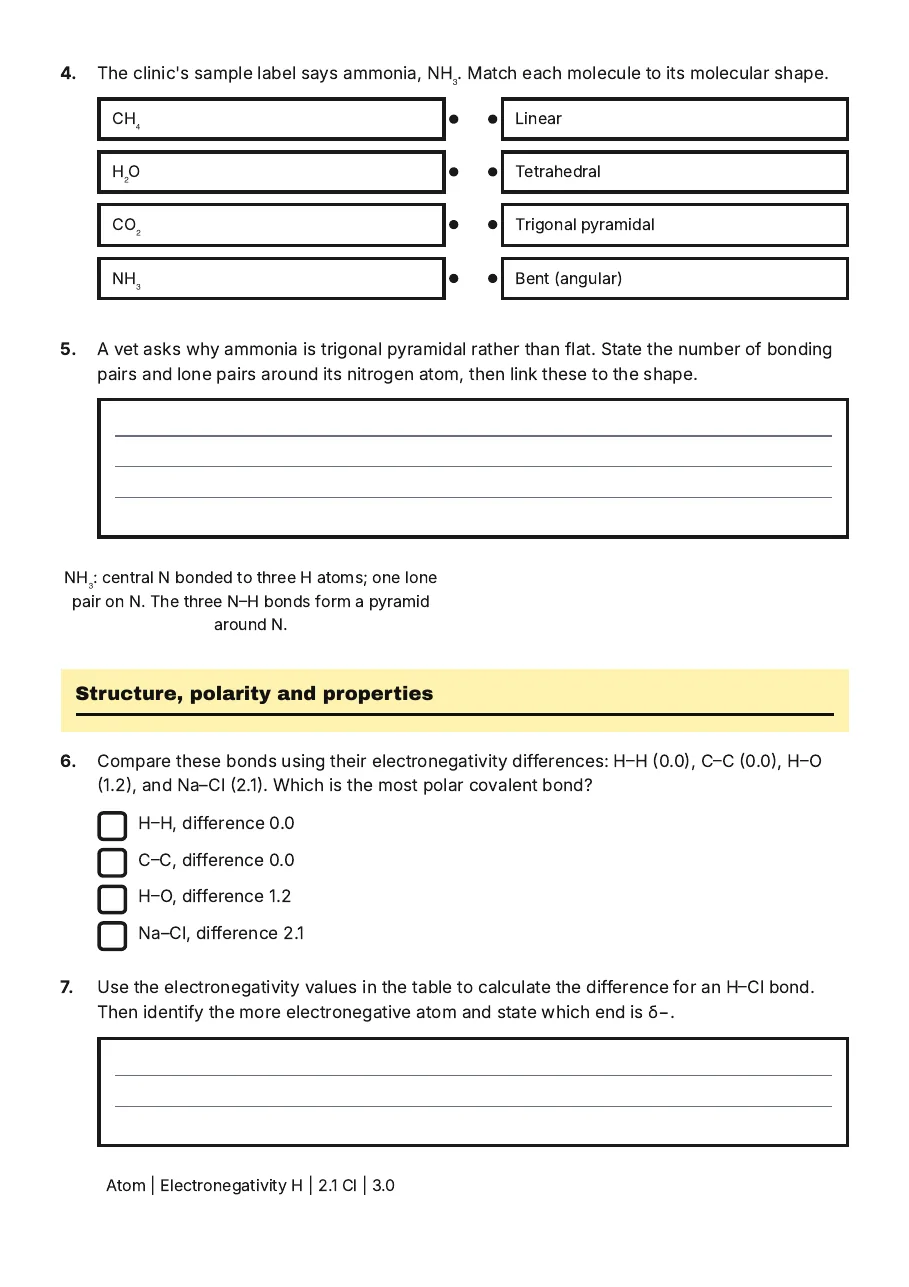
4.The clinic's sample label says ammonia, NH₃. Match each molecule to its molecular shape.
  • CH₄
  • H₂O
  • CO₂
  • NH₃
  • Linear
  • Tetrahedral
  • Trigonal pyramidal
  • Bent (angular)
5.A vet asks why ammonia is trigonal pyramidal rather than flat. State the number of bonding pairs and lone pairs around its nitrogen atom, then link these to the shape.

NH₃: central N bonded to three H atoms; one lone pair on N. The three N–H bonds form a pyramid around N.

Structure, polarity and properties

6.Compare these bonds using their electronegativity differences: H–H (0.0), C–C (0.0), H–O (1.2), and Na–Cl (2.1). Which is the most polar covalent bond?
  • H–H, difference 0.0
  • C–C, difference 0.0
  • H–O, difference 1.2
  • Na–Cl, difference 2.1
7.Use the electronegativity values in the table to calculate the difference for an H–Cl bond. Then identify the more electronegative atom and state which end is δ−.

Atom | Electronegativity H | 2.1 Cl | 3.0

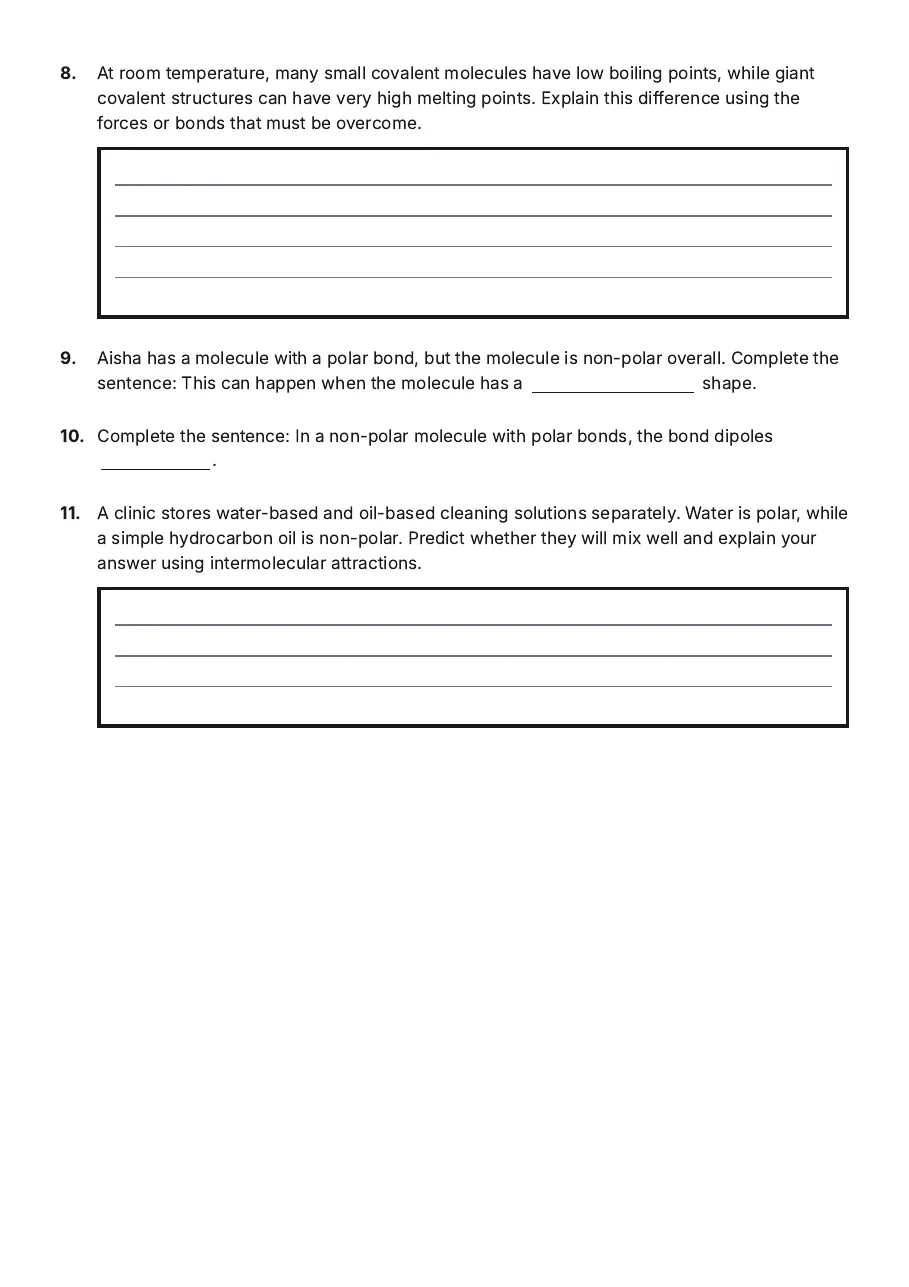
8.At room temperature, many small covalent molecules have low boiling points, while giant covalent structures can have very high melting points. Explain this difference using the forces or bonds that must be overcome.
9.Aisha has a molecule with a polar bond, but the molecule is non-polar overall. Complete the sentence: This can happen when the molecule has a shape.
10.Complete the sentence: In a non-polar molecule with polar bonds, the bond dipoles .
11.A clinic stores water-based and oil-based cleaning solutions separately. Water is polar, while a simple hydrocarbon oil is non-polar. Predict whether they will mix well and explain your answer using intermolecular attractions.

3 printable pages

  • Molecular Structure Exploration, page 1 of 3: Bonding and shape

    Page 1

  • Molecular Structure Exploration, page 2 of 3: Structure, polarity and properties

    Page 2

  • Molecular Structure Exploration, page 3 of 3: 8. At room temperature, many small covalent molecules have low boiling points, while giant

    Page 3

About This Worksheet

Free in Kuraplan

Sign up free, grab the PDF, and customize it for your class.

Print-Ready

Formatted for standard paper. Clean layout, easy to read.

AI-Generated

Created with Kuraplan's AI, designed for real classroom use.

For Teachers & Parents

Use in classrooms, for homework, tutoring, or homeschool.

Need a custom version of this worksheet?

Kuraplan's AI generates custom worksheets in seconds — differentiated for every learner, aligned to your curriculum.

Generate Custom Worksheets — Free
No credit card Curriculum-aligned Under 60 seconds