ScienceFreePrintable
Understanding Reaction Rates
A free science worksheet ready for your classroom. Open in Kuraplan to grab the print-ready PDF, customize it for your students, or generate a fresh version in seconds.
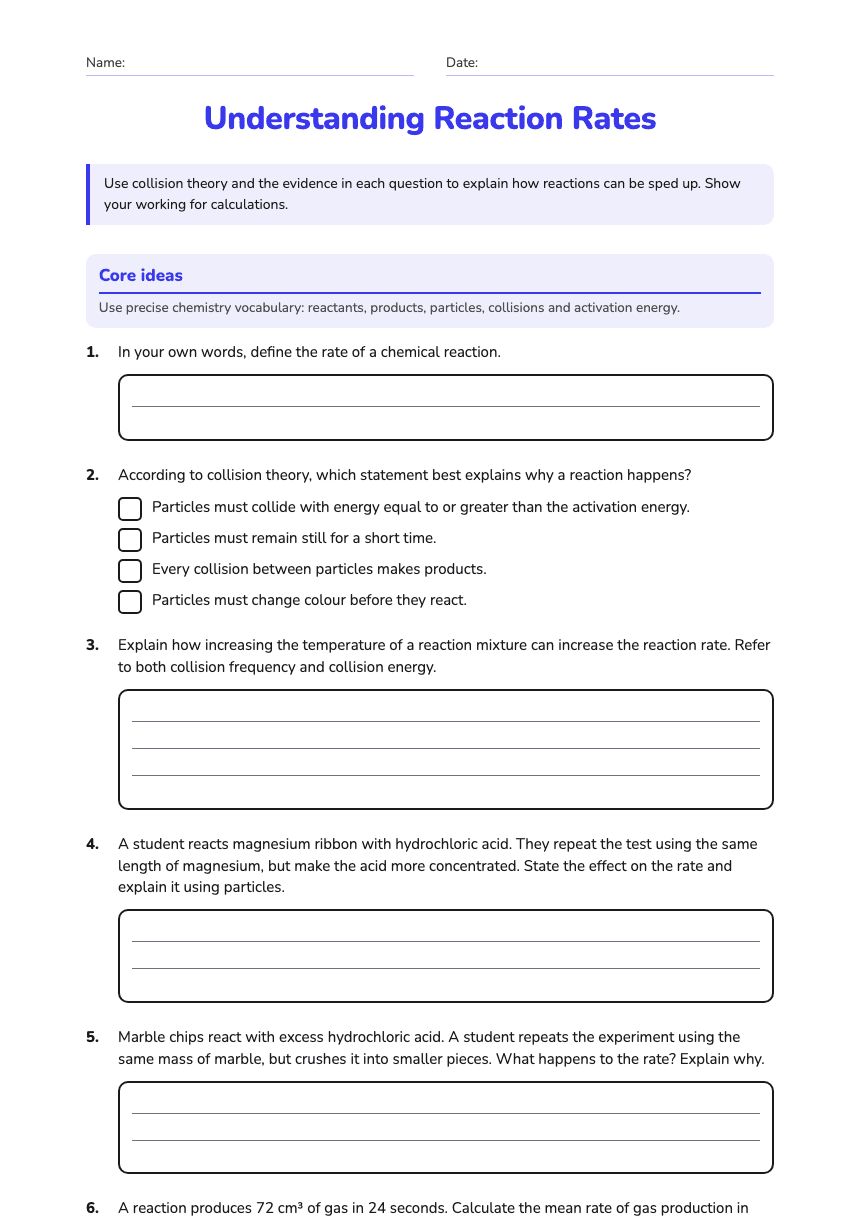
Name:Date:
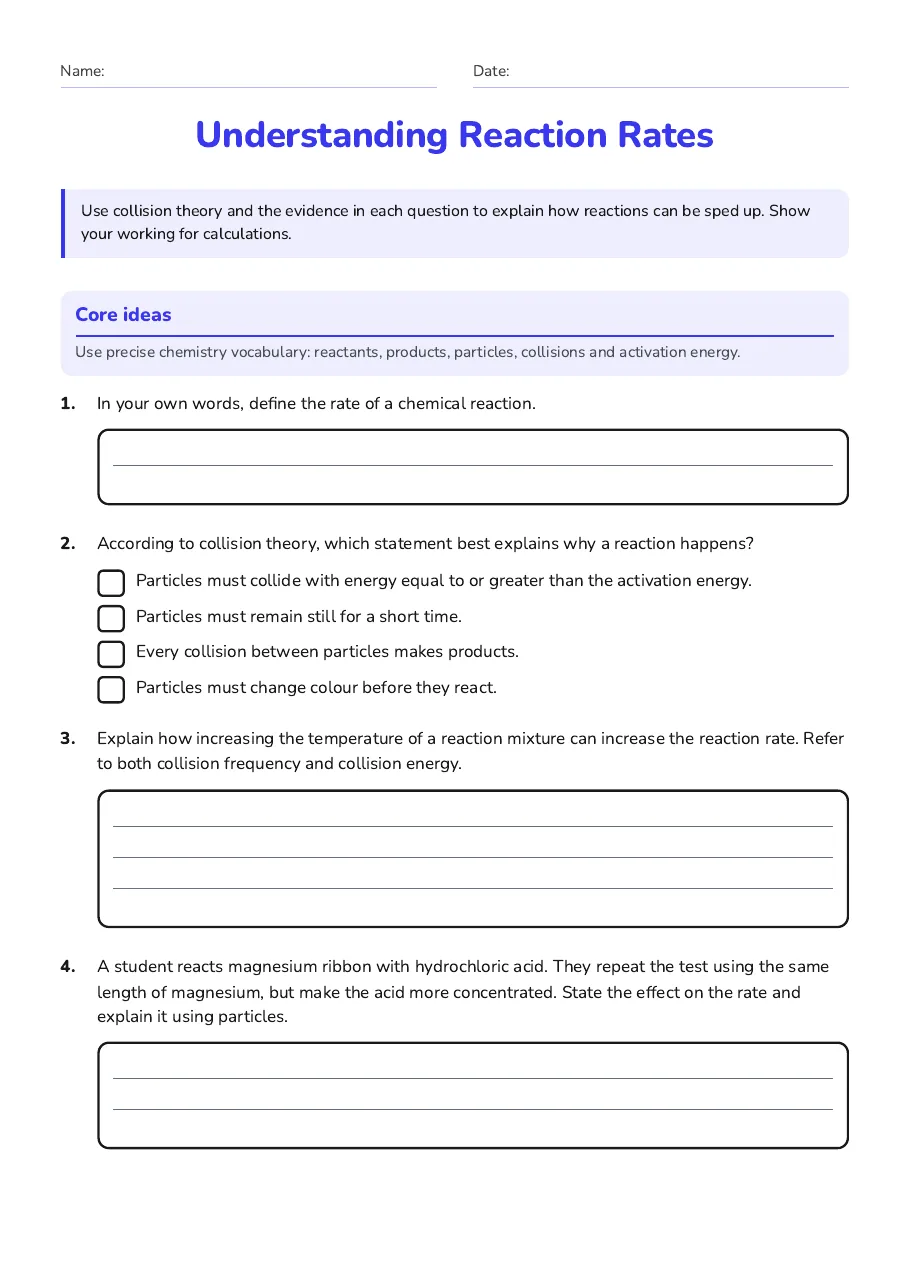
Understanding Reaction Rates
Use collision theory and the evidence in each question to explain how reactions can be sped up. Show your working for calculations.
Core ideas
Use precise chemistry vocabulary: reactants, products, particles, collisions and activation energy.
1.In your own words, define the rate of a chemical reaction.
2.According to collision theory, which statement best explains why a reaction happens?
- Particles must collide with energy equal to or greater than the activation energy.
- Particles must remain still for a short time.
- Every collision between particles makes products.
- Particles must change colour before they react.
3.Explain how increasing the temperature of a reaction mixture can increase the reaction rate. Refer to both collision frequency and collision energy.
4.A student reacts magnesium ribbon with hydrochloric acid. They repeat the test using the same length of magnesium, but make the acid more concentrated. State the effect on the rate and explain it using particles.
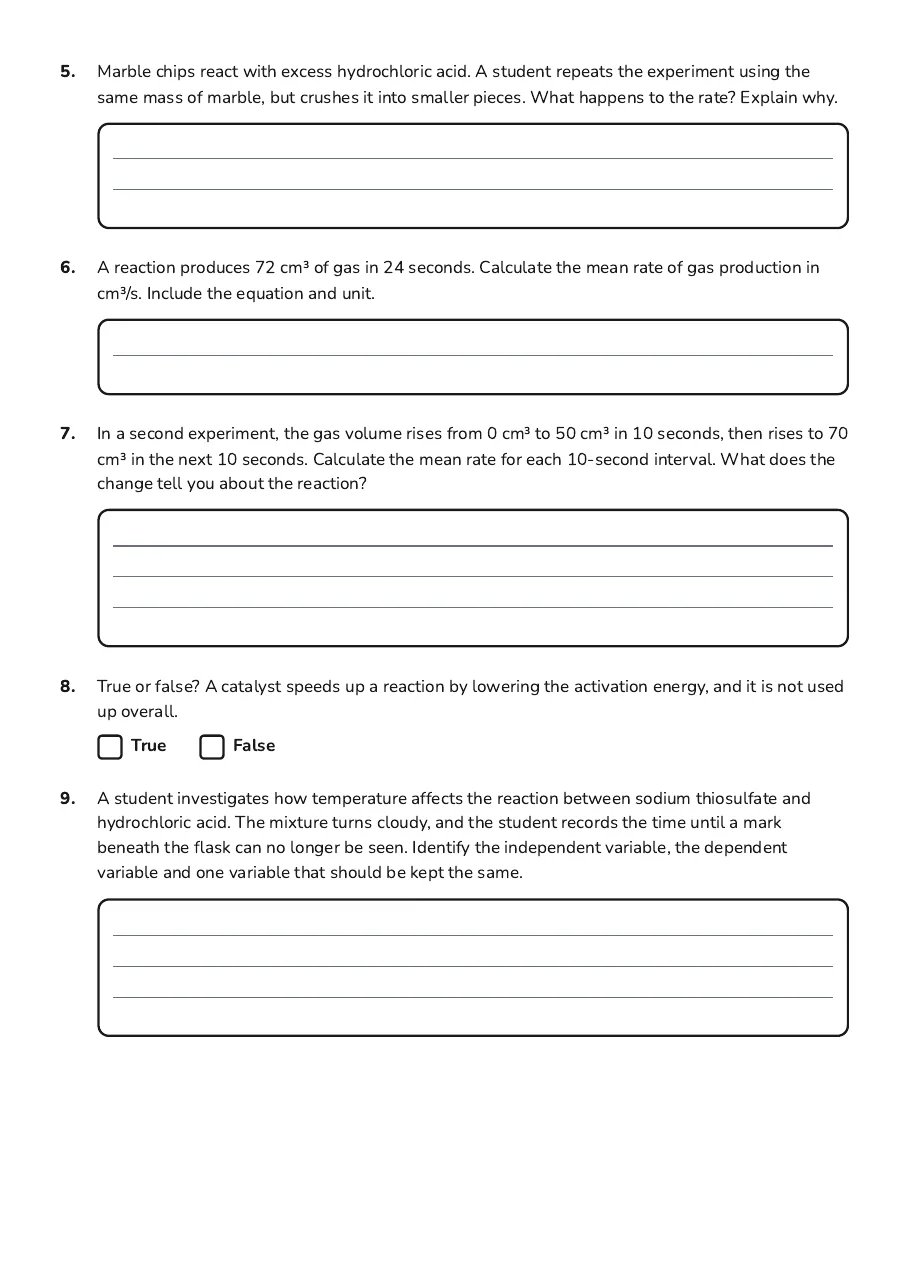
5.Marble chips react with excess hydrochloric acid. A student repeats the experiment using the same mass of marble, but crushes it into smaller pieces. What happens to the rate? Explain why.
6.A reaction produces 72 cm³ of gas in 24 seconds. Calculate the mean rate of gas production in cm³/s. Include the equation and unit.
7.In a second experiment, the gas volume rises from 0 cm³ to 50 cm³ in 10 seconds, then rises to 70 cm³ in the next 10 seconds. Calculate the mean rate for each 10-second interval. What does the change tell you about the reaction?
8.True or false? A catalyst speeds up a reaction by lowering the activation energy, and it is not used up overall.
TrueFalse
9.A student investigates how temperature affects the reaction between sodium thiosulfate and hydrochloric acid. The mixture turns cloudy, and the student records the time until a mark beneath the flask can no longer be seen. Identify the independent variable, the dependent variable and one variable that should be kept the same.
10.A food manufacturer wants a reaction in a production process to happen faster. Choose two different ways to increase the rate and explain how each changes the number of successful collisions per second.
3 printable pages
Page 1
Page 2
Page 3
About This Worksheet
Free in Kuraplan
Sign up free, grab the PDF, and customize it for your class.
Print-Ready
Formatted for standard paper. Clean layout, easy to read.
AI-Generated
Created with Kuraplan's AI, designed for real classroom use.
For Teachers & Parents
Use in classrooms, for homework, tutoring, or homeschool.
Need a custom version of this worksheet?
Kuraplan's AI generates custom worksheets in seconds — differentiated for every learner, aligned to your curriculum.
Generate Custom Worksheets — Free No credit card Curriculum-aligned Under 60 seconds