You’re probably here because a student handed in an “informative report” that sounded more like a debate speech.
I’ve seen that version many times. The topic looks fine at first glance, the structure seems school-ish, and then you read a line like, “Recess is obviously the most important part of school and everyone knows kids need more of it.” That’s not informative writing. That’s opinion wearing a report costume.
That confusion is common, and it’s one reason teaching this mode matters so much. Informative writing asks students to explain, describe, clarify, or teach using facts and relevant evidence rather than persuasion. In U.S. schools, that expectation isn’t optional. The Common Core State Standards require informative and explanatory writing across K-12, and a 2019 NAEP report summarized here found that 27% of 8th graders were proficient in writing, with informative tasks making up 40% of the assessment.
That gap tells me two things. First, students need far more practice than many of us can squeeze into a crowded week. Second, teachers need materials that are clear, repeatable, and easy to adapt. If you’re building those from scratch every time, even a simple lesson plan template for writing instruction can help you organize mini-lessons, mentor texts, and assessment checkpoints before the unit starts drifting.
Your Starting Point for Teaching Informative Writing
A lot of students don’t struggle because they have nothing to say. They struggle because they don’t yet understand what kind of saying the assignment requires.
When teachers ask students to “write about” a topic, many kids default to one of two modes. They either tell a story, or they argue. Both feel natural. Informative writing is trickier because it asks for restraint. Students have to stay focused on helping the reader understand something.
The confusion teachers see most often
Here’s the pattern I notice across grade levels:
- Students insert opinions too quickly: They move from “what is” to “what should be.”
- They use loaded words: Terms like best, worst, amazing, terrible, and obviously push the piece toward argument.
- They think facts alone are enough: A list of disconnected details isn’t informative writing unless the details are explained and organized.
Practical rule: If the reader finishes the piece knowing more, not feeling pushed, the writing is probably informative.
That distinction matters far beyond ELA class. Students need it in science explanations, social studies reports, health writing, technical directions, and even short responses on assessments.
Why this skill deserves direct instruction
Informative writing teaches students to sort information, define terms, explain processes, and present evidence clearly. That’s the work of school, but it’s also the work of everyday life. Students read articles, captions, instructions, charts, and reports constantly. They need practice producing that kind of writing too.
Teachers sometimes assume students will “pick it up” if they read enough nonfiction. Some do. Many don’t. They need explicit modeling, especially around tone, word choice, and structure.
A useful starting point is simple language:
- Informative writing explains
- Argumentative writing convinces
- Narrative writing tells a story
Once students hear that language often enough, they start to self-correct. You’ll hear them say things like, “Oh, I’m persuading here,” or “This sounds more like a story.” That’s when the instruction starts to stick.
What Exactly Is Informative Writing
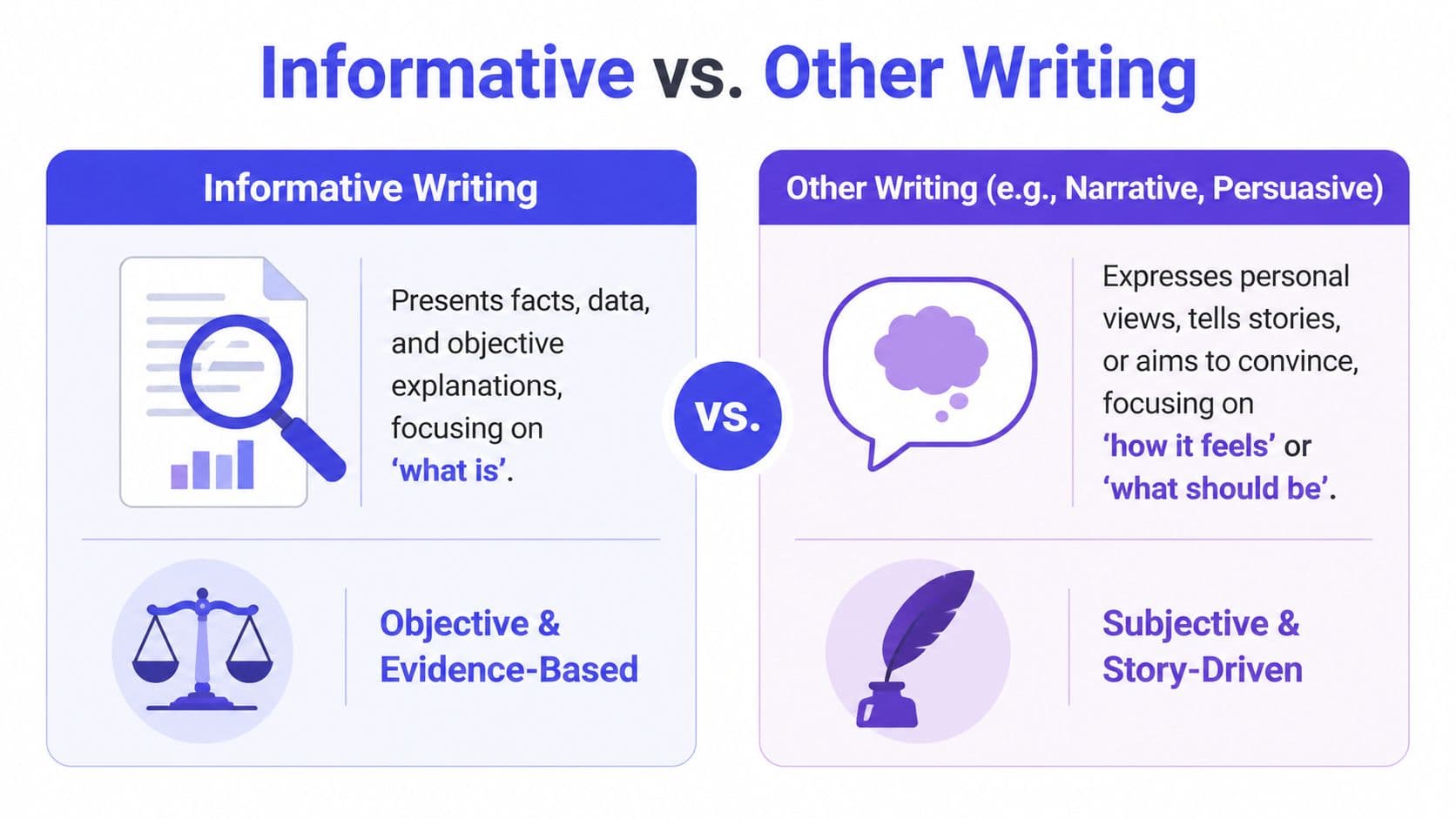
Informative writing is nonfiction writing that teaches the reader about a topic using facts, relevant details, and clear explanations. It’s also often called expository writing. Its job is not to win an argument. Its job is to help the reader understand.
One classroom analogy works especially well. Informative writing is the difference between a reporter and an opinion columnist. The reporter explains what happened, gives background, and uses evidence. The opinion columnist takes a position and tries to persuade the audience.
A working definition teachers can use
I usually give students a version like this:
Informative writing explains a topic clearly by using facts, examples, and details so the reader can learn something.
That definition is short enough to remember and strong enough to guide revision.
According to this overview of informative writing, informative writing is also known as expository writing, and its goal is to convey facts and increase reader knowledge without persuasion. The same source notes a Princeton study finding that integrating concrete examples improved student comprehension by 72%. That tracks with what we see in classrooms. Students understand “ecosystem” better when the writer gives a real example, not just a dictionary-style sentence.
What informative writing is and isn’t
Students usually need the contrast spelled out. A side-by-side table helps.
| Attribute | Informative Writing | Persuasive Writing | Narrative Writing |
|---|---|---|---|
| Purpose | Explain or teach | Convince the reader | Tell a story |
| Main focus | Facts, details, explanations | Claims, reasons, evidence for a position | Characters, events, plot |
| Tone | Neutral and clear | Strong, convincing, opinion-aware | Descriptive, voice-driven |
| Writer’s role | Expert guide | Advocate | Storyteller |
| Common features | Definitions, examples, facts, headings, explanations | Thesis, argument, counterargument, call to action | Setting, dialogue, sequence, conflict |
| Example prompt | Explain how volcanoes form | Should students wear uniforms? | Write about a time you felt brave |
A plain example students can hear
Take the topic of Morse code.
- Informative version: Morse code is a communication system that uses dots and dashes to represent letters and numbers. It has historical use in telegraphy and still appears in specialized communication contexts. For a real-world example, this explainer on modern uses of Morse code gives students a topic they can investigate without turning the piece into an opinion essay.
- Persuasive version: Morse code should be taught in every school because it’s more useful than people think.
- Narrative version: I was camping with my grandfather when he tapped a strange pattern onto the table.
Same topic. Different writing mode.
Where students get tripped up
A student can include facts and still miss the mark. Why? Because informative writing isn’t just about having information. It’s about organizing and explaining information.
Watch for these common misunderstandings:
- “No opinions” doesn’t mean “boring.” Strong informative writing can still sound lively.
- “Use facts” doesn’t mean “dump research.” Facts need context.
- “Be formal” doesn’t mean “use big words.” Clear beats fancy every time.
If you want students to define informative writing accurately, give them models and non-models. Read both aloud. Ask, “Is this trying to teach me, convince me, or tell me a story?” That single question clears up a lot.
The Building Blocks of Strong Informative Writing
Once students can define informative writing, the next hurdle is quality. They may understand the assignment and still produce writing that feels fuzzy, biased, or hard to follow.
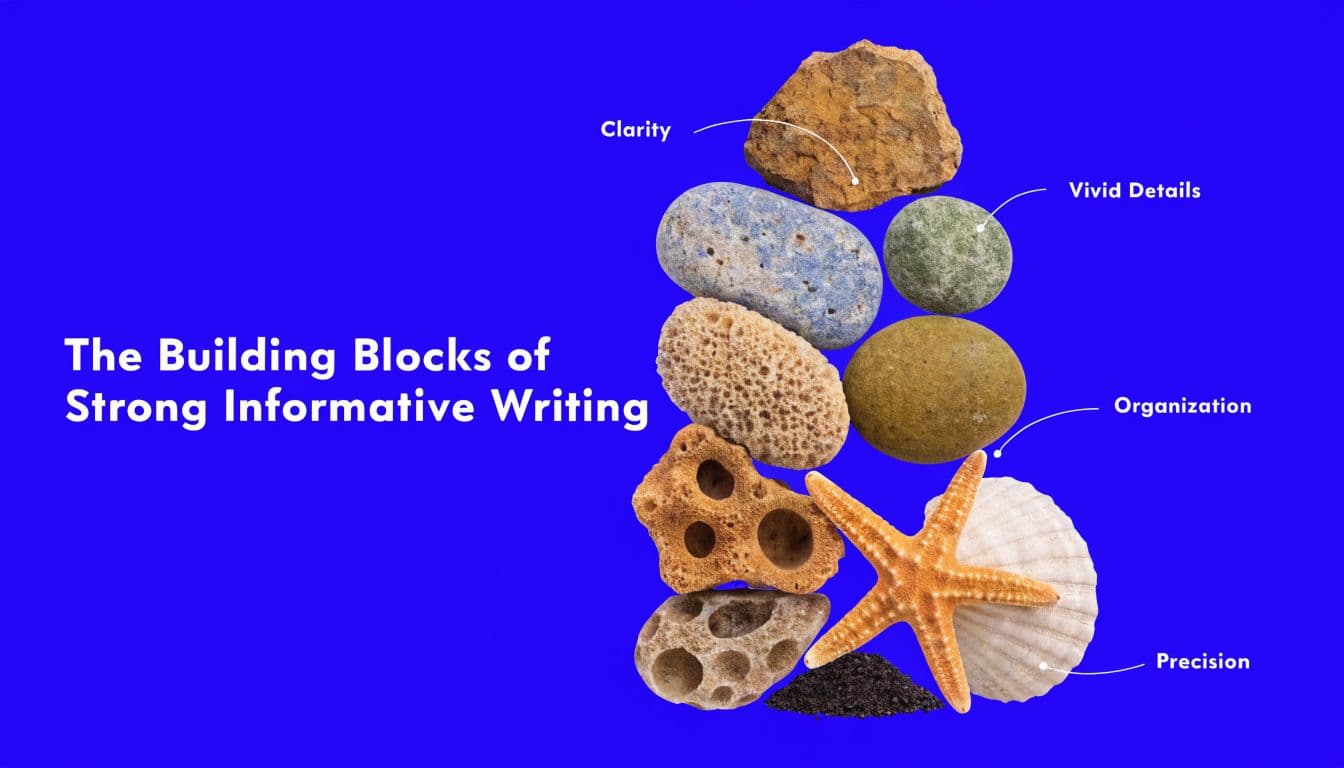
I’ve had the most success teaching four building blocks: clarity, accuracy, objectivity, and structure. Those are concrete enough for mini-lessons and specific enough for feedback.
Clarity helps the reader stay with the writer
Clear writing uses words the audience can understand. When a topic needs specialized language, the writer defines it.
That matters. A technical writing summary here notes that clearly defining terminology can produce a 64% increase in reader comprehension. In classroom terms, that means a sentence like “Condensation is water vapor cooling into liquid water” does more work than “Condensation is a phase transition.”
Try a quick before-and-after:
- Before: Photosynthesis is a biological process involving energy conversion.
- After: Photosynthesis is the process plants use to turn sunlight into energy.
If your older students need support with domain-specific language, a list of essential vocabulary for AP students can help you think about which academic terms need teaching, defining, or simplifying before students write.
Accuracy means the facts are correct and usable
Informative writing falls apart when students include shaky facts, half-remembered research, or unsupported statements. Accuracy means students check information and use sources carefully.
In practice, that can look like:
- Verifying details: Students confirm names, dates, and terms before drafting.
- Matching evidence to the topic: They don’t toss in an unrelated fact because it sounds smart.
- Citing appropriately: Even younger students can name where information came from in simple ways.
One helpful classroom move is to separate note-taking from drafting. If students write directly from websites into paragraphs, errors and copied language creep in fast.
Objectivity sounds neutral, not robotic
Students often think neutral writing has to sound stiff. It doesn’t. It just avoids emotional pushing.
Compare these:
- Biased: School lunches are terrible and should be fixed immediately.
- Objective: School lunch policies affect nutrition, cost, and student choice.
Good informative writing doesn’t hide the topic’s importance. It just keeps the focus on explanation rather than pressure.
A useful revision routine is to have students circle loaded words. If the piece includes best, worst, clearly, shocking, unfair, or everyone knows, they can decide whether those words belong.
Structure keeps the information teachable
Strong informative writing has a path. The reader can tell where the piece begins, how ideas connect, and what the main takeaway is.
A simple structure works across grades:
- Introduction: Name the topic and give the reader a focus.
- Body: Group related facts and explanations.
- Conclusion: Wrap up the main learning.
For students who struggle to sort details, visual organization helps before drafting. An organising information planning resource can support that stage by turning a broad topic into categories, key points, and sequence.
The payoff is easy to see in student drafts. Writing gets stronger when students know not just what informative writing is, but what strong informative writing looks like sentence by sentence.
Informative Writing in Action Across Grade Levels
Informative writing doesn’t appear all at once. It grows. Kindergarten students label and name. Upper elementary students group facts into paragraphs. Middle school students explain processes and ideas with more control. High school students handle research, synthesis, and formal structure.
That progression matters because teachers often expect the final version too early.

Primary grades focus on naming and noticing
In K-2, informative writing often starts with “All About” books, labels, captions, and simple fact pages.
A first-grade example might read like this:
Giraffes are tall animals. They have long necks. Giraffes eat leaves. Their spots are different on each giraffe.
That’s basic, but it’s appropriate. The student is identifying a topic and sharing relevant facts. Add a labeled diagram, and the piece becomes even stronger because the visual supports the information.
What makes this effective at that level?
- The topic is clear
- The facts are relevant
- The sentences stay on one subject
- The language is accessible
Upper elementary students start grouping ideas
By grades 3-5, students can handle categories and paragraph structure. A report about a state, animal habitat, or historical figure starts to sound more organized.
A grade 3 state report might include sections like landforms, climate, symbols, and economy. Students are no longer just listing facts. They’re grouping details and teaching the reader in chunks.
This is also a great point to use grade-level models. If you need examples or practice pages, 3rd grade writing worksheets can help you see what age-appropriate informative tasks look like in manageable pieces.
Middle school writing explains processes and systems
In grades 6-8, students can do more than describe. They can explain how something works.
A science example might begin like this:
During the experiment, the plant placed near sunlight grew more quickly than the plant kept in a shaded area. Light affects plant growth because plants use sunlight to make food through photosynthesis.
That writing is stronger because it connects observation to explanation. Students at this level can usually handle cause and effect, steps in a process, and simple evidence commentary.
One helpful model for middle school is procedural writing. “How to conduct a safe lab setup” or “How a bill becomes a law” keeps the focus on sequence and explanation.
A short video model can also help students hear the difference between explanation and opinion before they draft.
High school writers synthesize and frame information
By grades 9-12, informative writing often includes research-based introductions, analytical explanation, and more formal transitions.
A high school introduction might sound like this:
Renewable energy sources are becoming a larger part of national energy planning because they reduce reliance on fossil fuels and can be developed through multiple technologies, including wind, solar, and hydroelectric systems.
This kind of writing asks students to define scope, frame the topic, and prepare the reader for a structured explanation. They may include source-based evidence, charts, quotations, or terminology that needs explanation.
The best high school informative writing still does the same basic job as a first-grade “All About” book. It helps the reader understand something clearly. It just does it with more precision.
Across all grade bands, the core skill stays the same. The complexity changes. That’s useful to remember when a student draft feels immature. Often the student isn’t “bad at writing.” They’re writing from an earlier developmental stage and need stronger models.
How to Teach Informative Writing Effectively
A familiar classroom moment goes like this. You assign an informative piece, students pick topics quickly, and then the drafts come back sounding like scattered notes, opinion blurbs, or copied facts with no real explanation. I have seen that pattern many times, and it usually points to instruction that needs a clearer path, not students who "just can't write."
The strongest instruction is steady, visible, and practice-rich. Students need to see how informative writing works, try one small part at a time, and hear the teacher name the choices strong writers make.
If I had to choose one starting move, I would begin with noticing.
Start with mentor texts and non-examples
Before students write, give them short pieces and ask, What job is this writer doing for the reader?
That question helps more than asking for a definition too early. It shifts students from guessing at school vocabulary to noticing purpose. In teacher terms, you are building category sense first. Students start to recognize that informative writing explains, clarifies, and teaches.
Use a deliberate mix of texts:
- Informative samples: Short articles, encyclopedia entries, science explanations, how-to pieces
- Argument samples: Editorials, opinion paragraphs, persuasive letters
- Narrative samples: Personal stories, scenes, memoir excerpts
A simple card sort works well. Put short paragraphs on cards and ask students to label them as informative, persuasive, or narrative, then justify each choice with one text clue. That last step matters. It moves the lesson from sorting by instinct to sorting by evidence.
Teach planning as part of drafting
Many weak drafts begin as fuzzy plans. Students often choose a topic that is too big, then fill the page with loosely related facts.
Planning should feel like prewriting with a purpose, not an extra worksheet to finish before the "real" writing starts. I usually frame it this way for students: planning is how writers decide what belongs.
A few tools work especially well:
- Topic webs: Useful for younger students who are gathering subtopics
- Boxes and bullets: Helpful for students who need clear categories and details
- Main idea tables: Effective in upper grades because they connect facts to a central idea
For reluctant writers, the "three boxes" organizer is often enough to get momentum. Box one asks, What is it? Box two asks, What are its parts or features? Box three asks, Why does it matter? It works like a simple frame for explanation. Students are not staring at a blank page anymore. They are filling in a structure they can use.
Give students real teaching jobs
Informative writing improves when students feel responsible for helping someone else understand. That shift changes the quality of the draft. They stop writing to fill space and start writing to teach.
These classroom tasks are worth keeping in rotation:
Become an expert project
Students research a topic of interest and teach the class through a poster, slideshow, or short article.How-to class manual
Students write instructions for real classroom procedures like checking out books, cleaning up materials, or joining morning work.Fact or opinion revision task
Give students a persuasive paragraph and ask them to rewrite it as informative writing by removing loaded words and unsupported claims.Explain it to a younger student
Students write about a complex topic for a younger audience. This pushes them toward clarity, sequence, and accurate word choice.
This is also the point where content-area teachers can join in naturally. Science explanations, social studies background pieces, and technical process writing all give students authentic reasons to inform.
Keep revision simple and repeatable
Students rarely benefit from a long list of editing directions. They do better with a short routine they can remember across assignments.
Try using four revision questions:
- Did I explain the topic clearly?
- Did I use facts and examples that fit?
- Did I remove opinion words?
- Does each part connect to the topic?
I like this set because it works in conferences, peer review, and self-checks. It also lines up well with most informative writing rubrics, which makes assessment feel less mysterious. Over time, students begin to internalize the questions and use them without being prompted.
Use planning tools that save teacher time
Teachers need usable materials fast. If you want standards-aligned prompts, graphic organizers, rubrics, or model texts at different reading levels, Kuraplan can help generate classroom materials so your time goes toward modeling, conferring, and feedback.
That support matters most when you treat the tool as part of a teacher toolkit, not as the lesson itself. AI can help teachers in this area without replacing the teaching. Instructional quality still stems from teacher moves. Model a paragraph. Annotate a mentor text. Show students how a writer turns a broad topic into clear sections. Keep expectations visible, and the writing gets stronger.
Assessing Informative Writing with a Practical Rubric
A good rubric makes grading faster, but that’s not its main value. Its main value is clarity. Students write better when they can see what “better” means.
Too many informative writing assignments fail at the assessment stage. The prompt says “inform,” but the rubric mostly rewards length, neatness, or grammar. That leaves students guessing about what counts.
What a practical rubric should measure
For informative writing, I’d keep the criteria tight. Four categories are usually enough:
| Criteria | Beginning | Developing | Proficient | Advanced |
|---|---|---|---|---|
| Topic focus and development | Topic is unclear or drifts | Topic is present but unevenly explained | Topic is clear and explained with relevant details | Topic is clear, focused, and developed thoughtfully |
| Use of evidence and facts | Few facts, weak support, or confusing details | Some relevant facts but limited explanation | Relevant facts and examples support the topic | Facts are well chosen and explained with strong relevance |
| Organization and structure | Ideas feel scattered | Some structure is present | Clear beginning, middle, and end | Structure guides the reader smoothly across ideas |
| Clarity and conventions | Errors or wording block meaning | Meaning is mostly clear with some problems | Writing is clear and mostly correct | Writing is polished, precise, and easy to follow |
That rubric works best when you teach from it before students submit. I like to highlight one row at a time during mini-lessons.
Evidence needs context, not just presence
This part matters more than many students realize. A draft can include facts and still feel weak if the writer drops them in without explanation.
The UNECE guidance on statistical storytelling stresses using “newsworthy and timely” facts with context, and the same source notes that context-embedded reports are 22% more memorable. In classroom terms, that means a rubric should reward not only whether a student included data or examples, but whether the student helped the reader understand why that information matters.
A sentence with a statistic is not automatically strong evidence. The explanation after it often does the real teaching.
Let students use the rubric before you grade
Rubrics work better as teaching tools than surprise score sheets.
Here are three simple ways to use one:
- Self-assessment first: Students highlight where they think their draft falls in each category.
- Peer feedback next: Partners give one note on evidence and one note on organization.
- Teacher conference last: You focus on the single criterion that will move the draft forward most.
That sequence keeps feedback manageable. It also reduces the “Why did I get this score?” conversation because students have already worked with the language of the rubric.
If the rubric feels too abstract, rewrite the descriptors in student-friendly terms. Instead of “development,” say “Did I explain enough for the reader to understand?” That shift helps immediately.
Ready-to-Use Informative Writing Prompts
A good prompt points students toward curiosity, not just compliance. If the prompt is flat, the writing usually is too.
Students also need prompts that separate informative writing from argument. That means the topic has to invite explanation without nudging them into “should” language.
K-2 prompts
- Teach us about an animal: Write an “All About” page on a bird, bug, or sea animal.
- Explain a classroom job: Tell how to be the line leader, plant helper, or librarian.
- How does it grow: Explain how a seed becomes a plant.
- Parts of a place: Describe what you see and do at the playground, library, or park.
Grades 3-5 prompts
- Guide for a new student: Explain what a new student should know about your school.
- How something works: Write about how a bicycle, elevator, or pencil sharpener works.
- State or region report: Teach readers about weather, landforms, and symbols.
- Fact and opinion fix-up: Revise a persuasive paragraph by removing opinion-based phrases and turning it into an informative explanation, a strategy discussed in this classroom post on reinvigorating informative writing.
Grades 6-8 prompts
- Explain a scientific process: Describe photosynthesis, erosion, or the water cycle.
- How-to for middle school life: Write a practical guide for organizing materials, studying for tests, or joining a club.
- Technology explainer: Teach readers how a search engine, QR code, or weather app works.
- Historical background piece: Explain the causes of a major event without arguing who was most at fault.
Grades 9-12 prompts
- Research-based explanation: Inform readers about a current scientific topic or public issue.
- Career field overview: Explain the training, skills, and daily work in a profession.
- Text set synthesis: Read multiple sources and explain a topic for a general audience.
- Audience shift task: Explain a complex issue first for peers, then rewrite it for elementary students.
One of my favorite prompt moves is to add the phrase “Help your reader understand” at the end. It nudges students toward explanation and away from debate.
Empowering the Next Generation of Clear Communicators
A student finishes an explanation of the water cycle, and for the first time the reader does not have to guess what the student means. The ideas are in order. The facts are accurate. The explanation holds together from beginning to end. That is the payoff of teaching informative writing well.
Students gain more than a writing skill. They learn how to clarify their thinking, separate evidence from opinion, and explain a topic in a way another person can use. Those habits show up in science notebooks, social studies responses, math explanations, and real-world writing tasks far beyond school.
If students still blur the line between informing, persuading, and narrating, that is familiar classroom territory. It usually points to a few teachable needs: clearer models, a simpler rubric, and repeated practice with feedback they can act on right away. I have seen strong growth once those pieces are in place.
A good teacher toolkit makes that work lighter. Kuraplan helps educators build standards-aligned lesson plans, worksheets, visuals, and rubrics for informative writing, so each unit starts with a usable structure instead of a blank page.