Feudal Japan: Samurai Insights
A free social sciences worksheet ready for your classroom. Open in Kuraplan to grab the print-ready PDF, customize it for your students, or generate a fresh version in seconds.
Feudal Japan: Samurai Insights
Year 8 History — NSW NESA Outcomes: HT4-2, HT4-5
📖 Background Reading: Feudal Japan and the Samurai
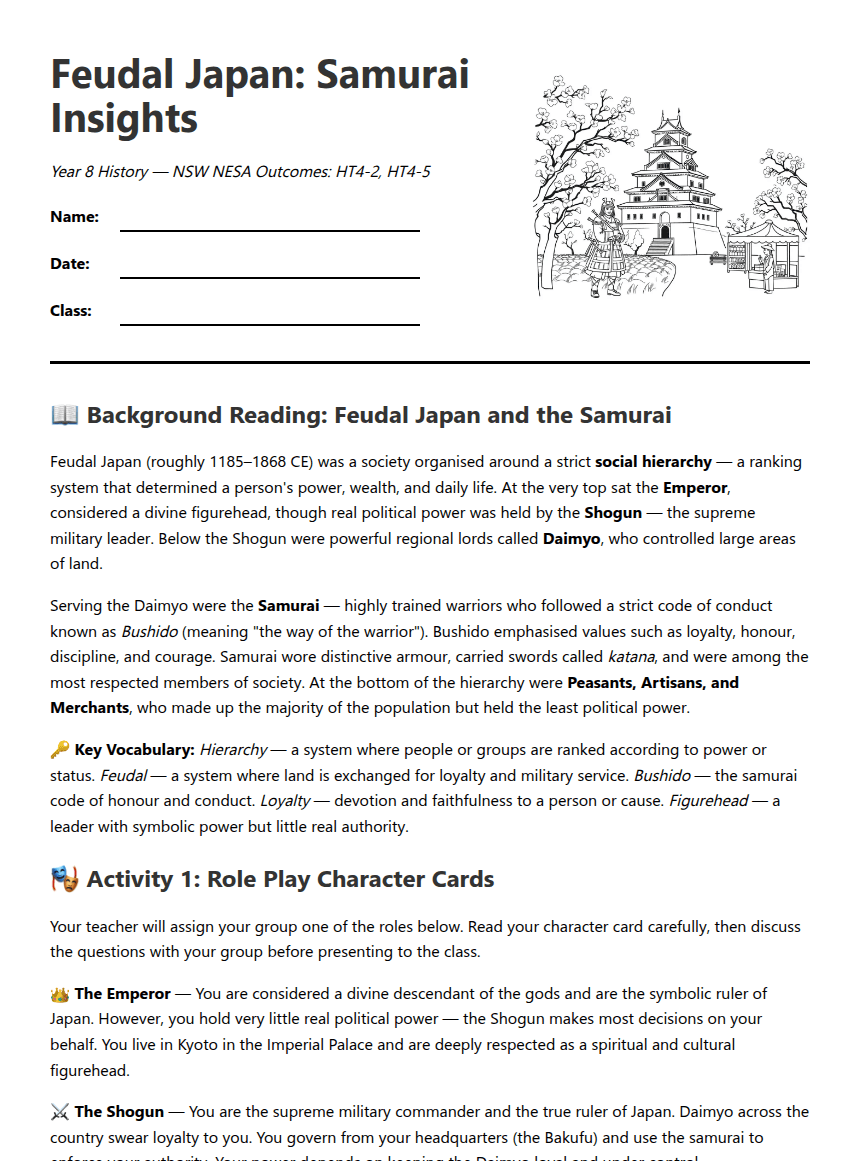
Feudal Japan (roughly 1185–1868 CE) was a society organised around a strict social hierarchy — a ranking system that determined a person's power, wealth, and daily life. At the very top sat the Emperor, considered a divine figurehead, though real political power was held by the Shogun — the supreme military leader. Below the Shogun were powerful regional lords called Daimyo, who controlled large areas of land.
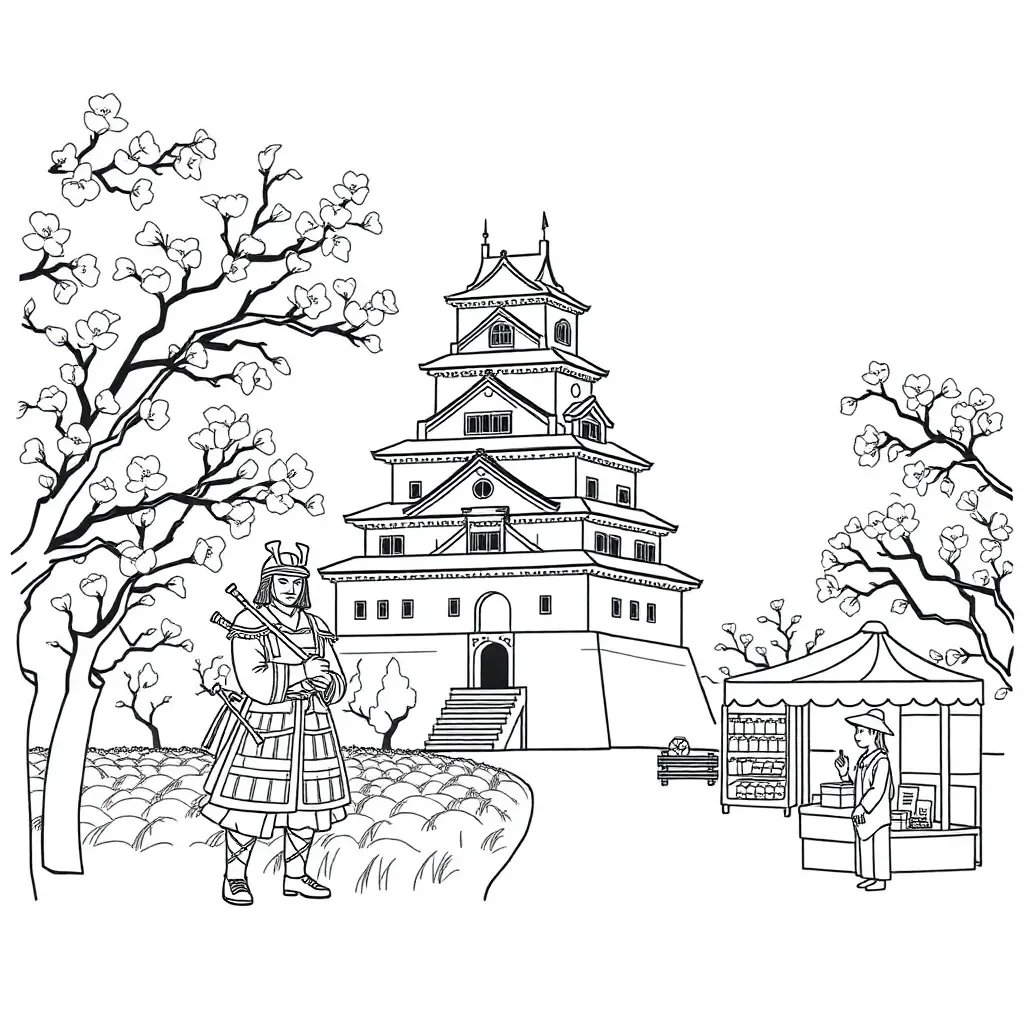
Serving the Daimyo were the Samurai — highly trained warriors who followed a strict code of conduct known as Bushido (meaning "the way of the warrior"). Bushido emphasised values such as loyalty, honour, discipline, and courage. Samurai wore distinctive armour, carried swords called katana, and were among the most respected members of society. At the bottom of the hierarchy were Peasants, Artisans, and Merchants, who made up the majority of the population but held the least political power.
🔑 Key Vocabulary: Hierarchy — a system where people or groups are ranked according to power or status. Feudal — a system where land is exchanged for loyalty and military service. Bushido — the samurai code of honour and conduct. Loyalty — devotion and faithfulness to a person or cause. Figurehead — a leader with symbolic power but little real authority.
🎭 Activity 1: Role Play Character Cards
Your teacher will assign your group one of the roles below. Read your character card carefully, then discuss the questions with your group before presenting to the class.
👑 The Emperor — You are considered a divine descendant of the gods and are the symbolic ruler of Japan. However, you hold very little real political power — the Shogun makes most decisions on your behalf. You live in Kyoto in the Imperial Palace and are deeply respected as a spiritual and cultural figurehead.
⚔️ The Shogun — You are the supreme military commander and the true ruler of Japan. Daimyo across the country swear loyalty to you. You govern from your headquarters (the Bakufu) and use the samurai to enforce your authority. Your power depends on keeping the Daimyo loyal and under control.
🏯 The Daimyo — You are a powerful regional lord who controls a large area of land called a han. You employ samurai to protect your lands and collect taxes from the peasants who farm your territory. You owe loyalty to the Shogun but have significant local power and wealth.
🗡️ The Samurai — You are a trained warrior who serves a Daimyo. You follow the Bushido code — living by the values of honour, loyalty, and courage. You train daily in swordsmanship and other martial arts. In return for your service, your Daimyo provides you with land or rice as payment.
🌾 The Peasant / Merchant — You make up the majority of Japan's population. As a peasant, you farm the land and pay heavy taxes to your Daimyo. As a merchant, you trade goods but are considered lower in status than farmers, even if you are wealthier. Life is difficult, and you have little say in political decisions.
Group Discussion Questions:
💡 EAL/D Sentence Starters: "My character is important because..." / "My character interacts with the [role] by..." / "My character has power over..."
🔍 Activity 2: Source Analysis — The Bushido Code
Primary Source Excerpt:
"The way of the samurai is found in death. Meditation on inevitable death should be performed daily... A samurai lives so that he will always be prepared to die, and in doing so, he will live without shame."
— Adapted from Hagakure (Book of the Samurai), written by Yamamoto Tsunetomo, c. 1716
💡 EAL/D Sentence Starters: "This source was created by... in order to..." / "This source tells us that samurai valued..." / "This source is useful because..."
🏔️ Activity 3: Create a Social Pyramid
In the space below, draw and label the social pyramid of feudal Japan. Place each group in the correct position — most powerful at the top, least powerful at the bottom. Write 1–2 sentences describing the role or lifestyle of each group.
Groups to include: Emperor | Shogun | Daimyo | Samurai | Peasants, Artisans & Merchants
⭐ Challenge: Add a symbol or small drawing next to each level to represent that group.
💡 EAL/D Tip: Use the Background Reading section to help you write your descriptions. Start each description with: "The [group] were responsible for..."
🎟️ Exit Ticket: What Did You Learn?
Answer both questions below in full sentences. Your teacher will collect this at the end of the lesson.
💡 EAL/D Sentence Starters: "One fact I learnt about the samurai is..." / "In feudal Japan, the social structure meant that..."
🌟 Learning Reflection: Place a tick next to each success criteria you feel confident about:
About This Worksheet
Free in Kuraplan
Sign up free, grab the PDF, and customize it for your class.
Print-Ready
Formatted for standard paper. Clean layout, easy to read.
AI-Generated
Created with Kuraplan's AI, designed for real classroom use.
For Teachers & Parents
Use in classrooms, for homework, tutoring, or homeschool.
Need a custom version of this worksheet?
Kuraplan's AI generates custom worksheets in seconds — differentiated for every learner, aligned to your curriculum.
Generate Custom Worksheets — Free