Formal vs Informal Writing
A free, printable general worksheet ready for your classroom. Download instantly, print, and hand out to your students — no account needed.
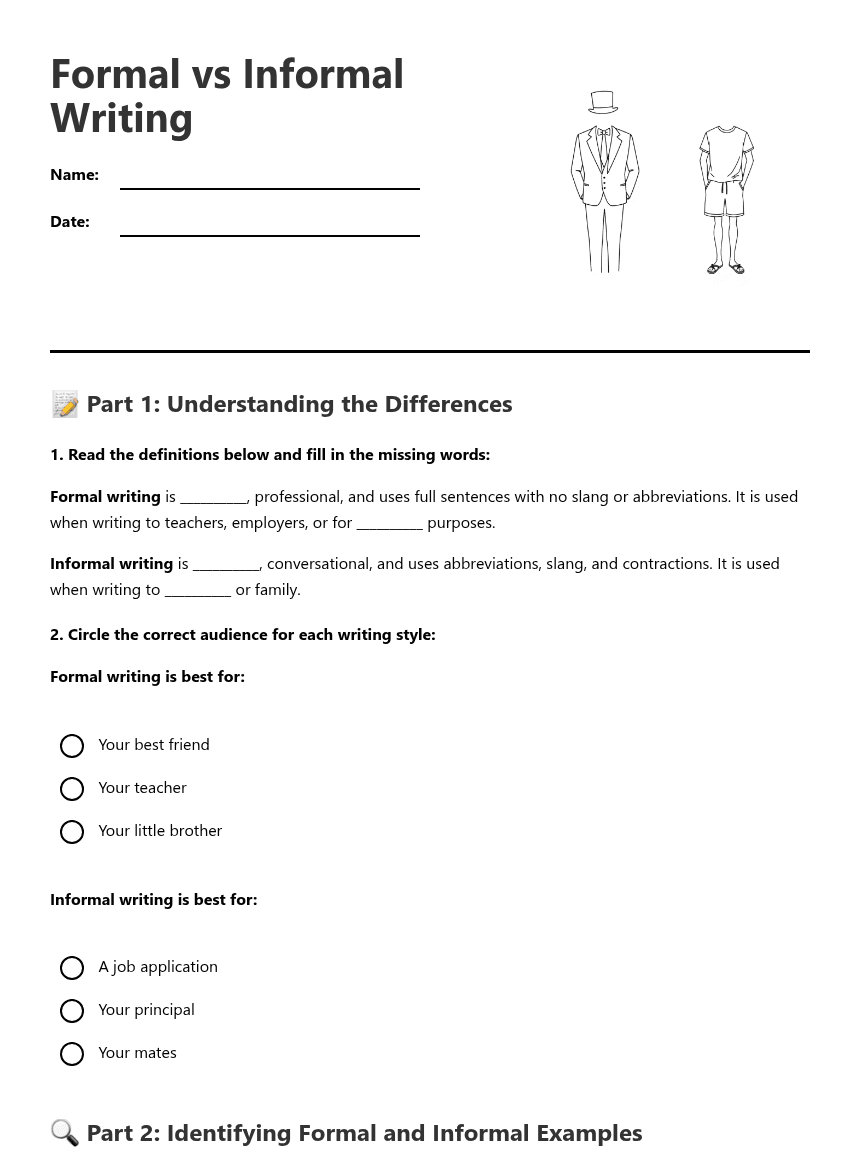
Formal vs Informal Writing
📝 Part 1: Understanding the Differences
Formal writing is __________, professional, and uses full sentences with no slang or abbreviations. It is used when writing to teachers, employers, or for __________ purposes.
Informal writing is __________, conversational, and uses abbreviations, slang, and contractions. It is used when writing to __________ or family.
Formal writing is best for:
Informal writing is best for:
🔍 Part 2: Identifying Formal and Informal Examples
Example A: "Hey Sarah! Can't wait 2 see u at the movies tonight! 😊"
Example B: "Dear Mrs Johnson, I am writing to request an extension for my assignment due to illness."
Example C: "OMG did u see what happened at lunch?? So funny lol"
Example D: "I would like to formally apply for the position of student representative."
🎯 Part 3: Features Matching Activity
✏️ Part 4: Language Features
🔄 Part 5: Rewriting Practice
Informal: "Hey Miss! Can't come 2 class 2day coz I'm sick. Will catch up l8r!"
Formal version:
Formal: "Dear James, I would like to invite you to attend my birthday celebration on Saturday."
Informal version:
💭 Part 6: When to Use Each Style
Writing a text to your friend about weekend plans:
Emailing your teacher about missing homework:
Writing a letter to the Prime Minister:
Messaging your cousin about a family BBQ:
About This Worksheet
Free Download
No sign-up, no email, no paywall. Just download and print.
Print-Ready
Formatted for standard paper. Clean layout, easy to read.
AI-Generated
Created with Kuraplan's AI, designed for real classroom use.
For Teachers & Parents
Use in classrooms, for homework, tutoring, or homeschool.
Need a custom version of this worksheet?
Kuraplan's AI generates custom worksheets in seconds — differentiated for every learner, aligned to your curriculum.
Generate Custom Worksheets — Free