Grammar Analysis Guide
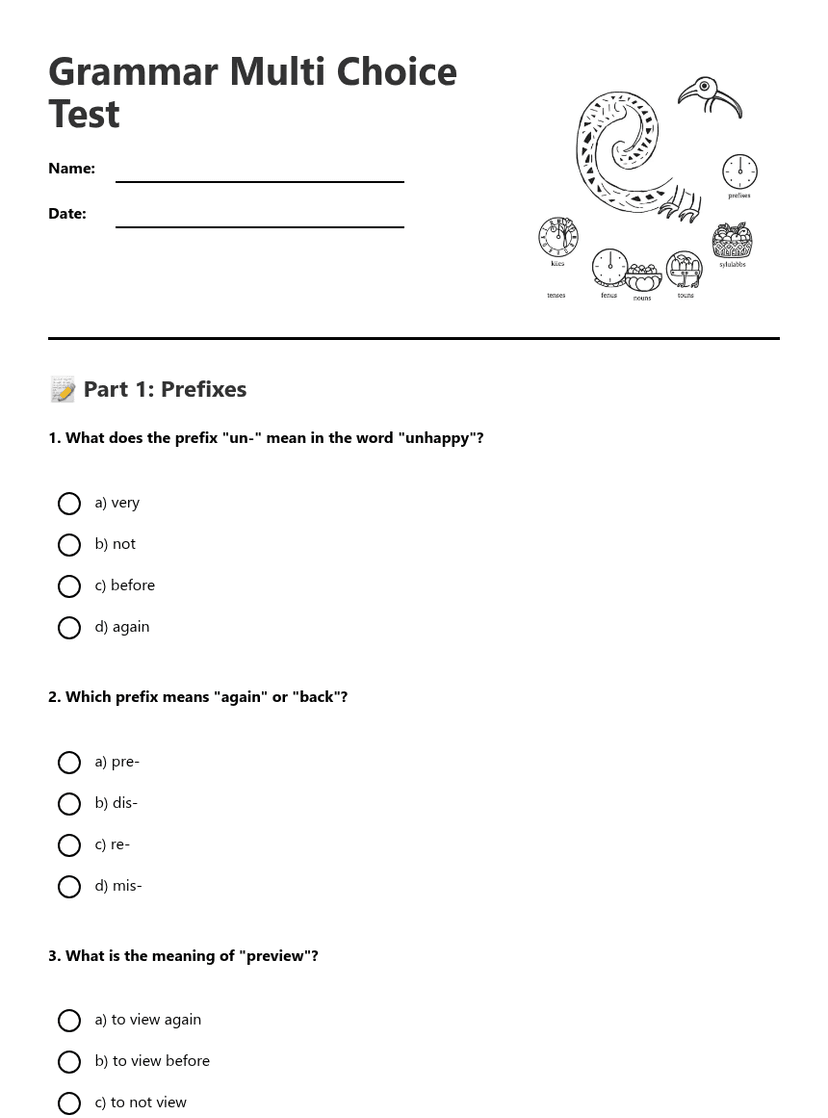
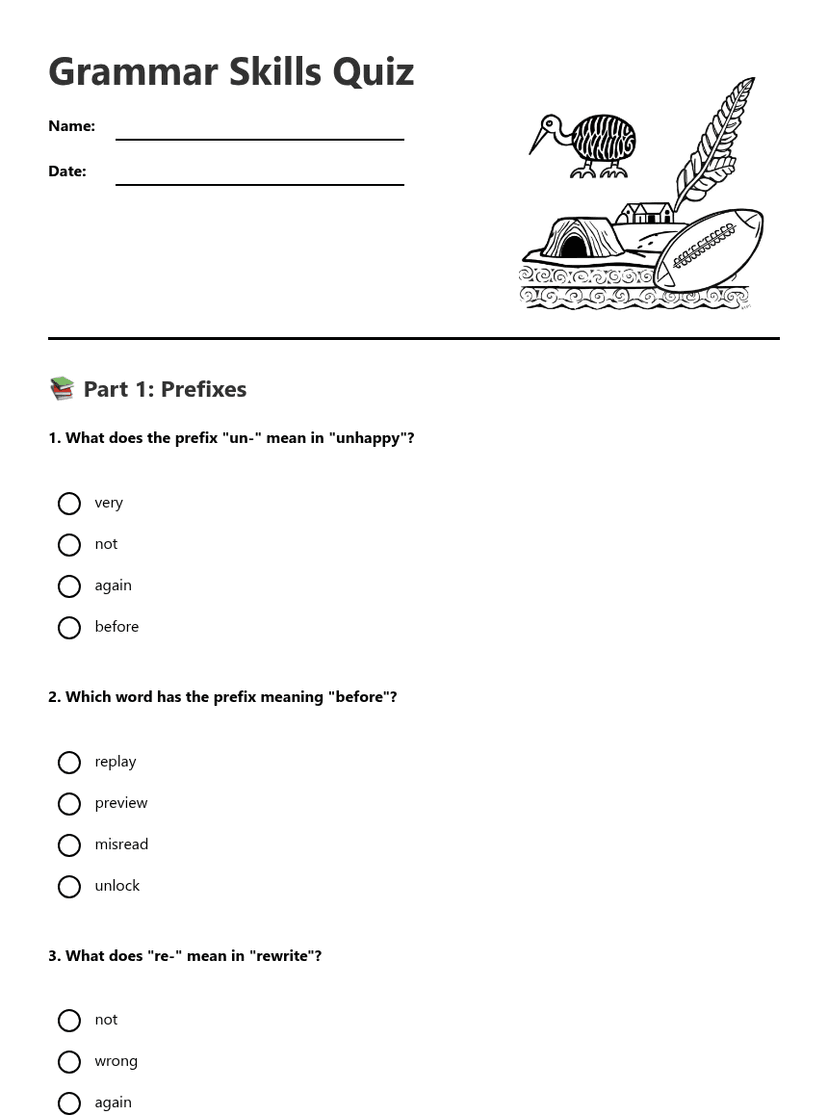
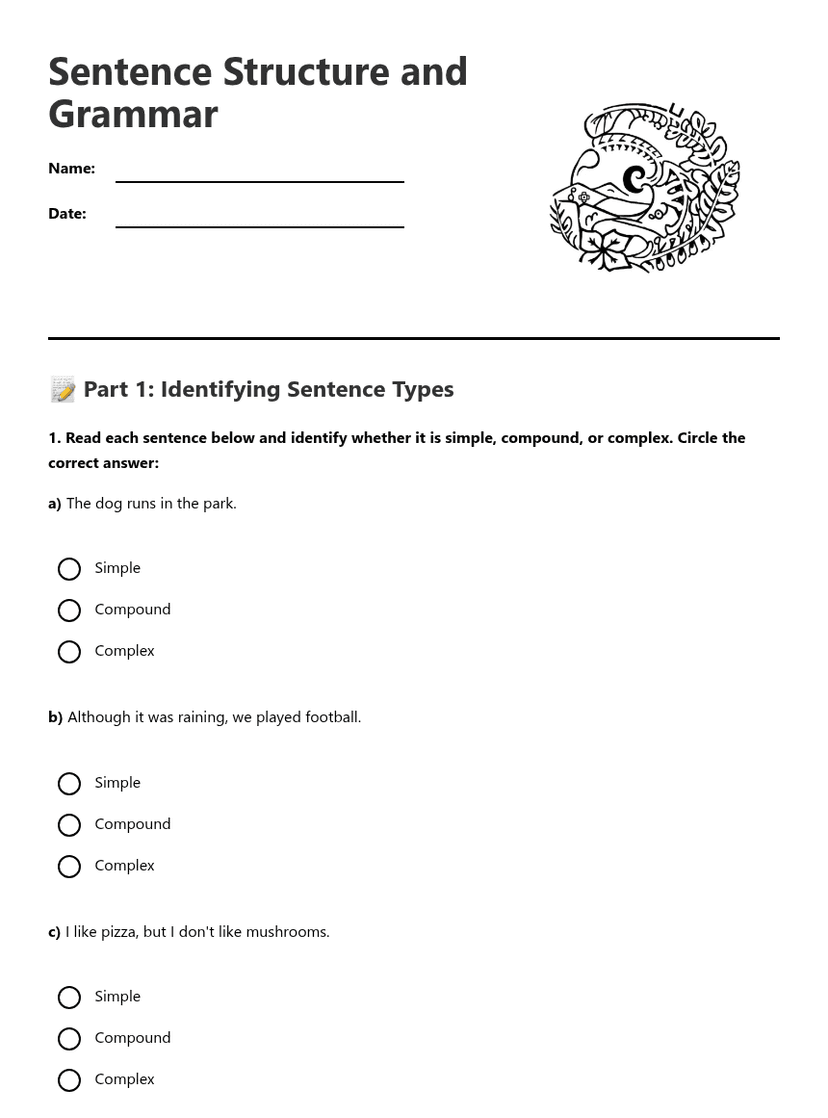
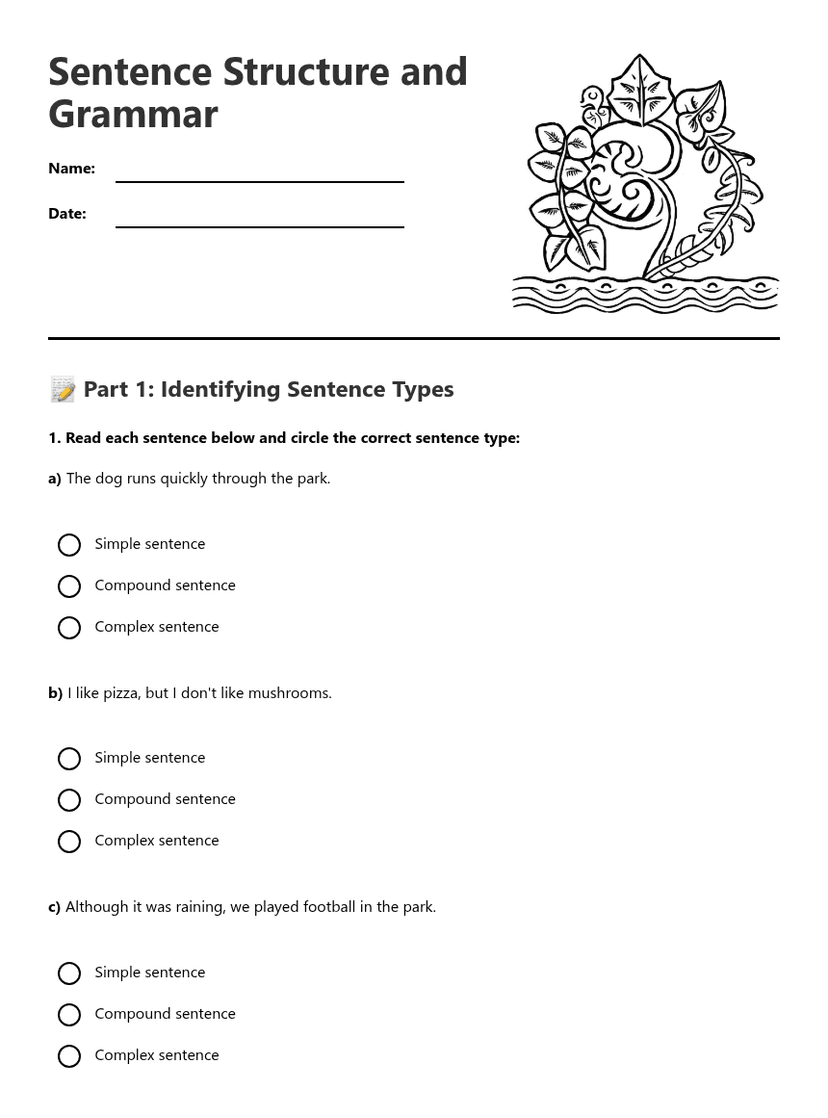
A free, printable general worksheet ready for your classroom. Download instantly, print, and hand out to your students — no account needed.
Grammar Analysis Guide
📚 Part 1: Identifying Parts of Speech
Look for words that name people, places, things, or ideas. Circle them in blue.
Tips: Ask yourself "What can I see, touch, or think about?" Common endings: -tion, -ness, -ment, -ity
Example: "The dog ran through the park with great excitement."
Find action words or state-of-being words. Underline them in red.
Tips: Ask "What is happening?" or "What is someone doing?" Look for words ending in -ed, -ing, or -s
Example: "Sarah walked quickly and was feeling confident about her presentation."
Search for describing words that tell us more about nouns. Highlight them in yellow.
Tips: Ask "What kind?" "How many?" "Which one?" Often come before nouns or after linking verbs
Example: "The tall, ancient tree had five branches reaching towards the cloudy sky."
Look for words that describe verbs, adjectives, or other adverbs. Mark them in green.
Tips: Ask "How?" "When?" "Where?" "How much?" Many end in -ly
Example: "She spoke softly and carefully explained the very difficult concept."
🔗 Part 2: Connecting Words and Phrases
Find words that join other words, phrases, or sentences. Put a box around them.
Coordinating conjunctions: and, but, or, nor, for, yet, so
Subordinating conjunctions: because, although, since, while, if, when, before, after
Example: "I wanted to go swimming, but it was raining. Although I was disappointed, I decided to read instead."
Look for words that show relationships between other words (usually involving position, time, or direction).
Common prepositions: in, on, at, by, for, with, under, over, through, between, during, after
Example: "The cat sat under the table during dinner and waited for scraps."
Identify words that replace nouns. Draw a triangle around them.
Personal pronouns: I, you, he, she, it, we, they, me, him, her, us, them
Possessive pronouns: my, your, his, her, its, our, their, mine, yours, ours, theirs
Example: "She gave her book to him because his was lost."
📝 Part 3: Analysing Sentence Types
Look for sentences with one main clause (one subject and one predicate).
Pattern: Subject + Verb + (Object/Complement)
Example: "The students studied hard." | "My brother plays rugby every Saturday."
Search for sentences with two or more independent clauses joined by coordinating conjunctions.
Pattern: Independent clause + conjunction + Independent clause
Example: "The rain stopped, and the sun came out." | "I studied for hours, but the test was still difficult."
Identify sentences with one independent clause and one or more dependent clauses.
Pattern: Independent clause + subordinating conjunction + dependent clause (or vice versa)
Example: "Although it was late, we continued working." | "The game was cancelled because of the weather."
Find sentences with multiple independent clauses AND at least one dependent clause.
Example: "When the bell rang, students rushed to class, but some were still late."
✏️ Part 4: Punctuation Analysis
Notice how sentences end and what this tells us about the sentence purpose:
Full stops (.): Statements and commands
Question marks (?): Direct questions
Exclamation marks (!): Strong emotion or emphasis
Commas (,): Separate items in lists, join clauses, set off extra information
Semicolons (;): Join related independent clauses, separate complex list items
Colons (:): Introduce lists, explanations, or quotations
Apostrophes ('): Show possession or contractions
Quotation marks (" "): Direct speech or quotations
For each punctuation mark you find, ask:
• What job is this punctuation doing?
• How does it help the reader understand the text?
• What would happen if it wasn't there?
🎯 Part 5: Annotation Strategy
Colour Coding System:
• Blue circles: Nouns
• Red underlines: Verbs
• Yellow highlights: Adjectives
• Green marks: Adverbs
• Boxes: Conjunctions
• Triangles: Pronouns
1. Read the sentence completely first
2. Identify the main subject and verb
3. Look for any joining words (conjunctions)
4. Count the clauses (independent and dependent)
5. Classify the sentence type
6. Note interesting punctuation and its purpose
• Start with shorter texts and build up to longer passages
• Focus on one grammar element at a time when beginning
• Compare how grammar differs between fiction and non-fiction texts
• Keep a grammar journal of interesting examples you find
• Discuss your findings with classmates to deepen understanding
About This Worksheet
Free Download
No sign-up, no email, no paywall. Just download and print.
Print-Ready
Formatted for standard paper. Clean layout, easy to read.
AI-Generated
Created with Kuraplan's AI, designed for real classroom use.
For Teachers & Parents
Use in classrooms, for homework, tutoring, or homeschool.
Need a custom version of this worksheet?
Kuraplan's AI generates custom worksheets in seconds — differentiated for every learner, aligned to your curriculum.
Generate Custom Worksheets — Free