FreePrintable

News Article Writing Guide

A free, printable general worksheet ready for your classroom. Download instantly, print, and hand out to your students — no account needed.
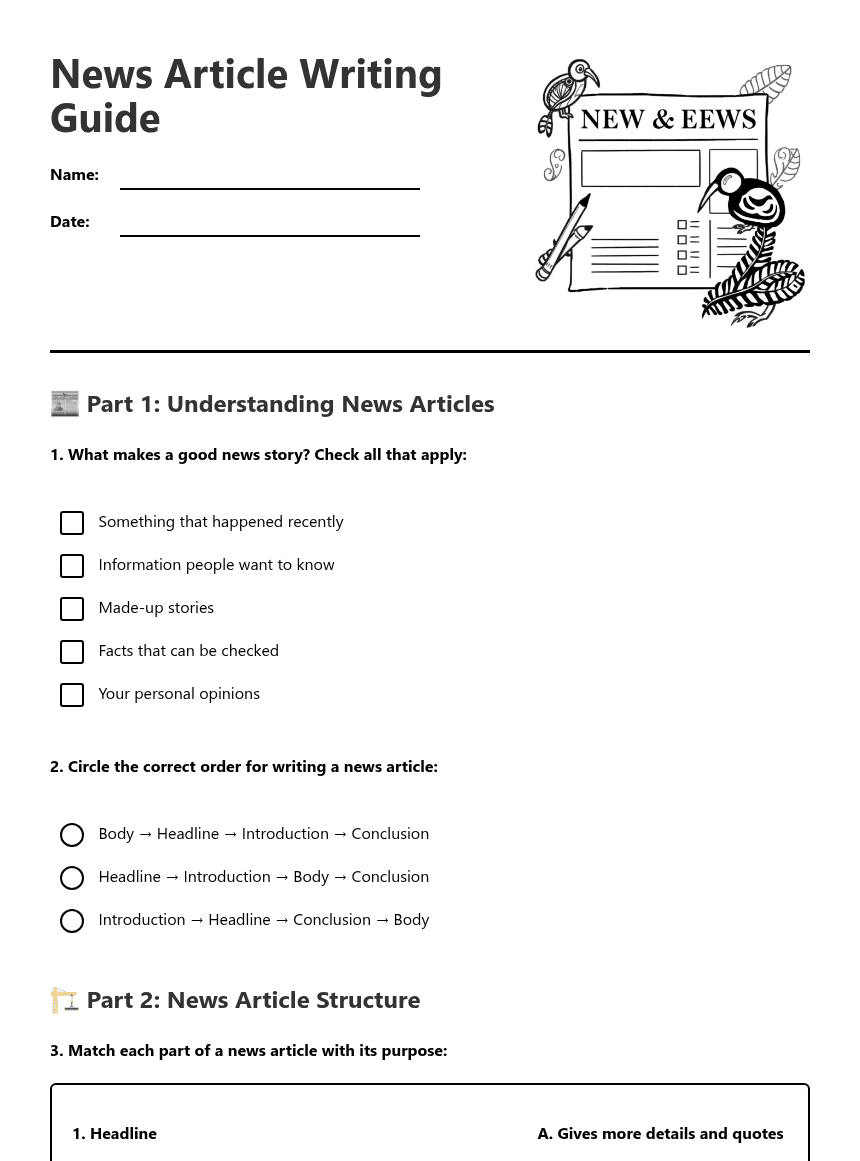
News Article Writing Guide worksheet preview

News Article Writing Guide

News Article Writing Guide

News article writing illustration

📰 Part 1: Understanding News Articles

1. What makes a good news story? Check all that apply:

Something that happened recently

Information people want to know

Made-up stories

Facts that can be checked

Your personal opinions

2. Circle the correct order for writing a news article:

Body → Headline → Introduction → Conclusion

Headline → Introduction → Body → Conclusion

Introduction → Headline → Conclusion → Body

🏗️ Part 2: News Article Structure

3. Match each part of a news article with its purpose:
1. Headline
2. Introduction
3. Body
4. Conclusion
A. Gives more details and quotes
B. Grabs attention in 5-8 words
C. Answers who, what, when, where
D. Wraps up the story
4. Fill in the missing parts of this news article structure:

1. ____________: Short and catchy (5-8 words)

2. Introduction: Answers the _____ questions (who, what, when, where, why)

3. ____________: More details, quotes, and background information

4. Conclusion: Sums up or tells what happens _______

📝 Part 3: Writing Your Headline

5. A good headline should be:

Short (5-8 words)

Interesting

Tell the main story

Very long and detailed

Use action words

6. Improve these headlines. Make them shorter and more exciting:

Bad headline: "There was a fire at the local school yesterday and the fire brigade came"

Bad headline: "Some students did well in a competition"

7. Practice writing headlines. Use these sentence starters:

For action stories: "[Someone] [action word] [something]"

For events: "[Event name] [brings/draws/attracts] [who]"

For achievements: "[Person/group] [wins/earns/receives] [what]"

🔍 Part 4: Writing Your Introduction

8. The introduction must answer the 5 W questions. Fill in what each W stands for:

Who: _________________ (the people involved)

What: _________________ (what happened)

When: _________________ (the time/date)

Where: _________________ (the place)

Why: _________________ (the reason it happened)

9. Read this introduction and identify the 5 Ws:

"Year 8 students from Auckland Grammar School won first place in the regional science fair last Friday at the Auckland Museum because of their innovative project on renewable energy."

Who: _________________________________

What: _________________________________

When: _________________________________

Where: _________________________________

Why: _________________________________

10. Sentence starters for introductions (choose what works for your story):

"Yesterday, [who] [did what] at [where]..."

"Local [people/group] [action] because..."

"[Number] of [people] gathered at [place] to..."

"A [event/incident] at [place] has [result]..."

📚 Part 5: Writing the Body

11. The body of your news article should include:

More details about what happened

Quotes from people involved

Background information

Your personal opinions

Facts that can be checked

12. How to write good quotes. Fill in the blanks:

Always use _____________ marks around the exact words someone said.

After the quote, write who said it: _____________ said.

Example: "We are very proud of our students," _____________ the principal.

13. Useful phrases for the body paragraphs:

To add information: "According to...", "The event also...", "In addition..."

To introduce quotes: "Ms Smith explained...", "One student said...", "The organiser told us..."

To give background: "This is the first time...", "Last year...", "The school has..."

🎯 Part 6: Writing Your Conclusion

14. A good conclusion can:

Summarise the main points

Tell what happens next

End with a final quote

Introduce completely new information

Give the final result

15. Conclusion sentence starters. Match each starter with when to use it:
1. "The event will continue..."
2. "Overall, the day was..."
3. "Students hope to..."
4. "The results will be..."
A. When talking about future plans
B. When the event is ongoing
C. When summarising the event
D. When waiting for outcomes

✅ Part 7: News Article Checklist

16. Before submitting your news article, check each box when complete:

📰 Headline Checklist:

Is it 5-8 words long?

Does it tell the main story?

Is it interesting and clear?

Does it use action words?

📝 Introduction Checklist:

Who is involved?

What happened?

When did it happen?

Where did it happen?

Why did it happen?

📚 Body Checklist:

More details included?

At least one quote included?

Quote marks used correctly?

Facts can be checked?

No personal opinions?

🎯 Conclusion Checklist:

Sums up the story?

Tells what happens next (if needed)?

Ends the story well?

🎨 Part 8: Plan Your News Article

17. Choose a topic for your news article and plan it out:
Topic ideas (circle one or write your own):

School sports day • New playground opening • Student achievement • School fundraiser • Environmental project • Other: ________________

18. Plan your headline (5-8 words):
19. Plan your introduction (answer the 5 Ws):
20. Plan your body paragraphs (list 3 main points and 1 quote):
21. Plan your conclusion:

About This Worksheet

Free Download

No sign-up, no email, no paywall. Just download and print.

Print-Ready

Formatted for standard paper. Clean layout, easy to read.

AI-Generated

Created with Kuraplan's AI, designed for real classroom use.

For Teachers & Parents

Use in classrooms, for homework, tutoring, or homeschool.

Need a custom version of this worksheet?

Kuraplan's AI generates custom worksheets in seconds — differentiated for every learner, aligned to your curriculum.

Generate Custom Worksheets — Free
No credit card Curriculum-aligned Under 60 seconds