Ōpōtiki Pūrākau Comprehension Quiz
A free, printable general worksheet ready for your classroom. Download instantly, print, and hand out to your students — no account needed.
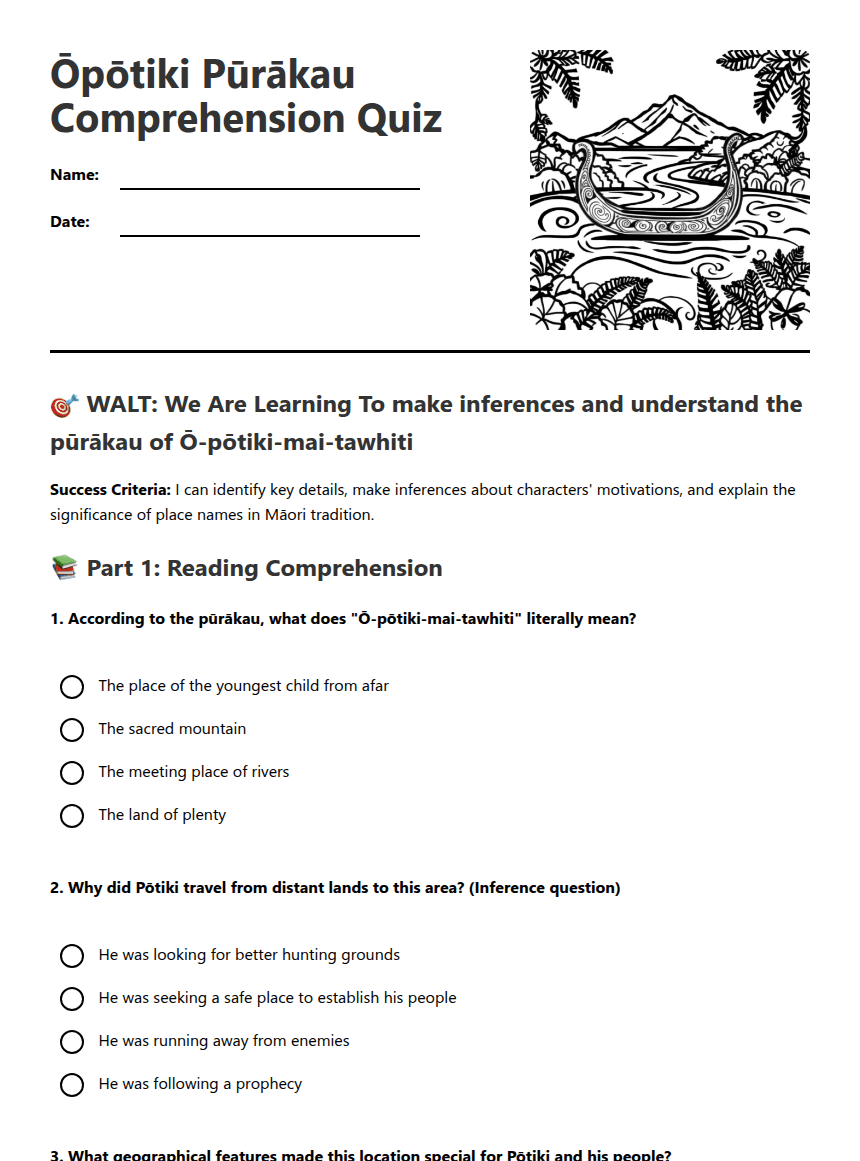
Ōpōtiki Pūrākau Critical Analysis
🎯 WALT: We Are Learning To critically analyse the pūrākau of Ō-pōtiki-mai-tawhiti, evaluating explicit and implicit meanings, cultural significance, and narrative techniques to demonstrate sophisticated comprehension and analytical thinking
Overall Success Criteria: I can synthesise textual evidence, construct well-reasoned inferences about cultural values and character motivations, evaluate the pūrākau's significance within Māori worldview, and articulate connections between traditional narratives and contemporary society.
Section-Specific Success Criteria:
- Analytical Reading: I can identify and evaluate literary devices, cultural symbols, and narrative structures within the pūrākau
- Critical Inference: I can construct sophisticated interpretations by synthesising textual evidence with cultural knowledge
- Evaluative Thinking: I can assess the pūrākau's relevance and significance in both historical and contemporary contexts
- Cultural Competency: I can demonstrate understanding of Māori worldview and values through thoughtful analysis
📚 Part 1: Textual Analysis & Comprehension
Success Focus: Demonstrating sophisticated understanding of narrative elements and cultural context
Critical Thinking Prompt: Consider: How does the pūrākau demonstrate the interconnectedness between people and environment in Māori worldview? What does this suggest about sustainable living practices?
🤔 Part 2: Critical Inference & Cultural Analysis
Success Focus: Constructing sophisticated interpretations and evaluating cultural significance
Reflection Prompt: Consider how this narrative element might function as social commentary about recognising potential in unexpected places.
Critical Analysis Prompt: Examine how place-naming functions as both memory-keeping and territorial claim. What parallels exist in contemporary society?
🎨 Part 3: Evaluative Thinking & Synthesis
Success Focus: Demonstrating sophisticated analysis and making meaningful connections
🌟 Differentiation Support & Advanced Extensions
Support Strategies for Complex Analysis:
- Analytical Framework: Use the PEEL structure (Point, Evidence, Explanation, Link) for extended responses
- Collaborative Analysis: Engage in structured academic discussions using sentence stems like "The evidence suggests..." or "This interpretation is supported by..."
- Concept Mapping: Create visual representations connecting themes, characters, and cultural concepts before writing
- Scaffolded Inquiry: Break complex questions into sub-questions: What? How? Why? So what?
Accessibility Accommodations:
- Access digital text-to-speech software for complex vocabulary
- Use graphic organisers to structure analytical thinking
- Provide alternative assessment formats (oral presentations, multimedia projects)
- Allow extended time for processing complex cultural and literary concepts
- Offer choice in response format while maintaining analytical rigour
Advanced Extension Challenges:
- Independent Research Project: Conduct ethnographic research on local iwi history and present findings using academic conventions
- Literary Analysis: Compare narrative techniques in this pūrākau with contemporary Māori literature, analysing evolution of storytelling methods
- Philosophical Inquiry: Develop a research question exploring concepts of time, space, and identity in Māori worldview versus Western perspectives
- Community Engagement: Design and conduct interviews with community members about the continuing relevance of traditional narratives
- Creative Scholarship: Produce an academic essay analysing how this pūrākau functions as both historical record and living cultural practice
- Cross-Disciplinary Investigation: Integrate geographical, historical, and anthropological perspectives to create a comprehensive analysis of settlement patterns in pre-colonial Aotearoa
Metacognitive Reflection Prompts:
"Evaluate your analytical process: What evidence did you find most compelling? How did your understanding evolve throughout this analysis? What questions emerged that merit further investigation? How has this study influenced your perspective on the relationship between traditional knowledge and contemporary understanding?"
About This Worksheet
Free Download
No sign-up, no email, no paywall. Just download and print.
Print-Ready
Formatted for standard paper. Clean layout, easy to read.
AI-Generated
Created with Kuraplan's AI, designed for real classroom use.
For Teachers & Parents
Use in classrooms, for homework, tutoring, or homeschool.
Need a custom version of this worksheet?
Kuraplan's AI generates custom worksheets in seconds — differentiated for every learner, aligned to your curriculum.
Generate Custom Worksheets — Free