MathsFreePrintable

Time Series PPDAC Analysis

A free, printable maths worksheet ready for your classroom. Download instantly, print, and hand out to your students — no account needed.
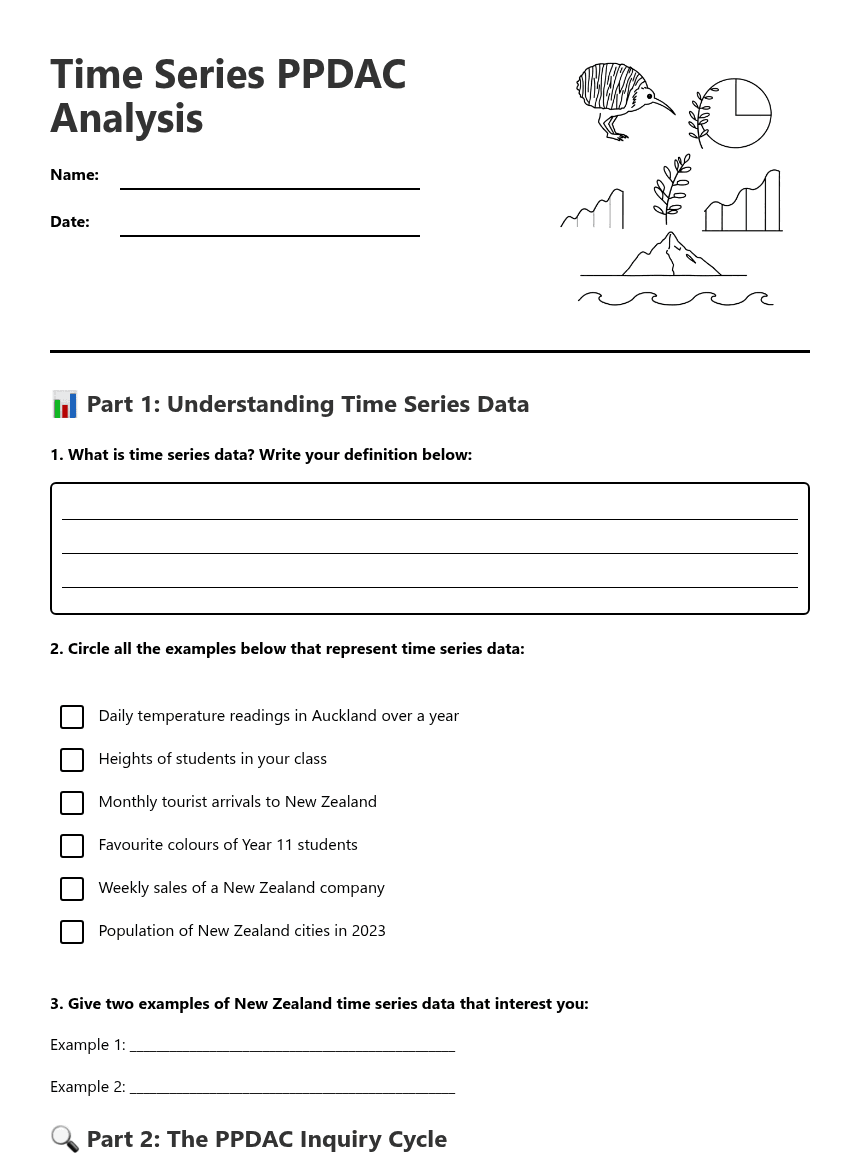
Time Series PPDAC Analysis worksheet preview

Time Series PPDAC Analysis

Time Series PPDAC Analysis

Time series graph illustration

📊 Part 1: Understanding Time Series Data

1. What is time series data? Write your definition below:
2. Circle all the examples below that represent time series data:

Daily temperature readings in Auckland over a year

Heights of students in your class

Monthly tourist arrivals to New Zealand

Favourite colours of Year 11 students

Weekly sales of a New Zealand company

Population of New Zealand cities in 2023

3. Give two examples of New Zealand time series data that interest you:

Example 1: _________________________________________________

Example 2: _________________________________________________

🔍 Part 2: The PPDAC Inquiry Cycle

4. Match each PPDAC stage with its correct description:
1. Problem
2. Plan
3. Data
4. Analysis
5. Conclusion
A. Collect and organise information
B. Decide what methods to use
C. Examine patterns and trends
D. Ask an investigative question
E. Summarise findings and answer the question
5. Complete the PPDAC cycle for this scenario: "Investigating tourism trends in Queenstown"

Problem: Write an investigative question about Queenstown tourism:

Plan: What data would you need and how would you collect it?

Data: What type of time series data would be most useful?

Analysis: How would you examine the data for patterns?

Conclusion: What type of conclusions might you draw?

📈 Part 3: Graph Analysis Task

6. Look at the sample time series graph below and complete the analysis:

Note: Your teacher will provide a sample graph of New Zealand data (e.g., rainfall, population, or economic data)

7. Identify the following features in the graph:

Overall trend: Is the data generally increasing, decreasing, or staying the same?

Patterns: Do you notice any repeating patterns (seasonal, cyclical)?

Outliers: Are there any unusual data points? Circle them on the graph and explain:

8. Based on this graph, what investigative question could you ask using PPDAC?

👥 Part 4: Group Discussion Reflection

9. Your group examined one of these New Zealand time series examples. Which one did your group discuss?

Climate data (temperature/rainfall)

Tourism statistics

Stock market trends

Sports attendance

Population growth

10. Record your group's main ideas for each PPDAC stage:

Problem (Investigative Question):

Plan (Data Collection Method):

Data (Type and Source):

Analysis (How to examine patterns):

Conclusion (Possible findings):

✅ Part 5: Success Criteria Self-Check

11. Check off what you can now do confidently:

Describe what time series data is

Give examples of New Zealand time series data

Explain all five stages of the PPDAC cycle

Identify trends and patterns in time series graphs

Use correct terminology (trend, pattern, outlier, time series)

Apply PPDAC to real-world New Zealand examples

12. Reflection: What is one thing you learned today about time series analysis?
13. What is one question you still have about time series data or PPDAC?

🏠 Homework Extension

14. Find a time series example from New Zealand media or internet and write one investigative question using PPDAC framing:

Source: ________________________________________________

Type of data: ________________________________________

Your investigative question:

About This Worksheet

Free Download

No sign-up, no email, no paywall. Just download and print.

Print-Ready

Formatted for standard paper. Clean layout, easy to read.

AI-Generated

Created with Kuraplan's AI, designed for real classroom use.

For Teachers & Parents

Use in classrooms, for homework, tutoring, or homeschool.

Need a custom version of this worksheet?

Kuraplan's AI generates custom worksheets in seconds — differentiated for every learner, aligned to your curriculum.

Generate Custom Worksheets — Free
No credit card Curriculum-aligned Under 60 seconds