You're teaching one lesson, but your classroom is giving you several different starting points. One student needs a worked example and sentence frames before attempting the task. Another can explain the concept independently and is ready to apply it in a less familiar context. A third understands the idea orally but needs a visual model, movement, or extra processing time to show it.
That doesn't mean you need ten separate lessons. Effective classroom differentiation strategies adjust the content students access, the process they use, the product they create, or the environment where learning happens, while keeping the learning objective meaningful for everyone. Differentiation has a long history of adapting teaching to individual learner needs, and modern practice connects that work to equitable access and inclusion. A historical review of differentiated instruction traces this lineage back to the eighteenth century and identifies the 1975 Individuals with Disabilities Education Act as a major policy milestone in the United States.
The strategies below move from planning and grouping decisions to classroom routines, student choice, and advanced extension. You'll find examples you can use in a fractions lesson, reading workshop, science inquiry, or writing unit, plus practical ways to use formative assessment, scaffolds, accommodations, and student interests without turning every afternoon into a worksheet-production session. For sensory and environmental ideas that support access, see this guide to a sensory-friendly classroom.
1. Tiered Instruction
Tiered instruction keeps the same essential objective while varying the level of support, complexity, or independence. It's one of the clearest ways to differentiate content without lowering expectations. Students work toward the same standard, but they don't all need the same route to get there.
In a fractions lesson, one group might use manipulatives to model halves and fourths. A second group could use visual fraction models with eighths. A third group might compare and order complex fractions, then justify its reasoning. In writing, every student can produce a persuasive essay, while some use sentence frames and a graphic organizer and others develop a counterargument independently.
The tiers should reflect readiness, not a permanent label. Use exit tickets, observations, student explanations, and short performance tasks alongside formal assessments. If a student demonstrates stronger understanding, move them to a more challenging task. If another needs additional modeling, provide it without presenting the work as a punishment.
Build respectful tiers
A reading class might use one shared passage with different question sets. One set focuses on recall, another on inference, and another on analysis and evaluation. The tasks differ in cognitive demand, but each student still discusses the text and supports ideas with evidence.
Practical rule: A lower tier should contain more support, not less intellectual value.
Give students meaningful choices within each tier, such as selecting which paragraph to analyze or which real-world example to use. Tools such as Kuraplan's differentiation teaching strategies can help you create multiple versions of a lesson, worksheet, or rubric while leaving placement and instructional judgment with you.
2. Learning Stations and Rotations
Learning stations turn a whole-class lesson into a sequence of smaller learning experiences. Students rotate through activities that address the same objective from different angles, while you teach a targeted group without leaving everyone else waiting for help.
For fraction practice, stations might include manipulatives, digital games, partner problem-solving cards, and a teacher-led table. In literacy, students could rotate through vocabulary practice, fluency work, comprehension, and guided reading. A science lesson on ecosystems might use observation, data analysis, model building, and teacher-led discussion.
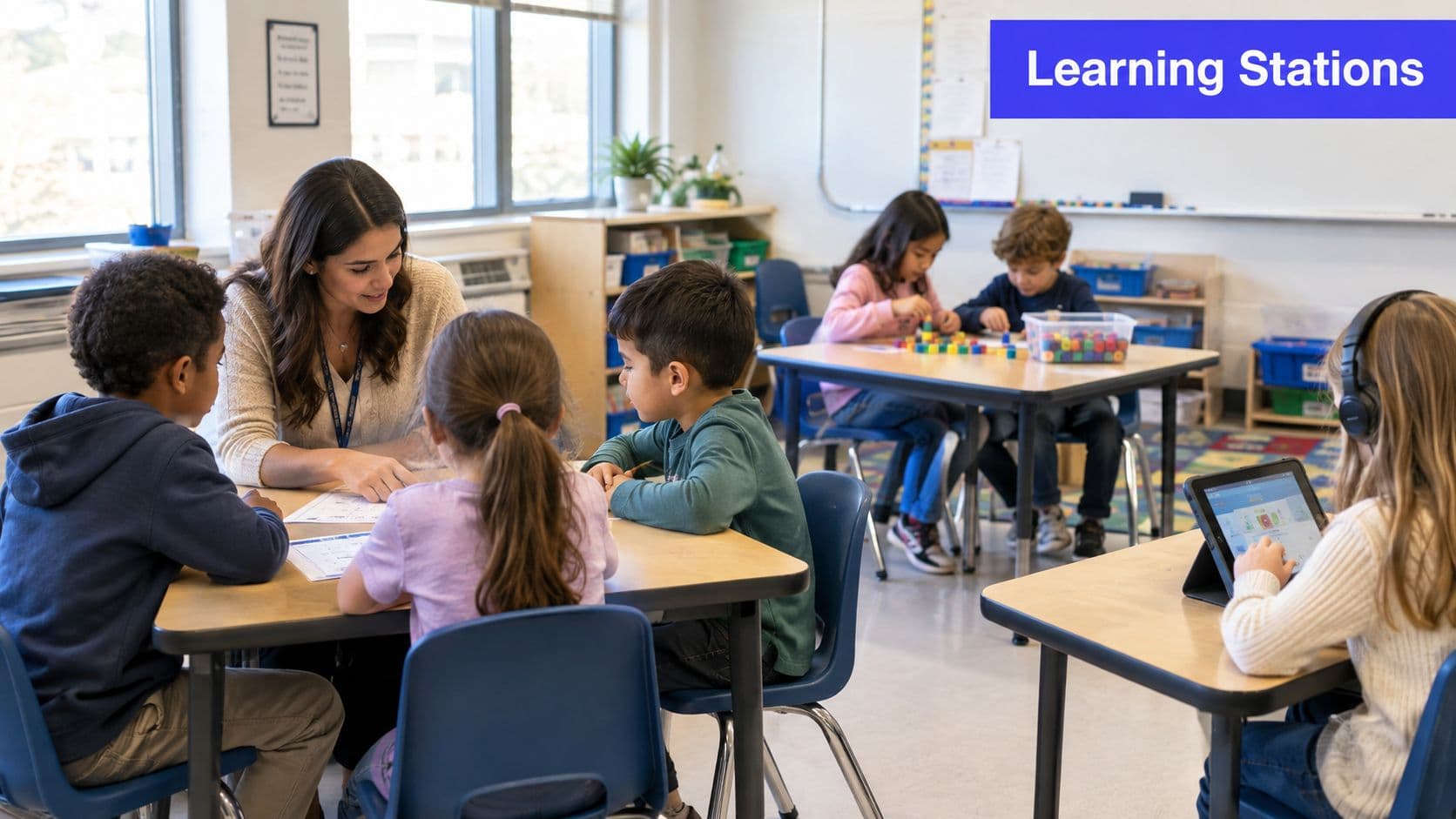
The management system matters as much as the activity design. Post a visual rotation schedule, place task cards at each station, and teach students how to collect materials, ask for help, and reset the space. One station should usually be teacher-led for precise instruction. The remaining stations need independent directions, not tasks that require you to answer questions every minute.
Keep rotations manageable
Use a mix of hands-on, digital, collaborative, and individual work, but don't introduce every format at once. Start with a small number of predictable routines and expand after students can transition calmly. Early practice may feel slow, but it prevents repeated interruptions later.
A clear chart or timer helps students see what comes next. Kuraplan can support preparation by generating differentiated worksheets, station task cards, and visuals aligned to the objective.
The video below offers another practical look at organizing differentiated classroom activity.
3. Choice Boards and Menus
A choice board gives students several ways to practice or demonstrate the same learning. The format might be a grid, menu, or tic-tac-toe board, but the instructional test is simple. Every option must still require students to use the target knowledge or skill.
For reading comprehension, students might write a character letter, create a comic strip, record a podcast review, design a poster, write an alternate ending, or produce a book trailer. A math menu could offer word problems, student-created problems, a game, digital practice, or a real-world scenario. In social studies, students might create a newspaper article, documentary, infographic, interview, or model.
The freedom needs boundaries. Give students a checklist or learning contract, and use one rubric focused on the standard rather than the appearance of the final product. A podcast and an essay can be assessed with the same criteria if both require a clear claim, accurate evidence, and explanation.
Prevent choice overload
Some students become more anxious when presented with a large menu. Start with binary choices, such as “write a response or record an explanation,” then increase the range as students learn to plan and self-assess. Include solo, partner, and group options, but make collaboration a choice only when the task can support it.
Choice also changes the product without changing the learning expectation. That distinction protects rigor. Kuraplan can help generate aligned activity descriptions, worksheets, and rubrics for several pathways, so you can spend more time conferencing with students about the quality of their thinking.
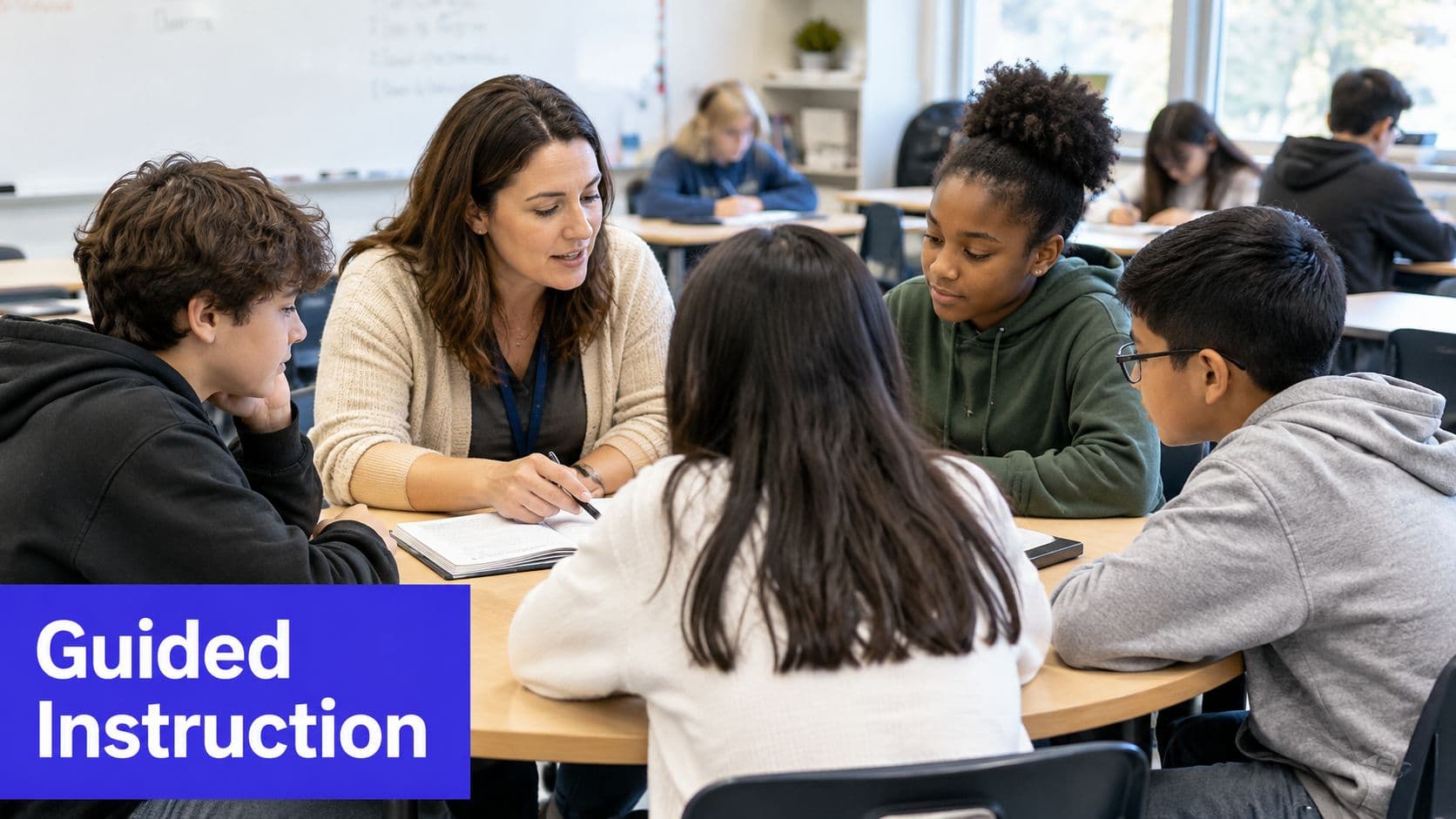
4. Small-Group Guided Instruction
Small-group instruction works best when the group has a clear instructional reason for existing. You might gather students who need to practice regrouping in addition, readers who need support with inference, or early learners who need explicit phonics work. The group shouldn't exist because students were placed there at the beginning of the term.
A guided reading group can work with you while classmates read independently or complete literacy stations. In math, you can model a strategy, guide practice, and listen for misconceptions before students return to independent work. The smaller setting gives you more opportunities to ask specific questions and respond immediately.
Use a repeatable teaching cycle
Keep the routine familiar: quick review, teacher modeling, guided practice, student attempt, and a brief check for understanding. Short, frequent meetings are usually easier to sustain than occasional extended sessions. The rest of the class must also have accountable work, such as a station task, choice board, or independent practice menu.
Use running records, exit tickets, observation notes, and student work to decide the group focus. The U.S. Department of Education guidance on data-driven differentiation emphasizes varying content focus, instructional time, and scaffolding according to reading proficiency. It also recommends progress monitoring in Tier 2 weekly when possible and at least monthly, which reinforces the need for a recurring assessment and adjustment cycle.
Kuraplan can help you prepare differentiated practice pages and small-group materials, but the data from your classroom should determine what you teach next.
5. Anchor Activities and Independent Practice Menus
Anchor activities protect instructional time when students finish early, arrive before the lesson begins, or wait while you work with a small group. They're not a holding pattern. A good anchor task reinforces priority skills, develops independence, and gives students a clear next step without requiring teacher intervention.
A reading menu might include independent reading, a book graphic organizer, a reading journal, or an audiobook response. Math options could include fact fluency, geometry pattern exploration, logic puzzles, or a digital practice activity. Writing anchors might use journal prompts, story starters, story dice, or a publish-ready template.
The strongest anchor activities are familiar enough to begin independently but varied enough to remain worthwhile. Display the menu visually and keep a completion log so you can see what students are choosing. If students repeatedly select only the easiest option, use a conference to teach them how to balance comfort with productive challenge.
Make independence the design requirement
Students shouldn't need you to explain the directions, find the materials, or decide what counts as finished. Include low-prep choices such as reading and digital practice alongside printables and manipulatives. Rotate the menu periodically, while keeping a few dependable options for students who benefit from predictability.
Introduce the routine explicitly, model it, and rehearse it until students can transition without interrupting guided instruction. Kuraplan can help you create and print differentiated anchor worksheets and task cards, which you can organize in a reusable folder by subject or standard.
6. Learning Contracts and Personalized Learning Pathways
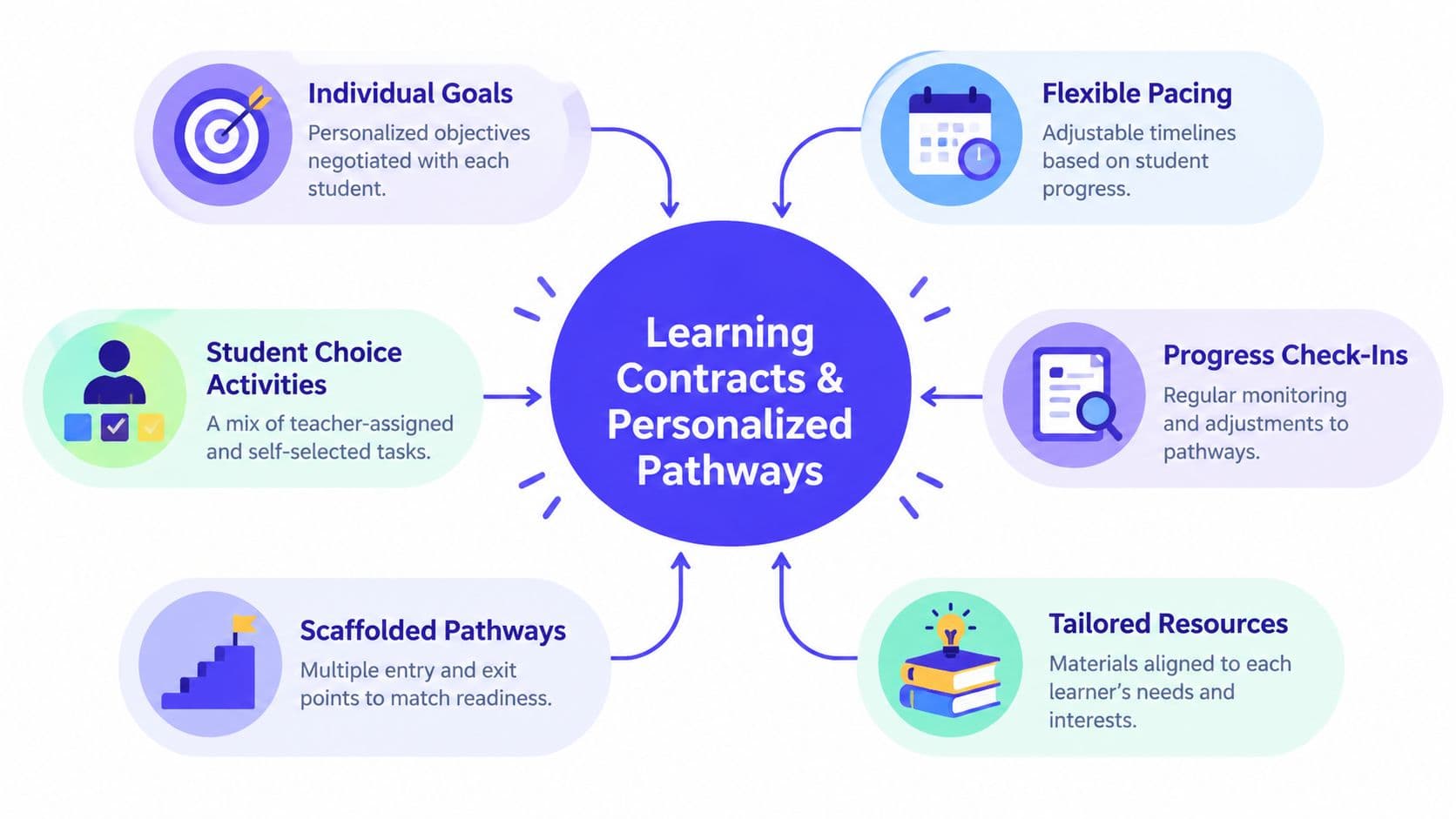
Learning contracts make expectations visible for students who need a more individualized sequence. A contract can identify the objective, required work, available choices, timeline, and evidence of learning. It's particularly useful when students are working at different entry points or need to manage a longer project.
A student reading above grade level might choose advanced texts, complete a comparison project, and participate in a student-led book discussion. A student developing multi-digit multiplication could follow a pathway through scaffolded practice, strategy explanations, and application tasks before moving to division. In middle school, a student interested in environmental science might plan a small independent study with milestones, research expectations, and a presentation.
Don't begin with a complicated long-term plan. Start with a short contract that includes essential work and one meaningful choice. Meet regularly to review progress, identify barriers, and adjust the sequence. Students need instruction in self-assessment, not just a form asking them to manage themselves.
Keep the teacher in the pathway
A clear visual tracker helps students see what they've completed and what comes next. Check-ins can be brief, but they should examine actual work and understanding rather than ask whether the student is finished. For younger learners, use a learning menu with teacher conferences instead of expecting a fully independent pathway.
Kuraplan can generate worksheets, rubrics, and lesson materials for different pathways, helping you prepare variations without building every resource from scratch. The contract still needs your judgment about readiness, accommodations, pacing, and the level of independence a student can handle.
7. Flexible Grouping and Regrouping
Flexible grouping means students move between groups as the purpose of the lesson changes. A student might work in a readiness-based reading group, a heterogeneous science team, and an interest-based math project group in the same week. That reflects how real learner needs vary by subject and skill.
A literature review describes flexible grouping as “not permanent or static,” with groups changing in response to periodic needs for different lessons and activities. Classroom studies also describe teachers grouping according to curriculum content, observations of individual needs, and student interest or choice. Read more about the research on flexible grouping before designing a system that treats groups as fixed ability tracks.
Group by purpose, then explain the purpose
Use assessment data, observation, interest surveys, and social considerations. Tell students why the current group exists: “This group is practicing commas,” or “This team chose the marine ecosystem topic.” Avoid labels such as “low group” and “smart group,” because they turn a temporary instructional arrangement into an identity.
Regroup when new evidence shows a different configuration would help. Keep materials ready for more than one readiness level, especially when students shift during a unit. Kuraplan's group generator can help organize group options and prepare differentiated resources, but it shouldn't replace your knowledge of relationships, confidence, language, or support needs.
8. Differentiation by Learning Modality
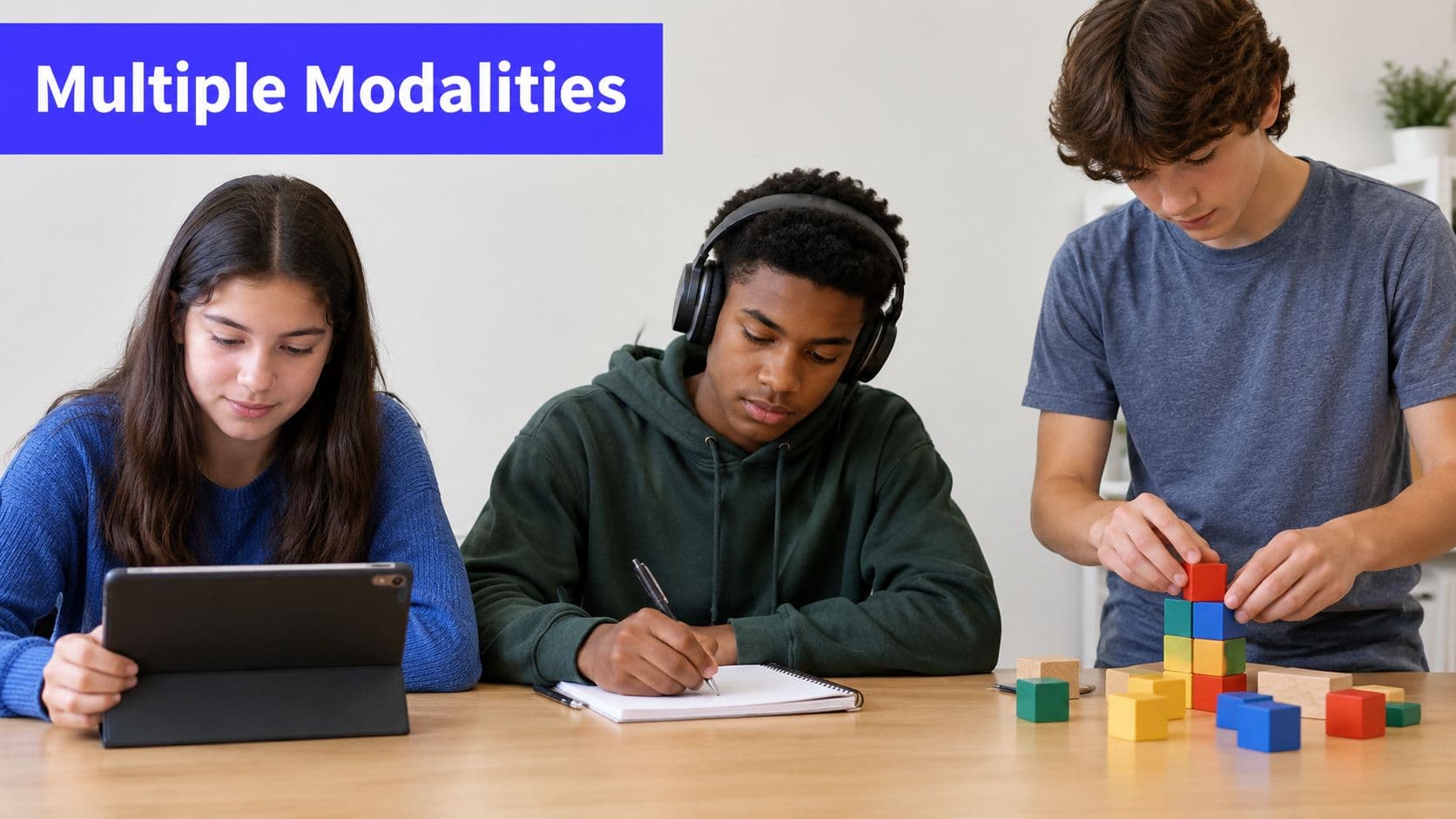
Offer information through visual, auditory, and kinesthetic routes, but don't reduce students to one permanent “learning style.” Most students use multiple modes, and learners benefit from building skill across them. The practical aim is to create several entry points and response options.
For fractions, students might examine fraction bars, talk through relationships with a partner, and physically divide objects into equal parts. In a photosynthesis lesson, a diagram and captioned video can support visual access, discussion can support oral processing, and a body-based model or lab can make the sequence tangible. Vocabulary instruction can combine a word and image, pronunciation and context, and a gesture or action.
The CAST UDL Guidelines organize inclusive lesson design around Engagement, Representation, and Action and Expression. In version 3.0, the framework expands to 9 guidelines and 35 considerations, offering more concrete planning prompts around choice, challenge, feedback, and accessibility supports, as described in this overview of CAST's UDL Guidelines 3.0.
Make access explicit
CAST also recommends customizing how information is displayed, providing alternatives for auditory and visual information, and using multiple media for communication, as shown in its UDL graphic organizer. Those mechanics can become ordinary classroom choices, such as reading, listening, viewing, manipulating, discussing, or drawing.
Use captions and transcripts when students watch videos or listen to audio. Resources on captions for student engagement can help you plan more accessible participation. Kuraplan can generate diagrams and visuals, while its audio read-aloud tool can support listening access and multimodal stations.
9. Compacting and Acceleration
Compacting begins with evidence that a student already understands part of the planned instruction. Instead of requiring repeated practice, you document mastery and use the released time for deeper application, advanced content, or a more complex product.
A third grader who demonstrates mastery of single-digit multiplication facts might move into multi-digit multiplication, strategy comparison, and real-world applications. A strong reader can shift from literal comprehension questions to literary analysis, inference, and critical evaluation. A student who understands fractions can apply them to probability, ratios, or proportional reasoning.
Compacting isn't the same as assigning extra pages. It should replace work the student has already mastered with work that increases depth or complexity. Students still need accountability through a performance task, conference, rubric, or other evidence.
Compact thoughtfully
Use a pre-assessment or performance task that measures the actual target, not a quick guess based on completed work. Explain the decision to families so they understand why the student is following a different path. Also consider the social side. Advanced learners still need belonging and meaningful opportunities to work with classmates.
The practice requires ongoing monitoring. A student may demonstrate mastery of computation but still need support explaining reasoning or applying the skill in an unfamiliar setting. Kuraplan can help create pre-assessments, extension tasks, and rubrics, while you decide whether the evidence supports acceleration and what enrichment will be worthwhile.
10. Differentiation by Interest and Student Choice
Interest-based differentiation gives students a meaningful reason to invest in a shared objective. It can change the topic, resource, format, or project pathway while keeping the standard and success criteria clear. This lever is especially useful in research, writing, inquiry, and application work.
During an ecosystems unit, students might select a rainforest, desert, Arctic, or other ecosystem for research. In persuasive writing, they could choose a cause they care about and produce a letter, opinion article, campaign, or proposal to the principal. In history, students might select a time period, person, or event and decide whether to present their learning through a speech, documentary, display, or written analysis.
Research suggests that teachers commonly use flexible grouping, tiered tasks, and adjustments to time or method, while differentiation by topic or interest appears less common. Recent research on the underused interest and topic dimension of differentiation points to a practical gap. Teachers often know what generic differentiation looks like, but need lower-prep ways to personalize topics without losing coherence.
Put guardrails around choice
Begin with a bounded menu connected to the unit. Use planning templates, checkpoints, and a common rubric so student interest doesn't become an excuse for incomplete work. Ask students directly through surveys or conversations rather than assuming you know what motivates them.
Choice should widen engagement, not widen confusion. Kuraplan can help create project menus, task descriptions, and aligned rubrics for several interest-based pathways while keeping the objective visible.
10 Differentiation Strategies Comparison
| Method | Implementation complexity 🔄 | Resource requirements ⚡ | Expected outcomes ⭐ | Ideal use cases 📊 | Key advantages 💡 |
|---|---|---|---|---|---|
| Tiered Instruction | High, careful assessment and tier design | Moderate, materials for multiple levels; planning time | Ensures grade‑level access with scaffolded challenge | Mixed‑ability, standards‑based units | Maintains high expectations; scalable differentiation |
| Learning Stations & Rotations | High, setup, routines, and transition management | High, multiple stations, space, timers, materials | Increased engagement; more targeted teacher time | Practice, multimodal lessons, center-based classrooms | Maximizes instructional time; varied modalities |
| Choice Boards & Menus | Moderate, design choices and common rubrics | Moderate, varied activity resources; grading time | Greater motivation and student ownership | Reinforcement, projects, differentiated practice | Promotes autonomy; differentiates without labels |
| Small‑Group Guided Instruction | Moderate, requires independent work systems | Low–Moderate, focused materials for groups | Improved skill mastery via timely feedback | Remediation, targeted skill instruction, guided reading | Precise diagnosis; responsive teaching |
| Anchor Activities & Independent Menus | Low, set routines and clear expectations | Low, reusable, low‑prep tasks | Reduced downtime; consistent practice opportunities | Early finishers, transitions, independent practice | Builds independence; frees teacher for focused instruction |
| Learning Contracts & Personalized Pathways | Very high, individualized planning and monitoring | High, tracking systems, custom materials | Strong ownership; tailored growth and pacing | Self‑directed learners, long‑term projects, acceleration | Maximizes agency; individualized progress pathways |
| Flexible Grouping & Regrouping | Moderate, ongoing data review and regrouping | Moderate, materials for multiple groupings | Responsive instruction across subjects and time | Classrooms with variable readiness by subject | Prevents permanent labels; targets needs promptly |
| Differentiation by Learning Modality | Moderate, design multimodal lessons and supports | Moderate, visual, auditory, kinesthetic materials | Broader engagement and improved retention | Lessons benefiting from multisensory approaches | Supports UDL; accessible for diverse learners |
| Compacting & Acceleration | Moderate, accurate pre‑assessment and planning | Low–Moderate, pretests and meaningful extensions | Eliminates redundancy; advances learning for ready students | Gifted/advanced learners; students with prior mastery | Efficient use of time; maintains challenge |
| Differentiation by Interest & Choice | Moderate, curate options and flexible rubrics | Moderate, diverse resources; varied assessment | Higher relevance, engagement, and motivation | Project‑based units, research, choice projects | Leverages student passion; increases engagement |
Start With One Change This Week
Differentiation works best as responsive design, not as a promise to create a separate lesson for every student. You're adjusting the route while preserving a meaningful destination. Sometimes the adjustment belongs in the content, such as a visual explanation or accessible text. Sometimes it belongs in the process, such as guided practice, flexible grouping, or a station. At other times, students need a different product or a learning environment that supports quiet focus, movement, collaboration, or assistive access.
Start with one objective this week. Give students a quick formative check before or during the lesson. Look for the specific barrier, not just the score. A student may understand the concept but struggle to read the directions, organize a response, sustain attention, or explain thinking without a model.
Then make one adjustment. Create a scaffolded version of the task, add a choice of response format, regroup students for a short guided lesson, offer an anchor activity while you teach, or change the seating and materials. Review the work before the next lesson and ask what the evidence tells you. Keep the adjustment if it helped, revise it if it didn't, and remove support when students no longer need it.
The most sustainable classroom differentiation strategies become reusable routines. Build a bank of tiered tasks, sentence frames, graphic organizers, accommodations, guided practice structures, choice menus, station directions, group lists, and anchor activities. Organize them by standard or skill so the next planning cycle starts with materials you can adapt rather than a blank page.
School-wide conditions matter, too. Review-level research indicates that long-term and large-scale evidence remains limited, with implementation often affected by time, resources, diagnostic assessment, professional development, leadership, and collaboration. A recent review of sustainable differentiated instruction supports a broader view. Differentiation isn't only an individual teacher technique. It becomes more durable when teams share planning practices, use common progress-monitoring routines, and protect time for professional learning.
Kuraplan can fit into that preparation system by helping teachers create differentiated lesson materials, worksheets, visuals, and rubrics. Use it to produce a starting set of variations, then check the language, alignment, accessibility, and level of challenge yourself. The teacher remains responsible for interpreting student evidence and deciding what support is appropriate.
You don't need to redesign the whole classroom tomorrow. Choose one lesson, one learner barrier, and one practical lever. A small adjustment that you review carefully is more useful than an elaborate system you can't sustain.
Kuraplan helps K–12 teachers create standards-aligned lessons, differentiated worksheets, educational visuals, and rubrics for varied learners. Visit Kuraplan to turn one upcoming lesson into practical content, process, product, or environment options you can use this week.