Rock cycle diagram
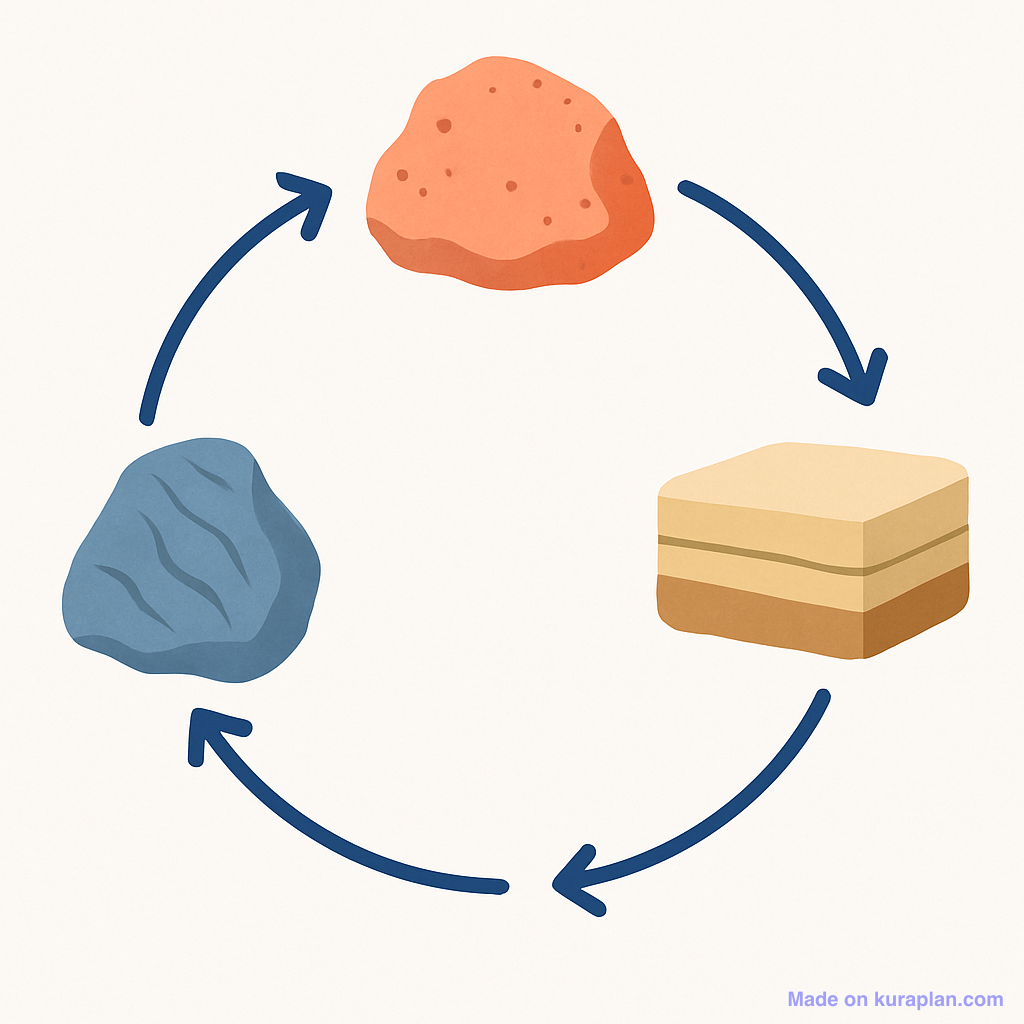
A labeled diagram of the rock cycle, a simplified version for younger classes, and a blank one for students to fill in — all free to download and print.
In one sentence: the rock cycle is how igneous, sedimentary and metamorphic rock turn into one another — melting and cooling, weathering and erosion, burial and compaction, heat and pressure — in a loop with no beginning and no end.
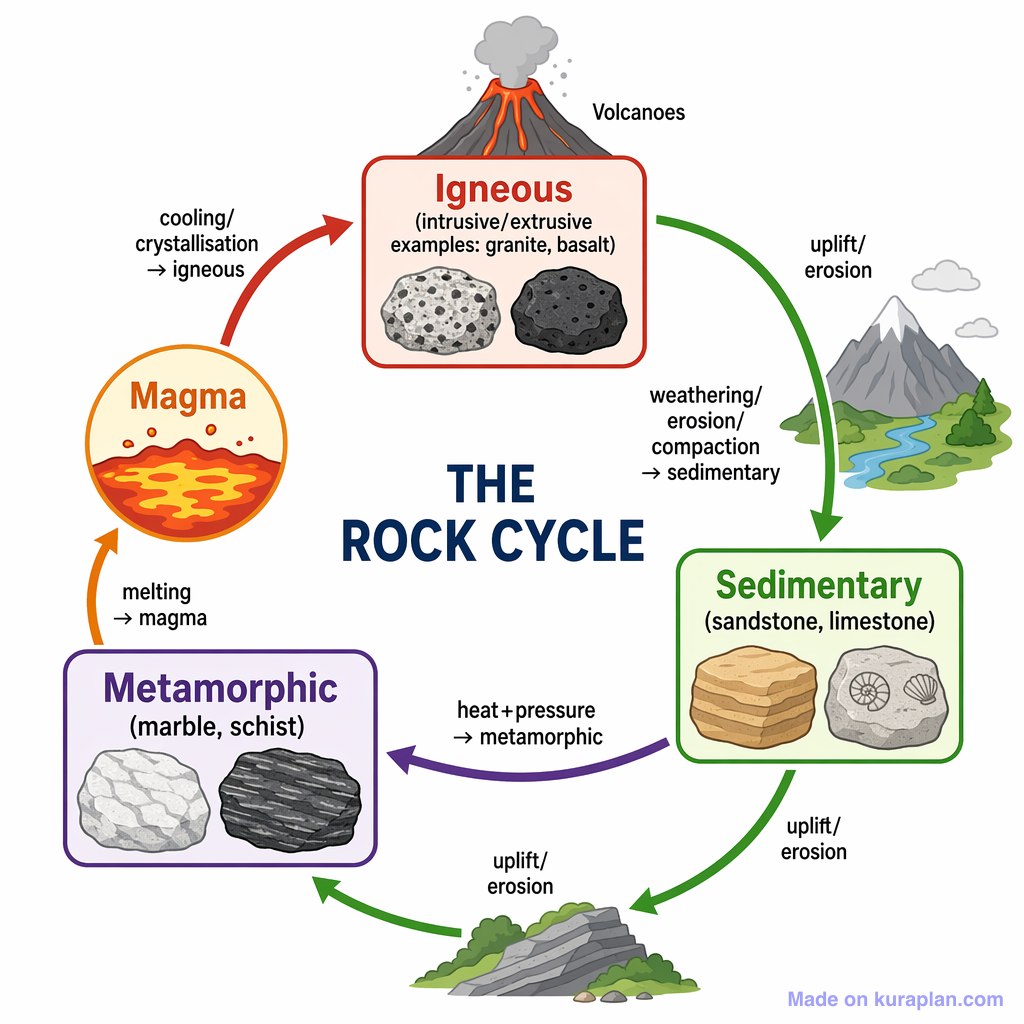
The labeled rock cycle: three rock types plus magma, with the process on every arrow. Click to download the full-size image.
The three rock types
Every rock on Earth is one of these three. What separates them is not what they are made of but how they formed.
Igneous
Molten rock cools and crystallises. If it cools slowly underground, the crystals grow large; if it erupts and cools quickly at the surface, the crystals are tiny or absent altogether.
Examples: Granite (slow, deep, large crystals), basalt (fast, at the surface), obsidian, pumice
How to spot it: Interlocking crystals and no layers. The name comes from ignis, Latin for fire.
Sedimentary
Loose sediment — sand, mud, shell fragments — settles in layers, then compaction squeezes the water out and cementation glues the grains together.
Examples: Sandstone, limestone, shale, conglomerate
How to spot it: Visible layers, often gritty, and the only rock type that can contain fossils.
Metamorphic
An existing rock is changed by heat and pressure without ever melting. The minerals recrystallise in the solid state, often lining up into bands.
Examples: Marble (from limestone), slate (from shale), schist, gneiss
How to spot it: Banding or a tendency to split into sheets, and crystals that look squashed or aligned.
The processes on the arrows
The boxes in the diagram are the rock types. The arrows — the part students most often skip — are these six processes.
| Process | Turns | Into | What happens |
|---|---|---|---|
| Melting | Any rock | Magma | Rock pushed deep enough gets hot enough to melt, becoming magma. This is the step that resets the cycle. |
| Cooling and crystallisation | Magma | Igneous rock | Magma cools, minerals crystallise, and the melt solidifies. Cooling speed decides the crystal size. |
| Weathering and erosion | Any rock at the surface | Sediment | Weathering breaks rock apart where it stands; erosion carries the pieces away. They are two different jobs, which is the distinction most exam questions are testing. |
| Deposition, compaction and cementation | Sediment | Sedimentary rock | Sediment is dropped, buried under more layers, squeezed until the water is forced out, and then cemented by minerals crystallising between the grains. |
| Heat and pressure | Igneous or sedimentary rock | Metamorphic rock | Burial or tectonic collision applies heat and pressure. The rock changes while staying solid — if it melts, it has left this path and become magma. |
| Uplift | Buried rock | Rock at the surface | Tectonic movement raises deep rock back to the surface, where weathering can reach it again. |
Reading the diagram in one loop
- 1Start at magma, molten rock beneath the surface.
- 2It cools and crystallises — now it is igneous rock.
- 3At the surface, weathering breaks it apart and erosion carries the fragments away as sediment.
- 4The sediment is deposited in layers, compacted under the weight above, and cemented into sedimentary rock.
- 5Buried deeper, heat and pressure recrystallise it — without melting — into metamorphic rock.
- 6Deeper still, it melts back into magma, and the loop begins again.
That is one lap, but it is not the only route. Any rock can melt, any rock at the surface can be weathered, and any buried rock can be metamorphosed — which is why the diagram has arrows through the middle as well as around the rim.
Simple and blank versions
Use the simple diagram to introduce the cycle, and the blank one as the assessment — hand it out and have students add the rock types and the process on each arrow from memory.
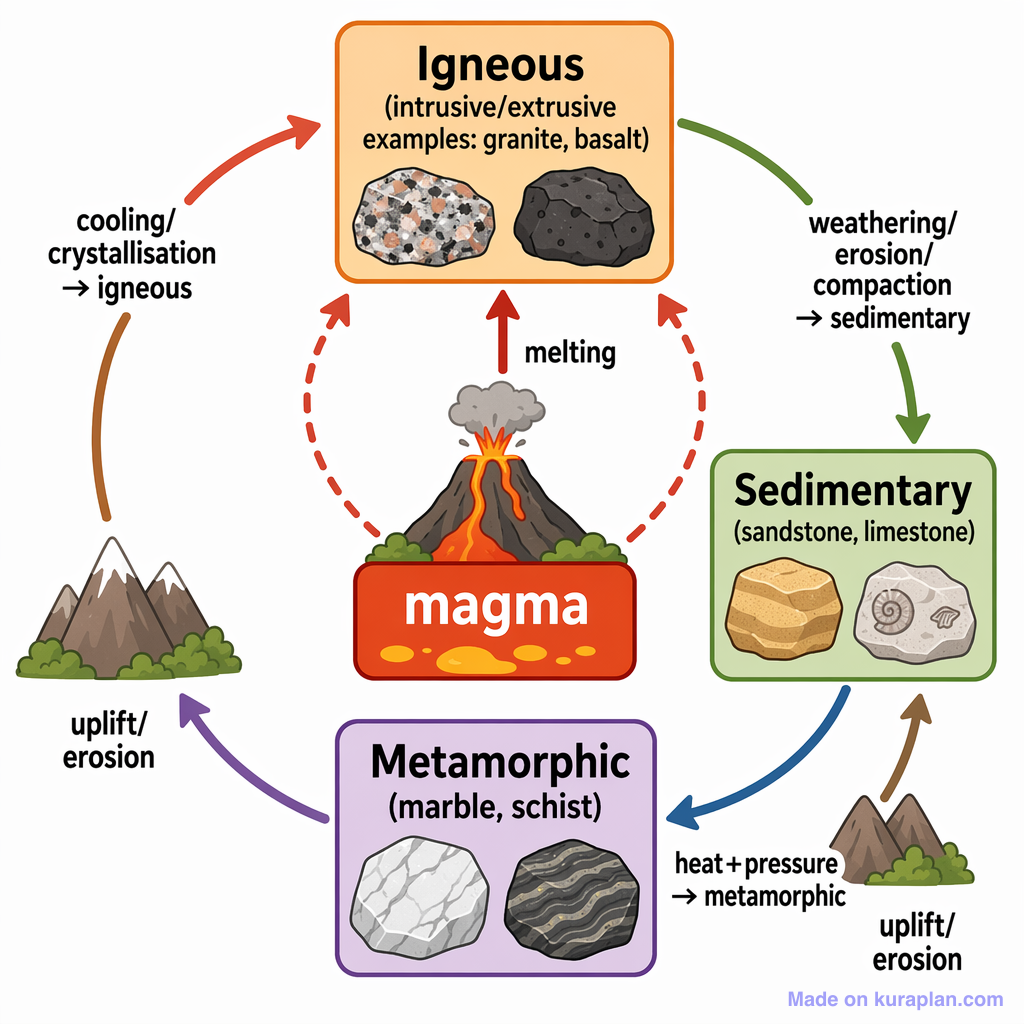
Rock cycle diagram poster
A print-ready classroom poster version of the diagram.
Four mix-ups worth heading off
Mix-up: The cycle runs in one direction, like a clock.
It does not. The arrows cross the middle as well as running around the edge: a sedimentary rock can be buried and become metamorphic, or melt straight to magma, or be weathered back into fresh sediment. The circle is a convenient drawing, not a fixed running order.
Mix-up: Metamorphic rocks are melted rocks.
Metamorphism happens in the solid state. Heat and pressure rearrange the minerals without turning the rock to liquid — the moment it melts it is magma, and whatever forms next is igneous.
Mix-up: Weathering and erosion are the same thing.
Weathering breaks rock down in place. Erosion transports the loosened material somewhere else. A diagram arrow labelled only 'erosion' is skipping a step.
Mix-up: Every rock passes through all three types in turn.
A rock can skip stages entirely, or repeat one many times. Some rock has been recycled through the cycle repeatedly; some igneous rock at the surface today has never been anything else.
Rock cycle questions
What is the rock cycle?
The rock cycle is the set of processes that turn the three rock types — igneous, sedimentary and metamorphic — into one another over geological time. Rock is melted, cooled, broken down, buried, compacted, heated and squeezed in a continuous loop, so the material making up rock today has been recycled many times.
What are the three types of rock in the rock cycle?
Igneous rock forms when molten rock cools and crystallises. Sedimentary rock forms when sediment is deposited in layers, then compacted and cemented. Metamorphic rock forms when an existing rock is changed by heat and pressure without melting.
How do you read a rock cycle diagram?
Read the boxes as the rock types and the arrows as the processes that change one into another. Start anywhere — say magma — and follow an arrow: magma cools and crystallises into igneous rock; that rock is weathered and eroded into sediment; the sediment is compacted and cemented into sedimentary rock; burial applies heat and pressure to make metamorphic rock; more heat melts it back to magma. The arrows across the middle matter as much as the ones around the edge.
What is the difference between weathering and erosion?
Weathering breaks rock down where it sits, by frost, rain, chemicals or plant roots. Erosion is the transport of the loosened fragments by water, wind or ice. Weathering happens first and stays put; erosion moves the material to where it can be deposited.
Which rocks can contain fossils?
Only sedimentary rocks realistically preserve fossils. Remains are buried gently in accumulating sediment, so they survive. The heat and pressure of metamorphism destroys them, and igneous rock forms from melt that nothing organic survives.
What drives the rock cycle?
Two energy sources. Heat from inside the Earth drives melting, tectonic movement, burial and uplift. Energy from the Sun drives the weather and water movement that cause weathering, erosion and deposition at the surface.
Is the rock cycle diagram free to print?
Yes. The diagrams on this page are free to download and use in class, and there is a printable rock cycle poster as well. A blank, unlabeled version is included so students can label it themselves.
More free science diagrams
Create your own the rock cycle lesson in seconds
Kuraplan's AI builds curriculum-aligned lessons, worksheets and slides - free to try.