You're in the middle of a normal school day. A student asks a question in front of the class, a parent email needs to go out before lunch, and your lesson notes still need one more pass before you share them. In moments like that, inclusive language can feel small, but it's usually the small phrases that decide whether a student feels noticed, boxed in, or fully included. The strongest examples of inclusive language are not complicated. They're the everyday words teachers use for greetings, family references, disability support, identities, and classroom routines.
The good news is that inclusive wording has already become standard practice in many institutions. Style guidance from the American Psychological Association's inclusive language guidance and university resources like Northwestern's inclusive language guide show how language choices now shape everything from person-first disability wording to identity-aware descriptions. In K–12 classrooms, that matters because students hear our language all day long, and they absorb its assumptions just as quickly as they absorb the content.
These examples of inclusive language are built for real classroom use. You can use them in lesson delivery, IEP and support notes, family communication, and curriculum planning, then adjust them to fit your students and community.
1. Using Students or Learners Instead of Guys or You Guys
“Guys” slips out fast. It shows up in transitions, praise, and quick directions because it sounds casual and familiar. The problem is that it also smuggles in a gendered assumption, even when the class includes students who don't see themselves in that word.
Use students, learners, everyone, class, or folks instead. These phrases keep the same pace without making any student the exception. They also sound natural once you've practiced them for a few days, which is why many teachers find the first week the hardest and the second week much easier.

Classroom swaps that work
- “Alright everyone, line up for lunch.” This replaces “Alright guys, line up for lunch” without changing the rhythm.
- “Class, you did great on that assignment.” This keeps praise focused on the group, not on gender.
- “Learners, please grab your materials.” This works well in elementary and middle school because it sounds calm and clear.
A sticky note near your desk helps during the first few weeks. So does saying the phrase aloud while you plan. If you use Kuraplan to draft classroom routines or expectations, review the generated text and swap in inclusive collective nouns before you print or share it. You can reinforce the language in your own voice, then watch students start using it with one another.
Practical rule: if the word is only there because it sounds informal, replace it with a neutral group term.
For a ready-made place to build those routines, Kuraplan's classroom expectations and agreements worksheet is a natural fit.
2. Using They Them Pronouns and Practicing Pronoun Inclusion
A teacher's pronoun routine sets the tone fast. If you share your pronouns in introductions, on slides, and in written materials, students see that pronouns are part of everyday respect, not a special announcement for one group of people. That works in elementary homeroom, middle school advisory, and parent-facing documents too.
The best practice is straightforward. Model your own pronouns, invite students to share theirs if they want to, and correct mistakes calmly without putting the student on display. The United Nations' gender-inclusive language guidance treats pronoun agreement as direct reference, and that fits classroom communication well because accuracy should sound normal, not theatrical.
A small routine helps more than a long explanation. Start with your own introduction, then give students a way to opt in if they want to share. On rosters, name tags, and seating charts, pairing names and pronouns can reduce guesswork, especially during the first weeks of school. Students should always be able to skip sharing if that feels personal or unsafe.
A few classroom moves that make pronoun inclusion stick
- Use your own intro first. “I'm Ms. Rivera, and my pronouns are she/her. What pronouns would you like me to use for you?”
- Model singular they in directions and writing. “Each student should bring their supplies” sounds natural in lesson plans, emails, and classroom routines.
- Pair names with pronouns where it helps. “Jordan, they/them” works on rosters, labels, and substitute plans.
- Keep sharing optional. Some students will want to share, some will not, and both choices deserve respect.
Mistakes will happen. The key is to correct them quickly, use the right pronouns, and move on without turning the moment into a class-wide event. That keeps the focus on accuracy and respect, and it also reduces the pressure on non-binary students to explain their identity to the room.
For teachers who want a ready-made classroom prompt, the Fantastic Fox pronouns worksheet fits neatly into early-year routines and can be used alongside name practice, community-building activities, or first-week slides. Kuraplan can also help you draft icebreakers and opening scripts, then you can check that pronouns are included clearly before you print or share them.
Share pronouns the same way you share your name, as part of ordinary classroom respect.
3. Replacing Boys and Girls with Students or Class
A teacher is lining up a class for recess and hears, “Boys and girls, get ready.” The phrase may feel routine, but it puts the room into a binary frame that leaves little space for students who are non-binary, gender-nonconforming, or still deciding how they want to be seen. In elementary and middle school, where identity language is still taking shape, that kind of wording can influence how students understand themselves and each other.
A better default is simple. Speak to the whole class without sorting children by gender unless gender is the actual topic. That approach fits broader institutional guidance, including APA's advice to use context-based identity terms and to avoid descriptors when they are not needed, and inclusive language resources that emphasize whether a descriptor should appear at all.
A few small wording swaps do a lot of work in daily classroom life.
Classroom language that keeps everyone in the room
- “Good morning, class.” This works in almost every setting and avoids the habit of saying “Good morning, boys and girls.”
- “Everyone should have a pencil.” This is clearer than a gendered call-and-response.
- “I need volunteers to help move desks.” This keeps the task open instead of implying who should help.
- “Line up by birthday month.” This replaces “Boys on this side, girls on that side” with a neutral direction that is easy for students to follow.
Teachers often notice these phrases only when they hear themselves on a recording or read them later in lesson notes. That is why it helps to review slides, scripts, and hallway directions with a quick eye for binary language before students see them. If you use Kuraplan to customize materials, check the output for gendered wording before you share it.
The pattern matters in the room as much as the individual phrase. When students hear neutral group language every day, they start using it with one another too. That shift is subtle, but it changes the tone of classroom conversations and makes the space feel more open to everyone.
4. Using Parents Guardians Caregivers Instead of Mom and Dad
A permission slip goes home. A parent email needs a quick update. A read-aloud prompt asks students to draw their family. Those everyday moments are where family language matters, because school templates often assume the same household structure even when the students in front of you do not live that way.
Using parents, guardians, or caregivers gives you wording that fits more homes and sounds more accurate in the classroom. It also signals that you are not treating one family model as the default. Students notice that difference quickly, especially when your notes, slides, and take-home messages reflect the people who support them. Guidance from Northwestern's counseling guide and related context-based recommendations points in the same direction, use the term that matches the situation instead of assuming “mom and dad” covers everyone.
A practical way to make that shift is to build it into the language you already reuse. Family communication, IEP notes, and homework directions often rely on the same wording for years, so a small edit there prevents repeated assumptions later. If you use inclusive education strategies in your planning, this is one of the places where careful wording supports access without adding extra work.
Ready-to-use phrases for school messages
- “Have a parent, guardian, or caregiver sign this.” This covers more family structures than “Ask your mom or dad.”
- “Draw the people in your family or household.” This avoids forcing a nuclear-family template onto an art assignment.
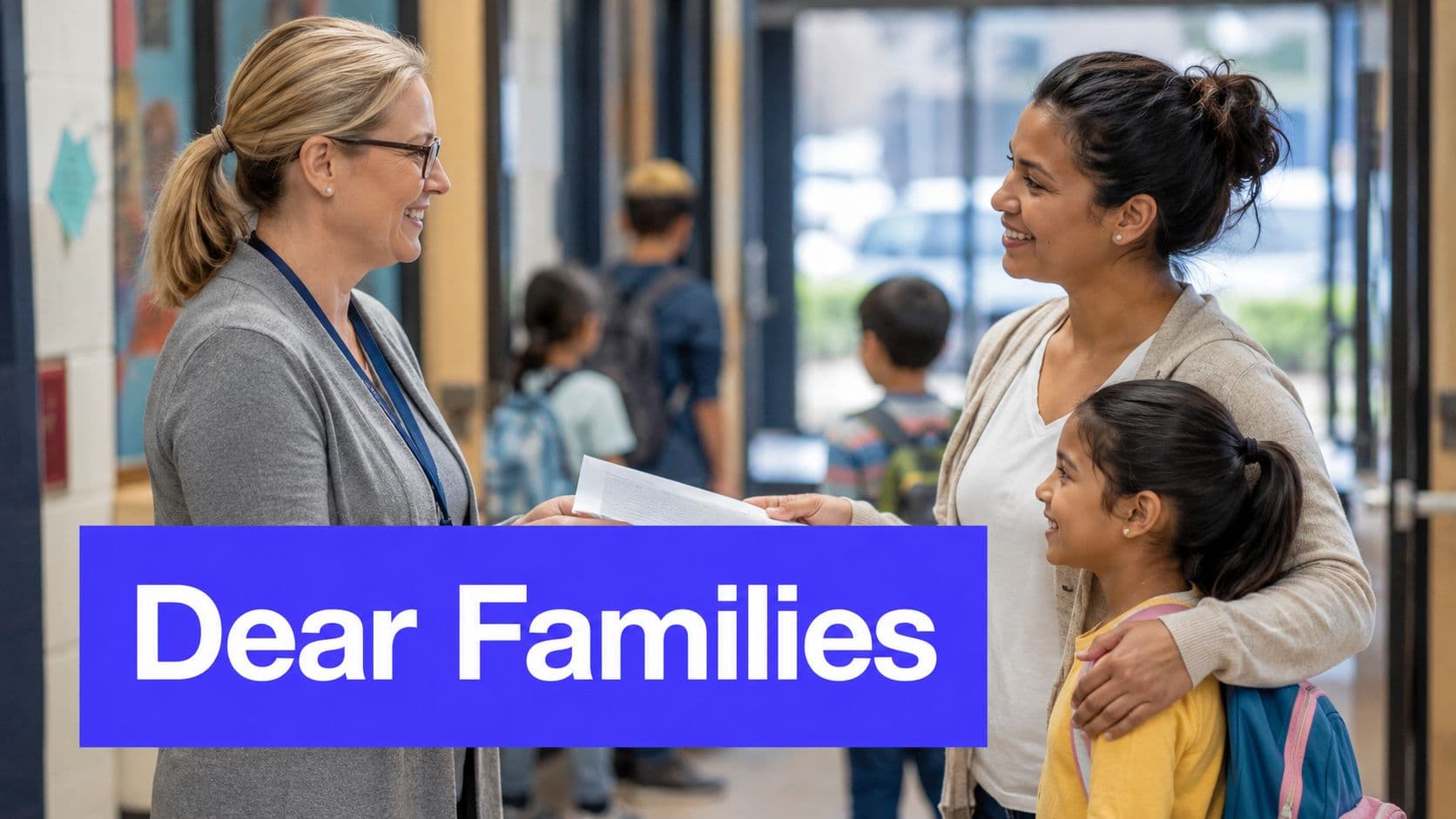
- “Dear Families and Guardians” works better than “Dear Parents” in most school communications.
- “Share today's learning with your family or caregivers.” This feels inclusive without sounding awkward.
Boilerplate language deserves a close look, because that is where assumptions usually hide. If you use Kuraplan to draft family engagement notes, parent communication templates, or take-home activities, revise the wording so it matches the students and families in front of you. That small adjustment can keep a routine message from implying that some homes are being treated as the exception.
Diverse family representation in read-alouds and curriculum examples matters too. When students see different family structures treated as ordinary, your language and your materials start saying the same thing.
5. Avoiding Ability-Based Language and Using People-First or Identity-First Language Appropriately
A quick comment in class can do more damage than you expect. Words like “crazy,” “insane,” “lame,” or “blind to the facts” turn disability into a metaphor or a punchline, and students who live with disability often hear that language as disrespect, even when no harm was intended. In a K-12 setting, the safer habit is to keep disability language precise and human.
The first decision is usually about preference. Use person-first language such as “student with a disability” when that matches the person's preference, or identity-first language such as “disabled student” when that is the form they use. Ask when you can, follow the student's or family's lead, and stay consistent once you know what they prefer. The University of Madrid's inclusive language guide makes the same point in Spanish by recommending forms like persona con discapacidad.
Better ways to say it in class
- “I struggled with that test.” This keeps the comment on your own experience instead of borrowing disability language as a metaphor.
- “I don't understand that choice.” This lets you respond clearly without calling a student “crazy.”
- “Do you prefer person-first language or identity-first language?” That question is direct, respectful, and usable in an IEP meeting or a family conversation.
- “What supports help this student learn?” This keeps the focus on access, not on what a student cannot do.
Support language works best when it names the adjustment instead of the shortfall. If a student needs a different format, extra processing time, or a quieter setting, say that plainly. Teachers who are building notes, lesson plans, or family updates can also check their phrasing against inclusive education strategies so the language matches the support being offered. For planning and differentiation, the differentiation teaching strategies guide is useful because it keeps the conversation on access, choice, and adjustment rather than deficit.
A final practical test helps here: if the sentence would sound harsh, careless, or childish in an IEP note, it probably should not be said aloud in class either. Teacher language sets the tone for how students talk to one another, how families hear the school, and how support services are described across the building.
6. Using Culturally Responsive Examples and Avoiding Cultural Stereotypes
A lesson can sound inclusive on the surface and still leave students out through the examples it uses. A math problem about a ski trip, a reading passage that only names one kind of family, or a science example that treats one cultural experience as the default all send a message about who belongs. Students hear that message fast.
The better option is to choose examples that fit the mix of your classroom and avoid turning any culture into a shortcut or a costume. Use names that reflect different backgrounds, include present-day Native perspectives instead of only historical references, and describe families, work, and traditions without forcing them into a single template. The same principle shows up outside the classroom too. A 2024 Australian policy case study on cervical screening shows that inclusive wording can be part of policy design, not just a style choice, by using lexicon changes and pronoun changes to make text more representative of women and gender-diverse people.
A quick check helps before you teach.
Ask three questions about the material in front of you. Whose perspective is centered, whose is missing, and which examples feel borrowed from somewhere else instead of drawn from real life? If the same cultural frame keeps showing up, students can spot the pattern even when the wording sounds polished. Partnerships with families and community members help catch those gaps because they notice details curriculum writers often miss. Teachers who use Kuraplan to draft lesson content can still revise the examples so they feel specific to their students, not generic. That same attention matters in other school systems too, including implementing inclusive wayfinding for multilingual families and visitors.
What to change in your materials
- Rotate the names you use. Use a wider mix in word problems, reading tasks, and discussion prompts.
- Include living Native communities. Keep Native representation in the present, not only in the past.
- Show more than one cultural lens. Bring in diverse mathematicians, scientists, writers, and community leaders.
- Check your defaults. A lesson does not always need the same family structure, the same trip, or the same set of assumptions about home life.
Teachers do not need to rewrite every lesson from scratch. Start with the texts and examples you already use, then notice what they normalize. If a pattern keeps placing one group at the center and everyone else at the edges, that is a signal to revise. Inclusive language becomes part of critical thinking when students learn to ask whose stories are present and whose are missing, and that is a habit they can use well beyond one unit.
7. Replacing Hearing Impaired with Deaf or Hard of Hearing as Preferred
A student may use a hearing aid, may communicate through ASL, or may identify with Deaf culture, and “hearing impaired” still misses the mark. The phrase centers loss first, which is why many Deaf people and hard of hearing people prefer language that names identity or access directly. In classroom writing, Deaf or hard of hearing, used according to the student's or family's preference, is usually the stronger choice.
The practical issue is not just wording. A label can shape how teachers write notes, describe support needs, and talk with families. If the language feels generic or clinical, it can flatten a student's identity and send the wrong signal about belonging. A direct, respectful label does the opposite.
Use the label the person uses
- Say “Deaf student” or “hard of hearing student.” Keep “hearing impaired student” out of routine classroom language unless that is the term the person prefers.
- Ask students and families how they identify. A device, an IEP, or an accommodation does not tell you the whole story.
- Treat Deaf culture as culture. Include Deaf authors, ASL, and Deaf community contributions when they fit the lesson.
- Make access ordinary. Interpreters and CART are part of participation, not something to spotlight.
Teachers can also use this language in lesson content. If Deaf people only show up as examples of limitation, students get a narrow message about what Deaf lives look like. If they appear as authors, artists, leaders, and community members, the classroom language starts reflecting reality more accurately.
A helpful test is simple. Read your own sentence and ask whether it describes the student as a person with a preferred identity, or as a problem to be managed. That check works in discussion posts, IEP notes, emails, and classroom handouts alike. It also fits the broader habit of respecting how people name themselves, which keeps your language consistent across different school settings.
8. Using Inclusive Language Around Socioeconomic Status and Avoiding Assumptions About Family Resources
A lot of exclusion shows up in ordinary assignment language. “Ask your parents to buy poster board,” “everyone has internet at home,” or “bring $20 for the trip” can turn access into a quiet test of who has the right materials, time, or money. Students who do not have those resources do not need a public reminder that their situation differs from the one the class seems to assume.
The goal is not to avoid mentioning resources altogether. The goal is to state what students need without assuming what their families can provide. That means naming alternatives, supplying materials at school, and checking homework directions for hidden costs or home requirements. It also means looking at examples, project choices, and fieldwork language with a practical eye, because small wording choices can create a barrier before the work even starts.
A simple classroom test helps here: if a task depends on money, transportation, a printer, or home technology, say so plainly and offer another path. That can be as direct as a sentence in an assignment, a note in an email, or a reminder in a family message. If you use Kuraplan to build activities, review whether the prompt assumes a device, a fee, or a paid outing, then adjust the wording or add a school-based option.
Better alternatives for everyday teacher language
- “Poster board will be provided.” This works better than asking families to purchase it.
- “Here are materials you can use.” This keeps the task intact without assuming supplies at home.
- “We have scholarships available if cost is a barrier.” That language is direct and nonjudgmental.
- “Describe a time you explored something new in your community.” This avoids requiring travel or paid experiences.
Short wording like this matters because it keeps the focus on the learning task, not on what a student may lack at home.
These choices also help in places teachers do not always think to review, like project directions, digital assignment instructions, and notes sent to families. A sentence that seems neutral can still assume a printer, a stable device, or an adult available to help after school. In lesson planning, inclusive language means checking for those assumptions before they become a reason a student cannot participate. For a useful comparison of how mission-driven organizations describe access and support, teachers can also compare nonprofit profiles on Alignmint, https://www.getalignmint.org/nonprofits/us/stem-is-for-everyone-inc-881896592.
Providing supplies, devices, and access as part of the plan keeps students from having to explain why they cannot complete an assignment in the way it was first written. It also makes the classroom message clearer. Participation should not depend on whether a student's home life matches the hidden expectations built into the wording.
9. Avoiding Gendered Expectations in Subjects and Careers
A student answers a math question quickly, and a teacher says, “You're so good at math, you must be a boy.” It may sound light in the moment, but the message is heavier than the joke. Students hear who is expected to belong in a subject, who is expected to lead, and who is expected to stay on the sidelines.
Inclusive language pushes back by keeping skill separate from gender. Name the work, the strategy, the curiosity, and the persistence. Make room in examples, praise, and career conversations for girls, boys, and non-binary students to see themselves in reading, writing, science, engineering, caregiving, and leadership.
One practical shift is to make your praise specific.
- “You used a strong strategy on that problem.” This keeps the focus on the student's thinking instead of gender.
- “We're studying female mathematicians and engineers alongside male authors and nurses.” This makes representation visible across subjects.
- “All students can be readers, writers, builders, and scientists.” This breaks the habit of sorting interests by gender.
- “Let's look at different career paths without sorting them by gender.” This works well in advisory, career day, and upper-elementary discussions.
- “What jobs do you notice here, and who could do them?” That question invites students to question stereotypes without making the lesson feel preachy.
The goal is not to erase gender from classroom life. It is to stop using gender as a shortcut for talent, interest, or future plans. Students pick up those signals quickly, especially in the small comments that come up during math groups, reading conferences, and career awareness lessons. Curricular variety matters too, because students need repeated examples that widen what feels possible. If you use Kuraplan to generate career examples or role-model prompts, check that the gender representation is spread across fields rather than clustered in one direction.
For nonprofit and community examples, the Alignmint profile on STEM representation is one useful point of reference for seeing how language and access connect in practice.
10. Using Affirming Language for LGBTQ+ Students and Creating Space for Diverse Family and Identity Structures
A hallway conversation, a family email, and a read-aloud can all send the same message, LGBTQ+ students belong here. That message matters because inclusion is not only about pronouns. It also includes the way teachers talk about families, identities, and relationships so those differences show up as normal parts of classroom life, not as exceptions that need special handling. Same-sex parents, transgender and non-binary identities, and many other family structures deserve the same matter-of-fact respect you would use for any other student experience.
The goal is ordinary belonging. Students notice quickly whether identity is treated as something to tiptoe around or something that can be named directly and respectfully. When LGBTQ+ representation appears in books, class discussions, and problem-solving contexts without fanfare, it feels less like a debate and more like part of the world students already live in.
Practical phrasing teachers can use
- “Each student's family looks different.” This works well when you want to open space for two dads, two moms, one parent, grandparents, foster families, or guardians without turning family structure into a separate lesson.
- “We're reading about LGBTQ+ people and their contributions.” Use this when you want inclusion to sound factual, not performative, especially in history, literature, or advisory.
- “This story includes same-sex families.” Say it plainly when the text calls for it. Clear language is often more respectful than vague wording.
- “Identity exploration is normal and healthy.” This can support emotional safety in advisory, counseling conversations, or other settings where students may need reassurance.
A classroom library can do a lot of quiet work here. Books with LGBTQ+ families or themes should sit alongside other everyday reading choices across grade levels, not be treated like special-interest materials that only appear when a teacher wants to make a point. Policies matter too, because words land differently when students also see clear anti-harassment expectations, visible allyship, and real partnerships with LGBTQ+ families and organizations.
Kuraplan can help when you are drafting discussion prompts or assignment text and want the representation to feel built in rather than added at the end. The strongest inclusive language does not single students out. It makes room for them before they have to ask.
Inclusive Language: 10 Examples Compared
| Practice | Implementation 🔄 | Resources & Training ⚡ | Expected Outcomes 📊⭐ | Ideal Use Cases 💡 | Key Advantages ⭐ |
|---|---|---|---|---|---|
| Using "Students" or "Learners" instead of "Guys" or "You guys" | Low, simple wording change; initial awkwardness | Minimal, practice and reminders | Improved everyday inclusion; quicker habit formation ⭐⭐ | Whole-group cues, transitions, verbal/written prompts | Immediate, low-cost inclusivity; models language for students |
| Using "They/Them" pronouns and practicing pronoun inclusion | Medium, routines plus consistent correction | Moderate, staff scripts, age-appropriate instruction | Strong affirmation for non-binary students; reduces misgendering ⭐⭐⭐ | Introductions, rosters, name tags, discussions | Direct mental-health and belonging benefits |
| Replacing "Boys and Girls" with "Students" or "Class" | Low–Medium, habit change and occasional family conversations | Minimal, audit materials, update phrasing | Validates non-binary students; simplifies management ⭐⭐ | Announcements, lining up, classroom instructions | Reduces exclusion; easy to adopt broadly |
| Using "Parents/Guardians/Caregivers" instead of "Mom and Dad" | Low, update templates and speech | Low–Moderate, revise communications and classroom prompts | Makes diverse family structures visible; increases engagement ⭐⭐ | Letters, permission slips, family-oriented assignments | Affirms varied family forms; reduces othering |
| Avoiding ability-based language; use person-/identity-first appropriately | Medium, personalized approach, sensitivity needed | Moderate–High, PD, consult families/students | Reduces stigma; models respectful discourse; honors preferences ⭐⭐⭐ | Discussions of disability, accommodations, assessments | Respects individual preference; removes ableist metaphors |
| Using culturally responsive examples; avoid cultural stereotypes | High, curriculum audit and sourcing authentic materials | High, diverse resources, community partnerships | Increases engagement and cultural competence; corrects bias ⭐⭐⭐ | Curriculum design, word problems, literature, history | Validates identities; improves relevance and accuracy |
| Replacing "hearing impaired" with "Deaf" or "hard of hearing" as preferred | Medium, learn community terminology and context | Moderate, consult Deaf community, learn basics of Deaf culture | Honors Deaf identity; shifts from deficit framing ⭐⭐ | Individual references, accommodations, cultural lessons | Respects cultural/linguistic identity; more accurate language |
| Using inclusive language around socioeconomic status | Medium, review assignments and provide alternatives | Moderate, budgeting, planning for materials/access | Reduces shame; increases equitable participation ⭐⭐⭐ | Homework, field trips, supply-dependent activities | Ensures access; prevents economic exclusion |
| Avoiding gendered expectations in subjects and careers | High, challenge biases and diversify role models | Moderate–High, collect diverse materials and training | Lowers stereotype threat; broadens aspirations ⭐⭐⭐ | Career talks, praise, curricular examples across subjects | Expands opportunities; counters limiting stereotypes |
| Using affirming language for LGBTQ+ students and diverse family/identity structures | High, systemic integration and clear policies needed | High, PD, inclusive resources, partnerships, policy work | Strong improvement in safety, mental health, and belonging ⭐⭐⭐ | Curriculum, library, anti-harassment policies, family representation | Normalizes LGBTQ+ identities; reduces harm and isolation |
Putting Inclusive Language into Practice
Adopting inclusive language is a journey, not a destination. It usually starts with one phrase you catch yourself saying, then one template you revise, then one lesson you rebuild with more care. That's normal. Most teachers don't shift every habit at once, and trying to do everything in a single week usually leads to frustration instead of change.
Start with the examples that show up most often in your day. For many teachers, that means moving from “guys” to “everyone,” replacing “mom and dad” with “parent, guardian, or caregiver,” and checking whether a lesson prompt assumes a certain family resource or identity. Those small edits change the tone of the room faster than a big one-time overhaul because students hear them over and over again.
Keep your attention on context, not just replacement words. The best inclusive wording depends on who you're speaking to, what you're talking about, and whether the person or group has a stated preference. That's why inclusive language works best when it's paired with listening, flexibility, and a willingness to revise your own habits.
Kuraplan can support that work by helping you draft lesson materials, worksheets, and communication templates that are easier to adapt for inclusive classroom use. If you're already planning units, it can save time while giving you a cleaner starting point for language that feels respectful, practical, and ready for K–12 students. Use it as a planning partner, then make the final wording yours.
If you want a faster way to build more inclusive lesson plans, worksheets, and classroom communication, visit Kuraplan and try it as a planning partner for your next unit. It can help you generate materials with inclusive wording from the start, then you can refine the language so it fits your students, your school, and your classroom voice.