You've finished grading the first few essays, and the standard is already drifting. One paper receives a generous mark because its ideas are interesting. The next, with similar weaknesses, receives less because the writing feels harder to read. By the time you reach the bottom of the stack, you're no longer sure whether every student has been judged against the same expectations.
That's the problem grading rubric writing is meant to solve. A rubric isn't just a scoring sheet or a way to finish marking faster. Used well, it makes quality visible before students submit their work, gives you a steadier basis for judgment, and helps students understand what their grade means.
Why Rubrics Matter More Than You Think
A rubric becomes valuable at the moment a student asks, “Why did I get this grade?” If your answer depends on your overall impression, the conversation can become defensive. If you can point to clear criteria and observable evidence, the discussion becomes more useful: the student can see what was expected, what they demonstrated, and what needs attention.
Rubrics have been described in education literature for at least two decades as matrices that list criteria alongside scaled levels of achievement. They're used for complex work such as papers, oral presentations, and teamwork, where a single score can hide important differences in performance. A review of rubric design and assessment emphasizes that a true rubric must match the purpose of the assessment and describe performance across a continuum, not merely attach points to a list of tasks.

From impression to evidence
Consider two essay criteria:
- Strong argument: The essay is thoughtful and well written.
- Argument and evidence: The essay states a defensible claim, explains how each cited detail supports that claim, and addresses a relevant counterpoint.
The first invites each marker to decide what “thoughtful” means. The second tells the marker what evidence to look for and gives the student a clearer target. That shift moves grading from impression-based judgment toward criteria-based assessment.
Research and instructional guidance consistently connect rubrics with greater grading consistency and less subjective variation. A review of rubric validity research from the University of Idaho reports that rubrics can strengthen reliable scoring, particularly when they're analytic, specific to the topic, and supported by exemplars or rater training.
Practical rule: If two reasonable teachers could read a descriptor and look for entirely different evidence, the descriptor needs more work.
A well-designed rubric also protects fairness. It separates the assignment into assessable dimensions, defines what quality looks like at each level, and gives students access to expectations before they submit. It won't eliminate professional judgment, but it makes that judgment easier to explain and apply.
Four Core Design Criteria for Effective Rubrics
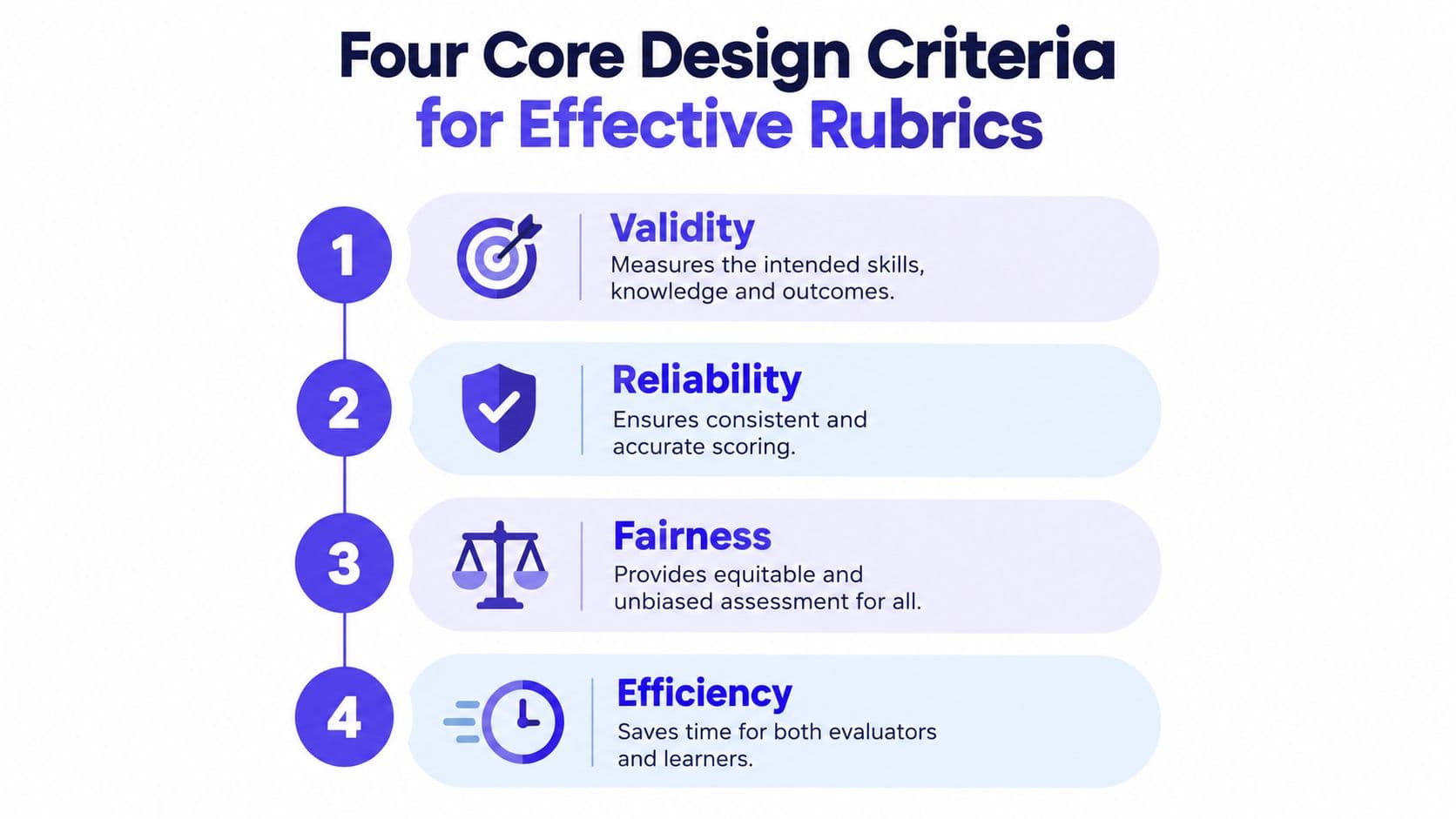
Before writing descriptors, test the assessment against four questions: Does it measure the intended learning? Can different raters use it consistently? Is it fair to the students being assessed? Can a teacher use it without wasting time? These questions correspond to validity, reliability, fairness, and efficiency, the four core design goals highlighted in UNL's guidance on effective rubric design.
Validity
Validity asks whether the rubric measures the skill you intended to assess. If the learning outcome is “interpret evidence,” a criterion focused on decorative formatting doesn't belong unless formatting is genuinely part of the outcome. An English rubric that heavily rewards spelling may obscure the quality of a student's reasoning. A science rubric that rewards lengthy explanations may confuse volume with understanding.
Start with the outcome, then select only the evidence that demonstrates it. Teachers creating assessments for professional or university settings may also find a university grading guide for MDs useful for thinking about how criteria should reflect the capabilities an assessment is meant to develop.
Reliability
Reliability means that the same work is likely to receive a similar judgment from different raters, or from you at different points in a long grading session. Vague adjectives weaken reliability. Observable actions and features strengthen it.
Calibration helps. Score a small set of sample responses with another teacher, compare decisions, and identify where the rubric led you in different directions. Rubric research commonly examines inter-rater reliability, and one empirical study reported acceptable reliability thresholds of ≥ .70 under specific combinations of raters and criteria, including three raters with eight criteria or four raters with nine criteria for relative or absolute decisions. Those findings don't prescribe a formula for every classroom, but they show why norming and well-defined criteria matter. See the Frontiers in Education review of rubric reliability for the research context.
Fairness and efficiency
Fairness requires more than using the same sheet for everyone. Check whether a criterion rewards background knowledge, cultural conventions, access to resources, or a preferred communication style that isn't part of the learning goal. Replace proxy criteria such as “looks professional” with evidence tied to the task.
Efficiency keeps the rubric usable. A rubric with too many overlapping rows slows grading and can bury the feedback students need most. Keep each criterion distinct, use consistent level labels, and make the evidence easy to locate.
For a practical connection between objectives and assessment language, review these learning intentions and success criteria resources. The best rubric is one you can apply thoughtfully to real student work, not one that appears impressive in a planning document.
Step-by-Step Process to Build Your Rubric
Good grading rubric writing starts before you draw a table. Follow the sequence below, and resist the temptation to begin with labels such as “excellent” or “poor.”
Start with the destination
1. Define the learning outcomes. Write what students should know or be able to do after completing the task. “Write a research paper” describes an assignment, not a learning outcome. “Develop a claim and support it with relevant, integrated evidence” gives you something assessable.
2. Identify distinct criteria. Turn the outcome into separate dimensions of performance. For the research paper, you might assess claim, evidence, reasoning, organization, and source use. Each criterion should answer a different question. If the same weakness could lower two rows for the same reason, the criteria may overlap.
3. Choose the rating model. Decide whether an analytic, overall, checklist, or single-point structure fits the purpose. An analytic model works when students need feedback on several traits. A checklist works when completion is the main concern. The choice affects how much detail you need to write.
Make quality visible
4. Select performance levels. Rubrics commonly use three to five performance levels, with clear descriptors in every cell, according to rubric best-practice guidance from NC State. Choose labels students can understand, such as Exemplary, Proficient, Developing, and Needs Improvement, or use another consistent set that suits your school.
5. Write descriptors from the evidence. Describe what the student does, includes, explains, or demonstrates. Avoid just changing adjectives across columns. “Excellent analysis,” “good analysis,” and “weak analysis” don't tell anyone what separates the levels.
A useful drafting habit is to write the proficient descriptor first. Then describe what is missing, incomplete, or inaccurate at the lower levels, and what additional complexity or control appears at the higher levels. Keep the language student-facing.
Test before grading
Give the draft rubric to a colleague and ask them to score sample work without coaching. Compare their decisions with yours. If you disagree, don't immediately decide that your colleague is wrong. First ask which words allowed both interpretations.
The same testing process works with students. Show anonymized examples, ask students to justify their scores with evidence, and discuss disagreements. For additional starting points, CBC grading criteria templates can help you inspect possible structures, but adapt every template to your own outcomes and task.
Finally, revise after the assignment. Note which rows took too long to apply, which descriptors students misunderstood, and where your comments repeated the same point. A rubric improves through use, not through one perfect drafting session.
Choosing the Right Rubric Type for Your Task
The right rubric depends on what you need the assessment to do. A quick completion task doesn't need the same machinery as a research paper or a group presentation.
| Rubric type | What it does | Useful for | Main limitation |
|---|---|---|---|
| Analytic | Scores separate traits independently | Essays, presentations, projects, lab reports | Takes longer to design and apply |
| Holistic | Gives one overall judgment | Quick performance decisions or broad first impressions | Provides less diagnostic feedback |
| Single-point | Lists proficient expectations and leaves room for comments on strengths or gaps | Conferences, drafts, complex projects | Doesn't predefine every performance level |
| Checklist | Confirms whether required elements are present | Process tasks, submissions, procedural work | Shows completion more readily than quality |
An analytic rubric is the strongest choice when feedback on individual dimensions matters. Its criteria sit on the left and performance levels run across the top. A student might earn a different level for evidence, organization, and language control, which gives you a more informative conversation than one overall mark.
A single-judgment rubric compresses the assignment into one overall score. It can be efficient when you need a broad decision, but it won't easily show whether a student's main difficulty is reasoning, structure, or conventions. Single-judgment rubrics are often built with a 1-to-4 or 1-to-6 scale, as described in DePaul's comparison of rubric types.
Match the structure to the purpose
Use a checklist when the question is, “Did the student include the required components?” Use a single-point rubric when proficient work is the central target and you'd rather write individualized notes about what exceeds or falls short of it.
For a complex group project, an analytic rubric can separate the quality of the final product from collaboration evidence. For a short oral response, a single, undifferentiated rubric may be enough. Don't choose a type because it's familiar. Choose the structure that gives you the evidence you need to make the decision.
Performance labels are also a design choice. Levels may use point values, percentages, letter grades, or titles such as Excellent, Good, Fair, and Poor. Whatever you select, explain what the labels mean through descriptors, not labels alone. UIC's rubric guidance offers examples of how naming systems can shape student understanding.
Writing Clear Descriptors Students Can Use
The descriptor is where a rubric either becomes useful or falls apart. “Good content” sounds clear to the teacher who wrote it because the teacher already knows what good content means. Students and colleagues don't have access to that private definition.
Write descriptors around visible evidence. Instead of “The presentation is engaging,” write, “The speaker explains the central idea, uses relevant examples, and responds directly to audience questions.” Instead of “Uses grammar correctly,” write, “Uses sentence structures and verb forms accurately enough that the meaning remains clear throughout.”
Replace labels with actions
Here's a practical before-and-after example for a persuasive essay:
| Vague wording | Observable wording |
|---|---|
| Strong evidence | Selects relevant evidence and explains how each example supports the claim |
| Good organization | Groups ideas into purposeful paragraphs and uses transitions that show the relationship between points |
| Needs improvement | Leaves important reasoning unexplained or includes evidence without connecting it to the claim |
The revised versions tell students what to look for in their own drafts. They also help another teacher make a comparable judgment.
Avoid criteria that measure a proxy for learning. “Neatness,” “effort,” and “professional appearance” may matter in some practical tasks, but they shouldn't replace the intended skill. If presentation matters, define the relevant feature: “Uses headings and visual elements to guide the audience through the process.”
A descriptor should help a student revise one sentence, one paragraph, or one action. If it can't, make it more concrete.
Use student-centered language where possible. “The student demonstrates an understanding of…” is formal and distant. “I explain how my evidence supports my claim” is easier for a student to use during planning and self-checking.
Test every descriptor against actual work. Ask yourself whether a student could point to evidence for the level. Ask a colleague to score the same sample. If different readers reach different judgments, identify the word causing the problem and replace it with an observable feature.
Tools and Strategies to Streamline Rubric Writing
A strong rubric still requires teacher judgment, but you don't need to rebuild its structure from an empty spreadsheet every time. Start with a previous rubric, a school template, or a digital drafting tool, then inspect every criterion against the current learning outcome.
AI-assisted tools can draft criteria, performance levels, and descriptors from an assignment or learning objective. Treat that draft as raw material. Check for vague language, overlapping rows, inaccessible terminology, and descriptors that reward features unrelated to the intended learning.
Kuraplan's rubric generator can create editable rubric language with criteria, performance levels, and descriptors, which makes it useful for producing a first structure inside a lesson-planning workflow. You can refine the draft by adding subject-specific evidence, adjusting the language for your students, and removing anything you will not use while grading. The Kuraplan rubric generator is one option for getting that initial framework onto the page.
Build a reusable system
Keep a rubric library organized by subject, task type, and skill. Save the final version alongside notes about which descriptors caused confusion and which student examples best illustrated each level. Over time, those notes become more valuable than a generic template.
Use the tool after, not instead of, the thinking described earlier. Define the outcome yourself, select the evidence, and then use digital support to speed up formatting and first-draft language.
A short demonstration of a rubric workflow can help teachers see how a digital tool fits into planning rather than treating it as a separate grading task.
Real-World Rubric Examples and Common Pitfalls
A history essay rubric might assess claim, evidence, reasoning, and organization. A presentation rubric might assess explanation, use of visuals, delivery, and response to questions. A science project rubric might assess method, interpretation of results, and communication. The subjects differ, but each criterion should point to evidence that belongs to that task.
A common failure is overlap. If “organization” includes paragraph structure, transitions, and logical reasoning, while “analysis” also rewards logical reasoning, one weakness can lower both rows. Separate the criteria or state exactly which evidence belongs in each.
Another problem is inconsistent movement between levels. A descriptor might say “uses evidence” at one level, “develops ideas” at another, and “shows understanding” at a third. Those phrases may describe different skills rather than increasing levels of the same skill. Keep the core action stable and change the quality, completeness, accuracy, or complexity.
Point values can create trouble too. A small formatting row shouldn't outweigh the central learning outcome just because it's easy to score. Weight criteria according to their importance, and check whether the total score still represents what you intended to assess.
For a ready-made example that you can inspect and adapt, see this personal narrative grading rubric. Don't copy it blindly. Ask whether its criteria match your learning goal, whether students can understand its descriptors, and whether you could defend each score with evidence.
The most useful revision habit is simple: after grading, mark every row that caused hesitation. Rewrite those rows before the next assignment, then test them on sample work. That small cycle turns rubric writing from a one-time document task into part of your assessment practice.
Kuraplan helps teachers create editable, standards-aligned lesson materials and rubric drafts from learning objectives, so you can spend less time formatting and more time refining the evidence students need to show. Visit Kuraplan to build a rubric you can use, explain, and improve in your next assignment.