Guided reading can produce striking gains, but it isn't a magic label for any small-group reading time. In one study of eighth-grade students learning online, average reading-comprehension scores rose from 60.11 before the intervention to 73.41 after the first cycle and 83.52 after the second in the reported study. The practical lesson is more useful than the numbers alone: students need a clear reading purpose, carefully chosen support, and evidence that shows what they understood.
The best guided reading activities give the teacher a manageable routine without reducing reading to worksheets. The eight activities below work across K–5 and 6–12 classrooms, with adjustments to text complexity, grouping, scaffolding, and assessment. Each one uses the same planning frame: a standards-aligned objective, materials, teacher prompts, differentiation, assessment or rubric ideas, and a printable resource suggestion.
1. Guided Reading Groups with Leveled Texts
Small-group instruction is the foundation of guided reading. Group students according to current instructional needs, give each group the same appropriately selected text, and listen closely enough to notice where individual readers need prompting. A research-based description places the teacher with four to six students based on individual needs, while another explanation emphasizes matching students to text levels and using the same text for focused reading and discussion in this guided reading overview.

Standards-aligned objective: Students will read a suitably challenging text, identify its central idea or main message, and support an oral or written response with details from the text.
Materials: Leveled books, a short running-record form, pencils, vocabulary cards, and a comprehension response sheet. Text difficulty should reflect more than length. Leveling may consider genre, structure, content, themes, language, sentence complexity, vocabulary, illustrations, and print features as outlined in this analysis of text-level criteria.
A focused routine
Use a brief before-reading conversation to introduce the purpose and essential vocabulary. During reading, listen to individual students and prompt strategically rather than correcting every pause. After reading, ask students to retell, explain an important detail, or connect the text to the objective.
Keep groups flexible. Regroup after assessment checkpoints instead of treating a reading level as a permanent identity. Guided reading sessions are commonly short, and one planning resource recommends 15 to 20 minutes overall, which helps the teacher maintain a precise focus in this session-planning guidance.
For differentiation, provide word cards, sentence frames, or a preview of difficult vocabulary for readers who need access support. Older students can use grade-level history, science, or ELA passages with teacher scaffolding rather than being restricted to simplified texts.
Assessment and printable support: Score a short retell with criteria for accuracy, sequence, text evidence, and clarity. A printable group record can include the objective, observed decoding or comprehension behavior, next prompt, and follow-up task. If choosing texts is slowing planning, Kuraplan's text leveler can help prepare text-specific questions and discussion prompts.
2. Think-Aloud Modeling During Reading
Readers often perform strategies without knowing how to describe them. A think-aloud makes that invisible work audible. The teacher reads a section and briefly models a prediction, question, connection, visualization, or repair when meaning breaks down. The point isn't to perform a long monologue. It's to show students what a purposeful reader notices and does.
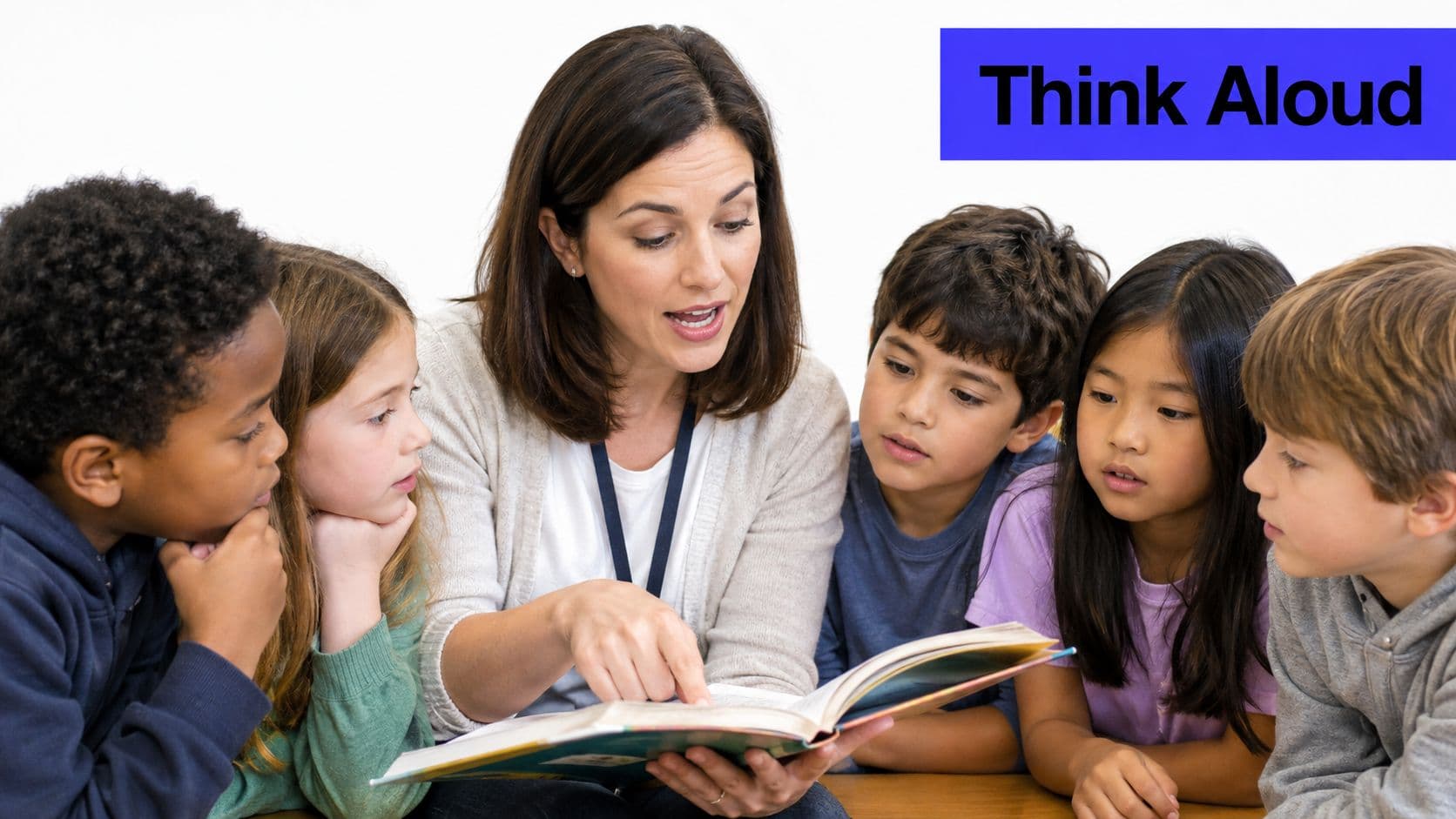
Standards-aligned objective: Students will apply one named comprehension strategy to explain how it helps them understand a literary or informational text.
Materials: A projected passage or shared book, a teacher annotation copy, strategy cards, and a student response slip. Choose a passage with a genuine point of difficulty. If every part is obvious, students won't see why the strategy matters.
Model, then release
Prepare the think-aloud before teaching so the language sounds natural. Read a short section, pause, and say what you notice. For example, “The heading suggests this section will explain a cause. I'm looking for the sentence that gives that cause.” Then point to the evidence. Keep the session centered on one strategy rather than combining prediction, questioning, visualization, and summarizing in a single lesson.
Students should take over quickly. Ask them to try the same move with a partner, then invite a few responses and compare the evidence they noticed. In elementary classrooms, a picture book may support prediction and visualization. In science, the teacher can model how to follow a procedure or interpret a diagram. In social studies, the model can connect an author's claim to a historical event.
Use expressive pauses, but don't overdramatize every thought. The goal is a transferable reading habit, not a script students repeat mechanically.
Watch a short classroom example of teacher modeling before adapting the routine for your text.
Differentiation: Give developing readers a sentence starter such as “I think ___ because the text says ___.” Offer older students a choice of evidence-based prompts while keeping the same strategy objective.
Assessment and printable support: Use a four-point rubric for strategy identification, relevant evidence, explanation, and independence. A printable “My reading thought” slip can include the strategy, quoted or paraphrased evidence, and an explanation of how the thinking changed understanding. Kuraplan can help create follow-up questions and practice pages from the modeled strategy.
3. Guided Reading with Vocabulary Pre-Teaching
A difficult word can block an otherwise accessible passage. Pre-teaching vocabulary works best when the teacher selects words that matter to the text's meaning, introduces them in context, and gives students more than a dictionary definition. Students should hear, see, say, and use each word before they meet it in demanding reading.
Standards-aligned objective: Students will use newly introduced domain-specific or academic vocabulary to explain a key idea in the text.
Materials: Word cards, photographs or illustrations, a short context sentence, a sorting mat, and a vocabulary exit ticket. Select only the words that open up the passage. If students spend most of the lesson copying definitions, the reading objective has disappeared.
Make words usable
Begin with a student-friendly explanation, then connect the word to an image, gesture, object, or familiar experience. Read the word in the sentence where students will encounter it. Ask students to distinguish it from a related word, act it out when appropriate, or place it into a new sentence.
An emergent reader might sort picture cards by words such as habitat and shelter. A science group might examine evaporate before reading about an investigation. A social studies class can connect terms such as migration or alliance to a primary source, then return to those words during discussion.
Don't pre-teach every unfamiliar word. Some words can be inferred, and students need practice using context and morphology. Teach the words that are central, repeated, or likely to prevent comprehension, then revisit them after reading and later in the week.
Teacher prompts:
- “Which part of the sentence helps you understand this word?”
- “What would this look like in our classroom or community?”
- “Which example fits the word, and which one doesn't?”
- “How does this word help us understand the author's point?”
Differentiation: Use images, gestures, bilingual glossaries, pronunciation support, and sentence frames for multilingual learners and students with language needs. Challenge proficient readers to compare a word's meaning across two contexts or analyze a prefix, suffix, or root.
Assessment and printable support: Ask students to match the word to an accurate example, explain it in their own words, and use it in a text-based response. Kuraplan's vocabulary picture card generator can support printable cards, image-based practice, and age-appropriate vocabulary worksheets.
4. Shared Reading with Interactive Annotation
A shared text should show students how readers make decisions. Project a passage, display it under a document camera, or give each student a copy. Read a short section, pause at a meaningful point, and ask students to mark evidence of an important idea, a confusing sentence, a question, or a connection. The teacher sets the pace, while students explain why each mark belongs.
Standards-aligned objective: Students will annotate a text to identify important information, pose a relevant question, and connect an idea to the text's structure or content.
Materials: A shared text, highlighters or sticky notes, an annotation key, and a response page. Elementary students can mark a short story or science paragraph with a few symbols. Secondary students can annotate essays, diagrams, procedures, captions, or historical documents with tools such as Kami or Hypothesis.
Make annotations carry meaning
Choose a small symbol system before reading. A star can identify an important idea, a question mark can flag confusion, and a “C” can show a connection. Model one mark, explain the evidence behind it, then ask students to justify the next one. Limit the number of symbols so students spend their attention on interpretation rather than coloring the page.
A useful routine is mark, point, explain. The student places a mark, points to the supporting words, and explains why the passage deserves attention. Rotate jobs so one student finds evidence, another records the annotation, and a third explains the reasoning. Older readers can examine the relationship between a claim and its evidence, a historical perspective, or an author's craft choice.
Teacher prompts:
- “What makes this sentence more important than the one before it?”
- “Where does the author define or explain the key idea?”
- “What question would help us resolve this confusion?”
- “Which detail connects to the objective?”
Differentiation: Give some students a partially annotated copy, fewer symbols, enlarged text, or sentence stems. Permit oral explanations before written responses. For proficient readers, add a category for tension, bias, structure, or an unanswered question. The trade-off is clear: more annotation choices create richer analysis, but fewer choices usually produce stronger discussion for beginning readers.
Assessment and printable support: Collect the annotated text, or ask students to transfer two marks into a written explanation. A short rubric can score relevance, textual evidence, explanation, and participation. Kuraplan can turn the class's annotation key into a printable reference sheet, comprehension worksheet, or brief follow-up assessment.
5. Reciprocal Teaching Circles
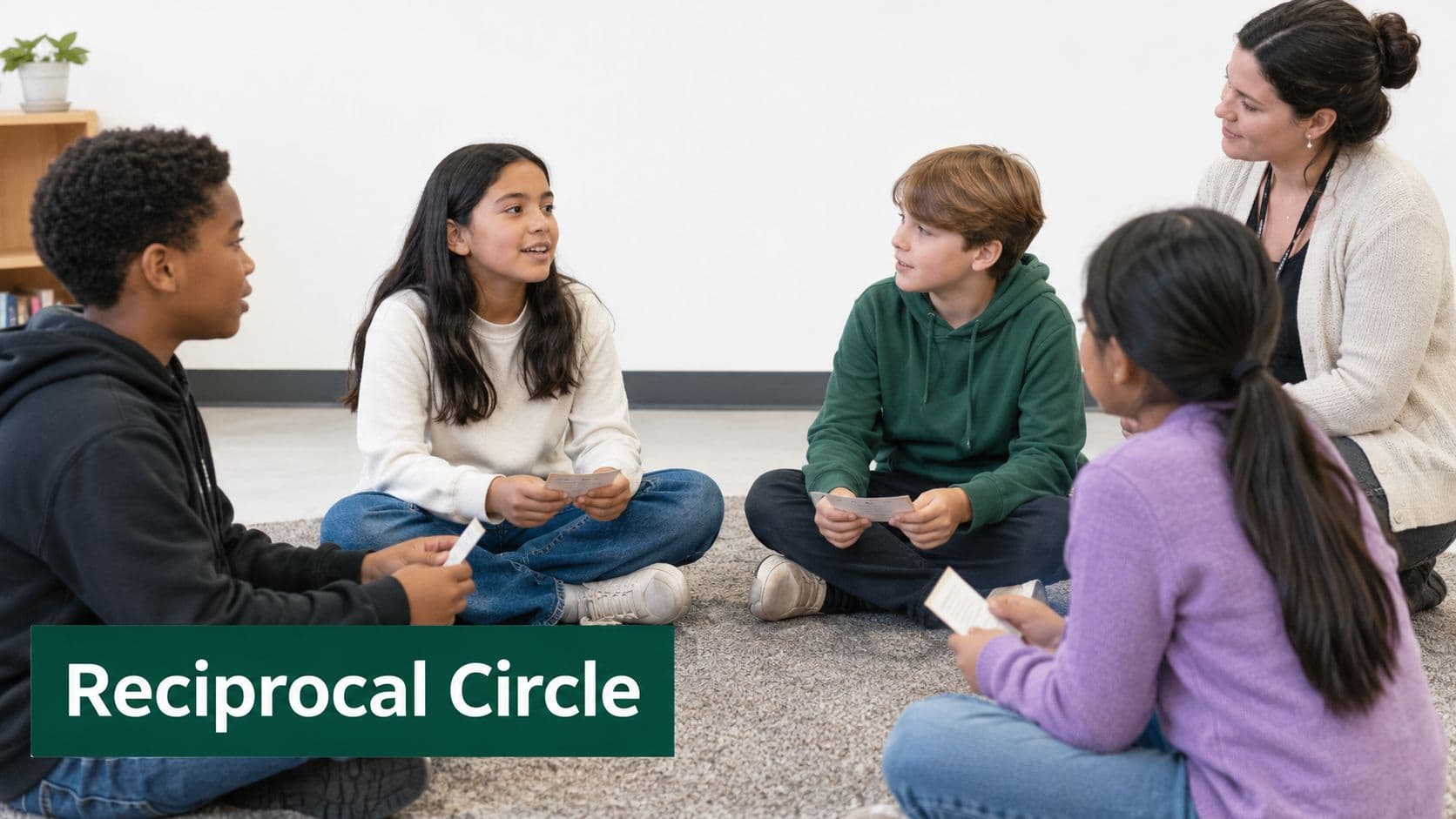
Reciprocal teaching turns reading discussion into a shared reasoning routine. Students rotate through four roles, predictor, questioner, clarifier, and summarizer, and each role requires evidence from the text. Model the process with a short passage first, then release responsibility as groups become more independent. The routine works in elementary classrooms with picture-supported role cards, in middle school social studies, and in secondary literature or nonfiction study.
Standards-aligned objective: Students will use collaborative discussion roles to predict, clarify meaning, ask text-based questions, and summarize a section with accurate evidence.
Materials: Prepare a common text, role cards, discussion stems, pencils, and a group record sheet. Add pictures to role cards for younger readers. For older students, include a copy of the relevant passage and space to record the evidence behind each contribution.
Run the circle around four moves
Assign one role to each student, then rotate roles after a paragraph or short section. The predictor identifies a clue and suggests what may follow. The questioner asks something that advances understanding. The clarifier selects a word, phrase, or idea that needs explanation. The summarizer states the central information and leaves out details that do not change the meaning.
Keep the first round brief. Listen for students who exchange answers without explaining their reasoning, prompt them for evidence, and then return the responsibility to the group. This balance gives students ownership while keeping the discussion academically focused.
Teacher prompts:
- “Which words support your prediction?”
- “What question would move us beyond recall?”
- “What needs clarification, and what can we infer?”
- “Which information belongs in the summary?”
Differentiation: Offer sentence frames, word banks, visual role cards, and partner rehearsal before whole-group speaking. Assign fewer roles for a first attempt, or let a student record evidence while a partner speaks. Advanced readers can explain how two ideas develop across the passage or connect a prediction to a later revision. More scaffolding supports participation, but too many prompts can make responses sound scripted, so remove them as confidence grows.
Assessment and printable support: Score preparation, evidence use, listening, role performance, and summary accuracy with a group rubric. Add an individual exit response so each student shows understanding, including quieter participants. Kuraplan can turn role-specific prompts into a printable discussion packet at several reading levels, reducing worksheet preparation while preserving the teacher's chosen text and objective.
6. Close Reading with Text-Dependent Questions
Close reading strengthens the instructional move from answering to proving. Students return to a short passage several times, notice details a quick read may miss, and connect each response to precise textual evidence. The routine suits elementary through secondary classrooms, including poetry, short stories, primary sources, technical passages, and texts where word choice or structure carries meaning.
Standards-aligned objective: Students will analyze how specific words, structural choices, or pieces of evidence contribute to a text's meaning, supporting each answer with relevant textual evidence.
Choose a passage that students can reread without losing the thread. Prepare multiple copies or a digital version, annotation tools, a question sequence, and a response rubric. Begin with a paragraph or brief excerpt while students learn the process. A longer text does not automatically create greater rigor. The quality of the questions and evidence work matters more.
Use three purposeful reads
The first read establishes literal understanding. Ask students what happened, what the author states, or what process the text describes. On the second read, direct attention to inference, relationships, and word choice. A final read can examine the author's craft, perspective, structure, or the strength of a claim.
Keep the passage visible as students discuss. Prompt them to point to line numbers or mark the words that support their thinking:
- “Which words in the passage support your answer?”
- “What changes when we replace this word with a synonym?”
- “How does the paragraph structure guide the reader?”
- “What can we infer, and which details make that inference reasonable?”
Accept background knowledge as a starting point, then bring the discussion back to the text. In history, ask how a primary-source writer's position shapes the account. In science, have students separate a claim from the evidence used to support it. A plausible answer without textual support should not receive full credit.
For younger readers, provide line numbers, chunk the passage, read the first section aloud, or offer evidence stems. Keep the text and objective appropriately demanding while varying the amount of prompting. Stronger readers can compare competing interpretations or explain how multiple pieces of evidence work together.
Assess answer accuracy, evidence selection, reasoning, and clarity with a four-point rubric. A close-reading organizer can include columns for the question, evidence, inference, and explanation. For more ideas on sequencing comprehension work, use This guide to reading-comprehension strategies. Kuraplan can help turn the question sequence into a printable organizer, reducing worksheet preparation while keeping the teacher's text and objective in place.
7. Guided Reading with Comprehension Strategy Stations
Comprehension stations work best when each one rehearses a clearly named instructional move, such as predicting, connecting, summarizing, or questioning. They give students repeated practice while the teacher provides targeted instruction, but only if the independent tasks are manageable. Too many stations create transition problems and pull the teacher away from readers who need support.
Standards-aligned objective: Students will apply a selected comprehension strategy to a short text, cite a relevant detail, and explain how the strategy supports understanding.
Materials: Short passages, strategy cards, response sheets, pencils, folders or containers, and a visible rotation signal. Begin with a small number of stations. Add rotations only after students can collect materials, read directions, complete the response, and move independently.
Build each station around one move
Use directions students can follow without teacher help. An icon, one completed example, and a short checklist help elementary readers; older students may use a brief paragraph explaining the task. At a prediction station, students identify a text clue, state what they expect, then revise the prediction after reading. At a summarizing station, they record the subject, important action or idea, and outcome.
Keep the teacher-led station flexible. Listen to students read, prompt the strategy, and record one observation before deciding whether to reteach, extend, or move on. The remaining stations should practise skills students have already learned, rather than introduce content that requires constant intervention. That trade-off keeps independent work productive while protecting time for responsive teaching.
Teacher prompts:
- “What does the text make you expect, and which clue supports it?”
- “Which detail belongs in the summary, and which can you leave out?”
- “How does this connection help you understand the passage?”
- “What question would a careful reader ask next?”
Differentiation: Provide two passage versions, sentence frames, audio support, or a completed model. For secondary students, raise the demand by asking them to compare two strategies, justify whether a connection is relevant, or summarize across related texts. For younger readers, chunk the passage and read the first part aloud.
Assessment and printable support: Collect one response from each station, or use a clipboard to mark a four-point rubric covering strategy accuracy, evidence, explanation, and independence. A useful folder contains the station card, passage, model response, and recording page. Kuraplan can generate strategy-specific worksheets, visuals, discussion prompts, and differentiated tasks, making those folders faster to prepare.
8. Book Tasting and Choice Reading Conferences
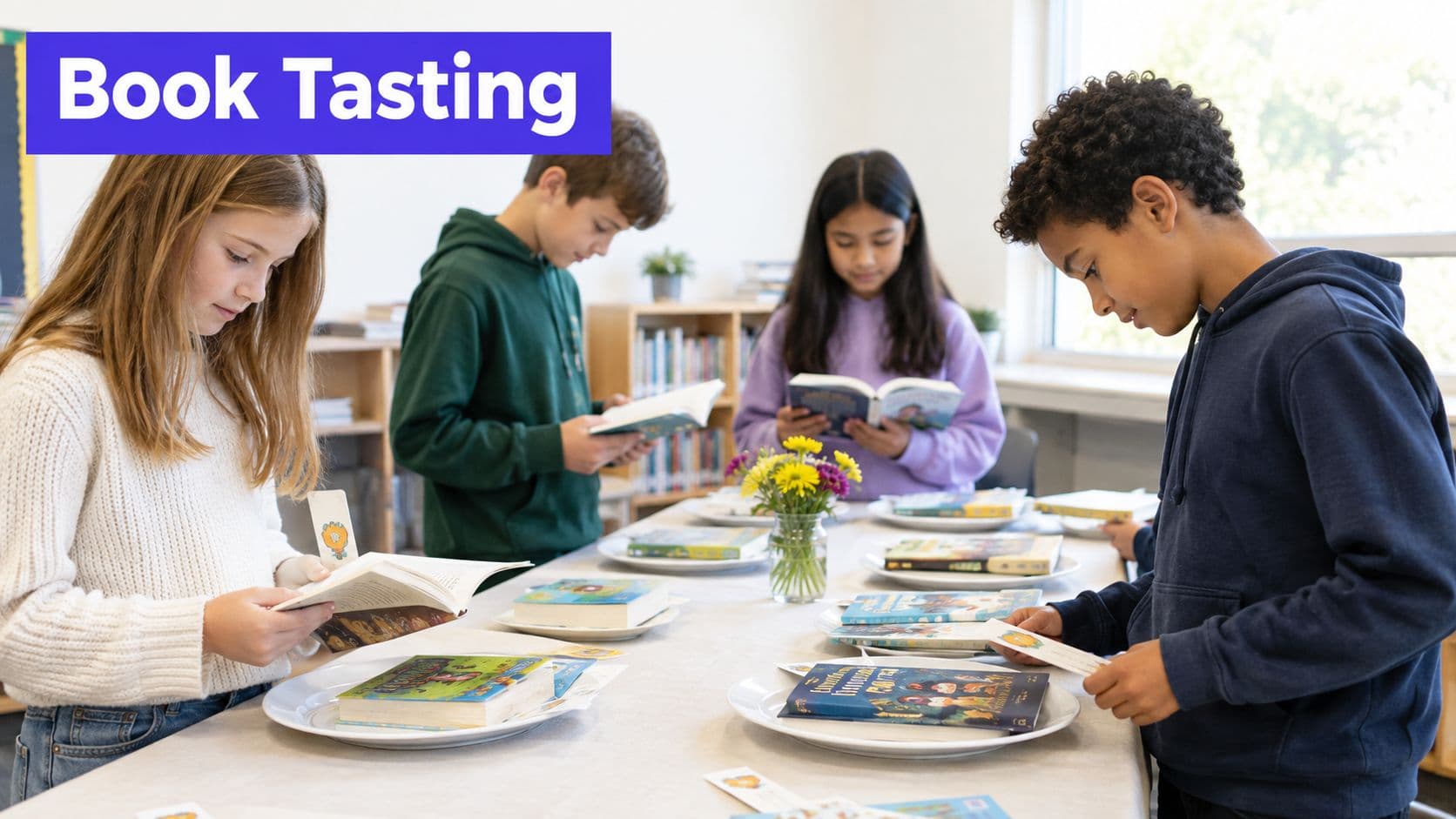
Choice reading becomes more useful for instruction when students can explain what they're reading and why they selected it. Set out fiction, nonfiction, poetry, graphic texts, and content-area options so students can preview books and make informed choices. Then hold brief conferences that combine motivation with a practical comprehension check.
Standards-aligned objective: Students will select a text for a stated reason, describe what they understand so far, and identify a question or next step for continued reading.
Materials: A browsable classroom library, book-preview slips, reading logs, conference notes, and a short response rubric. Organize books by genre, author, topic, or visual labels so students can make choices without waiting for the teacher to locate every title.
Conference for evidence, not performance
Use consistent prompts such as “Tell me about your book,” “What's happening so far?” and “What makes you want to keep reading?” Ask one follow-up question that requires evidence. A student who can name a character or topic may still need support explaining the problem, central idea, or author's purpose.
A conference shouldn't become a quiz that removes the pleasure of reading. If a student chose a challenging text, help them identify a support, such as a partner discussion, vocabulary note, or short preview. If the text is too easy, suggest a related title or invite the student to pursue a deeper question instead of just changing books.
Differentiation: Offer curated baskets by topic, audiobooks or read-along options, accessible texts with rich ideas, and a challenge choice for students ready for greater complexity. Multilingual learners may discuss the book in a preferred language before sharing key thinking in English, when classroom resources allow.
Assessment and printable support: Record the title, student's summary, evidence used, reading behavior, and next recommendation on a simple conference form. A rubric can assess comprehension, evidence, reflection, and independence. Kuraplan can help create quick comprehension checks or extension pages for independently selected books without forcing every reader into the same task.
8-Point Comparison of Guided Reading Activities
| Approach | 🔄 Implementation Complexity | ⚡ Resource & Prep | 📊 Expected Outcomes | Ideal Use Cases | ⭐ Key Advantages / 💡 Quick Tip |
|---|---|---|---|---|---|
| Guided Reading Groups with Leveled Texts | Moderate–High: ongoing grouping, assessment, teacher-led sessions | High: leveled book sets, assessment tools, planning time | Targeted reading growth; improved monitoring of individual progress | Small-group differentiation, interventions, elementary classrooms | ⭐ Differentiation & close teacher support. 💡 Rotate groups; keep sessions 15–20 min. |
| Think-Aloud Modeling During Reading | Low–Moderate: practice to sound natural; planning of pause points | Low: minimal materials; prep time for scripts/examples | Strong gains in metacognition and strategy transfer | Whole-class demos, cross-curricular strategy instruction | ⭐ Makes invisible thinking visible. 💡 Model one strategy per session and practice beforehand. |
| Guided Reading with Vocabulary Pre-Teaching | Moderate: select and sequence key words; integrate multimodal activities | Moderate: picture cards, word walls, prep for 5–10 words per text | Improved comprehension and fluency, especially for ELLs and struggling readers | Texts with dense or technical vocabulary; ELL support | ⭐ Removes comprehension barriers. 💡 Limit to 5–10 critical words; teach multimodally. |
| Shared Reading with Interactive Annotation | Moderate: set symbols/routines; manage whole-group marking | Moderate: shared texts, sticky notes or digital tools, document camera | Visible student thinking; transferable annotation habits; richer discussion | Whole-group text analysis, digital literacy lessons, mixed-ability classes | ⭐ Builds collaborative reading practices. 💡 Establish symbols and model with a projector. |
| Reciprocal Teaching Circles | High: explicit role instruction and gradual release required | Moderate: role cards, planning, coaching time for groups | Increased student accountability, higher-order thinking, improved discussion skills | Small-group literature circles, social studies, middle/high school | ⭐ Promotes peer-led comprehension. 💡 Model roles repeatedly; use role cards to scaffold. |
| Close Reading with Text-Dependent Questions | High: design layered questions and scaffold multiple readings | Moderate–High: careful question prep; reusable templates save time | Deep analytical skills; evidence-based answers and stronger text analysis | Secondary analysis, primary sources, standards-aligned instruction | ⭐ Builds rigorous analytical reading. 💡 Start with short texts and scaffold literal→inferential→analytic questions. |
| Guided Reading with Comprehension Strategy Stations | High: station design, rotations, and behavior management | High: multiple materials, space, timers, clear visual directions | Focused strategy practice; increased engagement and differentiated tasks | Elementary classrooms needing targeted strategy practice | ⭐ Intensive practice on discrete skills. 💡 Begin with 2–3 stations and clear visual directions. |
| Book Tasting and Choice Reading Conferences | Moderate: organize texts and run brief individual conferences | High: large, varied text collection; time for 5–10 min conferences | Higher motivation, personalized assessment, positive reading attitudes | Promoting independent reading, building classroom libraries | ⭐ Boosts engagement and ownership. 💡 Organize books for easy browsing; track quick conference notes. |
Turn the Activity Into a Repeatable Routine
Choose the activity from the instructional need in front of you, not from the activity's popularity. Use leveled small groups when students need close observation and targeted support. Choose think-alouds when a strategy remains invisible. Use vocabulary pre-teaching when language is blocking access to a text. Interactive annotation and reciprocal teaching support collaborative meaning-making, while close reading strengthens evidence-based analysis.
Stations suit classrooms that need repeated practice and predictable independence. Book tasting and conferences are better choices when students need stronger ownership, reading motivation, or help selecting texts. Secondary teachers shouldn't assume guided reading belongs only in early elementary classrooms. A study of guided reading in English instruction describes a before-reading, during-reading, and after-reading structure, while also noting that research at junior high levels remains scarce in its discussion of the approach. That gap makes careful adaptation important, especially in science, social studies, and secondary ELA.
Start with one text and one measurable objective. Keep the objective narrow enough that you can tell whether students met it during the lesson. For example, students might identify the central idea and support it with two details, explain how a word shapes meaning, or summarize a section without adding unrelated information.
Collect one small piece of evidence. It might be an annotation, an oral response recorded on a clipboard, a written summary, a discussion role sheet, or a rubric score. You don't need a large assessment packet to improve tomorrow's instruction. You need enough information to decide whether students require more modeling, a different text, stronger vocabulary access, or a greater challenge.
Practical rule: Keep the reading objective stable while you adjust the support.
Save prompts that produced strong thinking. Keep successful role cards, annotation keys, vocabulary templates, and response rubrics in a shared folder so the next lesson begins with adaptation rather than a blank page. Review them after teaching and remove anything that created busywork without revealing student understanding.
Planning time is often the barrier, particularly when teachers need differentiated worksheets, visuals, and assessment criteria for several groups. Kuraplan can generate standards-aligned lesson plans, printable worksheets, educational visuals, and assessment rubrics that teachers can adapt before using them with students. It can also help turn a guided reading objective into differentiated practice while leaving the teacher responsible for selecting the text, checking accuracy, and deciding what students need next.
The strongest guided reading activities are repeatable, but they aren't rigid. Keep the sequence clear, listen carefully, and change the prompt when student evidence tells you to. When the teacher knows the instructional move and the student knows what success looks like, a short reading session can produce useful information and meaningful practice.
Kuraplan helps K–12 teachers create standards-aligned guided reading lesson plans, differentiated worksheets, visuals, and assessment rubrics in minutes. Use it to prepare text-specific questions, vocabulary supports, annotation pages, or station materials, then adapt the result to your students and chosen text. Visit Kuraplan to build your next guided reading resource.