The last five minutes of a math lesson can tell you whether tomorrow should begin with extension, guided practice, or a complete rethink. Students may be able to perform the skill but not explain it, recognize a method but not apply it, or finish while still feeling stuck. Math exit tickets are brief formative checks that capture one useful piece of evidence before students leave, then help you decide what to do next. The U.S. Department of Education describes an exit ticket as a checkpoint aligned with the lesson objective and focused on the key skill or takeaway from that lesson (Formative Assessment Guide).
The right format depends on the evidence you need. The examples below move from fast, accessible signals to deeper tasks involving visual thinking, transfer, and mathematical argumentation. Adapt every template to the objective, grade level, language needs, accommodations, and instructional move you'll make the next day. If you're preparing or publishing educational materials, these formats can also provide a useful structure for printable classroom resources.
1. The 3-2-1 Exit Ticket
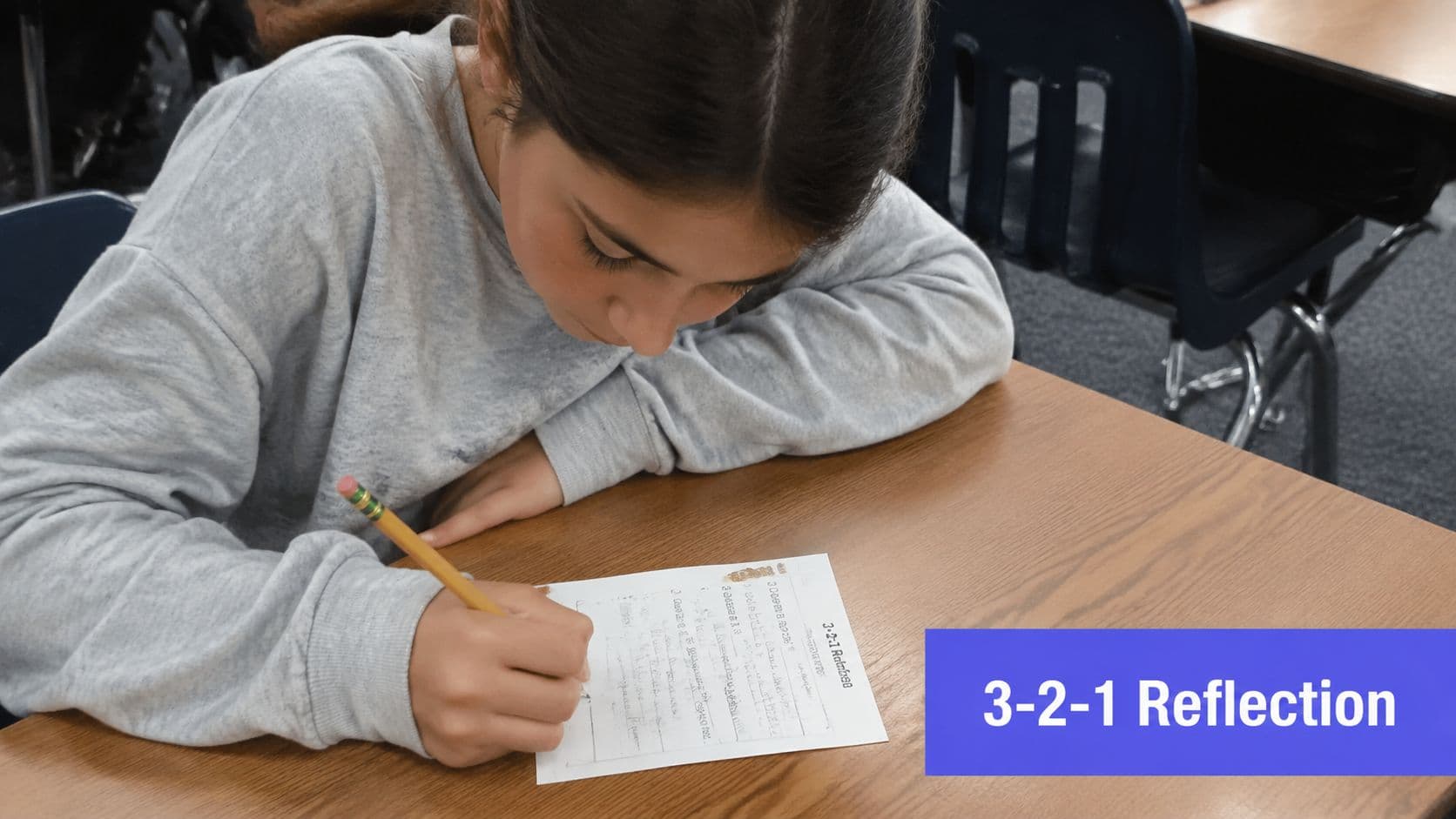
The 3-2-1 format gives students a compact way to reflect on the lesson while giving you clues about what they understand, value, and still need to clarify. Ask for three things learned, two things that interested them, and one question they still have. It works especially well from upper elementary through high school because students can respond briefly without reducing reflection to a confidence color or a correct answer.
After a fractions lesson, a student might list equivalent fractions, comparing fractions, and simplifying fractions as the three learned ideas. The two interesting points could involve fractions in recipes or sports statistics, while the remaining question might be, “How do I know when two fractions are equivalent?” That question is more useful than a blank response because it points toward a specific follow-up.
Practical rule: Treat the question as instructional evidence, not as an optional comment.
For a geometry lesson, students could record three properties of quadrilaterals, two shapes they noticed in the classroom, and one question about angle relationships. Keep the categories visible on the board, and provide word banks or sentence stems for multilingual learners and students who need writing support.
Make reflection actionable
You don't need to respond individually to every line. Sort responses into recurring questions, misconceptions, and extensions. Display a few common questions at the start of the next lesson, then use them to launch a mini-lesson or small-group conference. You can also rotate the categories occasionally, using “glad, sad, confused” or “new, connected, next,” so the routine doesn't become mechanical.
The format is less useful when students write vague statements such as “I learned math.” Ask for examples, representations, or vocabulary tied to the objective. A guide to exit ticket ideas can help you adapt the prompt, and Kuraplan can generate follow-up practice based on the questions students record.
2. One-Minute Paper With Error Analysis
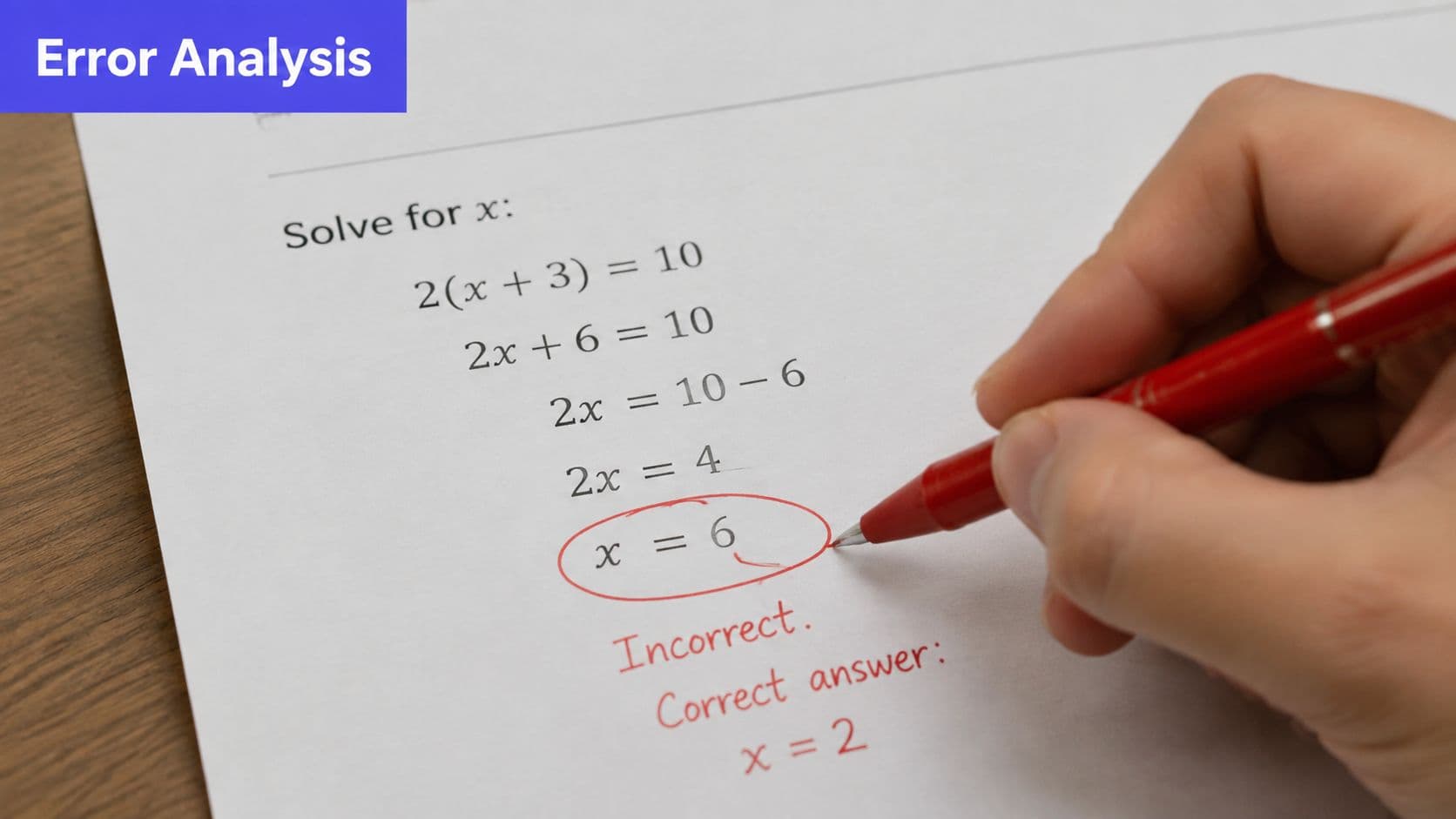
Give students a worked problem and ask them to decide whether the solution is correct, then explain why. This format reveals more than procedural fluency. It shows whether students can inspect a method, locate a faulty step, and use mathematical language to justify their judgment.
In algebra, present a solution to 2x + 5 = 13 that adds 5 to both sides instead of subtracting it. Students need to identify the invalid move and explain what should happen. In elementary multiplication, show an area model with a miscounted group of unit squares. In decimal work, use the incorrect statement 2.5 + 1.23 = 3.73 and ask students to identify the place-value error.
Vary the prompt. If every ticket contains an error, students may assume the solution must be wrong. Include correct work sometimes and ask students to defend it. A simple frame, “This problem is _____ because _____,” makes the reasoning accessible without giving away the answer.
Read the explanation, not just the verdict
A student who circles “incorrect” but cannot identify the faulty step needs different support from a student who explains that tenths and hundredths were not aligned. Sort responses by the kind of reasoning shown:
- Locate the step: Can the student point to the exact line where the reasoning changes?
- Name the principle: Can the student connect the error to inverse operations, place value, area, or another concept?
- Repair the work: Can the student show a valid correction?
Use authentic student work from previous lessons when possible. It creates a realistic discussion, but remove names and avoid errors so complicated that students spend the entire minute decoding the page. Kuraplan can generate varied error-analysis prompts aligned with the day's objective, which makes it easier to keep the routine fresh without writing every scenario yourself.
3. Traffic Light Exit Ticket for Self-Assessment
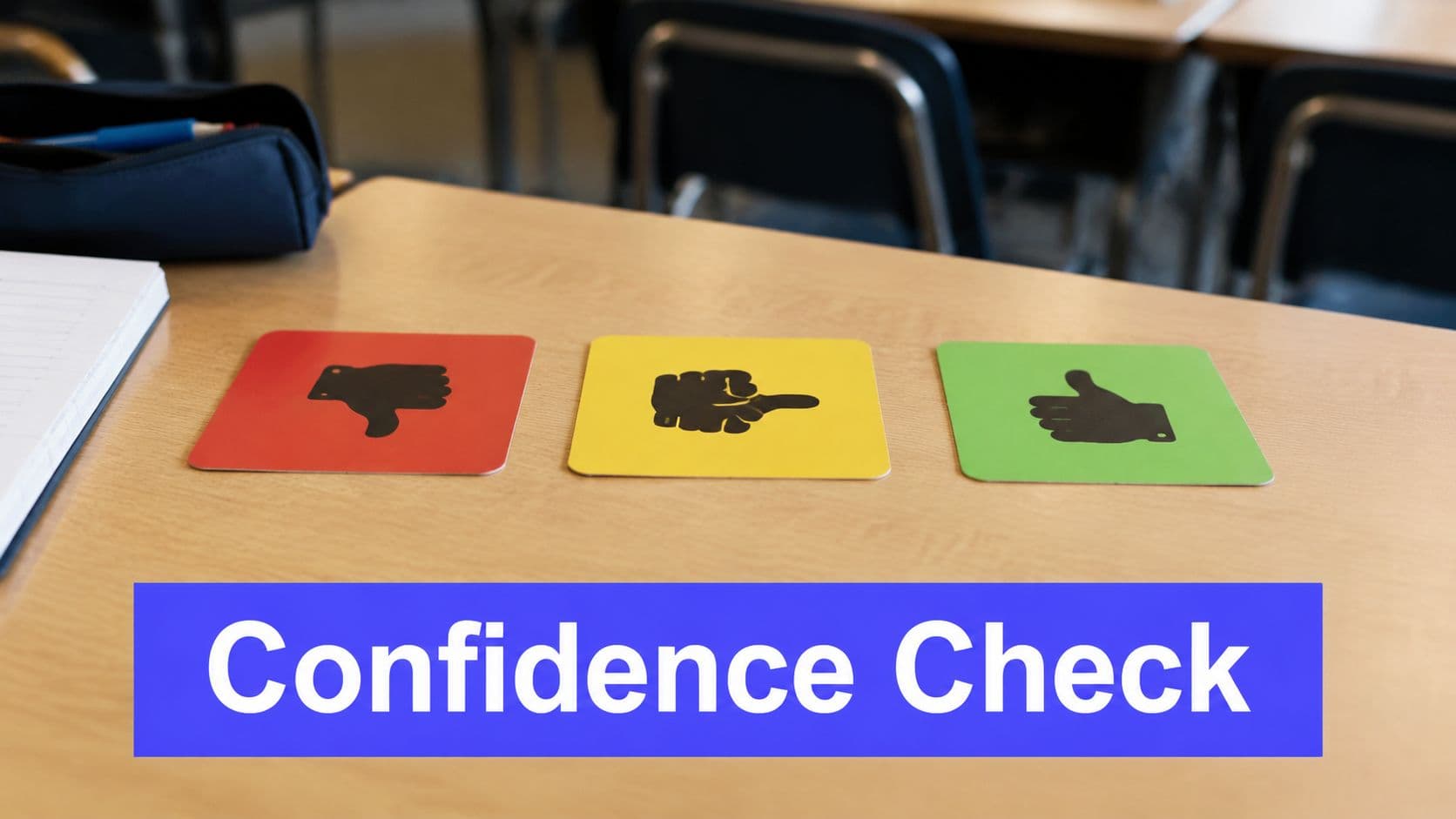
A traffic light ticket asks students to signal their current confidence with red for confused, yellow for somewhat confident, and green for mastered. It takes very little time and gives you an immediate view of how students perceive their readiness. That makes it useful for planning differentiated warm-ups, though confidence alone shouldn't determine who receives intervention.
After teaching equivalent fractions, ask students to select a color and complete one short follow-up: “What part confused you?” A student might choose yellow because they can find an equivalent fraction with a visual model but struggle with multiplication. After a lesson on multi-step word problems, students can rate the whole process or identify a specific step, such as choosing an operation, organizing information, or checking the answer.
Use colors as a starting point
The strongest routine combines the color with evidence. Red students might answer a targeted question orally, yellow students might solve a parallel problem with a visual scaffold, and green students might explain two strategies or tackle an extension. This prevents a student's self-rating from becoming a permanent label.
Track changes over time, but don't turn the colors into a public ranking system. Aggregated class patterns can normalize productive struggle, while private responses protect students who aren't ready to announce confusion. For students with limited English proficiency or communication differences, allow pointing, selecting, or recording an explanation rather than requiring a written paragraph.
A color tells you where a student thinks they are. A follow-up response helps you decide what support they actually need.
The main trade-off is that self-assessment can be inaccurate. Some students overestimate their understanding, while others choose red because they lack confidence despite producing correct work. Use the color to form a hypothesis, then check it against a problem, explanation, or conference. If you're building differentiated lessons in Kuraplan, use the traffic light groups to create tiered practice sets, then review the prompts before assigning them.
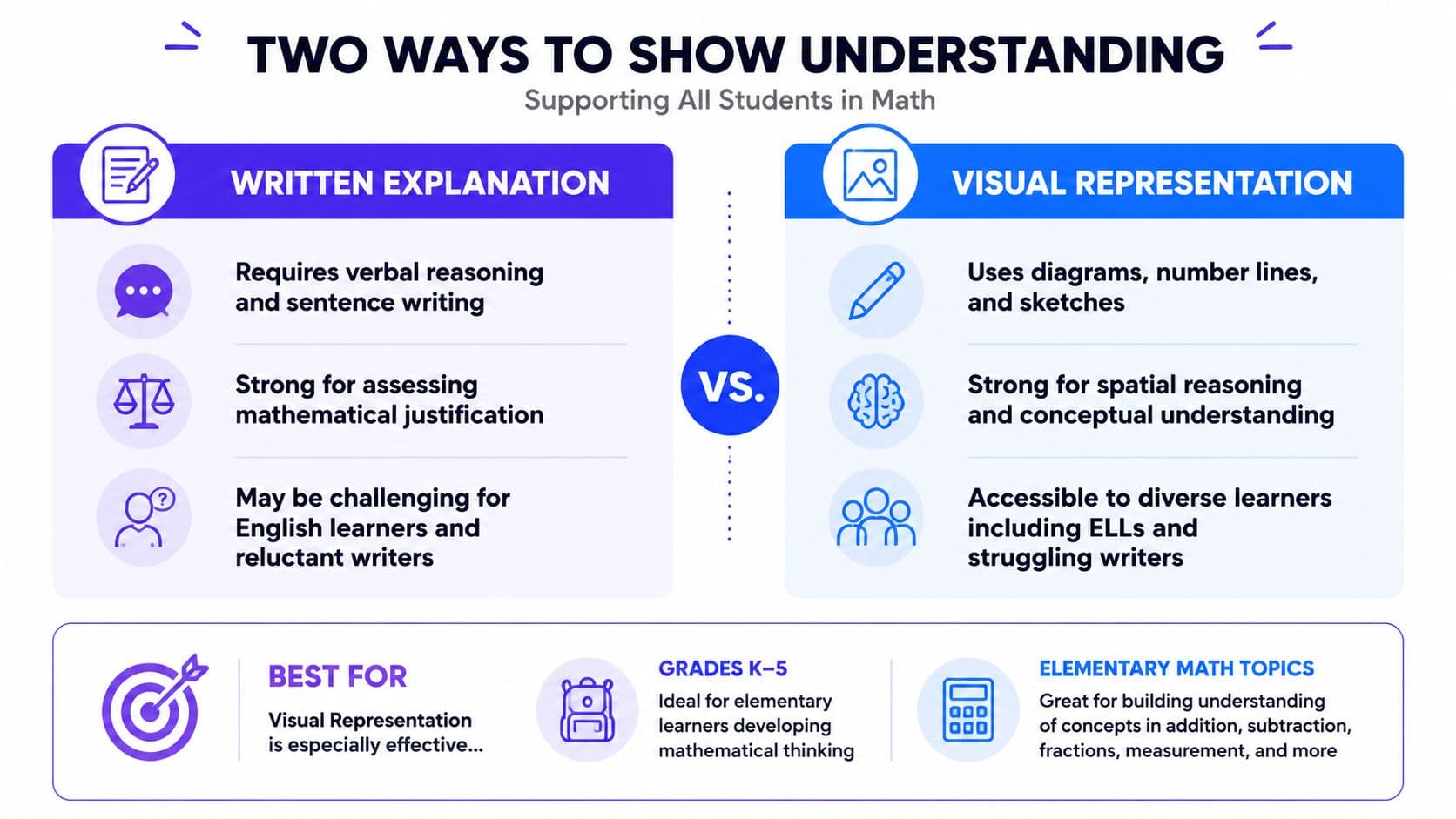
4. Exit Ticket With Visual Representation
Some students can show mathematical thinking more clearly with a diagram than with a paragraph. Ask them to draw a number line, area model, array, geometric figure, or quick sketch that represents the day's idea. Visual tickets are especially effective in elementary math, but they also reveal conceptual understanding in middle and high school.
After a fractions lesson, students can draw a rectangle divided into fourths and shade 3/4. After measurement, they can create a number line showing 2.5 meters. A geometry ticket might ask students to sketch three quadrilaterals and label defining features. For addition with regrouping, students can draw base-ten blocks to represent 27 + 15.
The drawing doesn't need to be artistic. You're looking for mathematical clarity, such as equal partitions, correctly placed values, or labeled relationships. Pre-drawn number lines and area-model frames reduce the motor and time demands, which helps students focus on the concept rather than page layout.
Make the visual do the explaining
Pair the drawing with one sentence, such as “Show me how you solved this with a picture.” This prevents a copied or guessed diagram from looking like full understanding. For younger students, accept oral explanations, labels, or arrows. For older students, ask them to connect the representation to an equation or property.
Photograph strong visual tickets for digital portfolios, and keep a few anonymous examples for the next lesson. Kuraplan's diagrams and kid-friendly illustrations can serve as reference models, but students should create their own representations rather than reproduce an answer. A model can clarify the expected form, while an open prompt reveals whether students can choose and construct a useful representation independently.
Use visual evidence carefully. A correct-looking picture may conceal an incorrect interpretation, and a rough drawing may contain complex reasoning. Read the labels, ask what each part means, and compare the visual with the student's written or spoken explanation.
5. Two-Question Exit Ticket for Procedural and Conceptual Understanding
A two-question ticket separates two kinds of evidence. The first question asks whether students can perform the procedure. The second asks whether they understand why it works. Together, the answers help you distinguish a calculation problem from a conceptual gap.
For multiplication, ask:
- Solve 7 × 8.
- Explain why 7 × 8 and 8 × 7 have the same answer.
For decimals, students can compare 0.5 and 0.50, then explain why the values are equal. For fractions, ask students to solve 1/3 + 1/4, then explain why they can't add the numerators and denominators.
Keep the first item straightforward. If the computation is unnecessarily difficult, you won't know whether the explanation reflects conceptual understanding or cognitive overload. Sentence stems such as “This works because...” and “I know this because...” support students who understand the mathematics but need help organizing written language.
Sort by the mismatch
The most useful information often appears when the answers disagree.
- Correct procedure, weak explanation: Plan a representation, discussion, or worked example focused on meaning.
- Incorrect procedure, strong idea: Provide targeted practice with feedback on execution.
- Incorrect on both: Reteach the prerequisite concept in a small group.
- Correct on both: Offer a transfer problem or ask the student to compare strategies.
Marking the first question with a check or cross keeps review fast. Read the second response more closely, looking for accurate vocabulary, a relevant representation, and a logical connection. The approach takes longer to interpret than a single answer, but it gives you much clearer intervention choices.
An exit ticket generator can create paired procedural and conceptual prompts aligned to a lesson objective. Even so, check that the second question asks “why,” rather than repeating the first question in more words.
6. Exit Ticket With a Real-World Application Connection
A transfer ticket asks students to solve a brief problem and connect the mathematics to a familiar situation. It can show whether students recognize the concept outside the exact examples practiced in class. The connection should remain mathematically precise, not become a forced story wrapped around a routine calculation.
After a percent lesson, ask, “You see a 20% off sign at a store. Explain how you'd use percent to find the new price.” After ratios, use a recipe with 2 cups of flour to 1 cup of sugar, then ask how students would scale it for a birthday party. In geometry, students can choose a shape for a garden bed and explain which measurements matter. In data lessons, students can interpret a weather forecast probability and connect it to outdoor planning.
Let students bring the context
Offer several settings, such as sports, cooking, shopping, building, or gaming. Students may explain the mathematics more authentically when they can choose a context they understand. For younger learners, provide a sentence starter and one worked example, such as, “Fractions appear in cooking when...” Then ask them to supply another example.
The trade-off is that real-world prompts can become reading assessments. Keep the scenario short, define unfamiliar vocabulary, and read it aloud when appropriate. Also watch for answers that sound realistic but don't contain usable mathematical evidence. Ask students to include an equation, estimate, labeled diagram, or clear calculation alongside the explanation.
Use responses to plan the next lesson. If students solve the calculation but can't name a situation where it applies, build a short matching activity. If they choose a relevant context but use the mathematics incorrectly, reteach the concept through that context rather than treating the connection as irrelevant. Kuraplan can generate age-appropriate scenarios for a math topic, which you can adapt to your students' interests before embedding them in printable or digital tickets.
7. Claim-Evidence Exit Ticket for Mathematical Argumentation
Claim-evidence tickets ask students to make a mathematical statement and support it with reasoning, examples, diagrams, properties, or step-by-step work. This format reveals whether students can justify an answer rather than merely produce one. It fits naturally with mathematical discourse and can grow in complexity from middle grades through high school.
For fractions, students can defend the claim, “1/2 is greater than 1/3.” Their evidence might show two equal rectangles, one divided into halves and the other into thirds, with one part shaded in each. In algebra, students can support the claim, “The equation 2x + 5 = 15 has only one solution,” by solving it and explaining why x must equal 5. In geometry, students can justify, “All squares are rectangles, but not all rectangles are squares,” using defining properties.
Teach the word “evidence” explicitly. Students may initially provide another opinion instead of support. Show that an example, diagram, property, counterexample, or sequence of valid steps can serve as evidence, depending on the claim.
Grade the quality of the reasoning
Use a small rubric with three questions:
- Claim: Does the statement accurately answer the mathematical prompt?
- Evidence: Is the support relevant to that statement?
- Sufficiency: Does the evidence establish the claim, or does it leave a gap?
Sentence frames help students enter the structure: “I claim that _____ because _____. Here's my evidence: _____.” Start with concrete examples in the middle grades, then move toward generalizations, counterexamples, and proofs in high school.
A convincing answer is not always a justified answer. Require students to connect the evidence to the claim.
Share strong anonymous responses and ask the class to identify what makes the evidence sufficient. A CER framework worksheet can provide a reusable structure, while Kuraplan can generate scaffolded claim-evidence prompts for different standards. Review every generated prompt for mathematical accuracy and for the level of reasoning your students are ready to produce.
Comparison of 7 Math Exit Ticket Formats
| Exit Ticket Type | Implementation Complexity 🔄 | Resource Needs ⚡ | Expected Outcomes ⭐ 📊 | Ideal Use Cases 💡 | Key Advantages |
|---|---|---|---|---|---|
| The 3-2-1 Exit Ticket | Low, simple three-part prompt, immediate use | Low, 3–5 min, minimal prep | Quick metacognitive snapshots; highlights mastery and confusion 📊 | Daily formative checks; upper elementary → high school 💡 | Quick to administer, scalable, differentiates naturally |
| One-Minute Paper with Error Analysis | Moderate, requires purposeful problem selection 🔄 | Low per student (1 min) but moderate teacher prep ⚡ | Reveals procedural fluency and justification skills ⭐📊 | Lessons emphasizing reasoning/debugging across grades 💡 | Promotes error detection and mathematical justification |
| Traffic Light Exit Ticket (Self-Assessment) | Very low, visual, instant response 🔄 | Minimal, colored cards/forms; <1 min ⚡ | Immediate class readiness snapshot; grouping data 📊 | K–12 quick checks and differentiation planning 💡 | Accessible, fast, reduces teacher judgment bias |
| Exit Ticket with Visual Representation | Low–Moderate, students draw; teacher interprets 🔄 | Moderate, templates/photography; ~<5 min ⚡ | Shows spatial and conceptual understanding ⭐📊 | K–5 and topics needing spatial reasoning; supports ELLs 💡 | Honors diverse learners; builds visual portfolios |
| Two-Question Exit Ticket (Procedural + Conceptual) | Moderate, needs paired question design 🔄 | Moderate, ~4–5 min; slightly more grading ⚡ | Distinguishes execution vs. understanding; actionable data ⭐📊 | Any grade when diagnosing skill vs concept gaps 💡 | Pinpoints reteaching focus; supports targeted instruction |
| Exit Ticket with Real-World Application Connection | Moderate–High, requires contextual planning 🔄 | Higher, 5–7 min, more analysis ⚡ | Measures transfer and relevance; increases engagement ⭐📊 | Grades 3–12; lessons linking math to authentic contexts 💡 | Boosts motivation and real-world application skills |
| Claim-Evidence Exit Ticket (Math Argumentation) | High, scaffolding and rubric needed 🔄 | Higher, 6–8 min, explicit instruction & grading ⚡ | Develops rigorous reasoning and mathematical discourse ⭐📊 | Grades 3–12 for argumentation and CCSS MP3 alignment 💡 | Builds justification skills and deep conceptual evidence |
Turn Responses Into the Next Teaching Move
The best exit ticket is the one that answers a question you need answered. Use a traffic light when you need a quick confidence signal, but verify the color with a short task. Choose a visual representation when you need to see how students model an idea. Use a two-question ticket when you need to separate procedural fluency from conceptual understanding. Choose error analysis when students have practiced a method but may be carrying a faulty rule.
For transfer, use a real-world application prompt. For reasoning, use claim and evidence. The 3-2-1 format is useful when you want students to name learning, interest, and unresolved questions in their own words. A concise ticket can still generate rich evidence when every part connects to the objective and the next instructional decision.
A practical routine is simple. Collect the responses, sort them by misconception or confidence, and plan one brief response for the next lesson. That response might be a corrected example during the warm-up, a small-group reteach, a partner explanation, targeted independent practice, or an extension task. Don't collect tickets merely to file them. If you won't use the information, shorten the routine or change the question.
Exit tickets are generally brief, end-of-lesson tasks. Guidance describes them as typically using one to three questions and taking about 3–5 minutes, making them practical for whole-class or differentiated instruction (ERIC's summary of exit-ticket research). A 2025 study of 1,067 grade 5 students in math-integrated computer science lessons found that exit-ticket responses consistently measured student affect across two administration points and met strict measurement invariance criteria, with χ2(21)=1.34, p=1.00. The study also reported that responses could predict self-efficacy and interest, suggesting that a brief prompt can capture learning-related attitudes as well as content evidence (the 2025 study in the journal Assessment in Education).
Vary the format so students don't learn to answer mechanically. A current research direction is redesigning tickets to capture confidence, strategy use, and self-regulated learning, including work involving at least 680 high school freshmen in Integrated Math I (Vanderbilt's report on metacognitive-driven exit tickets). Kuraplan can support the workflow by generating standards-aligned follow-up practice, differentiated sets, visuals, and printable or shareable worksheets. The teacher still has to review the prompts, interpret the actual student thinking, and choose the next move.
Use Kuraplan to create standards-aligned math exit tickets, differentiated follow-up practice, diagrams, and printable or shareable worksheets. Start with one lesson objective, generate a ticket that matches the evidence you need, and adapt the result to your students before tomorrow's class.