It's Tuesday afternoon, you've got twenty minutes left, and half your newcomers are staring at a passage they can't decode while two stronger readers finished five minutes ago. The worksheet asks for the main idea. Three students don't have the vocabulary to get past line two. That's the problem with random printables. They test recall. They don't build a skill.
Good reading comprehension worksheets ESL teachers can use do one clear job per page. They train main idea, or inference, or vocabulary in context, at a level a student can handle with support. Difficulty hides inside averages, too. In a 2024 study of students reading in an English-medium university context reported in the Springer study of English reading difficulty, 74% of participants reported varying degrees of difficulty reading English, with unfamiliar words and slow reading speed as the main problems. Scores in that same group ranged widely. Your class is the same, just younger.
This list sorts ten sources by CEFR or grade band, the skill each one trains best, and where it fits in a lesson. Warm-up. Guided practice. Homework. I'll say plainly where each one falls flat, whether that's a paywall, a babyish design for teens, or texts leveled by grade instead of English proficiency. Pick by fit, not by how pretty the preview looks.
1. Worksheets - Reading Comprehension
Start here if your problem isn't finding a passage. It's finding one that matches today's lesson without spending your prep period formatting it. Kuraplan's Reading Comprehension worksheets page connects worksheet creation to lesson planning, so you build the reading task from the objective you already planned. That matters for ESL. You can keep the same topic for the whole class and change the question demand.
What it trains and how I'd use it
Use it to separate skills instead of lumping ten mixed questions together. The Institute of Education Sciences project on academic reading comprehension for English learners identifies five distinct subskills for assessment, which are general understanding, making connections, extracting content, comprehension strategies, and academic vocabulary knowledge. Build a page that labels those. One gist question. Two detail questions. One inference that needs evidence. One academic word used in a new sentence. Then you can see why a student missed, not just that they missed.
That's guided practice and exit ticket territory. Generate a shorter, supported version for newcomers and a version with open response for students ready to explain their thinking. Worksheets can include multiple choice questions and images, they're generated with one click from any lesson, and they can be downloaded as PDFs. For a busy week, that workflow beats hunting, copying, and reformatting.
- Best fit: K-12 teachers who plan by standards and need differentiated versions fast
- Lesson slot: Guided practice, small group, or a focused homework page tied to class reading
- Watch out: The page gives no specific worksheet previews or detail on reading features, and you'll likely need the broader platform to use the tools well
Practical rule: If every question can be answered by copying a line, you haven't taught comprehension. Add one question that asks which strategy helped.
2. ESL Pathway
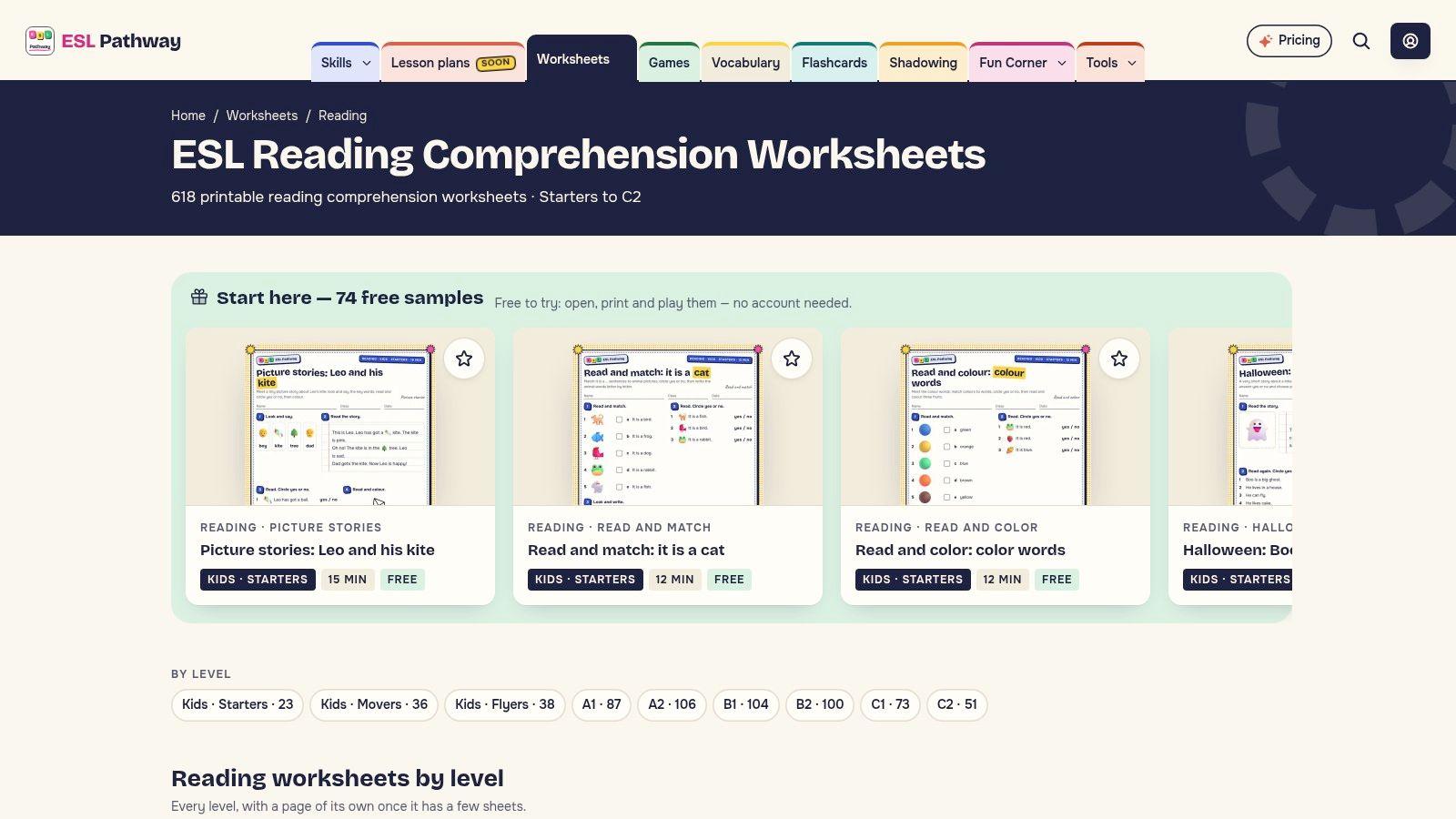
ESL Pathway is the cleanest CEFR sort on this list. You get young learners through A1 to C2, and the text types feel like real ESL class, not US ELA with simpler words. Stories, notices, fact files, emails, reviews. That variety is useful because students need to scan a notice differently from how they read a story.
Use the lower levels for literal retrieval and scanning. Use B1 and up for opinion, detail, and vocabulary in context. That scanning work pays off. In a classroom intervention reported in the Journal of English Teaching study on leveled texts and scanning, 91.7% of students reported that scanning for keywords helped them answer questions and 75.0% found leveled texts easier than regular texts. Don't treat those perception numbers as proof of gains. Do treat them as a sign students will use the routine.
- Strengths: Clear level labels, printable PDFs with teacher copies and answer keys, free samples you can print without an account, and some Cambridge style tasks
- Limits: Full library needs a subscription, and it's built for ESL and EFL rather than US grade level standards
I pair an ESL Pathway notice as a five minute warm-up, then follow with a listening comprehension generator activity on the same topic so students meet the words twice. Reading first, listening second works well for A2 and B1. Reverse it and weaker readers often panic.
3. ReadTheory
A mixed class finishes the mini-lesson, and two students still need main idea work at different reading levels. ReadTheory's ESL reading comprehension collection covers that job online and on paper. Passages are tagged for main idea, sequencing, cause and effect, and summarizing. Assignments and progress reports sit on the teacher side. The free Basic plan is enough for a short trial.
National reading data show English learners' scores rising, while the gap with non-English learners persists. Short passages with repeated checks make a better weekly routine than one hard text. They will not close that gap by themselves.
Where it fits in class
I recommend ReadTheory for independent practice and homework, after the skill has already been taught. Adaptive items let a newcomer and a long-term English learner work side by side without a level label on the page. The ESL materials lean less on unfamiliar cultural knowledge, which helps when background, not decoding, blocks the answer.
The set sits in a K-12 library, so match the passage to English proficiency, not only the grade tag. Paper and digital both work. Skill tags let you assign one target on purpose, and progress tracking cuts the extra grading. Some texts repeat from the general collection. Teachers who want illustrated, age-specific packets will find these pages thin.
Pull the report before the next lesson. Find the skill that stalled, reteach it with a printed passage, and only then send students back for another independent round.
4. K5 Learning
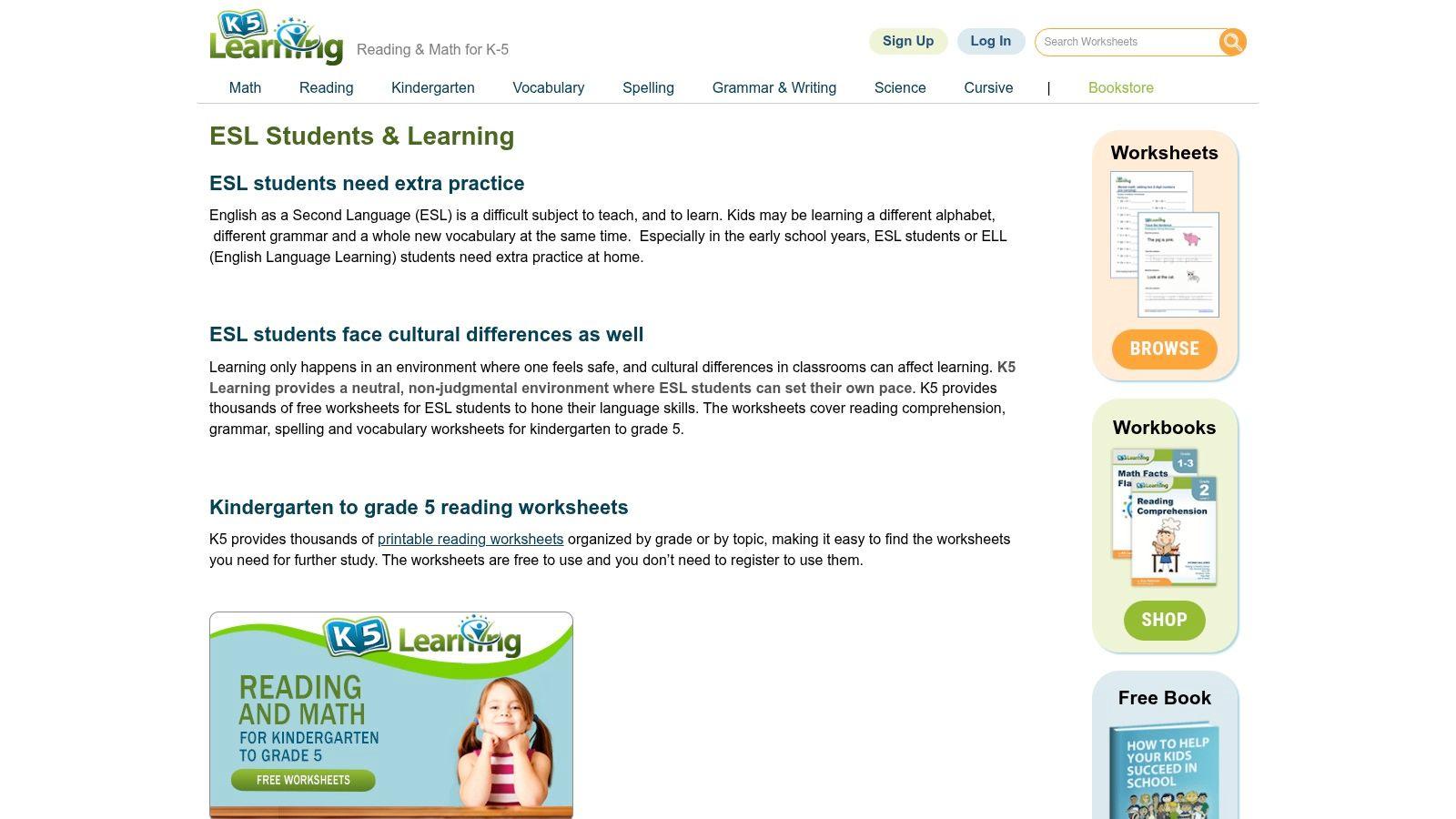
K5 Learning's ESL student resources are exactly what the name says. Kindergarten through grade 5. Reading sorted by grade or topic, plus grammar, spelling, and vocabulary on the same site. Free worksheets, no registration. For primary teachers who need something printable in two minutes, that's hard to beat.
Keep expectations straight. Much of this is general elementary reading, not passages leveled by English proficiency. A grade 3 newcomer and a grade 3 native speaker are not the same reader. You'll often need to drop a grade level, pre-teach three or four words, and read the first paragraph together.
That read aloud step isn't fluff for young ESL learners. A quasi experimental study described in the Journal of Development and Social Sciences Grade 2 study used 50 Grade 2 ESL learners in Lahore, Pakistan, comparing an interactive read aloud group with a traditional method control group. Use K5 pages after you've read and talked, not as cold independent work.
- Best for: Early literal questions, sequencing, and short vocabulary practice in grades K to 5
- Lesson slot: Morning work, centers, or homework parents can support without a login
- Limits: Useless past elementary, and you'll adapt often for true beginners
Print two levels on the same topic. Same discussion, different page. Nobody has to announce who's on which one.
5. 7ESL
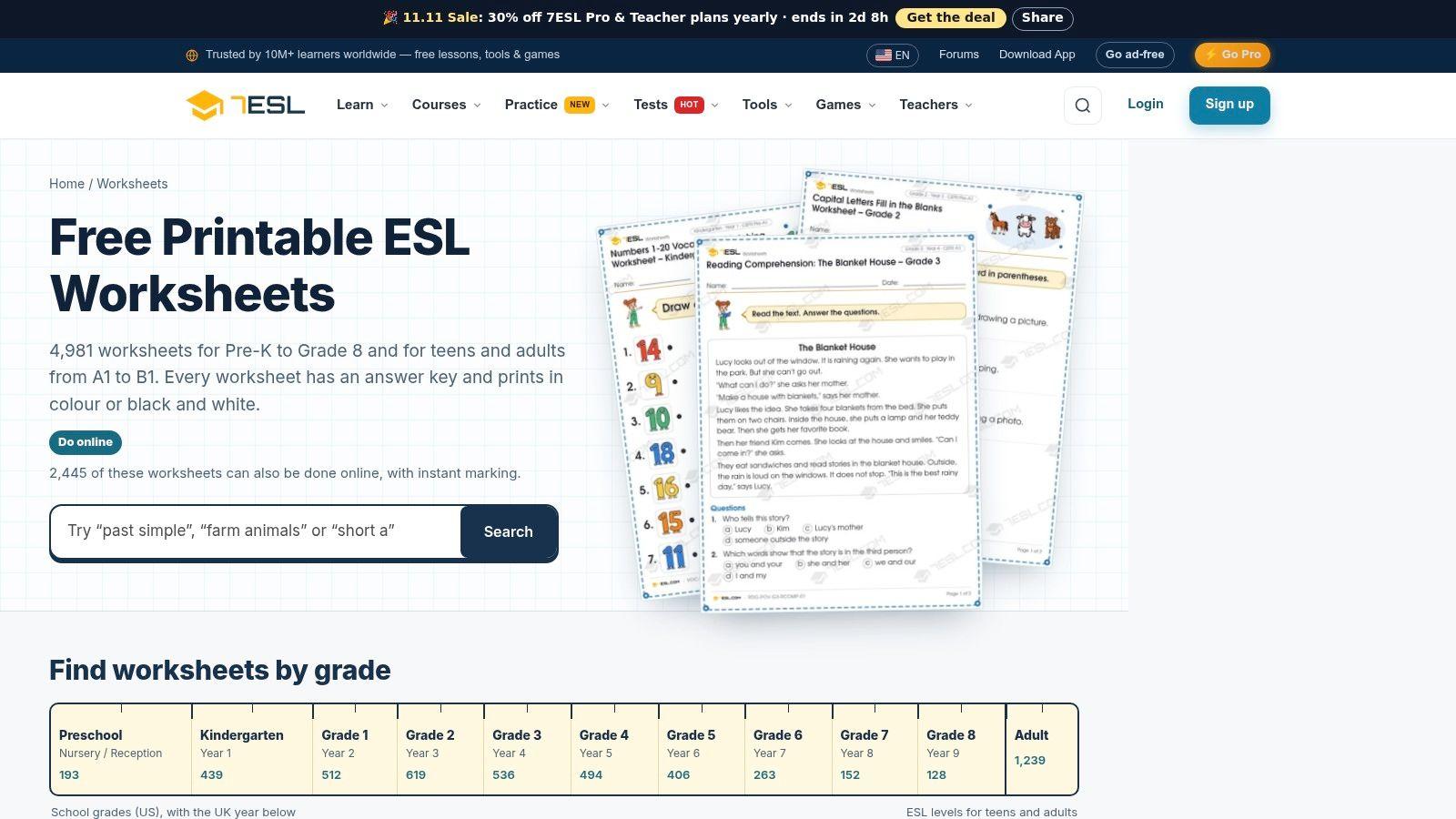
Breadth is the selling point at 7ESL worksheets. Pre-K through grade 8, plus teens and adults. Reading sits next to phonics, vocabulary, grammar, and writing, with grade and CEFR filters, answer keys, black and white print versions, and some online work with automatic marking. When you teach mixed ages, one library saves time.
Don't confuse breadth with a sequence. You'll still decide the order. A sensible order is supported retrieval first, then independent inference, with a graphic organizer in between. That approach lines up with a meta analysis summarized in the ERIC meta analysis of English learner reading strategies, which covered 23 experimental and quasi experimental studies involving 2,284 English learners and found benefits for scaffolding, graphic organizers, interactive read alouds, and leveled questions. Duration mattered. One worksheet won't do it. A routine over weeks might.
How I'd use it without drowning in options
Pick one skill for the week. Monday, a 7ESL page with a story map. Wednesday, same skill, less support. Friday, a short online set that marks itself. That's a sequence, not a stack.
- Strengths: Wide age range, printable and digital in one place, free teacher account to start
- Limits: The full library isn't freely downloadable, and CEFR coverage concentrates at beginner to intermediate, so advanced teens outgrow it fast
6. Ellii
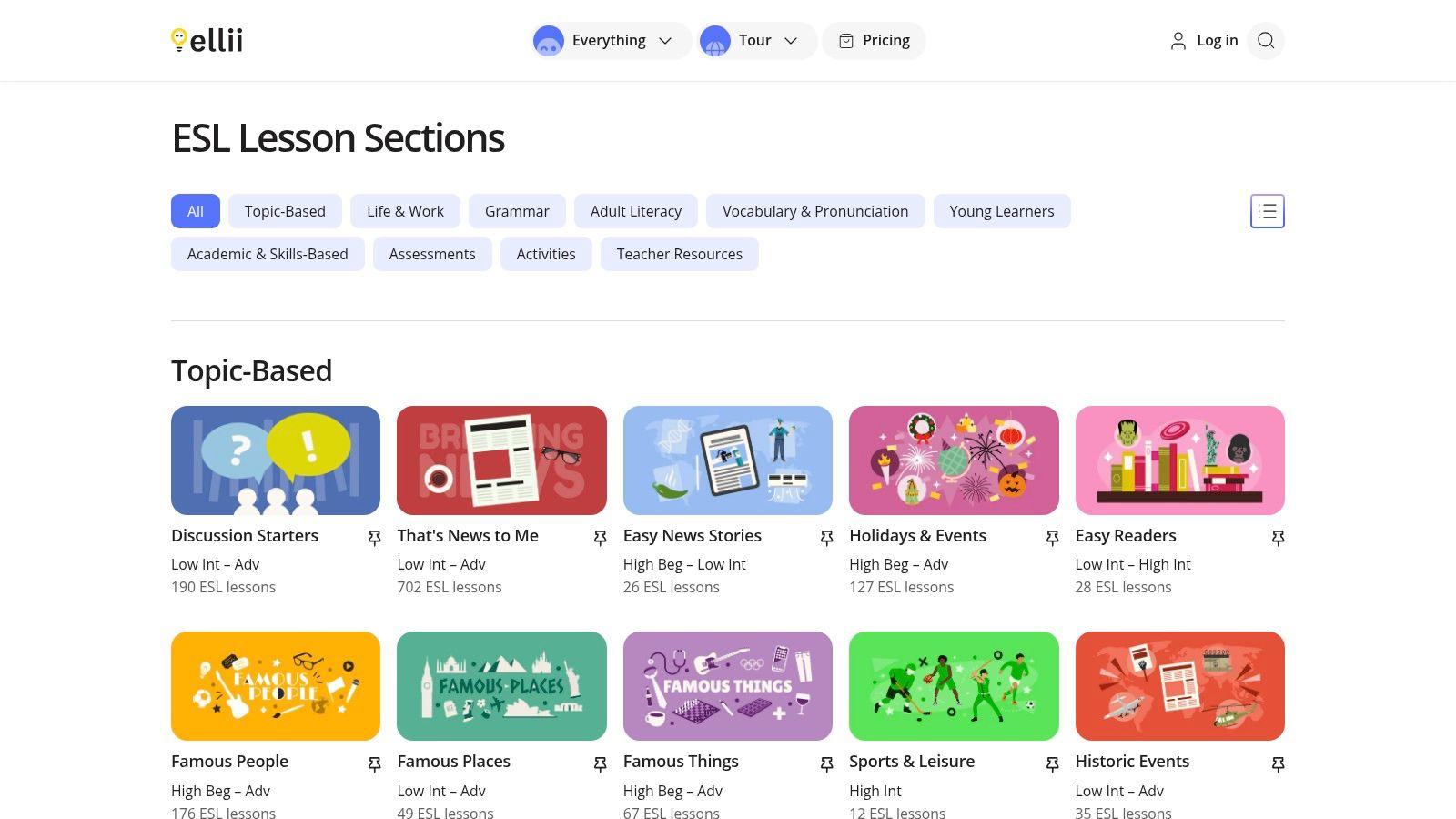
Ellii lessons feel like lessons, not loose pages. That's the difference. You get printable and digital reading for young learners, adult literacy, and higher level students, including academic reading, easy readers, news, phonics stories, menus, and workplace documents. Many lessons add audio, vocabulary, and follow up tasks.
I'd use Ellii when the text type is the point. A menu teaches scanning for prices and categories. A workplace notice teaches finding who must do what by when. Those are real comprehension skills, and they transfer outside school. Audio support also helps students who understand more by ear than by eye.
Check the level before you print. Mismatch is common and costly. A 2024 study in Frontiers in Psychology on Chilean teacher education students found ESL students' average reading levels ranged from 919 to 954 Lexile, while assigned first term texts were approximately 1,250 Lexile. Your students won't tell you a text is 300 points too hard. They'll just stop.
- Strengths: Vocabulary and discussion built around the reading, practical real world texts, samples to preview before you commit
- Limits: Full access needs a subscription, and young learner material isn't filtered by grade, so preview for age fit every time
For adult and older teen classes, Ellii is one of the strongest picks here. For a grade 2 class, you'll work harder to sort it.
7. British Council LearnEnglish Kids
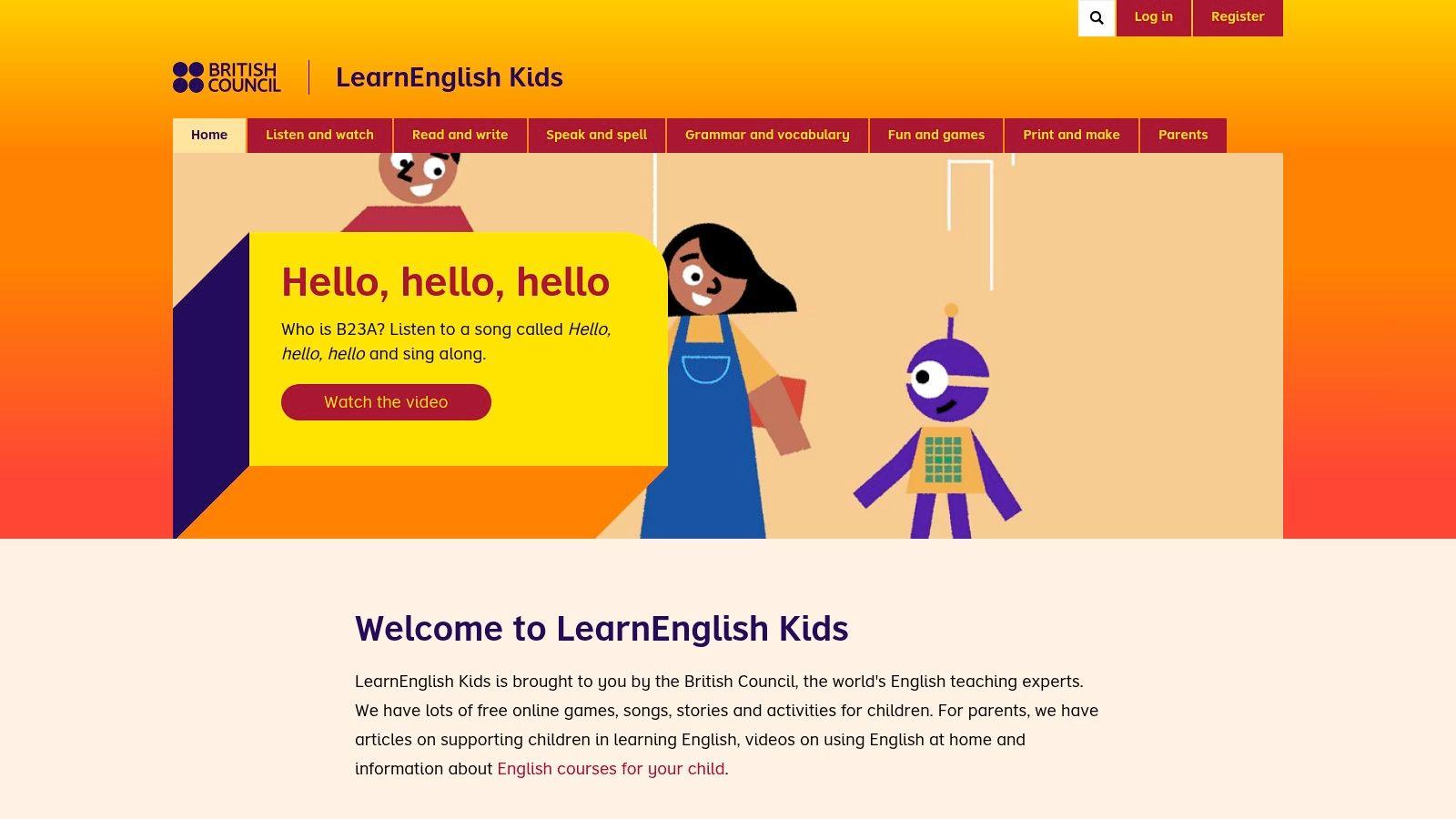
Free, cheerful, and built for children ages 5 to 12. British Council LearnEnglish Kids pairs texts with preparation and comprehension exercises, plus downloadable worksheets for offline work. Stories, songs, videos, and games sit around the reading, so a shy student can meet the language more than once.
Use the preparation step. Teachers skip it and then wonder why comprehension fails. A picture, a prediction, and two key words change the whole task for a young English learner. That before, during, and after structure matches the IES K-3 reading comprehension toolkit, which names six evidence based strategies including activating prior knowledge or predicting, questioning, visualizing, monitoring and clarifying, inferencing, and summarizing or retelling.
A simple way to run it
Predict from the title. Read or listen. Draw the scene. Retell in three sentences. You've covered four strategies with one short text, and the drawing tells you who understood before writing gets in the way.
- Strengths: No subscription, child friendly, reading connected to songs and games instead of isolated drills
- Limits: It's a learner facing site, not a teacher database. No class management, and you'll map activities to your own objectives
Best as a warm-up or a home link. Not enough on its own for a planned comprehension sequence.
8. British Council LearnEnglish Teens
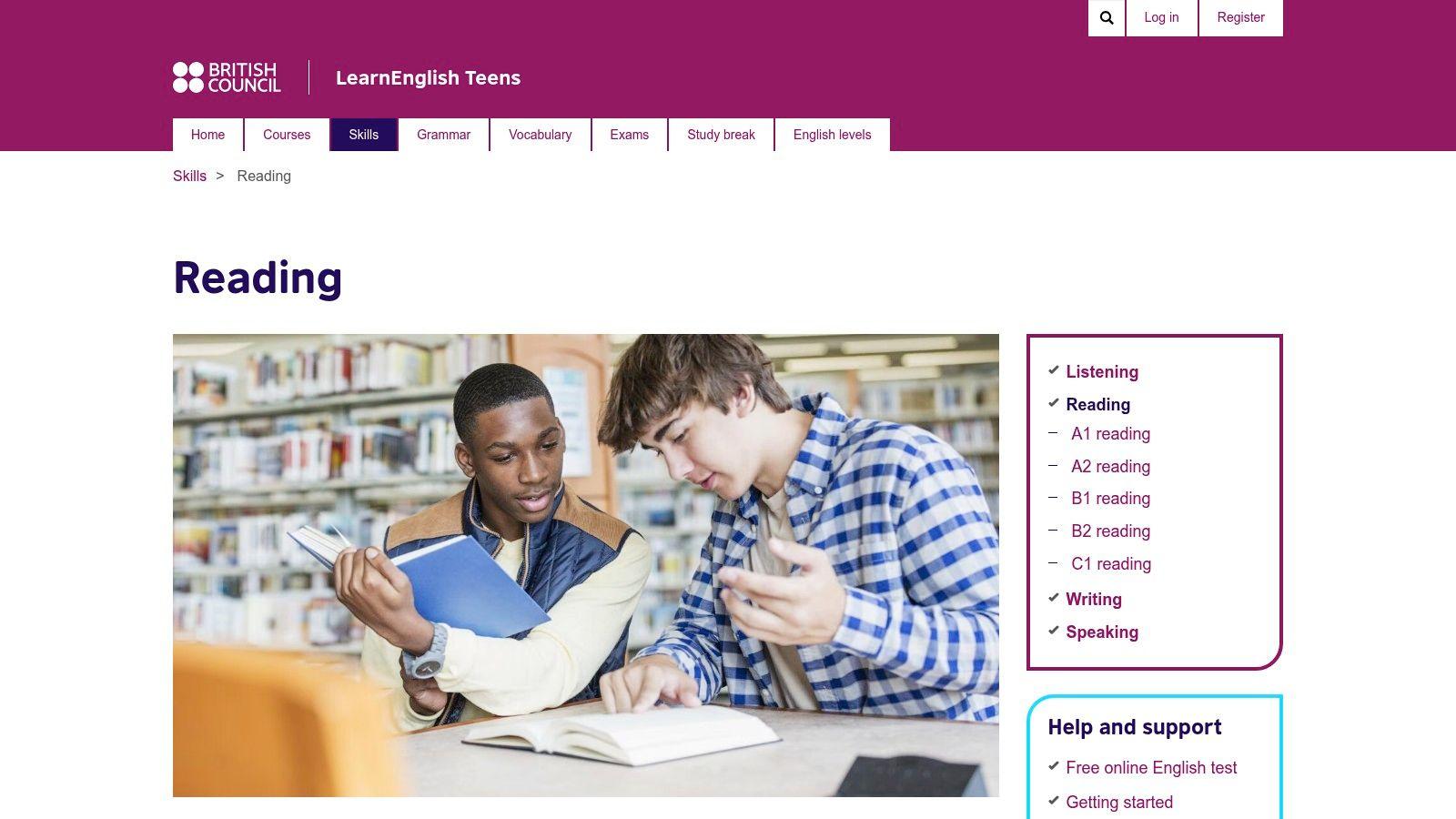
Teens reject babyish texts fast, and they're right to. British Council LearnEnglish Teens reading is built for ages 13 to 17, sorted A1 to C1, with notices, emails, flyers, menus, job adverts, and articles. Many tasks include online exercises, downloadable worksheets, and answer sheets. Free.
This is my pick for gist and detail in short real world texts. Read a job advert for the gist. Read again for hours, pay, and requirements. That two pass routine teaches students that good readers change speed on purpose. It also fits older learners who need vocabulary work before fluency work. The IES middle school intervention resource for grades 6-8 recommends identifying unfamiliar or less common words and teaching them explicitly before fluency building activities, plus morphology work on prefixes, suffixes, and roots.
Don't hand a B1 teen an A2 text with cartoon animals and call it differentiation. Lower the language load. Keep the topic grown up.
- Strengths: Honest CEFR labels, printable homework that doesn't need a login, topics teens don't find insulting
- Limits: No use for elementary, and you'll still check each task against your curriculum goal and your students' maturity
Use one text for guided gist work in class. Send a parallel text home. Same skill, new content. That's how transfer starts.
9. ReadWorks
ReadWorks isn't ESL only, and you should know that upfront. It's a free K-12 library with thousands of fiction and nonfiction passages, multiple choice and open ended question sets, and printable or digital assignments. The ESL value comes from StepReads, which offer a more accessible version of a related passage, and Spanish English paired texts.
That shared topic at two levels is gold for inclusion. Your English learners join the science discussion instead of doing a separate baby worksheet at the back. The need is real. A 2025 New York State synthesis described in the New York State Education Department multilingual literacy synthesis covered more than 2,000 studies and found multilingual learners generally attain word level skills comparable to monolingual English speakers, while comprehension and writing remain the greater challenges.
So don't stop at literal questions. Pair a StepRead with talk, background building, and one inference prompt. If you want a structure for that teaching, work through reading comprehension strategies that move past recall and apply one strategy per passage.
- Strengths: Free for teachers and schools, huge subject range, differentiation that keeps a common topic and objective
- Limits: Leveled by grade, not English proficiency, and paired text support helps Spanish speakers most directly
For content area teachers with English learners in the room, ReadWorks is often the most practical free option here.
10. Reading A-Z
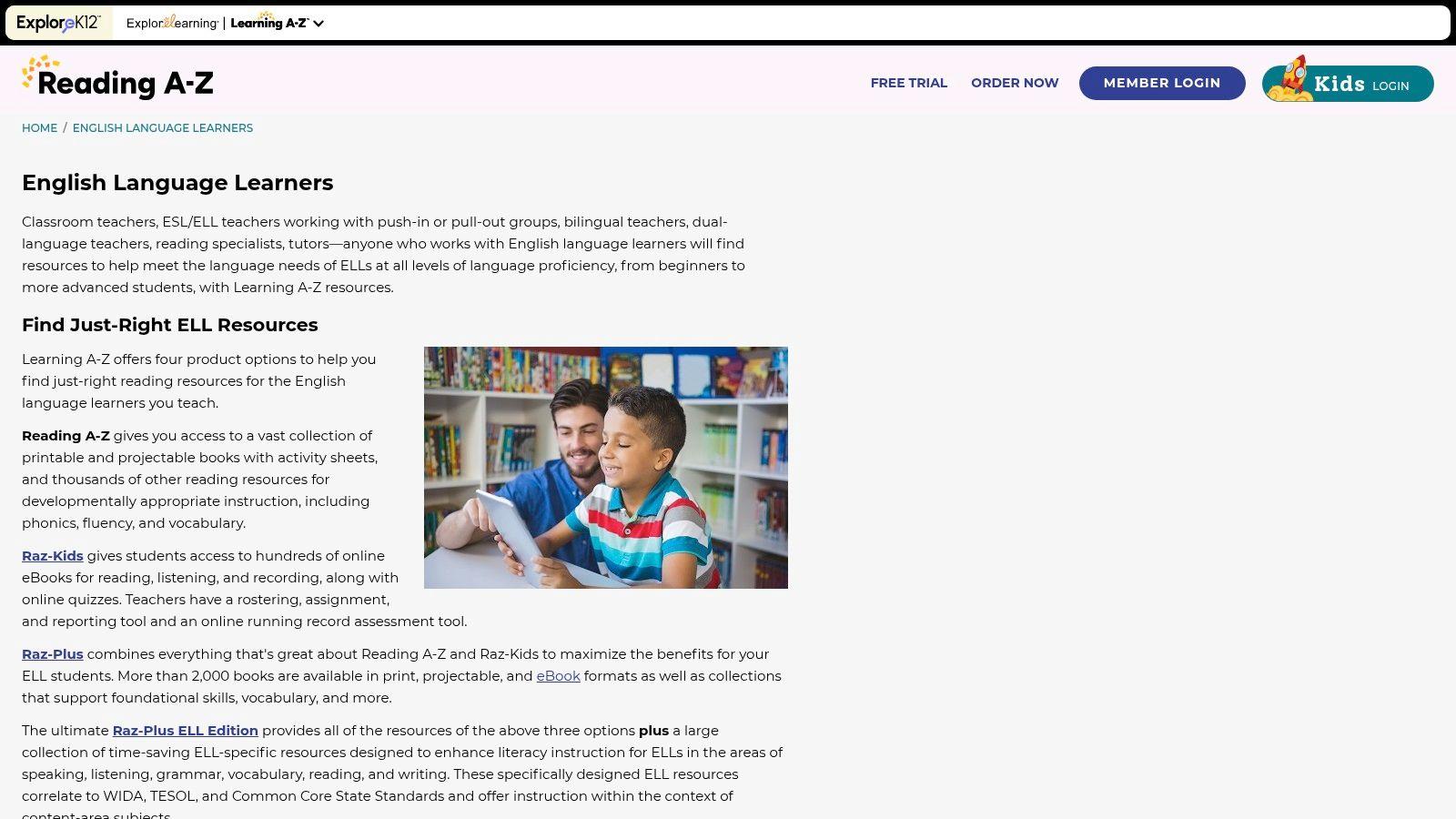
If you want a program, not a pile of pages, Reading A-Z ELL resources is the structured end of this list. Leveled books come printable and projectable, with activity sheets, quizzes, and assessments. ELL Book Packs add comprehension quizzes, answer sheets, and multiday lesson plans, sorted by grade range and language proficiency, with alignment to WIDA, TESOL, and Common Core frameworks.
That structure suits older English learners who can think at grade level but get buried by dense informational text. Support should build knowledge, not just simplify. A 2025 study in AERA Open on upper elementary multilingual learners ran a randomized study of 66 students and found content knowledge improved significantly while reading fluency did not. More pages alone won't fix comprehension. Knowledge, vocabulary, and discussion have to travel together.
Who should pay for it and who shouldn't
Pay if you'll run leveled groups all year and use the lesson plans and assessments. Don't pay for occasional printables. That's buying a bus to cross the street. If your main need is adjusting one tough text, a text leveler for classroom passages solves the immediate problem faster.
- Strengths: Texts, vocabulary, lessons, and assessment in one system, with ELL scaffolds beside content reading
- Limits: Subscription required, and the sheer volume can slow down a teacher who only needs one passage tomorrow
How the ten reading comprehension sources compare for ESL classrooms
Pick by skill first: main idea, inference, or vocabulary. Then match the level band to warm-up, guided practice, or homework. Free access decides whether you can run it tomorrow.
| Item | Level or Age Range | Free Access | Best For |
|---|---|---|---|
| Worksheets - Reading Comprehension | K–12 | Free printable worksheets, including reading | Creating age-appropriate, standards-aligned worksheets |
| ESL Pathway | Young learners; CEFR A1–C2 | Free samples; subscription for full library | ESL/EFL practice across proficiency levels |
| ReadTheory | ESL, K–12, and adults | Free Basic plan | Adaptive online or printable practice with teacher progress tools |
| K5 Learning | Kindergarten–Grade 5 | Free worksheets without registration | Elementary learners needing print-ready practice |
| 7ESL | Pre-K–Grade 8, teens, and adults | Free teacher account; paid plans available | A broad library of printable and digital ESL practice |
| Ellii | Young learners, adult literacy, and higher-level students | Sample lessons; subscription for full access | ESL lessons with practical texts, audio, and follow-up practice |
| British Council LearnEnglish Kids | Ages 5–12 | Free | Children's reading practice and engaging language activities |
| British Council LearnEnglish Teens | Ages 13–17; CEFR A1–C1 | Free | Teen learners using real-world texts and printable activities |
| ReadWorks | K–12 | Free for teachers, schools, and districts | Differentiated fiction and nonfiction reading practice |
| Reading A-Z | Grade ranges and English-proficiency levels | Subscription required | Structured leveled reading instruction and ELL support |
Start With One Passage Type and Build From There
Don't overhaul your reading block this week. Pick one source that matches your students' level, print a single passage, and teach it properly. Pre-teach the words that block meaning. Read once for gist. Read again for detail. Ask one inference question and make students point to evidence. That's a lesson. A stack of untaught worksheets is just paper.
Match the tool to the job in front of you. Need honest CEFR levels for a mixed ESL class? Start with ESL Pathway or British Council LearnEnglish Teens. Need young children engaged without a login? Use LearnEnglish Kids or K5 Learning, and read aloud first. Need English learners inside a grade level science or social studies topic? ReadWorks StepReads keep the class on one topic. Need a full leveled system your school will fund? Reading A-Z earns its cost only if you'll use the lessons and assessments all year.
Watch the two traps that waste the most time. First, level by English proficiency, not just grade. A strong thinker with new English needs grown up ideas at a language load she can carry. Second, don't score English output and comprehension as one thing. A student who points to the right evidence but writes a broken sentence understood the text. Teach the sentence next. Don't mark the reading wrong.
Check one thing before you move on. Can your learners name the main idea in their own words, home language planning first if that helps, then English? If they can't, inference questions will only produce guessing. Stay on gist for another text or two. If they can, add vocabulary in context, then inference with evidence, then a short written explanation. Same routine, rising demand. Students relax when the routine is familiar and the text is new.
If formatting is the step that keeps eating your prep, skip it. Kuraplan can turn a lesson into a printable reading worksheet in one click, and its free resources include more than 1,000 printable worksheets across reading, math, science, and more. Take any source you provide, adapt it for reading age, gloss the unfamiliar vocabulary, generate comprehension questions, and print. I recommend starting with one text type your class meets often, a notice, a short story, or a science passage, and running the same routine for three weeks. You'll learn more from three weeks of one routine than from ten sources used once.
Turn tomorrow's lesson into a leveled ESL reading page with glossed vocabulary, main idea and inference questions, and a printable PDF, without rebuilding the formatting by hand. Visit Kuraplan to generate your first worksheet from a lesson you have already planned and print a version your newcomers and your stronger readers can both use.