You're probably reading this after a day when a small conflict took over far too much class time.
Two students snap at each other. One mutters something under their breath. A chair scrapes back. The rest of the room goes quiet in that tense way teachers know immediately. You stop instruction, separate the students, assign a consequence, and get everyone moving again. Technically, the problem is handled. But it doesn't feel resolved. The students are still upset, the class feels off, and you know there's a decent chance the same issue will show up again tomorrow.
That's where restorative practices start to matter.
They are not the “soft” alternative people sometimes assume they are. In strong classrooms, restorative practices are a disciplined way of teaching students how to handle harm, rebuild trust, and take responsibility in ways that stick. They help teachers move from repeatedly managing disruption to steadily building a room where students know how to repair conflict.
That shift matters in any grade level. It also lines up with the kind of relational work many counselors and family support professionals already emphasize. If you want a useful companion read on the habits that support connection, these expert strategies for healthy relationships fit naturally with classroom restorative work because they focus on communication, boundaries, and repair.
From Conflict to Connection
A punitive response can stop behavior in the moment. It often doesn't teach students what to do next.
A restorative response asks a different set of questions. What happened? Who was affected? What needs to happen now to make this right as much as possible? That sounds simple, but it changes the emotional climate of a room. Students learn that behavior has impact, community matters, and repair is expected.
What this looks like in real classrooms
A fourth grader blurts out an insult during partner work. The usual move is removal, warning, maybe a call home. Sometimes that's still part of the response, especially if safety or repeated behavior is involved. But a restorative teacher also circles back with the harmed student and the student who caused harm. The goal isn't to erase accountability. It's to make accountability meaningful.
A middle school example is even more familiar. Two students trade comments in the hallway, carry it into class, and suddenly the whole lesson is gone. If the only response is detention, both students may leave believing the other “won” or “started it.” If you facilitate a structured conversation later, they have to hear impact, name choices, and agree on what repair will look like.
Behavior is often a clumsy form of communication. Restorative practice helps adults respond to the message without excusing the harm.
The mindset shift teachers feel first
The first change isn't a circle or a script. It's the decision to treat conflict as something to teach through, not just suppress.
That doesn't mean every conflict becomes a long meeting. It means the classroom runs on a clear belief. Relationships are part of instruction. Repair is part of discipline. Students don't just need consequences. They need practice in honesty, listening, and making things right.
For a lot of teachers, that's the moment restorative practices stop sounding theoretical and start feeling useful.
What Are Restorative Practices Really?
Restorative practices are the routines, language, and structured processes schools use to build relationships, prevent harm, and respond to conflict by repairing damage to the community.
The easiest way to explain them is this. Traditional discipline often tries to patch a problem. Restorative practices try to mend the fabric that was torn.
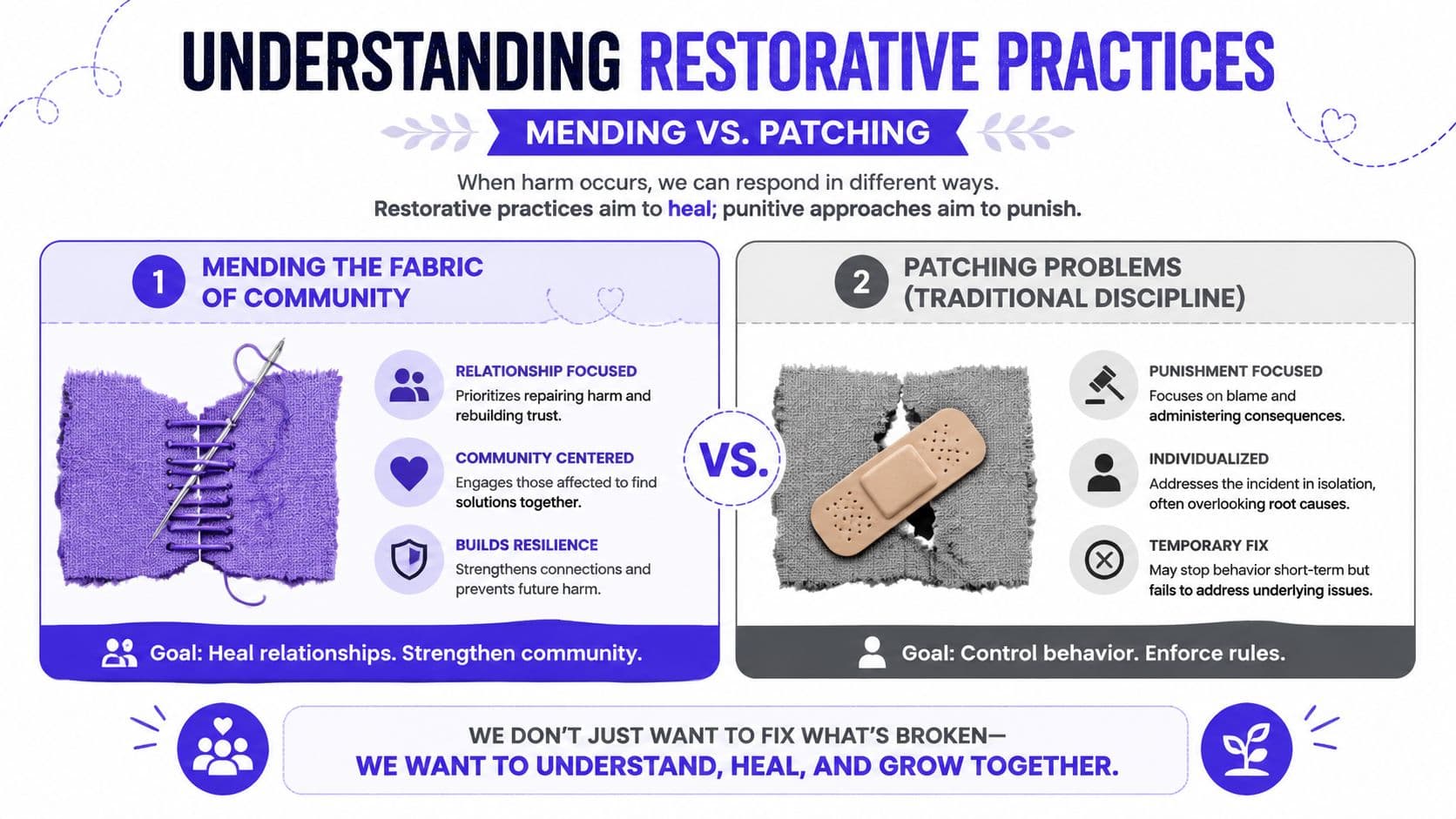
Mending versus patching
A patch covers the damage. Sometimes that's necessary in the short term. A student is removed. A referral is written. A consequence is assigned.
Mending does something different. It asks students to understand impact, hear from others, take responsibility, and contribute to repair. The community ends up stronger because the response teaches skills that reduce repeat harm.
Here's the practical distinction:
| Approach | Main question | Likely result |
|---|---|---|
| Traditional punitive discipline | What rule was broken and what consequence follows? | Fast response, but often limited repair |
| Restorative practices | Who was affected, what harm was done, and how can it be repaired? | Accountability tied to relationship and community |
What counts as restorative
Teachers sometimes think restorative practices only mean circles. Circles are one tool. The broader approach includes:
- Daily relationship routines that help students feel seen before there's a problem
- Restorative questions after conflict so students reflect on impact
- Structured class conversations that build trust and shared norms
- Formal conferences when harm is serious and multiple people were affected
This is why restorative practices work best as a culture, not an isolated strategy.
Why schools keep investing in them
The strongest argument for restorative practices is that they don't just sound good. They produce measurable changes when schools implement them seriously.
Schools that implemented restorative practices policies saw a 35% reduction in student arrests within school settings, a 15% reduction in out-of-school student arrests, and an 18% decrease in out-of-school suspensions, along with significant improvements in students' feelings of belonging and safety, according to the NEA summary of the University of Chicago Education Lab study.
That matters because teachers feel those shifts every day. Fewer exclusions. Better climate. Stronger relationships. More time teaching.
It also matters that benefits were especially strong for students who are often hit hardest by exclusionary discipline. That doesn't mean restorative practices automatically solve inequity. It does mean they offer a more constructive direction than a discipline system built mostly around removal.
If a discipline system ends the conversation at punishment, it misses the chance to teach responsibility.
The Core Principles of a Restorative Classroom
A restorative classroom isn't built on a script. It's built on a few consistent principles that shape how adults respond when things go well and when things go badly.
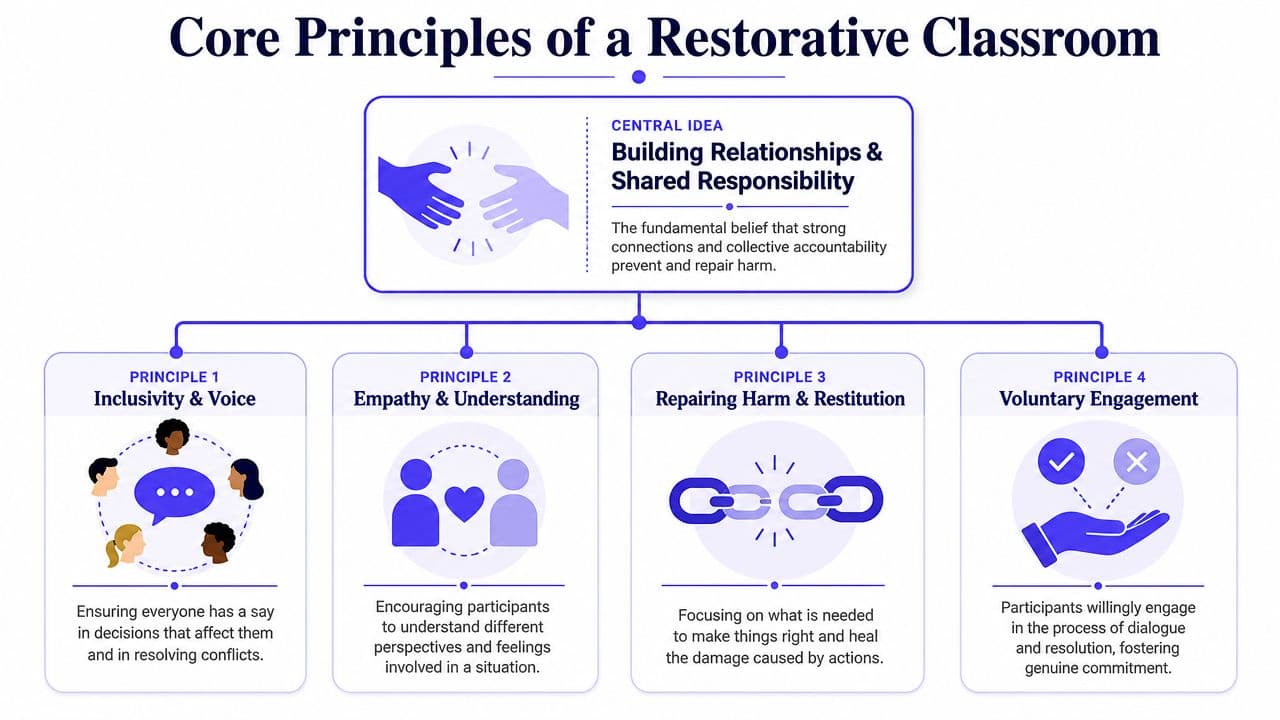
Relationships come first
In a restorative room, connection isn't extra. It's preventative discipline.
That means greeting students by name, building routines for participation, and noticing when a student's behavior shifts before it turns into a bigger issue. Teachers who do this well aren't being permissive. They're building enough trust that correction lands without becoming a power struggle.
Voice matters
Students are more likely to own a solution when they've had a real chance to speak.
This doesn't mean every opinion carries equal decision-making power. The teacher still leads. But students need space to explain what happened, what they were thinking, and what they need. Without that, discipline becomes something done to them instead of something they learn from.
Harm needs repair
Restorative classrooms don't stop at “say sorry.”
Repair might mean replacing damaged materials, making a plan for safer partner work, writing a reflection, participating in a facilitated conversation, or following through on a commitment made to a peer. The key is that the action connects logically to the harm.
Practical rule: If the consequence has no relationship to the harm, students often experience it as control rather than accountability.
Participation should be genuine
This principle gets skipped too often. Restorative conversations work best when participants are willing enough to engage honestly.
That's one reason formal restorative conferences are so carefully structured. In schools using a whole-school approach, research summarized by the International Institute for Restorative Practices found a 30–50% reduction in suspensions, 92% of restorative conferences resulted in successful agreements, and only 4% of agreements were broken within three months.
Those numbers matter because they point to something teachers know from experience. Students are much more likely to keep an agreement they helped create than a lecture they barely listened to.
Your Guide to Implementing Restorative Practices
You don't need to launch with a formal conference tomorrow. Most successful implementation starts small, becomes routine, and only later expands into more formal processes.
A continuum helps. Use lighter-touch practices daily. Save the most structured responses for bigger harm.
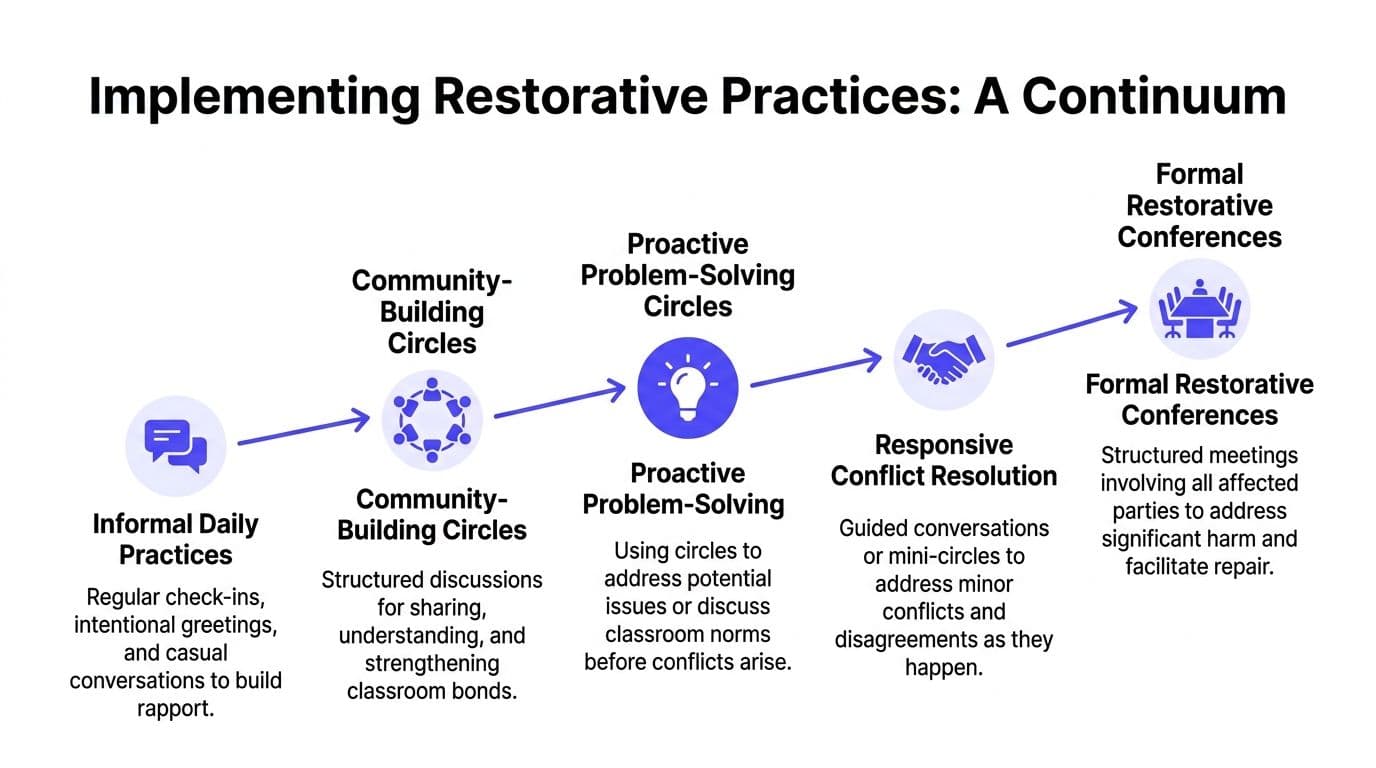
Start with everyday language
The fastest entry point is changing how you respond in the moment.
Try affective statements. These are simple statements of impact, such as “When you interrupted Maya while she was sharing, I saw her shut down, and it affected the discussion.” That language is direct, specific, and less likely to pull you into a power contest.
Then add restorative questions:
- After a low-level conflict: What happened?
- When a student minimizes it: Who was affected by that choice?
- When moving toward repair: What do you think needs to happen now?
These questions work because they shift students from defense to reflection.
Build community before you need repair
Teachers get frustrated with circles when they only use them after a problem. That's too late.
Use short community-building circles when things are calm. Topics can stay simple:
- Belonging: What helps you feel comfortable in a class?
- Respect: What does respect look like when people disagree?
- Frustration: What helps you reset when you're annoyed?
A strong circle routine teaches turn-taking, listening, and emotional vocabulary. It also gives you a clearer read on your students long before conflict escalates.
Here's a useful way to keep circles manageable:
- Keep the prompt tight. One question is enough.
- Model brevity. If your share is a speech, students will drift.
- Allow pass options. Forced vulnerability backfires.
- Close with one action. Ask what the class should remember tomorrow.
Use responsive conversations for minor harm
Not every conflict needs a whole-class process. Sometimes two students need a short mediated conversation after independent work or during a transition.
A good mini-conference is brief and specific. You guide each student to describe what happened, identify impact, and agree on what they'll do next. Then you revisit it later. That follow-up is where many teachers either build credibility or lose it.
The conversation is only half the intervention. The follow-up tells students whether the agreement actually matters.
Later in the section, it helps to watch a modeled example of restorative communication in action:
Reserve formal conferences for significant harm
When the harm is serious, involves several people, or has ongoing impact, schools may use a formal restorative conference. These are not casual chats.
According to the NAESP implementation indicators document, formal restorative conferences use a structured problem-solving process with voluntary participation to identify needs, reflect on harm, and create action plans. They also need trauma-informed interventions and follow-up mechanisms to ensure repair is completed.
That structure matters. Without it, a conference can become performative, unsafe, or pressure-filled for the harmed student.
If your school is early in implementation, don't fake the formal version. Start with strong daily routines, consistent restorative language, and manageable class circles. That foundation does more than people expect.
Sample Restorative Activities and Lesson Templates
Teachers usually don't need one more philosophy. They need examples they can use on Tuesday.
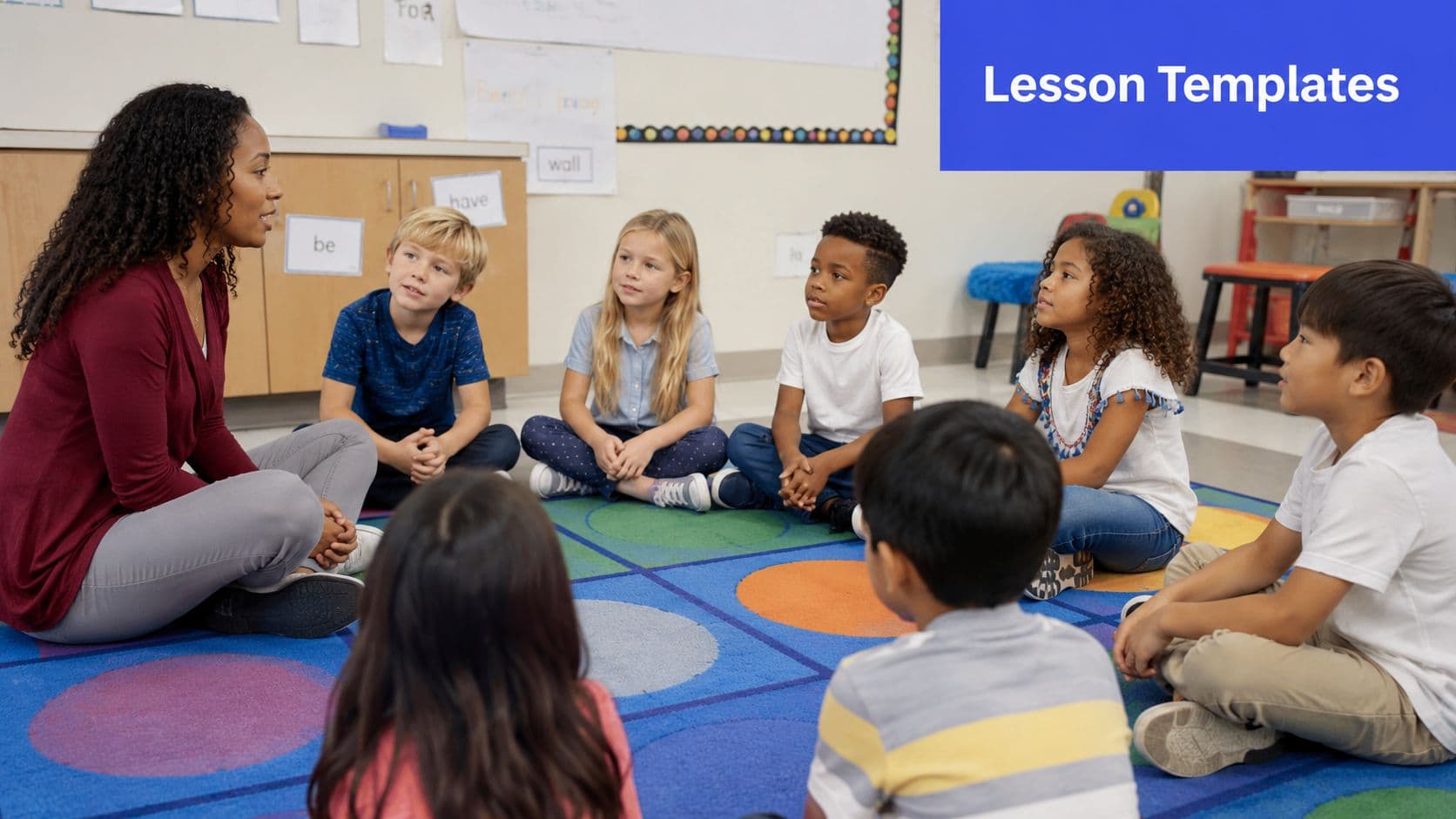
Community-building circle prompts
These work well at the start of the week, after recess, or as part of advisory.
- On respect: Share one way a classmate shows respect without saying a word.
- On frustration: What helps you calm down when you feel annoyed?
- On group work: What makes you trust someone as a partner?
- On mistakes: How should people respond when someone gets something wrong in class?
The key is to choose prompts that surface social expectations before conflict forces the conversation.
Responsive circle prompts after a conflict
After a tense class period or repeated issue, you need questions that move the group toward accountability without turning the discussion into a public trial.
Try prompts like these:
- Impact-focused: How did today's problem affect our ability to learn?
- Responsibility-focused: What choices made the situation worse?
- Repair-focused: What do we need from each other tomorrow?
- Forward-looking: What should our reset look like in the next class?
Notice what these prompts do not ask. They don't invite students to name and shame classmates. They focus on the shared learning environment.
A simple follow-up lesson template
A strong restorative conversation often reveals a missing skill. If students can't take perspective, regulate frustration, or disagree respectfully, the class needs instruction, not just correction.
Use a follow-up lesson like this:
| Lesson element | Example |
|---|---|
| Skill focus | Perspective-taking during disagreement |
| Opening task | Short scenario with two different student viewpoints |
| Mini-lesson | Sentence stems for disagreement and clarification |
| Practice | Partner role-play with a low-stakes conflict |
| Reflection | What phrase helped you stay respectful? |
| Exit ticket | One thing I can do next time I feel misunderstood |
Restorative practices expand beyond mere discipline. They feed directly into social-emotional instruction, speaking and listening work, and classroom routines.
A useful test for any restorative response is this. Did students leave with a clearer skill, or only a stronger memory of the conflict?
If a circle reveals that students need help with empathy, turn that into a short lesson the next day. If the issue is interrupting, teach discussion norms and rehearse them. If students struggle to express impact, model sentence frames and let them practice in low-risk scenarios.
How to Know If Your Restorative Efforts Are Working
One of the biggest mistakes schools make is measuring restorative practices only by whether suspensions went down. That data matters, but it's not enough.
If you only count major discipline events, you miss the everyday cultural shifts that tell you whether implementation is shallow or real.
Use a broader measurement lens
A stronger approach tracks what's happening in classrooms, not just in the office.
The technical framework outlined in this report on measuring restorative practices implementation identifies six critical pillars: culture, learning, practices, exposure, structures, and outcomes. The point is simple. If you want credible evidence, you have to measure more than anecdotes.
Here's what those pillars can look like in practice:
- Culture means student belonging, trust, and perceived fairness.
- Learning means whether staff understand restorative approaches and can use them well.
- Practices means what teachers do, such as circles, restorative questions, and follow-up routines.
- Exposure means which students consistently experience those practices.
- Structures means schedules, referral processes, coaching, and leadership support.
- Outcomes means the changes you can see in behavior, attendance, climate, and other indicators your school already tracks.
What teachers and leaders can track
You don't need a giant dashboard on day one. Start with a few measures that are realistic and worth discussing as a team.
Consider tracking:
- Office referrals by behavior type so you can see whether specific issues are changing
- Classroom removals because many schools undercount these even though students feel them
- Student climate check-ins on belonging, safety, and voice
- Teacher implementation notes on what restorative routines are taking place
- Follow-through on repair plans so conferences don't end as paperwork
A good measurement system should answer two questions. Are adults using the practices consistently? Are students experiencing the classroom differently because of them?
What not to do
Don't rely only on staff impressions. Don't label one successful circle as proof the system works. And don't ignore uneven implementation across classrooms.
If some students get restorative responses while others still get only punitive ones, your data will blur together and tell you very little. Measurement matters because it protects the work from becoming vague, uneven, or fad-driven.
Common Questions About Restorative Practices
Is this the same as restorative justice
Not exactly. In schools, restorative practices is the broader umbrella. It includes proactive community-building, classroom routines, language, and informal repair. Restorative justice usually refers more narrowly to the responsive processes used after harm occurs.
That distinction matters because a school can run a few conferences and still not have a restorative culture.
What if students refuse to participate
Resistance is normal, especially if students are used to adult-driven discipline. Don't confuse reluctance with failure.
Start with lower-stakes routines. Build predictability. Offer structured prompts and pass options when appropriate. Students often participate more openly when they trust that the process won't become a lecture or a public embarrassment.
Are circles enough to address inequity
No. This is one of the most important cautions in the whole conversation.
A frequently neglected question is how to keep restorative practices from managing conflict while ignoring deeper causes. As Novak Education's discussion of restorative practices puts it, leaders need to adopt a restorative approach from the start, align resources with community needs, and move beyond tools to a framework that challenges punitive norms systemically.
That means schools have to look at referral patterns, adult bias, access to support, and who gets heard when harm happens. If those issues stay untouched, circles can become a bandage placed over a system that still produces the same injuries.
Is this too time-consuming for a busy teacher
Bad implementation is time-consuming. Good implementation often saves time.
The class that spends a few intentional minutes building trust and repairing small harms usually loses less instructional time to repeated conflict later. That doesn't mean the work is effortless. It means the time goes toward prevention and repair instead of constant reset.
If you want help turning restorative insights into actual instruction, Kuraplan is worth a look. It helps teachers build standards-aligned lessons, worksheets, visuals, and follow-up activities quickly, which is especially useful when a class circle reveals a skill gap you need to teach right away.