You're probably reading this after a lesson that felt like triage.
You taught the whole class. A handful of students got it right away. A larger group sort of tracked with you. A few stared at the paper like it was written in another language. Someone asked to go to the bathroom during the one part you really needed everyone's attention. By the time independent work started, you were already behind.
That's the moment when small group instruction stops sounding like a buzzword and starts sounding like survival.
Done well, it gives you a way to teach the students sitting in front of you instead of aiming at some imaginary middle. Done poorly, it creates noise, chews up time, and leaves you wondering why you tried. The difference usually isn't your effort. It's the structure.
From Classroom Chaos to Focused Learning
A lot of teachers arrive at small group instruction out of frustration, not inspiration. Whole-group teaching can feel clean on paper, but real classrooms aren't tidy. In one class, you might have students who need direct re-teaching, students who are ready to move faster, and students who can do the work but need more talk time before they'll show it.
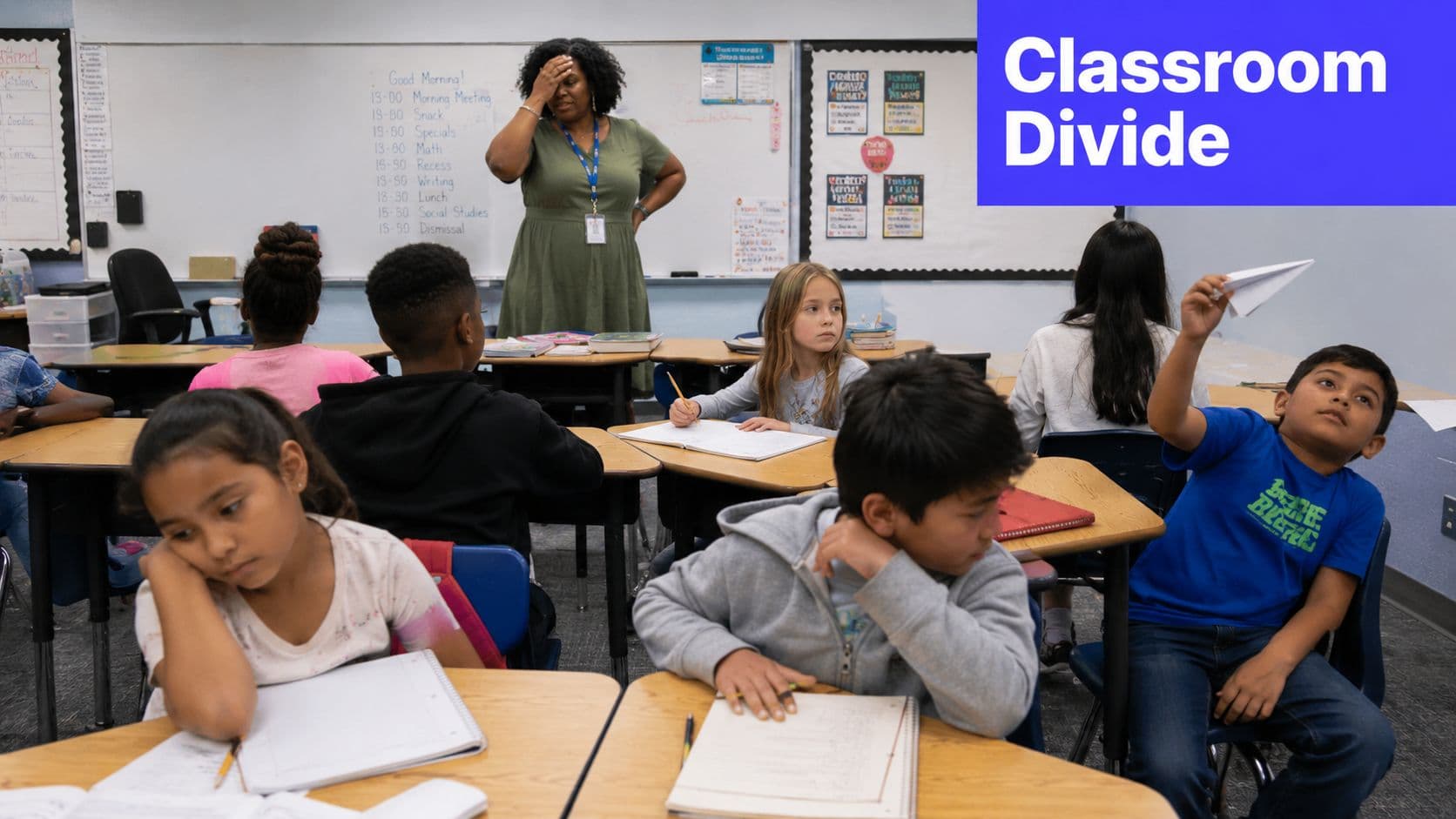
I've seen new teachers assume the answer is to make the whole-class lesson more engaging, more visual, more scaffolded, more everything. Sometimes that helps. Often it just means you're working harder while the gap between students keeps widening.
Why whole-group alone starts to break down
The issue isn't that whole-group instruction is bad. It's that it asks one lesson format to do too many jobs at once.
A single explanation can introduce a concept, but it usually can't do all of these at the same time:
- Catch misconceptions early: You don't always hear the quiet student's confusion during whole-group discussion.
- Adjust the pace: Some students need slower modeling. Others need faster release.
- Give useful feedback: Comments students hear three minutes after the task matter more than comments they get after school.
- Create safe participation: Many students will talk in a group of four long before they'll volunteer in front of the class.
Small groups work because they shrink the distance between teaching and noticing.
That's why small group instruction matters in real classrooms. It gives you a manageable way to listen, respond, and redirect while the lesson is still alive. Not later, when you're sorting through papers and realizing half the class practiced the wrong thing.
What this looks like on an ordinary Tuesday
It doesn't have to be elaborate. Sometimes it's a reading group working on decoding and phrasing while the rest of the class reads, writes, or practices known skills. Sometimes it's a math table where you re-teach multi-step thinking to a few students while another group tackles extension work independently.
The point is simple. You stop teaching to the room as if everyone needs the same thing, and you start teaching to patterns you can see.
What Is Small Group Instruction and Why Does It Work
Small group instruction is targeted teaching with a small set of students who share a need, a skill focus, or a next step. That group might work directly with you, with each other, or through a structured task that you've clearly taught and monitored.
It isn't random table work. It isn't “low kids at the back table.” It isn't just centers with nicer branding.
A practical definition that holds up
In daily practice, small group instruction usually has three features:
- Intentional grouping: Students are together for a reason.
- A narrow objective: The lesson focuses on one skill, strategy, or misconception.
- Short feedback loops: You can watch, prompt, correct, and adjust in the moment.
That's why it works. You're reducing the number of students you're trying to reach at one time, which makes your teaching more precise.
What teachers actually gain from it
The biggest benefit is that assessment happens while students are learning, not after the fact. You hear the approximation before it turns into a habit. You notice who can explain a strategy and who is copying one.
That changes the quality of feedback. Instead of writing “check your work” on a paper later, you can say, “Tell me why you chose that operation,” or “Try that sentence again with stronger evidence.” Students can use that feedback right away.
Classroom reality: Quiet students often reveal much more in a small group than they ever will during whole-class questioning.
There's also a participation shift. Students who stay silent in a full room often talk more when the audience is smaller and the task is more focused. That matters in reading discussions, math reasoning, writing conferences, lab prep, and intervention.
It also builds independence, not dependence
This surprises newer teachers. Good small group instruction doesn't make students cling to the teacher. It can help them do more on their own because the teaching is specific enough to move them forward.
That's one reason many teachers also look at approaches connected to fostering independence with Montessori. You don't need to run a Montessori classroom to borrow the core idea that students do better when routines, materials, and expectations support independent work.
When small groups are clear and purposeful, students start to understand what they're working on and why. That clarity cuts down on helplessness. It also cuts down on behavior issues that come from confusion, waiting, or work that feels either too hard or too easy.
Choosing Your Small Group Model
Not every version of small group instruction fits every subject, grade, or classroom rhythm. The model matters. A structure that works beautifully in a primary reading block can feel clunky in middle school science.
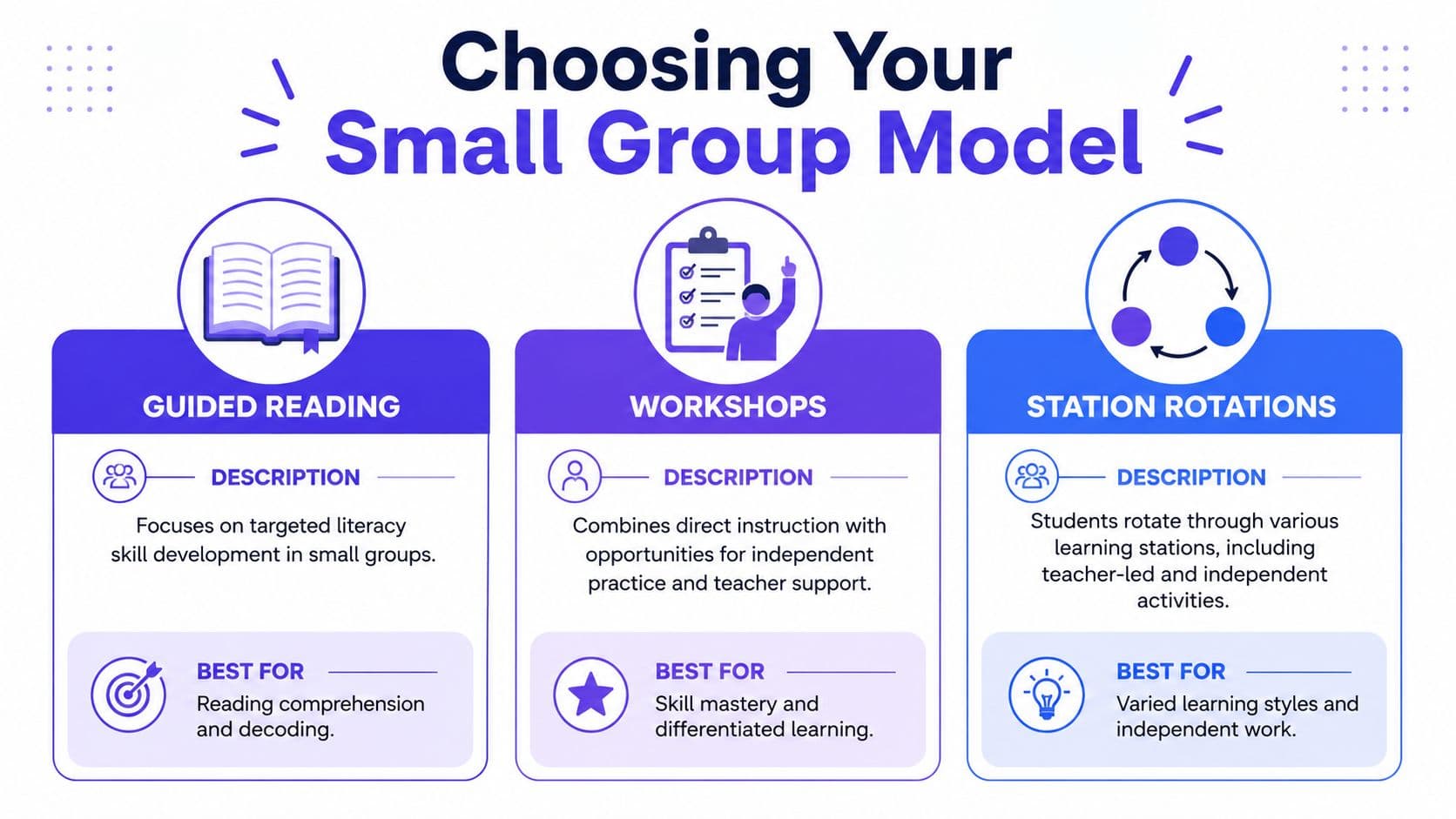
The three models most teachers lean on are Guided Reading, Workshops, and Station Rotations. Each solves a different classroom problem.
Small Group Instruction Models at a Glance
| Model | Primary Goal | Typical Group Size | Best For... |
|---|---|---|---|
| Guided Reading | Targeted support with a specific reading skill or text demand | Small, teacher-led group | Reading comprehension, decoding, fluency, discussion support |
| Workshops | Direct instruction followed by independent practice and teacher conferencing or group support | Flexible and mixed across the block | Skill mastery, writing instruction, differentiated follow-up |
| Station Rotations | Structured movement through several tasks, including teacher-led work | Small groups rotating through planned tasks | Varied learning formats, practice cycles, classes that need built-in movement |
Guided Reading
Best for targeted literacy instruction.
This is the model many elementary teachers know first, but the core idea travels well beyond early reading. You meet with a small group around a specific text demand or literacy skill while the rest of the class works on familiar tasks.
What works well here is the close listening. You can hear decoding patterns, notice comprehension breakdowns, and prompt students before they lose the thread. The lesson tends to be tight and teacher-directed.
What doesn't work is using guided reading as a vague conversation time. If the group objective isn't clear, the session drifts. Students leave having “met with the teacher” but not having learned a precise next step.
Workshops
Best for skill mastery and differentiated support.
Workshop structure starts with a focused mini-lesson. Then students move into independent practice, partner work, or project work while you confer or pull a group. This model is strong in writing, upper elementary reading, math problem solving, and many secondary classrooms.
The strength of workshops is flexibility. You keep a shared class target, but you don't trap everyone in the same pace. Students who need reteaching can meet with you. Students who are ready to apply can keep going.
The trade-off is management. Workshop blocks fall apart when independent work is too open-ended or when students haven't been trained to solve small problems without you.
If students interrupt your small group every two minutes, the issue usually isn't the group. It's the independence routine around it.
Station Rotations
Best for classrooms that need variety and predictable movement.
In station rotations, students move through a set of planned tasks. One station might be teacher-led. Another could be digital practice. Another might be partner application, vocabulary work, or hands-on review.
This format helps when attention dips quickly or when students benefit from changing task types. It can also make your schedule feel more visible to students because everyone knows where they're going next.
The danger is overbuilding it. Too many stations, too many materials, or too many new directions create noise fast. The strongest station rotations use simple tasks students already know how to do.
How to choose without overthinking it
Use these questions:
- Need close teacher feedback on a narrow skill? Start with guided reading or a teacher-led intervention group.
- Need one class goal with different levels of support? Use a workshop model.
- Need movement, variety, and repeated task structures? Try station rotations.
- Teaching older students? Workshop is often the easiest entry point.
- Worried about management? Pick the model with the fewest moving pieces first.
A simple model implemented consistently beats an ambitious one you can't sustain.
Your Step-by-Step Implementation Plan
The easiest way to fail with small group instruction is to try to build the whole thing at once. Start smaller. One clear grouping method, one consistent schedule, one type of independent task students can handle without drama.
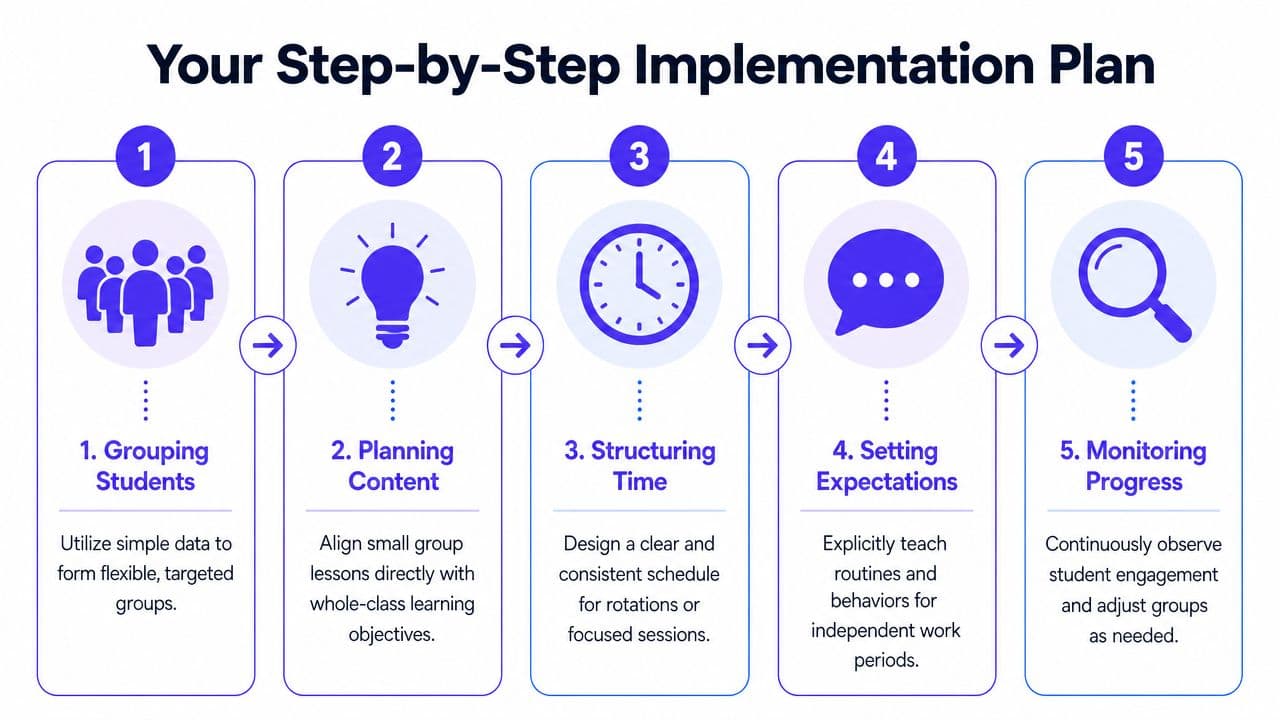
Start with the data you already have
You don't need a complicated spreadsheet to form groups. Use the evidence already on your desk. Exit tickets, classwork, running records, quick writes, warm-ups, and conferring notes are enough to begin.
Group students by a shared instructional need, not by a permanent label. A group might need support with inferencing, regrouping, text evidence, sentence structure, lab vocabulary, or solving word problems with more than one step.
Keep the groups flexible. If a student has the skill, they move. If they need more practice, they stay. That mindset matters because students can feel when a group is instructional versus fixed.
Plan one objective per group
The cleanest small group lessons are narrow. Don't try to reteach the whole unit at the table.
Use this planning filter:
- Name the exact skill
- Decide what students will do
- Choose the prompt, text, problem set, or task
- Prepare one quick check for understanding
That's it.
A reading group might work on tracking character change with one short passage. A math group might practice representing a multi-step problem before solving it. A writing group might revise topic sentences and evidence in a single paragraph.
Color-coded folders help. So do clipboards, baskets, or simple group binders. The point isn't aesthetic organization. The point is being able to grab what you need without losing minutes.
Build time into the week, not just the day
Small group instruction becomes manageable when it lives in a predictable slot. If you treat it like something you'll squeeze in “if there's time,” it won't happen consistently.
Some teachers use a daily block. Others assign certain groups to certain days. Both can work. The more important thing is that students know the rhythm and you know what each block is for.
Here's a useful pattern:
- Early week: Pull groups based on fresh formative data
- Midweek: Re-teach or extend
- Later week: Check whether the learning held
That makes small groups part of instruction, not just intervention after something goes wrong.
A quick model can help if you want to see one in action.
Teach routines before expecting independence
Many teachers face difficulties in this scenario. They plan the group lesson carefully and assume the rest of the class will somehow work without direct oversight because the directions were posted.
Students need explicit practice in:
- Getting started fast: What to do first when the block begins
- Handling small problems: What to do if a pencil breaks, a tab closes, or they finish one task
- Asking for help appropriately: When to ask a peer, when to use a help card, when to wait
- Transitioning cleanly: How to move without resetting the noise level of the room
Non-negotiable: Never launch full small group rotations on the same day you introduce all the routines. Practice the routines first.
Monitor and adjust as you go
Walk the room before you sit down with a group. Scan materials. Check that students have started. Then teach.
When the group ends, jot a quick note. Who got it? Who still needs support? Which task caused confusion? Those notes matter more than a perfect digital tracker because they help you regroup with accuracy.
If something isn't working, change one variable at a time. Don't redesign the entire block after one rough day.
Managing the Rest of the Class Successfully
The question most teachers ask isn't really about small groups. It's about the other students. What are they doing while you're teaching? And are they learning, or just staying busy enough that you can survive ten minutes at the back table?
This part decides whether small group instruction feels sustainable.
Independent work has to be real work
Students need meaningful independent tasks tied to skills they already know how to practice. If the task is brand new, too hard, or unclear, they'll need you immediately. Then your group collapses.
The best anchor activities are familiar and repeatable. They don't need fresh explanations every day.
Strong options include:
- Reading practice: Silent reading, rereading, response journals, annotation, vocabulary sorting
- Writing work: Revising an earlier piece, sentence combining, evidence gathering, short response practice
- Math practice: Spiral review, error analysis, fact fluency, worked-example comparison
- Content tasks: Notes completion, concept maps, source analysis, project checkpoints
- Digital practice: Focused skill review on a platform students already know how to use
Busywork creates behavior problems because students can tell when the task has no point.
Routines matter more than volume control tricks
Teachers often look for the perfect attention signal or noise monitor. Those can help, but they don't solve the root issue. Students stay on task when they know exactly what to do, how long to do it, and what happens when they finish.
Use visible systems:
- A posted rotation board: Students should know where they belong without asking you.
- A visual timer: This reduces the constant “Are we switching yet?”
- An early finisher menu: It prevents the two-minute worker from becoming your class entertainment committee.
- A help system: Ask three before me, a table captain, sticky-note parking lot, or a help cup. Pick one and train it.
Model it like content
Don't explain routines once and expect them to stick. Model them. Then have students practice badly, reset, and practice again.
You can rehearse things like:
- Walking to a station
- Taking out materials
- Starting without teacher reminders
- Solving a minor problem
- Cleaning up and rotating
That sounds basic because it is. Basic is what works.
Students can handle independent work during small group time, but only if the work is familiar and the routines are taught like academic content.
When the room still gets loud
It will happen. The fix usually isn't a lecture.
Try these moves first:
- Shorten the task: Long independent blocks create drift.
- Reduce materials: Too many supplies invite side conversations.
- Tighten the directions: One task is better than a packet with choices.
- Seat strategically: Put your most independent students where they anchor the room.
- Reteach one routine: Don't reteach everything if only transitions are messy.
A productive room during small group instruction doesn't have to be silent. It has to be stable.
Streamline Your Planning with Modern Tools
Planning small group instruction is where good intentions often hit a wall. The teaching itself is usually the rewarding part. The drain comes before that. You need multiple versions of a task, clear objectives for different groups, extension work that isn't fluff, and independent activities that won't derail the room.
That's a lot to build by hand during a busy week.

Where tools actually help
The most useful planning tools don't replace teacher judgment. They remove formatting, drafting, and repetitive prep.
That can look like:
- Generating differentiated tasks: One class objective, with support, on-level, and extension versions
- Building small group materials fast: Quick passages, problem sets, discussion prompts, or scaffolded worksheets
- Keeping alignment tight: Objectives, activities, and checks for understanding all pointing to the same target
- Creating visuals and organizers: Especially useful when students need structured support without extra teacher talk
For teachers who want that kind of support in one place, Kuraplan can help with standards-aligned lesson planning, differentiated worksheets, small-group activity ideas, and classroom visuals. That's useful when you need to pull a reteach group, assign an extension group, and still prepare independent work that matches the lesson.
Don't let the tool overcomplicate the lesson
This matters. If a tool gives you five pages when your group needs one clean task, use the one clean task.
Modern planning support is most effective when you already know the instructional move you want to make. The tool helps you build it faster. It shouldn't tempt you into making every small group a brand-new production.
A simple teacher-led group with a focused task, clear modeling, and quick feedback will outperform a flashy but unfocused lesson every time.
Small Group FAQs From Real Teachers
How often should I change my groups
Change groups when the instructional need changes. Sometimes that happens quickly. Sometimes a group needs to stay together for a bit so students get enough repetition and feedback to solidify the skill.
Don't reshuffle just to prove the groups are flexible. Move students when the evidence says to move them.
What do I do with a student who finishes in two minutes
Plan for that before the lesson starts. An early-finisher menu works well if the options are quiet, familiar, and useful. Think rereading, revision, challenge problems, vocabulary review, or a standing extension task.
If the student always finishes instantly, check whether the task is too easy or just too short.
How do I handle interruptions while I'm with a group
Use one help routine across the whole room. If students can ask a neighbor, post a sticky note, or place a marker in a help spot, many interruptions disappear.
If the interruptions keep happening, stop and reteach the routine outside of small group time. Don't try to solve a systems issue in whispers while teaching.
What if a group is too loud or off-task
Look at task design first. Students often get loud when the task is vague, too difficult, or too long. Tighten the objective, reduce the amount, and model what successful work sounds like.
A quick reset is often enough. Pull the group back, restate the goal, and have them try again with one concrete expectation.
What if I can only meet with one or two groups in a day
That's fine. Consistency matters more than squeezing in every group every day. A smaller, steady system beats an overplanned rotation chart you can't maintain.
Start with the groups that need your direct teaching most. Build from there.
If you want to make small group instruction easier to sustain, Kuraplan is worth a look. It can help you build standards-aligned group lessons, create differentiated worksheets, and prep visuals or support materials faster, which gives you more time for the part that matters most. Teaching the students in front of you.