
You're halfway through the school year when a student's assessment reveals a missing foundation. The class has discussed the topic, completed activities, and moved through the planned units, yet nobody can point to where that skill was deliberately taught, practiced, or assessed. Another teacher may have spent weeks on the same outcome, while a neighboring grade assumes students already mastered it.
That's the practical problem behind what is curriculum mapping. Curriculum mapping is a shared visual plan that connects standards and learning outcomes to courses, lessons, activities, resources, and assessments. It helps teachers see what students should learn, when they'll encounter it, and how they'll demonstrate it, without requiring every classroom to look the same.
The Reality of Unmapped Instruction
Consider a sixth-grade teacher preparing students for a writing task. During moderation, the team notices that students can identify evidence but struggle to explain how it supports a claim. The standard appears in the curriculum documents, but the map reveals a problem: one teacher introduced the skill briefly, another focused on a different interpretation, and the assessment expected a level of reasoning no class had practiced consistently.
Nothing about this situation suggests that the teachers were careless. They were responding to interruptions, student needs, new materials, and the ordinary pressure of getting through a school year. Without a shared map, however, each teacher had to hold the entire learning journey in memory. That's where omissions and unnecessary repetition become difficult to spot.
Curriculum mapping provides a safety net for planning. It records what students are expected to learn, where the learning appears, and what evidence will show progress. A map can compare what's taught, how long it receives attention, and how it aligns with standards or testing frameworks. The practice has roots in early twentieth-century essentialism, while the term itself emerged in the early 1990s. William C. Bagley's early calls for standards and accountability influenced its conceptual foundations, and Heidi Hayes Jacobs helped popularize the practice through her 1991 work, as described in this review of curriculum mapping's development.
Practical rule: A curriculum map should reduce surprises, not create paperwork.
A useful map doesn't tell you how to teach every minute. It gives your team enough shared visibility to answer practical questions:
- Coverage: Which outcomes are introduced, reinforced, and mastered?
- Timing: When do students encounter each outcome?
- Evidence: Which tasks or assessments show what they can do?
- Coherence: Does the next unit build on the previous one?
That distinction matters. A pacing guide may list units in order, but a curriculum map connects those units to intended learning and evidence. It turns “I think we covered that” into something a team can inspect, discuss, and improve.
Core Mechanics of Scope and Sequence
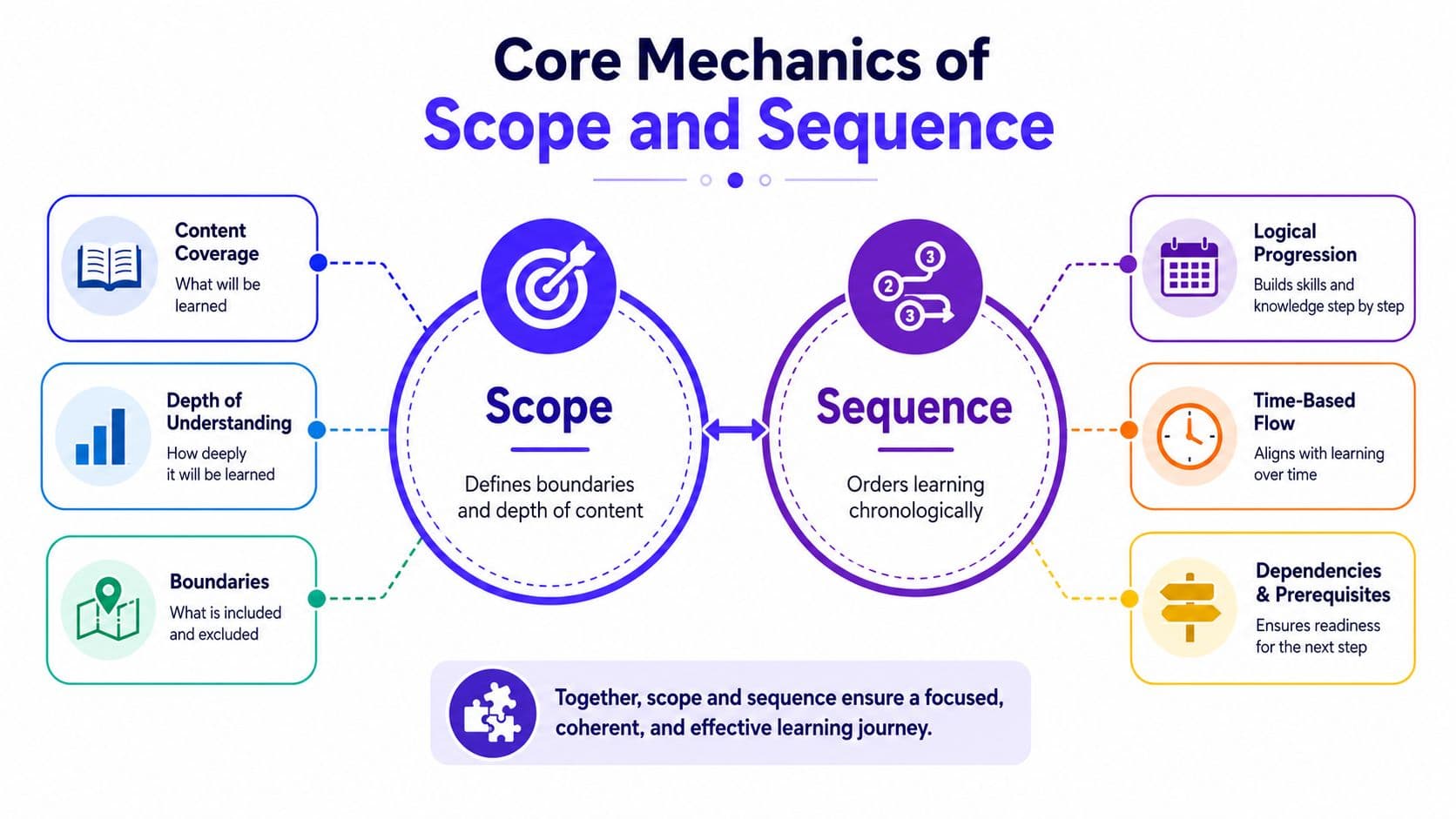
A curriculum map is commonly understood as a collection of unit plans aligned to content standards. Its two essential mechanics are scope, which defines what content, standards, or objectives will be taught, and sequence, which defines the order in which students encounter them so scaffolding develops across the course or year, as explained in this guide to curriculum mapping.
Think of building a house. The scope is the blueprint. It identifies the rooms, materials, and boundaries of the project. In classroom planning, scope answers questions such as:
- Which standards belong in this course or grade?
- How thoroughly should students work with each outcome?
- Which knowledge and skills are essential?
- What content can be integrated rather than taught separately?
The sequence is the construction timeline. It determines what gets built first, what depends on earlier work, and when students are ready for more complex applications. In a mathematics course, students might first interpret ratios, then represent them visually, then solve problems involving proportional relationships. The topic list alone doesn't show that progression. The sequence does.
Turning the plan into a matrix
The map becomes more useful when you place outcomes down one side and courses, units, or lessons across the other. Each cell can show whether an outcome is introduced, reinforced, or mastered, along with the assessment that provides evidence.
This matrix reveals two kinds of alignment:
- Horizontal alignment compares classrooms, courses, or units at the same level. It helps teams notice whether students receive broadly consistent opportunities to learn.
- Vertical alignment follows an outcome across grade levels or course stages. It shows whether instruction builds deliberately instead of restarting or jumping ahead.
For example, a reading-comprehension skill might be introduced in one grade, reinforced through science and social studies in later grades, and assessed through increasingly independent analysis. The map doesn't prescribe the exact text, discussion protocol, or project. It clarifies the learning path.
A map can also connect instruction to assessment. If an outcome appears in several units but never in a student task, the team has found a measurement gap. If an assessment expects students to synthesize ideas but the map shows only recall activities, the team can adjust before students encounter the test.
Here's a short video that illustrates the relationship between curriculum planning, scope, and sequence:
The goal isn't to produce a beautiful spreadsheet. It's to make the learning journey visible enough that teachers can make better decisions together.
Identifying Gaps and Redundancies with Data
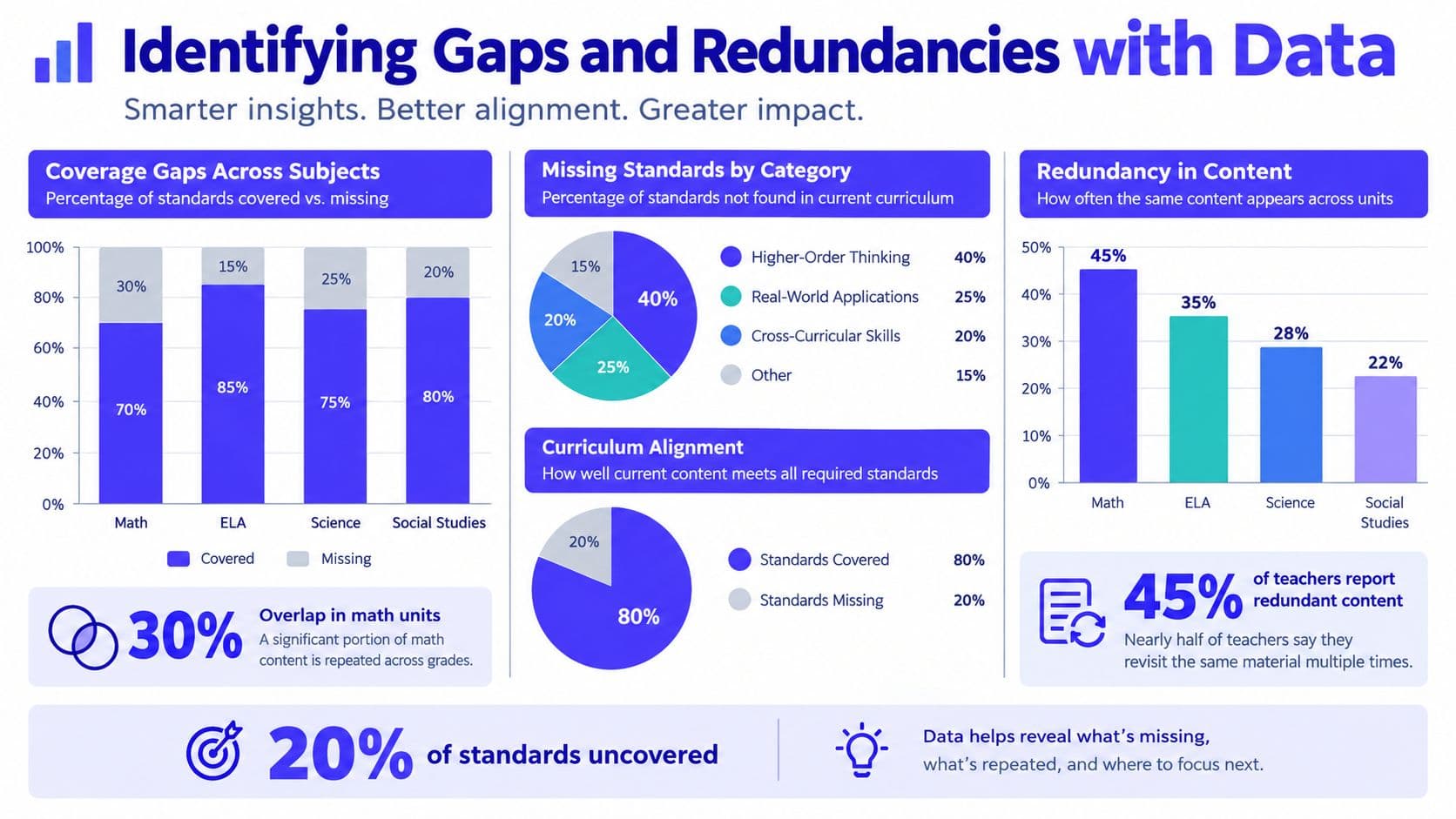
Teachers often have strong instincts about curriculum coverage, but memory and familiarity can hide problems. A topic may feel prominent because it appears in a favorite unit, while another essential competency receives only a brief introduction. A team may also repeat the same content because each course assumes students need a fresh start.
Mapping turns those impressions into an auditable pattern. In one peer-reviewed study, potential curriculum gaps were defined as competencies covered in 20% or fewer of courses, while redundancies were flagged at 80% or more course coverage. A separate health-professions revision reported that alignment between course learning outcomes and major learning outcomes improved from 86.9% to 100% after mapping, according to this study of curriculum alignment through mapping.
These thresholds aren't universal rules for every school. They demonstrate a useful habit: agree in advance on what counts as limited exposure or excessive repetition, then apply that definition consistently.
Reading the map as an audit
Start with one outcome rather than trying to analyze the entire curriculum at once. Ask four questions:
- Where is the outcome introduced? Students need an explicit first encounter.
- Where do they practice it? Reinforcement should occur in meaningful contexts.
- Where do they demonstrate it? An assessment should make the intended performance visible.
- What happens after the assessment? Results should inform reteaching, extension, or sequencing.
A gap doesn't always mean “add another unit.” It may mean the outcome is present but buried inside activities without clear success criteria. A redundancy doesn't always mean “delete the content.” Repeated practice can be appropriate when the task becomes more complex. The question is whether students are progressing or only receiving the same exposure again.
Learning intentions and success criteria help here. When teachers state what students are learning and what successful evidence looks like, the map becomes easier to interpret. Use this guide to learning intentions and success criteria to connect mapped outcomes with classroom-facing expectations.
A strong team also compares the map with actual student work. If the document says students master an analytical skill but their responses show only identification, the map is making an important problem visible. Teachers can then revise the task, provide more guided practice, or move mastery to a later point in the sequence.
Balancing Standards Alignment and Teacher Autonomy
Many teachers hear “curriculum mapping” and picture identical slides, identical scripts, and identical pacing in every classroom. That concern is understandable. Research on implementation challenges found that teacher buy-in is a major barrier, with some educators fearing that mapping would remove individuality and creativity. The same research found that one-shot training focused only on technical mechanics wasn't enough, as reported in this study of curriculum mapping implementation.
A strong map should standardize the destination, not the route.
The destination includes the standards, essential learning outcomes, agreed evidence of proficiency, and key timing decisions that protect progression. The route can still include teacher judgment, local examples, culturally responsive materials, flexible grouping, student interests, and different forms of practice.
What belongs on the shared map
A team might agree that students will analyze how an author develops a central idea and support their interpretation with evidence. That agreement doesn't require everyone to use the same novel, mini-lesson, discussion structure, or writing prompt.
Instead, teachers can choose:
- Texts that reflect their students' identities and interests.
- Scaffolds suited to current language and reading needs.
- Enrichment tasks for students ready to extend the outcome.
- Small-group instruction based on formative evidence.
- Different examples that connect the standard to local communities.
The map protects that flexibility by making the essentials clear. When colleagues know the intended outcome and the evidence students need to produce, they don't have to spend planning time debating whether a standard matters. They can focus their professional expertise on helping particular learners reach it.
Mapping becomes compliance theater when teachers fill cells for inspection but never use the information to make instructional decisions.
Teacher autonomy also needs a practical operating agreement. Teams should decide which elements require shared consistency, which allow variation, and how teachers will document meaningful adaptations. That conversation is more valuable than a training session on how to format a spreadsheet.
A map should invite professional dialogue. If a teacher's students need additional modeling, the map should make room for that response. If another teacher finds an engaging way to integrate the outcome into science or an arts project, colleagues should be able to learn from it. Alignment works best when it creates a common language for collaboration without replacing the teacher's role as the interpreter of student needs.
A Reflective Workflow for Building Your Map
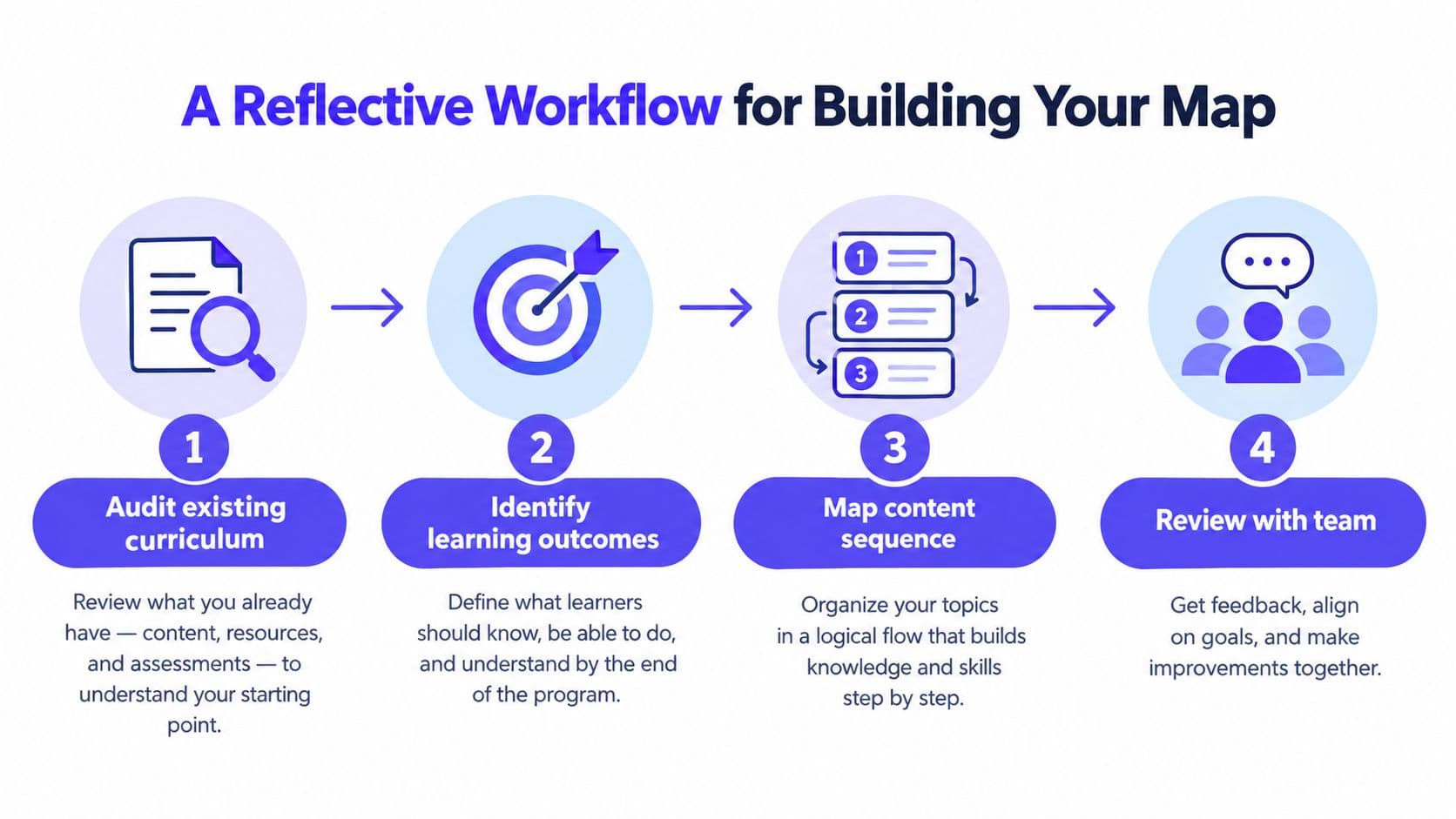
You don't need to begin with a perfect curriculum document. Start with what actually happened. A rough map based on real instruction is more useful than an impressive plan that no teacher recognizes.
Begin with an honest inventory
For each unit or teaching period, record four categories:
- Topics or essential questions: What ideas, problems, or questions anchored the work?
- Major activities: What did students do to explore or apply the learning?
- Skills or standards: Which outcomes were introduced, practiced, or revisited?
- Products or assessments: What did students create, perform, explain, or submit?
This reflective approach is described in a practical curriculum-mapping workflow. The point of the first draft isn't evaluation. It's accuracy.
You may discover that a favorite project supports several standards, but only one was assessed. You may find that a skill was taught repeatedly without a clear progression. You may also notice that a unit includes activities that are enjoyable but disconnected from the intended outcome. Those observations give the team something concrete to improve.
Compare before you redesign
Once teachers have drafted their individual maps, place them side by side. Look for patterns rather than immediately judging differences.
A productive team conversation might sound like this:
- “We all introduce this outcome, but where do students get independent practice?”
- “Several units assess vocabulary, but none assesses the broader communication goal.”
- “Students encounter this skill in two grades, but the expected complexity stays the same.”
- “This project already supports the standard. Could we make the evidence more explicit?”
After that comparison, build or revise the scope and sequence. Identify the first introduction, plan meaningful reinforcement, and mark the point where students should demonstrate the outcome. Add resources and activities only after the learning progression is clear.
A digital lesson-planning workspace can help turn the agreed map into usable materials. For example, Kuraplan's lesson plan template can support the move from an identified outcome to a structured lesson plan, while teachers still decide how to adapt the lesson for their students.
Keep the first cycle manageable. Map one subject, grade band, or priority outcome, then use what you learn to improve the process. A living map grows through review. It shouldn't arrive fully formed before teachers have tested whether it helps them plan.
Maintaining Maps with AI and Continuous Review
A curriculum map becomes shelfware when it records an old version of instruction and nobody owns the update. New resources arrive, units change, assessments are revised, and teachers adjust lessons in response to students. If those changes never reach the map, the document slowly stops describing the curriculum students actually experience.
Guidance on curriculum mapping emphasizes continuous review because maps become outdated quickly and are difficult to maintain at scale. The map should function as a planning, monitoring, and control process, not a file created once for accreditation or inspection, as explained in this overview of curriculum mapping maintenance.
Give maintenance a clear owner
A sustainable system answers three questions:
- Who updates the map? Assign responsibility to a course team, curriculum coordinator, or instructional coach rather than assuming someone will do it.
- When is it reviewed? Use scheduled checkpoints tied to unit completion, assessment analysis, and annual planning.
- What evidence is checked? Compare the map with lesson plans, student tasks, assessment results, and teacher observations.
The review doesn't need to rewrite every cell. Teachers can flag changes as they happen, then use team time to decide whether a change is local or affects the wider progression. A new project may replace an old activity without changing the outcome. A revised assessment may reveal that the sequence needs more practice before students are expected to demonstrate mastery.
Maintenance principle: Update the map when instruction changes, not months later when everyone has forgotten why.
AI can reduce the friction between the high-level map and daily planning. A tool can help translate a selected standard or outcome into a lesson outline, differentiated activities, worksheets, visuals, and assessment prompts. Teachers still need to verify accuracy, suitability, accessibility, and alignment, but they don't have to begin every resource from a blank page.
Kuraplan is one example of an AI-powered planning platform that creates standards-aligned lesson and unit plans, worksheets, educational visuals, and assessment rubrics for K–12 educators. It can help teachers move from mapped objectives to classroom materials, while its guidance on AI in schools provides a starting point for thinking about responsible classroom use.
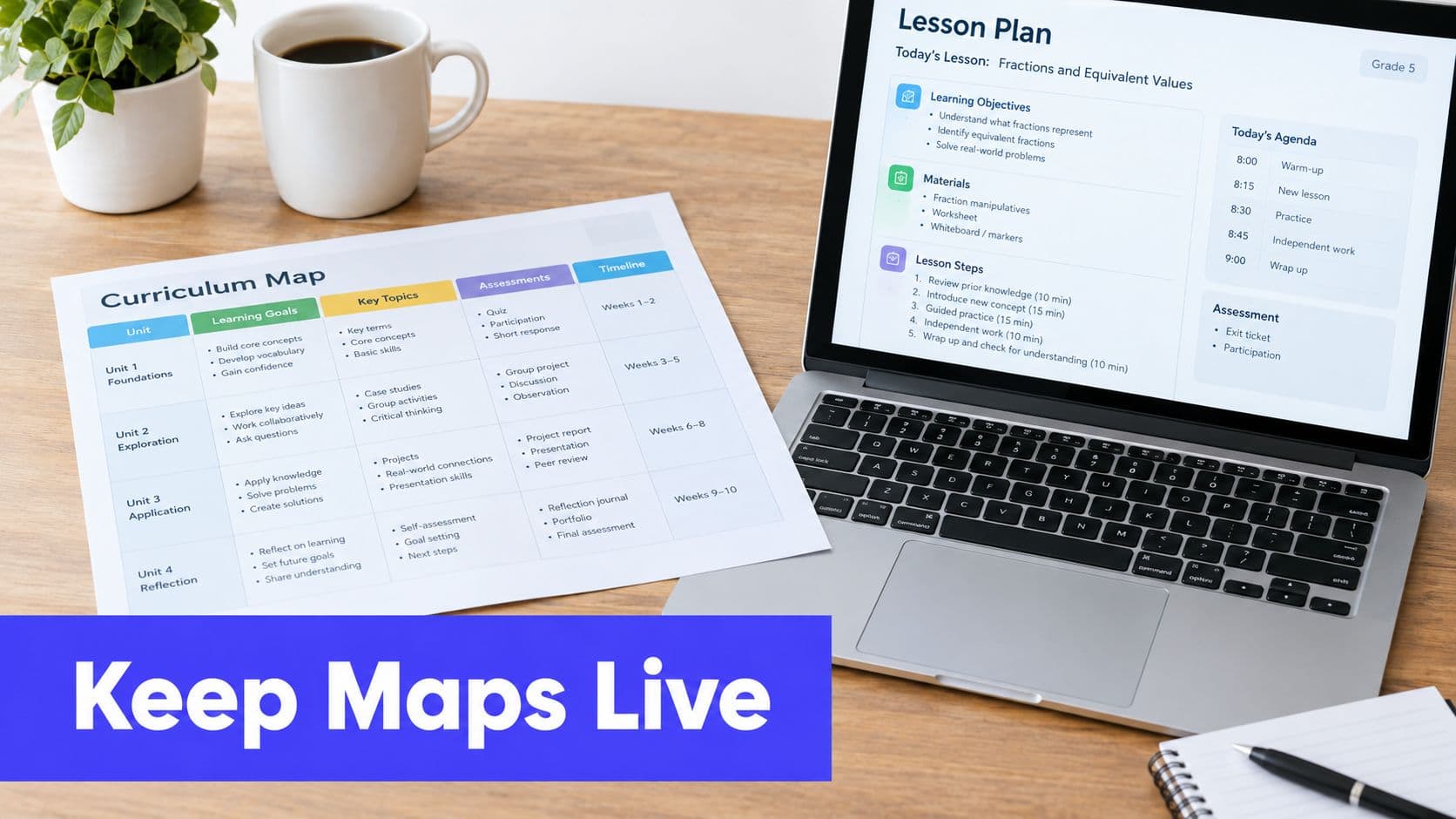
The key is to keep the teacher in the review loop. AI-generated materials may need changes for reading level, cultural context, student accommodations, or the exact evidence an outcome requires. The map remains the source of truth, while AI helps make its intentions visible in lessons students can use.
Strategic Implementation for School Leaders
School leaders don't need to launch a building-wide mapping project by collecting every unit plan at once. Start with a priority that matters to teachers and students, such as a recurring assessment concern, a transition between grade levels, or a standard that appears inconsistently across courses.
Standards-based planning can prioritize outcomes for deeper instruction, bundle complementary standards into interdisciplinary sets, and divide the map by marking period so teams can reach meaningful closure on selected standards within a term. Leaders should also revise maps annually while planning the upcoming year, as described in this guidance on curriculum mapping for school planning.
A workable launch checklist
- Choose a focused starting point. Select one grade band, subject, or priority outcome.
- Protect collaboration time. Schedule meetings where teachers can compare maps and student evidence.
- Define the shared destination. Agree on essential outcomes and what acceptable evidence looks like.
- Separate consistency from flexibility. Identify what must align and where teachers can adapt.
- Review the current reality. Map past instruction before designing a new sequence.
- Use assessment evidence. Look for outcomes students weren't taught, practiced, or asked to demonstrate.
- Assign ownership. Name the people responsible for updates and quality checks.
- Set a review cycle. Revisit the map during the year and revise it during annual planning.
The most effective leaders frame mapping as support for better decisions, not surveillance of teacher behavior. They give teams time to interpret standards, examine student work, and adjust instruction. They also ask whether the map is helping teachers plan more clearly. If it isn't, the process needs improvement.
A well-maintained map gives teachers a shared learning architecture while preserving room for judgment. Students receive a more coherent progression, and leaders gain a practical way to connect standards, instruction, and assessment without reducing teaching to a script.
Kuraplan helps educators turn mapped outcomes into standards-aligned lesson and unit plans, worksheets, visuals, and assessments, so the curriculum map stays connected to daily classroom work. Visit Kuraplan to explore how it can support your planning workflow and give your team more time to focus on students.