ScienceFreePrintable
Bonding and VSEPR Worksheet
A free science worksheet ready for your classroom. Open in Kuraplan to grab the print-ready PDF, customize it for your students, or generate a fresh version in seconds.

Bonding and VSEPR Worksheet
🎯 WALT: Identify bonding types and predict molecular shapes
1. Which element would form an ionic bond with chlorine?
Carbon
Magnesium
Nitrogen
Fluorine
2. What is the molecular shape of ammonia (NH₃)?
Tetrahedral
Trigonal pyramidal
Trigonal planar
Linear
3. Which of these molecules is polar?
CO₂
CH₄
H₂O
BF₃
4. The approximate bond angle in methane (CH₄) is:
90°
109.5°
120°
180°
5. Which bonding type allows electrical conductivity in solids?
Ionic bonding
Covalent bonding
Metallic bonding
Hydrogen bonding
✏️ WALT: Draw Lewis structures and apply VSEPR theory
6. Draw the Lewis structure for water (H₂O) and explain why the bond angle is less than 109.5°.
7. Using VSEPR theory, predict the shape and bond angles of sulfur tetrafluoride (SF₄). Is this molecule polar or non-polar? Justify your answer.
8. Calculate the formal charge on each atom in the nitrate ion (NO₃⁻). Show your working.
9. Explain why sodium chloride (NaCl) has a much higher melting point than water (H₂O), referring to bonding types and structure.
🚀 Extension Challenge: Advanced Molecular Analysis
10. Compare the properties of diamond and graphite. Draw simplified diagrams showing their bonding arrangements and explain how structure affects their properties (hardness, conductivity, and uses).
11. Molecular Detective Challenge: A mystery compound has the formula XY₂. It is linear and non-polar. The X-Y bonds are polar. Draw the Lewis structure, identify possible elements for X and Y, and explain how this molecule can be non-polar despite having polar bonds.
Success Criteria Check:
I can identify different types of chemical bonding
I can draw Lewis structures correctly
I can predict molecular shapes using VSEPR theory
I can determine molecular polarity
I can explain how bonding affects properties
About This Worksheet
Free in Kuraplan
Sign up free, grab the PDF, and customize it for your class.
Print-Ready
Formatted for standard paper. Clean layout, easy to read.
AI-Generated
Created with Kuraplan's AI, designed for real classroom use.
For Teachers & Parents
Use in classrooms, for homework, tutoring, or homeschool.
Need a custom version of this worksheet?
Kuraplan's AI generates custom worksheets in seconds — differentiated for every learner, aligned to your curriculum.
Generate Custom Worksheets — Free No credit card Curriculum-aligned Under 60 seconds
More Science Worksheets
Year 8
Atomic Theory Research Worksheet
Free
Year 8
Physical and Chemical Changes
Free
Year 8
Physical and Chemical Changes
Free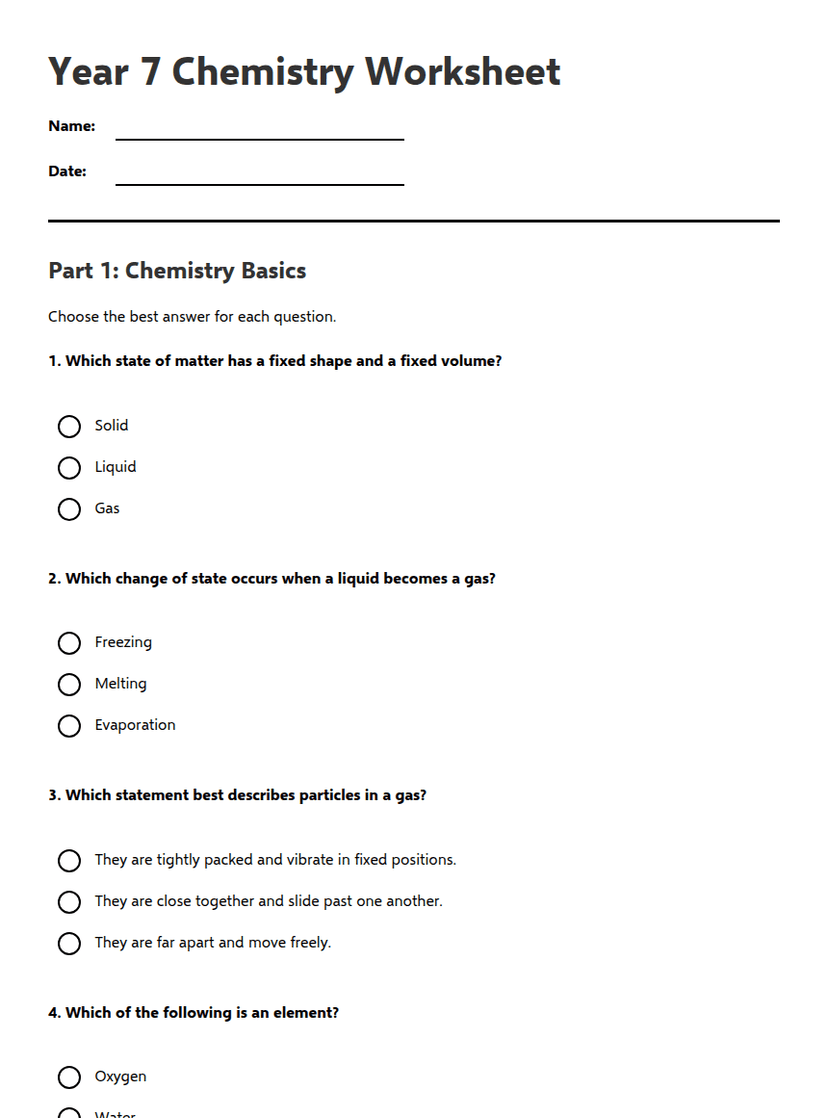
Year 7
Year 7 Chemistry Worksheet
Free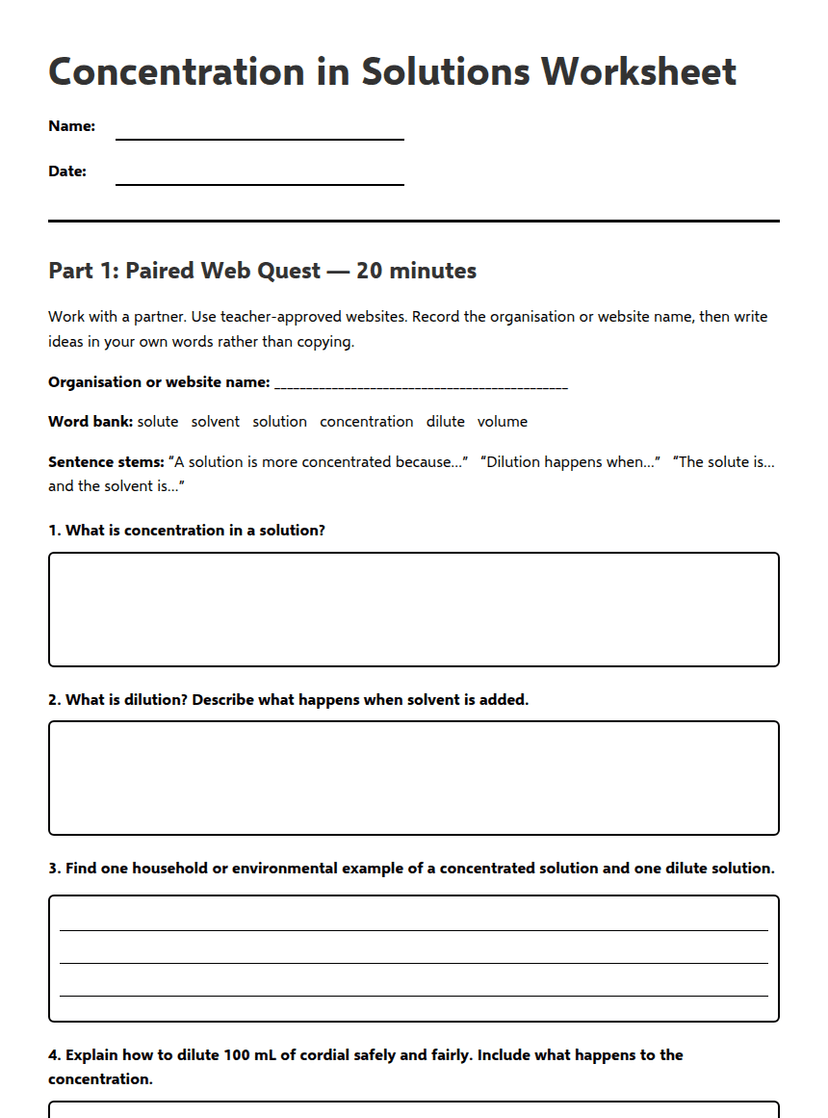
Year 7
Concentration in Solutions Worksheet
Free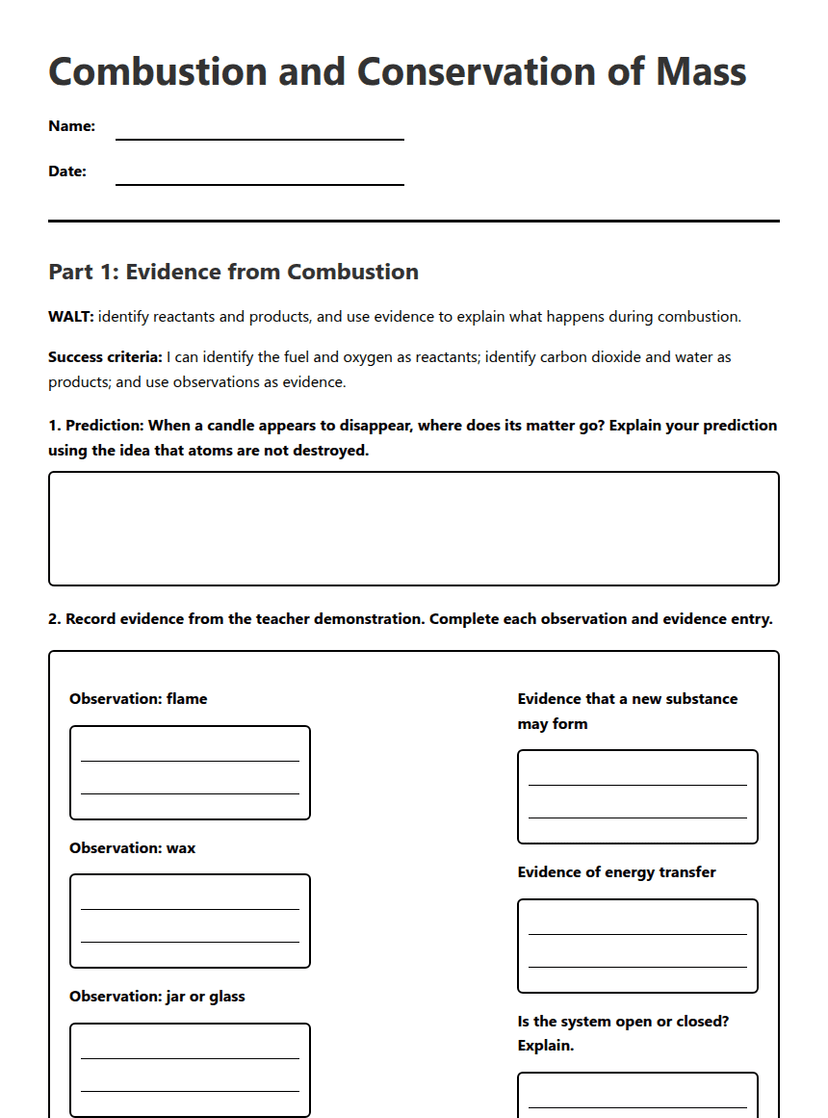
Year 9
Combustion and Conservation of Mass
Free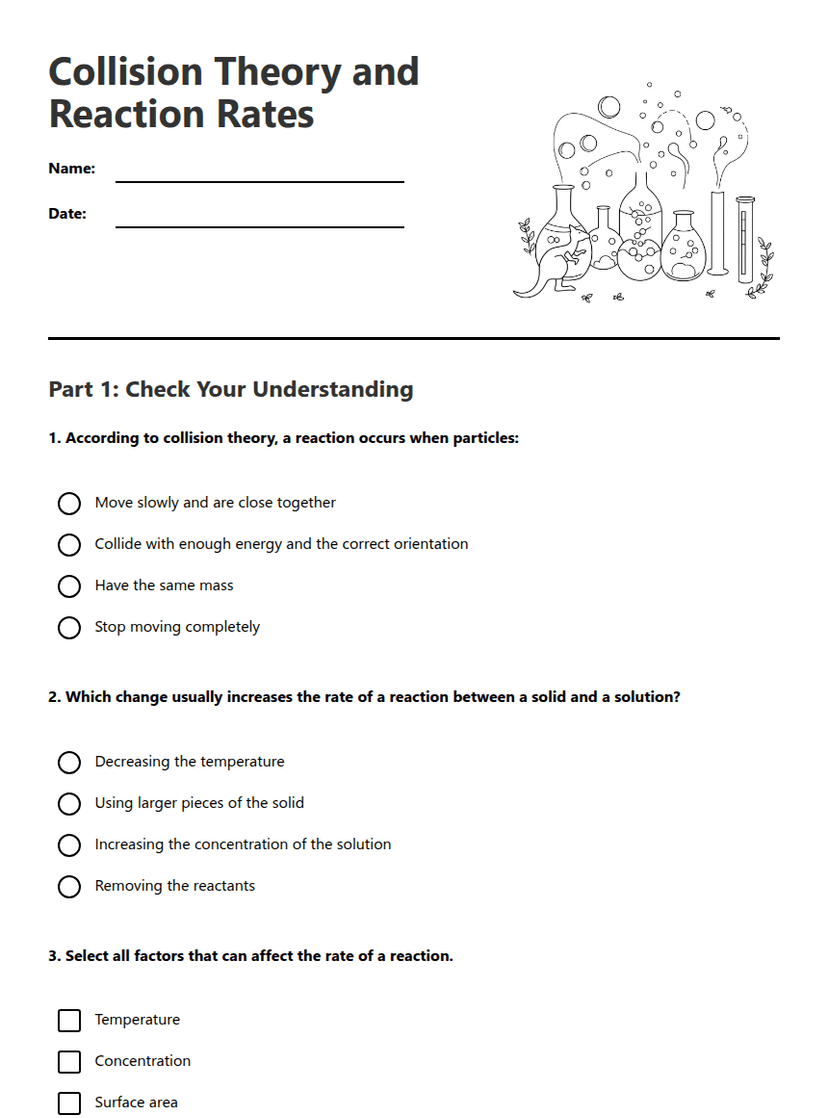
Year 10
Collision Theory and Reaction Rates
Free
Year 9