We’ve all been there. You spend hours designing what seems like the perfect, engaging activity for your students. But when it's all over, you're left with a nagging feeling they completely missed the point.
That's the exact problem backwards design lesson planning solves. It flips the traditional model on its head. Instead of starting with fun activities and hoping the learning sticks, you begin with the end goal—what you want students to know and be able to do—and work your way back from there.
Beyond Activities: Rethinking Lesson Planning
It’s a classic teacher trap: you stumble upon a brilliant hands-on experiment or a captivating project and decide to build a whole lesson around it. The engagement might be through the roof, but the learning can feel almost accidental. Did the key concepts actually land, or do they just remember the fun parts?
This activity-first approach often creates a huge gap between what we teach and what students truly grasp. Backwards design is about planning with purpose, not just activities. It forces you to ask the hard questions right from the start.
What's the single most important takeaway from this unit? And how will I see concrete evidence that my students have actually mastered it? You only start thinking about daily lessons after you have solid answers to those questions. This simple shift turns you from a "content-coverer" into a true designer of learning experiences.
Why This Shift Matters
This strategic approach, popularized by the Understanding by Design (UbD) framework, brings incredible clarity and focus to your curriculum. It guarantees that every single worksheet, discussion, and activity you plan serves the ultimate learning goals. The benefits become obvious almost immediately:
- Clarity for Everyone: From day one, students know exactly what they’re expected to learn and how they’ll be assessed. No more guessing games.
- Purposeful Instruction: You can cut the "fluff"—those activities that are fun but don't actually move the needle on mastery. This saves a ton of precious class time.
- Stronger Assessments: Your assessments are built to measure deep understanding, not just whether students can spit back isolated facts.
- Deeper Learning: Because everything is connected, students are far more likely to retain information and apply their knowledge in new situations.
This isn't about making your lessons rigid or boring. It's about building a rock-solid foundation. Once that's in place, you have the freedom to be incredibly creative and responsive, knowing that every path you take leads to the same clear destination.
For educators looking to get even more creative, exploring frameworks like Project-Based Learning lesson plans can be a great next step, as they also put the end goal first.
Ultimately, backwards design is about making sure all our hard work in the classroom translates into meaningful, lasting student achievement. This guide will walk you through the three core stages of this powerful framework, completely changing how you approach your planning.
Defining Your Destination with Desired Results
Ever tried to plan a road trip without picking a destination first? You'd have a full tank of gas and nowhere to go. The first stage of backwards design is all about setting that destination—getting crystal clear on what you want students to know, understand, and be able to do by the end of your unit.
This is way more than just copying and pasting a state standard onto your plan. It’s about digging into the why behind the content. We're not just aiming for students to memorize facts for a test; we want them to walk away with big, transferable ideas that actually stick.
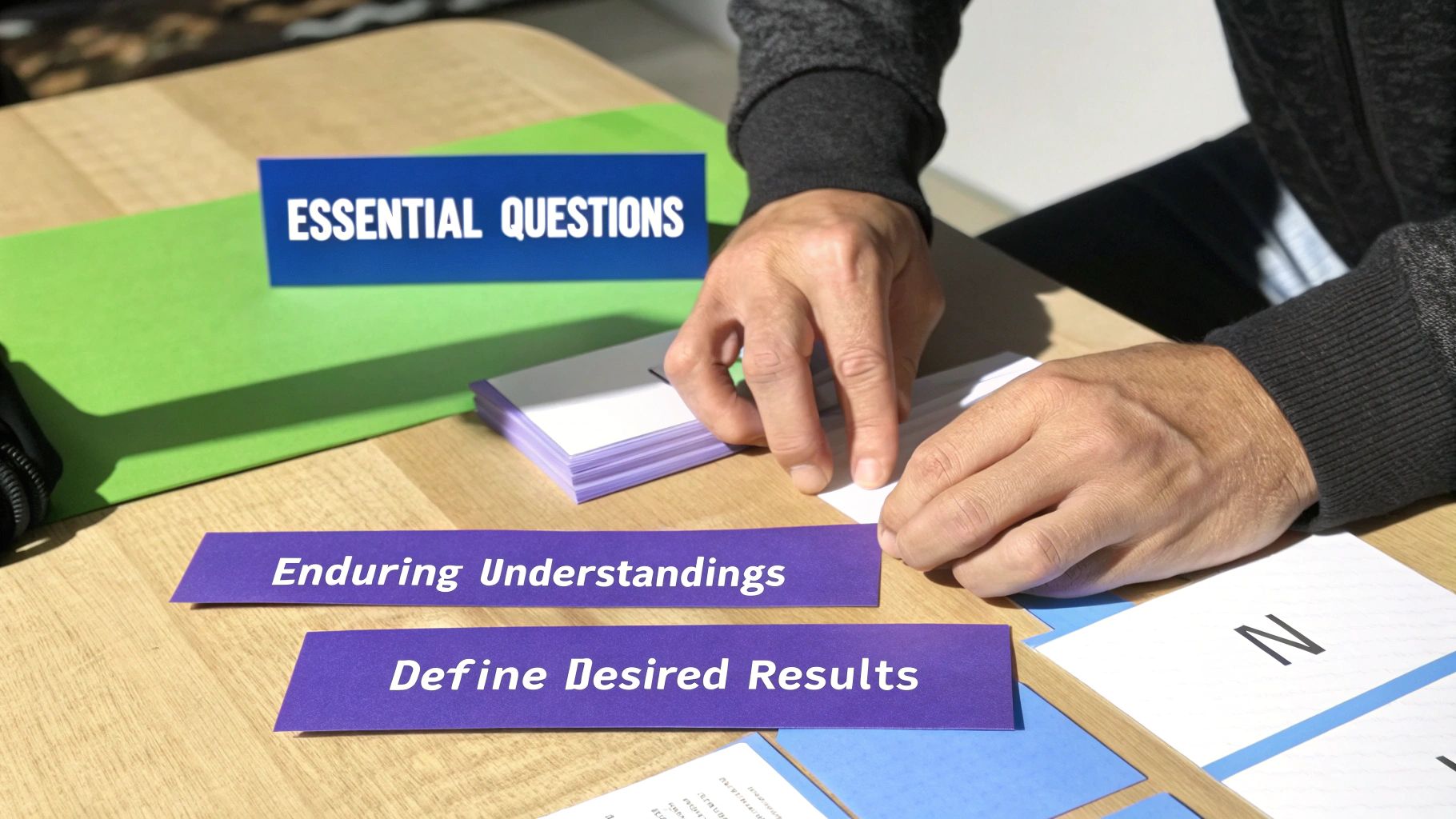
This focus on core concepts is exactly why the Understanding by Design model became so foundational. In fact, it's now used in 75% of U.S. teacher preparation programs. Research shows that prioritizing these "enduring understandings" can cut content overload by as much as 50% while boosting long-term retention. Jennifer Gonzalez breaks this down beautifully on the Cult of Pedagogy website.
From Standards to Enduring Understandings
Standards tell us what to teach. Enduring understandings tell us why it matters. They’re the big-picture concepts, the moral of the story for your unit. They connect all the little facts and skills into a meaningful whole.
To uncover these big ideas, start with your required standards and ask yourself a few key questions:
- What’s the single most important idea I want my students to take away from this?
- What common misconceptions might they bring with them?
- How does this connect to the world outside our classroom?
- If they forget everything else in five years, what’s the one thing they should remember?
Let's take a common science standard: "Identify the parts of a plant cell." A traditional objective might be, "Students will be able to label the parts of a plant cell diagram." That’s fine, but it’s just memorization.
An enduring understanding gets to the heart of it: "Every part of a system has a specific function that contributes to the whole."
See the difference? That simple shift changes everything. Now the goal isn't just labeling—it's about understanding relationships and functions. That's a concept that applies to biology, engineering, social systems, you name it.
Sparking Curiosity with Essential Questions
Once you have your enduring understandings, the next step is to frame them as essential questions. These are the open-ended, thought-provoking questions that drive the entire unit. They don't have a single right answer; they're meant to be explored.
Essential questions turn students from passive listeners into active investigators. They hook them at the start and give the entire unit a "north star" to keep coming back to.
So, how does our "cell as a system" understanding become an essential question?
- Enduring Understanding: Every part of a system has a specific function that contributes to the whole.
- Essential Question: How do small parts work together to create a complex system?
This is a question you can revisit over and over, whether you're studying a plant cell, the human body, or even your school community.
Making It Real Across Grade Levels
Let’s see how this looks in a couple of real-world units.
4th Grade History Unit on the American Revolution:
- Standard: Explain the causes of the American Revolution.
- Traditional Goal: Students will list three causes of the war.
- Enduring Understanding: Conflict often arises when one group feels its rights are being denied by a more powerful group.
- Essential Question: When is it right to challenge authority?
10th Grade ELA Unit on Of Mice and Men:
- Standard: Analyze how complex characters develop over the course of a text.
- Traditional Goal: Students will write a character analysis of Lennie.
- Enduring Understanding: True friendship requires sacrifice, loyalty, and facing difficult truths.
- Essential Question: What do we owe the people we care about?
In both cases, we’ve moved from a narrow task to a timeless, transferable idea. Nailing down your learning goals is a skill in itself. If you want a deeper dive, check out our article on how to write objectives for lesson plans.
Defining your desired results is easily the most challenging part of backwards design, but it’s also the most important. A clear destination makes the rest of the journey—designing assessments and planning activities—infinitely more focused. And if you ever get stuck, AI tools like Kuraplan can help you brainstorm enduring understandings and essential questions that are tied directly to your standards.
Designing Assessments That Reveal True Understanding
Once you’ve set your destination, how will you know your students have actually arrived? This is where the second stage of backwards design planning comes in, and frankly, it’s a game-changer.
Instead of treating assessments as an afterthought—something you scramble to create the night before a unit ends—you design them before you even think about learning activities. This simple flip ensures your assessments aren't just for assigning a grade. They become precise tools for gathering real evidence that your "desired results" have been met. It's the difference between asking, "Did they do the work?" and asking, "Did they get it?"
This entire approach was famously detailed by Grant Wiggins and Jay McTighe in their 1998 book, Understanding by Design. Their focus on determining "Acceptable Evidence" by crafting assessments first was a major shift for a lot of us. The results speak for themselves; a 2019 study of courses using this method saw 25-30% average gains in mastery on pre- and post-tests.
To get a sense of how this works in practice, let's look at the core difference between the old way and the backwards design way.
Traditional Planning vs Backwards Design
This table shows the fundamental shift in focus between traditional lesson planning and the backwards design approach.
| Planning Element | Traditional Forward Planning | Backwards Design Planning |
|---|---|---|
| Starting Point | Select a topic or textbook chapter. | Identify learning goals (standards). |
| Second Step | Plan learning activities and lessons. | Design the final assessment. |
| Final Step | Create and give an assessment. | Plan learning activities. |
| Primary Focus | Teaching (covering content). | Learning (ensuring understanding). |
| Assessment Role | Evaluates what was taught. | Measures mastery of learning goals. |
As you can see, backwards design forces us to begin with the end in mind, making sure every activity we plan has a clear purpose tied directly to the final assessment.
Moving Beyond the Multiple-Choice Test
If we want to measure the deep, enduring understandings we identified in Stage 1, a simple bubble test often won’t cut it. We need assessments that push students to apply what they’ve learned in authentic, meaningful contexts.
This is where performance assessments shine. These tasks challenge students to use their knowledge to solve a real-world problem or create something new.
Here are a few examples of what this looks like in action:
- Instead of a test on the water cycle: Students design a filtration system for a hypothetical local water contamination issue, explaining how each stage mimics natural processes.
- Instead of an essay on a historical figure: Students curate a museum exhibit, complete with artifacts and placards, arguing for their chosen figure's historical significance.
- Instead of a quiz on geometric shapes: Students act as architects, using their knowledge of area and perimeter to design a blueprint for a community park.
These tasks demand more than just recall. They require students to analyze, evaluate, and create—giving you a much richer picture of their understanding.
Creating Crystal-Clear Rubrics
A great performance task is only half the equation. Without a clear rubric, "mastery" is just a fuzzy concept. A well-designed rubric makes your expectations totally transparent for you, your students, and even their families. It becomes your most powerful instructional tool.
A strong rubric does more than list point values; it describes what different levels of proficiency look like in concrete terms. Instead of saying "Good Use of Evidence," a history rubric might say: "Integrates multiple primary and secondary sources to build a compelling and well-supported argument."
A rubric should be so clear that a student can use it to accurately assess their own work before they turn it in. When students understand the target, they are far more likely to hit it.
I know creating detailed rubrics from scratch is a huge time sink. This is a perfect place to use an AI tool like Kuraplan, which can generate a standards-aligned rubric for your performance task in seconds. You can then tweak it to perfectly match your project and your students' needs.
The Power of a Balanced Assessment Diet
While performance tasks are the main course, a good assessment plan needs appetizers and side dishes, too. Layering in different types of evidence gives you a much more complete picture of student learning. Think of it as collecting data from multiple sources to triangulate your findings.
A robust plan should include a mix of these:
- Formative Checks: These are the quick, informal assessments you do every day. Think exit tickets, think-pair-share discussions, or a quick poll. They give you immediate feedback on what students are grasping and where you need to adjust your instruction on the fly. There are tons of creative formative assessment examples to keep things fresh.
- Traditional Quizzes: Yep, there's still a place for them! Quizzes are an efficient way to check for understanding of foundational knowledge and key vocabulary—the building blocks students need to succeed on the larger performance task.
- Observations and Conversations: Honestly, some of the best evidence comes from just watching and listening to your students work. The anecdotal notes you jot down during a small group discussion can reveal more about a student's reasoning than a dozen multiple-choice questions ever could.
- Self-Assessments and Reflection: Asking students to reflect on their own learning is incredibly powerful. A simple prompt like, "What was the most challenging part of this project, and how did you work through it?" gives you insight into their metacognitive skills and builds real student ownership.
By combining these different forms of "acceptable evidence," you ensure you’re not just measuring one type of skill. You're building a comprehensive portfolio that shows exactly what each student knows, understands, and can do—which is the true goal of any assessment.
Crafting Learning Experiences with Purpose
You’ve got your destination locked in and you know exactly how you’ll check if students have arrived. Now for the fun part—planning the actual journey. This is where you architect the day-to-day lessons, activities, and discussions that will guide your students toward mastery.
The big shift here? Everything you plan now has a crystal-clear purpose. You’re no longer just looking for a cool activity and trying to make it fit. Instead, you're strategically sequencing experiences that directly build the skills and knowledge students need to succeed on the assessments you've already designed. There's a real power in that kind of focus.
This simple flow is what we've been working toward.
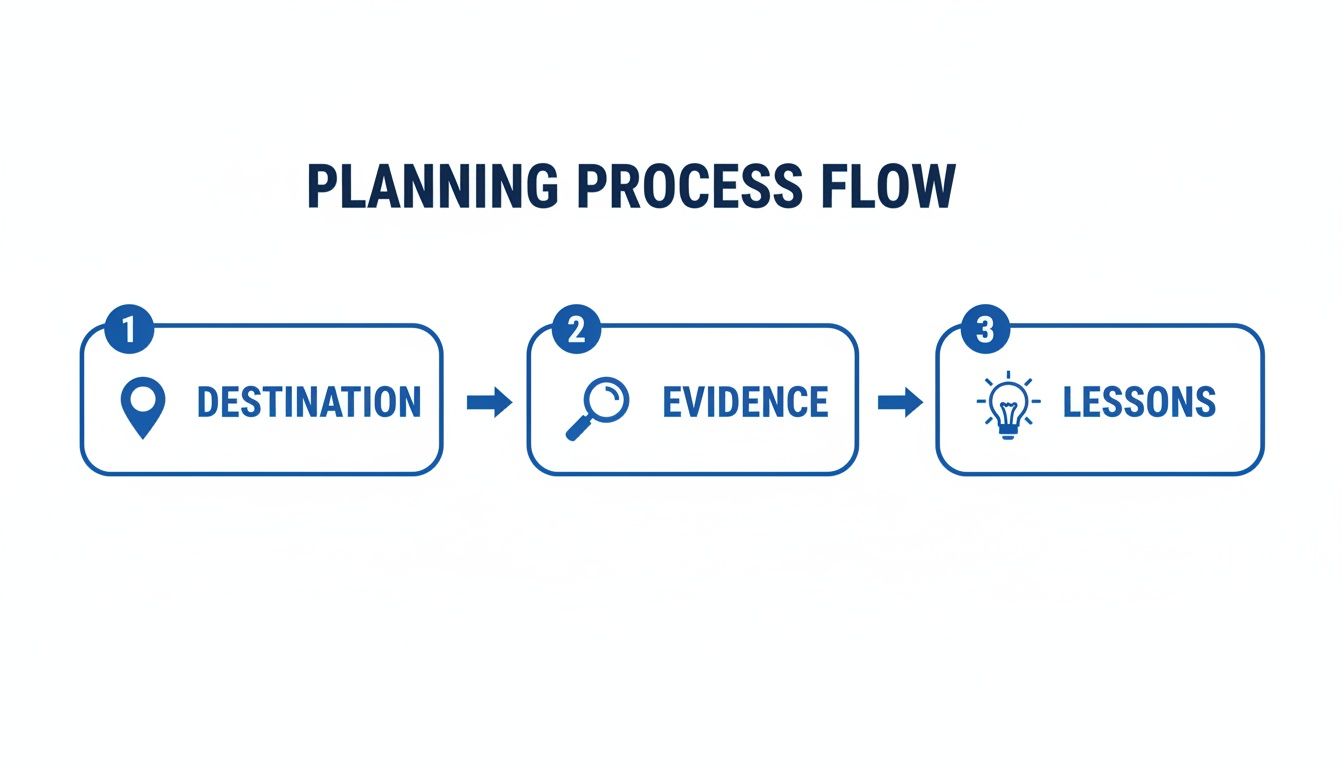
This process makes sure every lesson is a deliberate step toward the evidence of learning you need to see.
A Framework for Purposeful Lessons: WHERETO
So, how do you actually build these lessons? A fantastic tool for this stage is the WHERETO acronym from the Understanding by Design framework. Think of it less like a rigid checklist and more like a set of guiding questions to make sure your lessons are engaging, effective, and perfectly aligned with your goals.
Let's break down what it stands for.
- W - Where and Why: Students need to know where the unit is headed and why it matters. Share the essential questions and the final performance task right from the start.
- H - Hook and Hold: Hook them on day one and find ways to hold their interest. This is your unit-level anticipatory set.
- E - Equip and Experience: Give students the knowledge they need (equip) and let them experience key ideas through hands-on, meaningful activities.
- R - Rethink and Revise: Build in moments for students to rethink the big ideas, reflect on their understanding, and revise their work based on feedback.
- E - Evaluate: Weave in opportunities for self-evaluation and peer feedback. Assessment becomes part of the learning, not just a final grade.
- T - Tailor: Tailor the learning plan to meet the diverse needs, interests, and strengths of your actual students.
- O - Organize: Organize the lessons so they flow logically, building from foundational knowledge to complex application, leading straight to that final task.
Using WHERETO helps you get beyond just "covering the material" and into designing genuine learning experiences where every piece has a job.
Bringing WHERETO to Life
Theory is one thing, but what does this actually look like in a real classroom? Let’s jump back into our 4th-grade history unit on the American Revolution.
Remember, the essential question is, "When is it right to challenge authority?" and the big task is a letter to the editor arguing for or against independence from a colonist's perspective.
Hooking Students with a Gallery Walk
To kick things off, you could set up a gallery walk with primary source images—a political cartoon here, a portrait there—and short quotes from both Patriots and Loyalists. As students wander, they jot down what they notice and wonder. It’s an immediate immersion into the core conflict that sparks curiosity without giving away any answers.
Equipping Them with Skills and Knowledge
Next, you have to equip them. This is where your direct instruction, readings, and group work come into play.
- Mini-lessons: You'll teach the key events and concepts—the Stamp Act, the Boston Tea Party, "taxation without representation."
- Modeling: You'd explicitly model how to analyze a primary source for bias, a skill absolutely critical for their final letter.
- Collaborative Practice: Put students in small groups to analyze different primary source documents, maybe using a graphic organizer to guide their thinking.
The key is that these activities aren't random; they are meticulously chosen to build the specific skills and knowledge students will need to write a compelling, evidence-based letter. They are practicing the building blocks of the final assessment all along the way.
Opportunities to Rethink and Revise
Building in feedback loops is a must. Before the final letter is due, students could do a peer review using a simplified rubric. This gives them a low-stakes chance to rethink their arguments and revise their work.
This is also a fantastic place to use AI tools. A platform like Kuraplan can generate differentiated reading passages or create scaffolded worksheets for students who need extra support analyzing those tricky texts. This makes the "T" for Tailor so much more manageable, helping you meet the needs of every learner without spending hours creating different materials from scratch.
By sequencing these experiences with care, you aren't just crossing your fingers and hoping students get it. You're building a clear, supportive pathway that leads them straight to deep and lasting understanding.
Streamlining Your Planning with Modern Tools
Let's be real. Backwards design sounds like a lot of extra work upfront, especially when we're all juggling a million other things. The idea of adding another detailed framework can feel pretty overwhelming.
The good news? We don't have to do all the heavy lifting ourselves anymore. Tech, especially AI tools built for teachers, can make the whole process faster and way more effective. It's not about replacing your professional judgment; it's about getting a brilliant planning partner.
AI as Your Backwards Design Assistant
Imagine this: you plug in your grade level, subject, and a core state standard. Within seconds, you get a solid list of potential enduring understandings and essential questions to choose from. That's a task that used to take me a good hour of brainstorming and digging through curriculum binders.
Modern AI platforms are actually built to understand the logic of backwards design. They help with the most time-consuming parts, freeing you up to focus on what matters—the creative side of teaching and connecting with your students.
Specifically, AI can help you:
- Align Goals to Standards: Instantly map your "desired results" to the right state or national standards, so your unit is perfectly aligned from the get-go.
- Generate High-Quality Assessments: Create detailed rubrics for performance tasks in minutes, complete with clear criteria for different proficiency levels.
- Draft Differentiated Materials: Produce leveled reading passages, scaffolded worksheets, or varied practice activities to meet the needs of every single learner.
- Brainstorm Ideas: Get unstuck by generating ideas for engaging hooks, learning activities, or real-world connections for your unit.
Using AI isn’t cheating; it's just working smarter. Think of it as an incredibly knowledgeable co-teacher who handles the tedious paperwork, letting you pour your energy into creating a dynamic classroom.
Putting AI Tools into Practice
So, how does this actually look in the classroom? Let's go back to that 10th-grade ELA unit on Of Mice and Men. You've figured out your enduring understanding: "True friendship requires sacrifice, loyalty, and facing difficult truths."
Instead of starting from a blank page, you could use a tool like Kuraplan to speed things up. It’s built on the principles of backwards design lesson planning, making it a natural fit. You'd start by defining your goals, and the platform helps build out the rest of the unit logically.
You could ask it to generate a performance task where students write a closing argument in a mock trial for George. Then, you can have it create the rubric for that task, saving you a massive chunk of time.
Need to support your struggling readers? Ask the AI to create a simplified summary of a key chapter or a vocabulary list with student-friendly definitions. For your high-flyers, it could generate higher-order thinking questions for a Socratic seminar. This ability to instantly create tailored resources is a huge win for differentiation.
For a deeper dive, our guide on how to use AI for lesson planning offers even more practical tips and strategies.
Ultimately, the goal is to make the best practices of backwards design more accessible. When you can build a high-quality, purposeful unit in a fraction of the time, you’re more likely to stick with it and see the incredible impact it has on student learning. It’s all about reclaiming your time for what matters most—connecting with your students and bringing your lessons to life.
Answering Your Top Backwards Design Questions
I get it. Even when the three stages make perfect sense on paper, shifting to backwards design can feel like you're learning to plan all over again. It’s a big change, and it’s totally normal to have questions pop up.
Here are some of the most common ones I hear from teachers making the switch, along with some straight-up answers from my own experience.
Isn't Backwards Design Way Too Rigid and Time-Consuming?
It can definitely feel that way when you first start. That initial time investment is no joke because you're forced to think deeply about the big picture—the "so what?"—before you even think about a single activity. It's a huge mental shift from just planning week-to-week.
But here's the thing: that upfront work pays off, big time. Once you know exactly where your unit is headed, daily lesson planning becomes so much faster and more purposeful. You're not just scrambling to find "fun stuff" to fill the time; you have a clear roadmap.
Honestly, this approach ends up saving time in the long run and seriously cuts down on that Sunday night planning panic. The clarity it gives you also means less reteaching of core concepts, which opens up more class time for the fun stuff—like deeper discussions and projects.
How Does This Actually Help with Differentiation?
Backwards design and differentiation are a perfect match. You start by setting the same core learning goals for every single student, and then you build out multiple, flexible ways for them to get there.
The "desired results" stay the same for everyone, but the "acceptable evidence" (how they show what they know) and the "learning experiences" (how they learn it) can be completely different.
- Offer different products: One student could show their understanding of a historical event by writing an essay, while another creates a podcast, and a third designs an interactive timeline.
- Use flexible processes: You can support students toward that common goal by offering different readings, providing sentence starters or graphic organizers, or pulling small groups for targeted instruction.
- Align with IEPs: For students with IEPs, you can map their specific goals directly to the unit's essential concepts. This allows you to provide the necessary scaffolds and modified assessments without watering down the core learning.
This way, every student is working toward the same important goal, even if their path looks a little different.
Can I Still Be Spontaneous and Use Teachable Moments?
Yes! A thousand times, yes. One of the biggest myths about backwards design is that it locks you into a rigid script. The reality is that a solid plan gives you more freedom, not less. Think of it as a roadmap, not a straitjacket.
When you have crystal-clear goals, you have the professional confidence to take a detour for a powerful teachable moment. You always know your final destination, so you can dive into a student's brilliant question or a relevant current event and know exactly how to steer it back to the unit's big ideas.
In fact, it makes those spontaneous moments even more meaningful. They stop being random tangents and become powerful opportunities to reinforce the enduring understandings in a fresh, authentic way. The structure is what gives you the freedom to be truly responsive to your students.
Feeling the planning crunch? Kuraplan is an AI-powered platform built by educators to make backwards design feel easy and intuitive. You can generate standards-aligned units, create differentiated materials, and design high-quality assessments in minutes, not hours. Get your planning period back so you can focus on what you love—teaching. See how it works at https://kuraplan.com.