We've all been there: you finish a lesson, ask 'Any questions?', and get met with a sea of blank stares. It's not that students aren't curious; they just need a framework to channel that curiosity into real learning. That’s the power of inquiry-based learning. It’s not a single method but a powerful mindset that shifts the classroom from a place of passive reception to one of active discovery, transforming students into investigators rather than just listeners.
This isn't about ditching your curriculum or creating classroom chaos. It’s about strategically designing experiences that empower students to ask meaningful questions, investigate authentic problems, and construct their own understanding. The core of this approach lies in the quality of the questions posed, both by the teacher and the students. To truly spark curiosity and move beyond superficial inquiries, educators can benefit from exploring strategies for crafting effective questions that elicit deeper thinking and more meaningful responses from students.
In this guide, we'll break down 10 practical and classroom-tested inquiry based learning strategies you can start using tomorrow. We'll get straight to the 'how-to,' providing clear steps, real-world examples, and actionable tips for implementation. You'll find everything you need to adapt these methods for your unique classroom, including differentiation ideas and sample lesson plans to get you started quickly. Let's explore how to make your classroom buzz with genuine intellectual energy.
1. Guided Inquiry
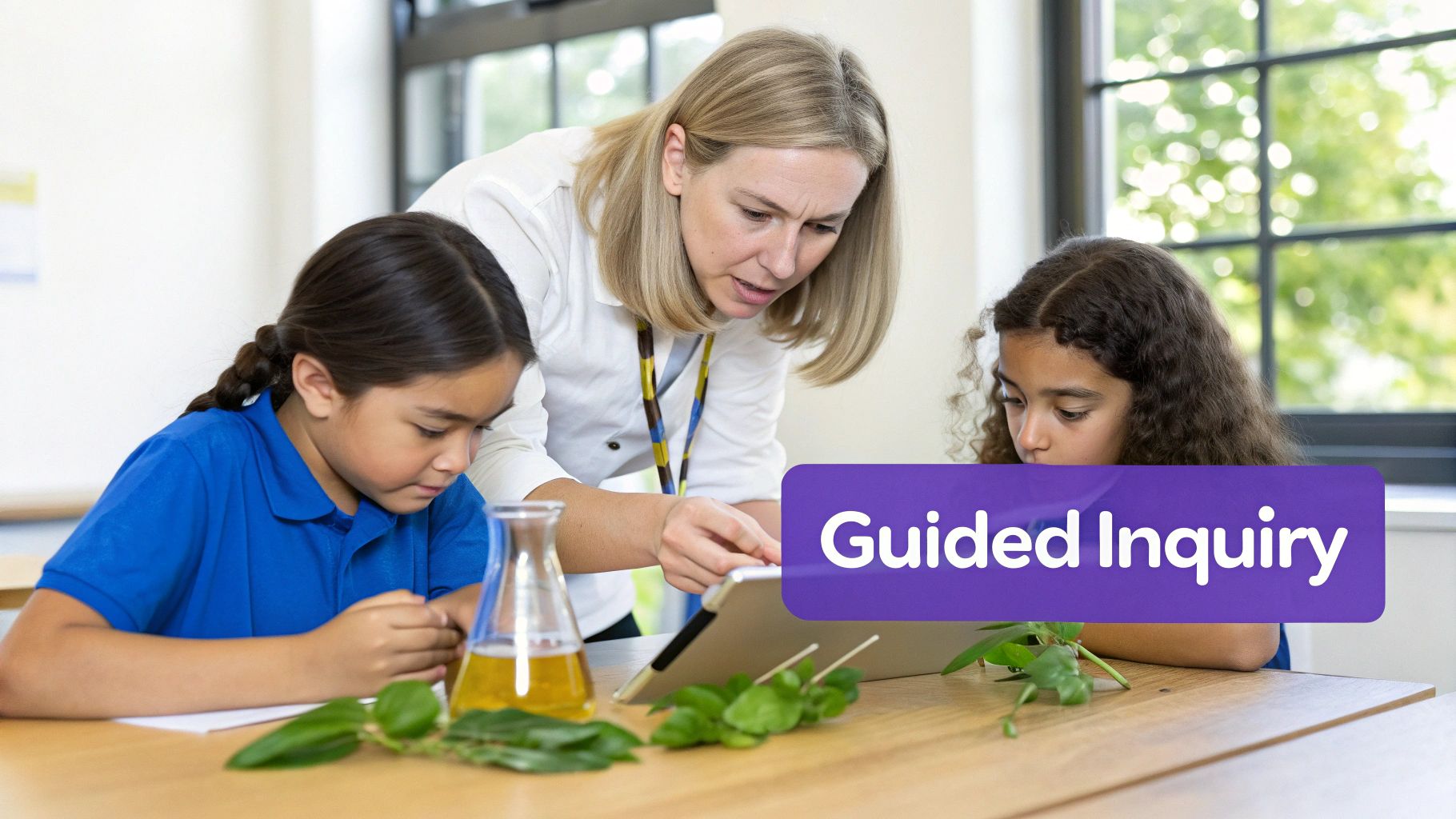
Guided inquiry is one of the most versatile inquiry based learning strategies because it strikes a perfect balance between teacher support and student autonomy. In this model, you act as a facilitator, providing a foundational question, key resources, and a structured pathway for investigation. Students then navigate the inquiry process within these established parameters, allowing them to practice critical thinking and problem-solving skills without feeling overwhelmed.
This approach is particularly effective for introducing complex topics or for younger learners who are still developing their research skills. It provides the necessary scaffolding to build confidence and ensures students stay on a productive learning path.
When to Use Guided Inquiry
Guided inquiry is an excellent starting point for educators new to inquiry-based learning or for students who need more structure. It works well when you have specific learning objectives to meet but want to give students ownership over the discovery process. It is a core component of a scaffolded teaching framework, where support is gradually removed as students become more proficient. You can explore how this fits into a broader instructional strategy by reading more about the Gradual Release of Responsibility Model.
How to Implement Guided Inquiry
- Pose a Central Question: Start with a compelling, open-ended question that frames the investigation. For example, "How did the geography of ancient Egypt contribute to the development of its civilization?"
- Provide Curated Resources: Give students a selection of pre-vetted resources, such as specific websites, articles, videos, or primary source documents. This prevents them from getting lost in unreliable information.
- Structure the Investigation: Offer a clear roadmap for their inquiry. This could be a graphic organizer, a series of smaller guiding questions, or a step-by-step lab procedure.
- Facilitate and Monitor: Circulate the classroom to check for understanding, ask probing questions to deepen thinking, and provide targeted feedback at key checkpoints.
Actionable Tips for Success
- Plan with Purpose: Using a lesson planner like Kuraplan can help you map out your entire guided inquiry unit. You can pre-load your guiding questions, link resources directly into the plan, and set up your checkpoint assessments.
- Use Visual Aids: Create flowcharts or graphic organizers that outline the steps of the inquiry process. This visual support helps students track their progress and understand the expectations at each stage.
- Offer Sentence Starters: Provide sentence starters for hypothesis formation, evidence recording, and conclusion writing to support students, especially English learners and those with writing difficulties.
2. Problem-Based Learning (PBL)
Problem-based learning (PBL) is one of the most dynamic inquiry based learning strategies, as it launches students directly into a complex, authentic problem. Instead of being taught content first, students confront a real-world challenge, identify what they need to know to solve it, and then collaboratively conduct research to propose viable solutions. This model immerses learners in the inquiry process from the very beginning.
This strategy is highly effective for developing skills that transfer directly beyond the classroom, such as critical thinking, collaboration, and applying knowledge to new, unstructured situations. It empowers students to see the real-world relevance of their education by tackling issues that matter.
When to Use Problem-Based Learning
PBL is ideal for capstone projects or multi-week units where deep, interdisciplinary learning is the goal. Use it when you want students to move beyond simple comprehension and engage in analysis, synthesis, and evaluation. It is particularly powerful for project-based assessments where the process of discovery is just as important as the final product.
How to Implement Problem-Based Learning
- Present an Ill-Structured Problem: Introduce a complex, real-world problem that has multiple potential solutions. For example, "How can our local community reduce its plastic waste by 20% in the next two years?"
- Identify "Need-to-Knows": Guide students in brainstorming what they already know and what they need to learn to address the problem. This phase is crucial for developing student-driven research questions.
- Conduct Research and Inquiry: Students work in collaborative teams to find information, conduct experiments, consult experts, and analyze data. The teacher acts as a coach, providing resources and targeted mini-lessons as needed.
- Develop and Present Solutions: Teams synthesize their findings to create a well-reasoned solution or proposal. They present their solution to an authentic audience, such as classmates, community members, or a panel of experts.
Actionable Tips for Success
- Brainstorm Authentic Problems: Tools with built-in AI, like Kuraplan's lesson planner, can be a huge help here. You can ask it to generate grade-appropriate, real-world problems aligned with your curriculum standards, like designing a sustainable community garden or creating a public health campaign.
- Create Clear Rubrics: Develop and share rubrics that assess both the final product and the collaborative process. In a digital planner, you can build detailed rubrics that evaluate critical thinking, teamwork, and communication skills, and easily share them with students.
- Plan for Just-in-Time Support: Anticipate knowledge gaps and plan scaffolded mini-lessons to provide necessary background information right when students need it, ensuring they don't get stuck.
3. 5E Learning Cycle (Engage, Explore, Explain, Elaborate, Evaluate)
The 5E Learning Cycle is a highly structured yet student-centered inquiry framework that guides students through a natural learning progression. As one of the most effective inquiry based learning strategies, particularly in STEM fields, it breaks down the learning process into five distinct phases: Engage, Explore, Explain, Elaborate, and Evaluate. This sequential approach ensures students build a deep, conceptual understanding by connecting new information to prior knowledge and hands-on experiences.
This model is celebrated for its logical flow, which mirrors the scientific method. It starts by sparking curiosity (Engage), moves to hands-on investigation (Explore), formalizes concepts (Explain), applies knowledge to new situations (Elaborate), and finally assesses understanding (Evaluate). This creates a comprehensive learning arc that promotes retention and critical thinking.
When to Use the 5E Learning Cycle
The 5E model is ideal for teaching complex concepts that benefit from a step-by-step discovery process. It is exceptionally powerful in science units, such as an exploration of weather patterns or a life science unit on plant growth. However, its structure is easily adaptable to other subjects, like an ELA lesson exploring narrative elements through story analysis or a math investigation into geometric properties. Use this model when you want to ensure a thorough, scaffolded journey from initial curiosity to demonstrated mastery.
How to Implement the 5E Learning Cycle
- Engage: Start with a "hook" to capture student interest and activate prior knowledge. This could be a surprising demonstration, a puzzling question, or a short, provocative video.
- Explore: Provide a hands-on activity where students can directly interact with the concept. In this phase, they investigate, ask questions, and work collaboratively to make initial discoveries with minimal direct instruction.
- Explain: Guide students to articulate their understanding. The teacher introduces formal vocabulary and scientific explanations to connect student explorations with established concepts.
- Elaborate: Challenge students to apply what they've learned to a new context. This phase extends their understanding and helps them see the concept's real-world applications.
- Evaluate: Assess student learning through both formative and summative methods. This can include observations, exit tickets, project-based assessments, or formal quizzes.
Actionable Tips for Success
- Template Your Units: Creating a 5E lesson template in a digital planner like Kuraplan is a game-changer. You can structure your plan with distinct sections for each phase, ensuring all components are thoughtfully addressed.
- Design a Strong Hook: A good hook is everything. If you're stuck, use an AI tool to brainstorm compelling phenomena or questions for the "Engage" phase that will genuinely capture student curiosity.
- Integrate Formative Checks: Build quick formative assessments, like exit tickets or think-pair-share prompts, into the end of each phase to monitor understanding and adjust instruction as needed.
4. Station Rotation and Learning Stations
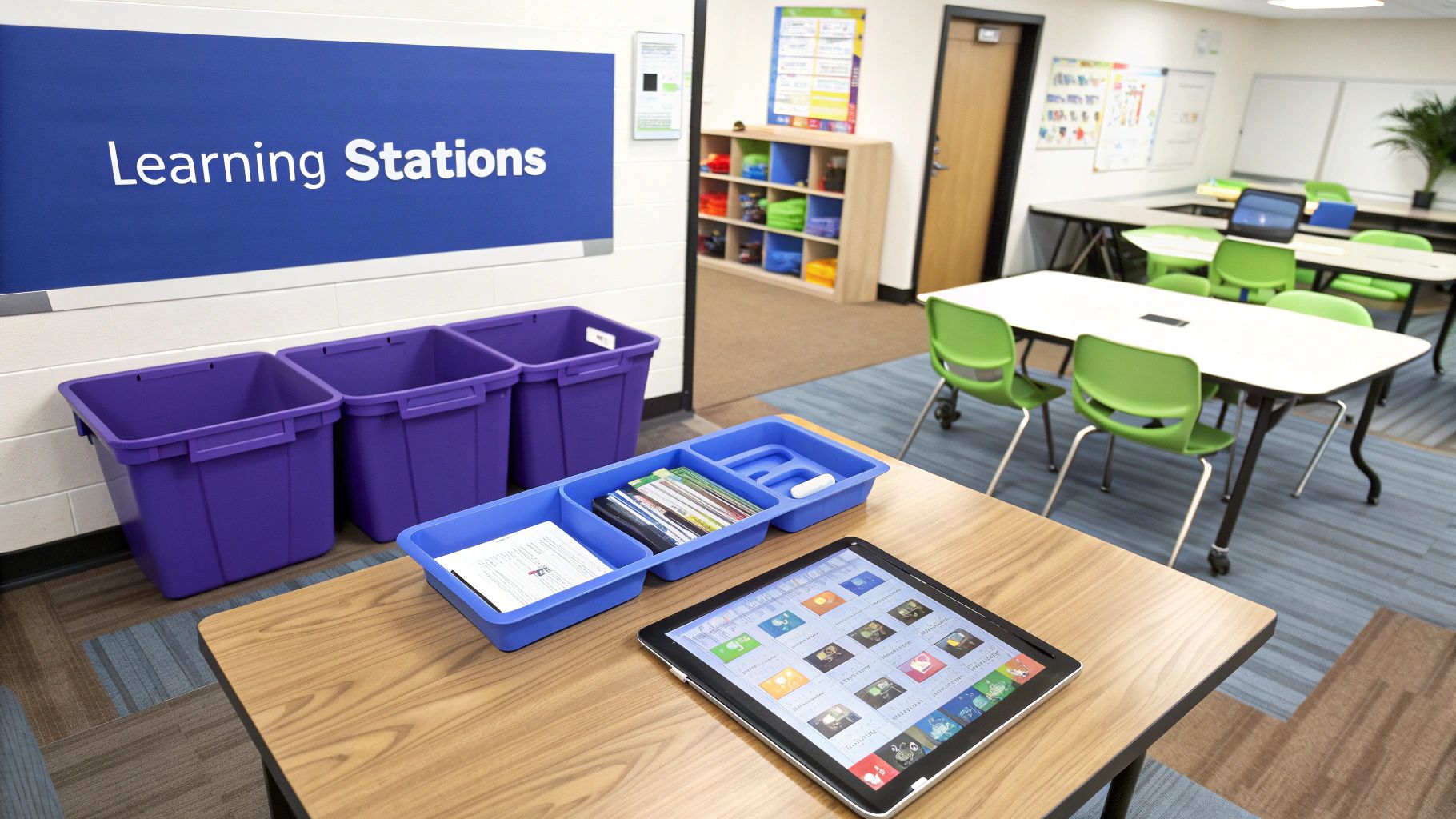
Station rotation is one of the most dynamic inquiry based learning strategies for promoting student-led exploration in a structured environment. This model organizes the classroom into distinct physical or digital "stations," each offering a different activity related to a central learning objective. Students rotate through these stations in small groups, engaging with the content in varied and interactive ways.
This approach is powerful because it allows for differentiation and personalized pacing. While one group is engaged in a hands-on experiment, another might be conducting digital research, and a third could be collaborating on a creative project. You can float between stations to provide targeted support or work with a small group for focused instruction.
When to Use Station Rotation
Station rotation is ideal when you need to cover multiple facets of a complex topic or want to cater to diverse learning styles simultaneously. It's particularly effective for breaking down a large inquiry question into manageable sub-topics. This strategy also excels in classrooms with a wide range of ability levels, as activities at each station can be tiered to meet individual student needs.
How to Implement Station Rotation
- Define the Core Objective: Start with a clear learning goal and a central inquiry question that connects all station activities. For example, "What makes a habitat suitable for an animal?"
- Design Differentiated Stations: Create 3-5 stations, each with a distinct purpose. For the habitat example, stations could include: a research station with tablets, a building station with craft materials to construct a diorama, a writing station for descriptive paragraphs, and a teacher-led station for discussing food chains.
- Establish Clear Procedures: Provide simple, visual instructions at each station. Use timers to manage rotations and establish clear expectations for transitioning between activities.
- Incorporate a Synthesis Task: Conclude with an activity that requires students to synthesize their learning from all stations, such as a gallery walk, a short presentation, or an exit ticket.
Actionable Tips for Success
- Vary Station Activities: Mix up the types of tasks to maintain engagement. Include a combination of hands-on, technology-based, collaborative, and independent work.
- Plan with AI Assistance: A tool like Kuraplan can be a huge time-saver here. Its AI assistant can generate differentiated activity ideas, worksheets, and guiding questions for each station, cutting your prep time in half.
- Create a Tracking Sheet: Give students a "passport" or a simple graphic organizer to complete as they move through the stations. This helps them track their progress and holds them accountable for their learning at each stop.
5. Think-Pair-Share
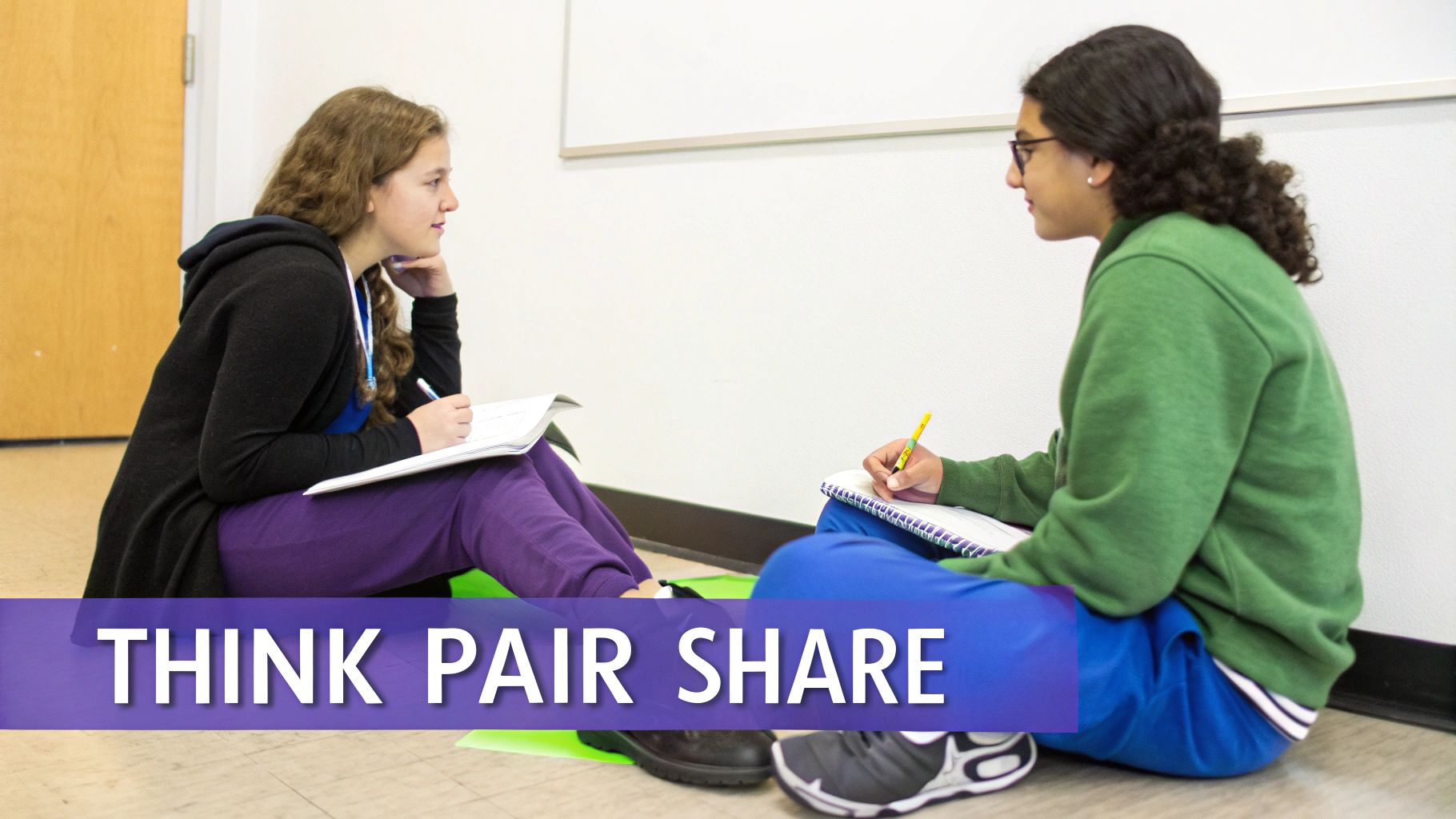
Think-Pair-Share is a highly effective collaborative discussion strategy that transforms passive listeners into active participants. This model breaks down learning into three distinct phases: students first reflect independently on a question (Think), then discuss their ideas with a partner (Pair), and finally share their refined thoughts with the entire class (Share). This structured process ensures every student engages with the content before a whole-group discussion begins.
As one of the most accessible inquiry based learning strategies, it builds a safe environment for students to formulate and test their ideas in a low-stakes setting. It boosts confidence, increases participation, and ensures a richer variety of perspectives are brought to the forefront of the lesson, moving beyond the few students who typically volunteer.
When to Use Think-Pair-Share
This strategy is incredibly versatile and can be used at any point in a lesson to break up direct instruction, check for understanding, or spark deeper inquiry. Use it to activate prior knowledge at the beginning of a unit, to process new information after a reading or video, or as a formative assessment tool to gauge comprehension. Its simplicity makes it ideal for all grade levels and subject areas.
How to Implement Think-Pair-Share
- Pose a Thought-Provoking Question: Present a clear, open-ended question or prompt that requires more than a simple yes/no answer. For example, "Based on the character's actions in this chapter, what do you predict will happen next and why?"
- Allow for Individual 'Think' Time: Give students a designated amount of silent time (1-2 minutes) to think and jot down their initial ideas. This independent processing is a critical first step.
- Facilitate the 'Pair' Discussion: Instruct students to turn to a partner and discuss their thoughts. Set a time limit (2-3 minutes) and encourage them to compare, contrast, and build upon each other's ideas.
- Conduct the 'Share' Out: Bring the class back together and call on several pairs to share the key takeaways from their conversation with the larger group. Record these ideas on the board to validate contributions.
Actionable Tips for Success
- Plan the Prompt: When you’re planning, drop the prompt directly into your lesson plan. Using a digital planner like Kuraplan means you can have worksheets or digital prompts ready to go, ensuring a smooth transition.
- Use a Timer: Project a visible timer for each phase to keep the activity structured and focused. This helps students manage their time effectively during both individual and partner work.
- Provide Discussion Scaffolds: Offer sentence starters like "I agree with you because..." or "An alternative idea could be..." to guide productive and respectful partner conversations, especially for younger students or English learners.
6. Project-Based Learning (PjBL)
Project-Based Learning (PjBL) transforms the classroom into a dynamic workshop where students engage in extended, in-depth investigations. This approach is one of the most powerful inquiry based learning strategies because it challenges students to respond to a complex question or problem by creating a public product or presentation for a real-world audience. Over weeks or even months, students drive their own learning, conduct research, collaborate, and build something tangible that demonstrates their understanding.
Unlike traditional projects that come at the end of a unit, in PjBL, the project is the vehicle for learning. It emphasizes the creation of a meaningful product and fosters skills like critical thinking, communication, and project management, preparing students for challenges beyond the classroom.
When to Use Project-Based Learning
PjBL is ideal for culminating units or for tackling multi-faceted topics that cannot be covered in a single lesson. It works best when you want to develop deep, enduring understanding and build 21st-century skills. This strategy is perfect for assessing a wide range of standards simultaneously and allowing students to connect their learning to authentic, real-world contexts. Use it when you want to shift the focus from rote memorization to application and creation.
How to Implement Project-Based Learning
- Launch with a Driving Question: Begin with an open-ended, engaging question that frames the project. For example, "How can we, as urban planners, design a model city that addresses future sustainability challenges?"
- Facilitate Student Inquiry: Guide students as they ask their own questions, conduct research, and gather information. This phase is student-led, with the teacher acting as a resource and facilitator.
- Structure Collaboration and Creation: Establish clear milestones and checkpoints for the project. Students work in teams to design, build, and refine their product, whether it's a digital documentary, a physical model, or a community campaign.
- Present to an Authentic Audience: Conclude the project by having students present their work to an audience beyond the classroom, such as community members, industry experts, or other students.
Actionable Tips for Success
- Map It Out: A big project needs a solid plan. Using a planner like Kuraplan helps you meticulously map out your PjBL unit. You can align each phase with specific standards, set milestone deadlines, and embed resources directly into the plan.
- Create Detailed Rubrics: Develop clear rubrics that assess both the final product and the process skills, including collaboration and critical thinking. This ensures students understand the expectations from day one.
- Provide Scaffolding: Offer scaffolding documents like research guides, planning templates, and checklists to support students. These tools help them manage their time and stay on track without limiting their creativity.
- Differentiate Product Options: Allow for student choice in the final product to match individual strengths and interests. Some may excel at creating a video, while others might prefer building a physical prototype.
7. Socratic Seminar / Structured Academic Controversy
A Socratic Seminar is a powerful dialogue-based strategy where students drive the conversation to construct a deeper understanding of a text or concept. In this model, the teacher acts as a facilitator, asking carefully crafted, open-ended questions to stimulate critical thinking and collaborative exploration. The goal is not to find a single "right" answer but to examine ideas, challenge assumptions, and build meaning together.
This approach transforms the classroom into a community of thinkers, where students must listen actively, articulate their reasoning clearly, and respond respectfully to their peers' ideas. It is one of the most effective inquiry based learning strategies for developing argumentation, communication, and analytical skills.
When to Use Socratic Seminars
Socratic Seminars are ideal for exploring complex topics that have multiple valid interpretations, such as literary themes, historical events, ethical dilemmas, or scientific controversies. Use this strategy when you want to move beyond surface-level comprehension and encourage students to grapple with ambiguity and nuance. It is particularly effective after students have already engaged with a foundational text or a set of data and are ready to synthesize their initial thoughts.
How to Implement Socratic Seminars
- Select a Rich Text or Topic: Choose a compelling piece of content (a primary source, a short story, a case study, a data set) that sparks curiosity and invites multiple perspectives.
- Prepare Probing Questions: Develop a sequence of high-level questions that guide the discussion from literal understanding to abstract analysis and evaluation. Start with an opening question that every student can answer.
- Establish Clear Norms: Co-create rules for the discussion with your students. Key norms should include listening to understand, citing evidence from the text, disagreeing respectfully, and ensuring equitable participation.
- Facilitate, Don't Dominate: Your role is to guide, not to lecture. Ask follow-up questions like, "What in the text makes you say that?" or "Can you rephrase what Maria just said?" Redirect questions back to the group to foster student-led dialogue.
Actionable Tips for Success
- Plan Questions Deliberately: This is another area where an AI-powered planner shines. With a tool like Kuraplan, you can generate, store, and organize your question banks. You can even tag questions by cognitive level (e.g., Bloom's Taxonomy) and build a library of high-quality prompts for different texts.
- Use an Inner/Outer Circle: For larger classes, divide students into two circles. The inner circle participates in the discussion, while the outer circle observes, takes notes on specific criteria, and provides feedback afterward before switching roles.
- Provide Thinking Time: Give students time to write or annotate their responses to key questions before the seminar begins. This pre-processing helps ensure more thoughtful contributions during the live discussion.
8. Discovery Learning and Experiential Learning
Discovery and experiential learning are powerful inquiry based learning strategies that place students at the center of their own education. This approach emphasizes learning by doing, where students directly engage with materials, problems, or real-world phenomena to construct their own understanding. Instead of being told facts, they make observations, form hypotheses, and test their ideas through hands-on exploration.
This model taps into students' natural curiosity and fosters intrinsic motivation through the joy of discovery. It builds deep, memorable knowledge because it is rooted in personal experience, trial, and refinement, making abstract concepts tangible and relevant.
When to Use Discovery and Experiential Learning
This approach is ideal for introducing new concepts where direct interaction is more impactful than a lecture, such as exploring properties of matter in science or understanding number relationships with math manipulatives. It's also highly effective for developing problem-solving and critical-thinking skills. It works best when the process of exploration is as important as the final answer, allowing for creativity and unexpected learning outcomes. This method aligns perfectly with other engagement-focused approaches; you can find more ideas in this guide to active learning strategies.
How to Implement Discovery and Experiential Learning
- Set the Stage: Create a rich learning environment with accessible materials. This could be science stations with various objects to test for magnetism, an art studio with different media, or a coding sandbox.
- Establish Clear Boundaries: Provide essential safety guidelines and behavioral expectations to ensure exploration is productive and safe, especially in science labs or outdoor settings.
- Prompt, Don't Prescribe: Offer a central challenge or a broad guiding question instead of step-by-step instructions. For example, "How many different ways can you build a bridge that spans this gap using only these materials?"
- Facilitate Reflection: After the discovery phase, lead a structured discussion or provide journal prompts to help students articulate what they learned, what surprised them, and what questions they still have.
Actionable Tips for Success
- Plan for Observation: Create observation checklists or data collection sheets that students can use to document their findings. This adds structure to their exploration without dictating the outcome. A digital planner can help you build and attach these directly to your lesson.
- Balance Freedom and Focus: Provide just enough structure to prevent aimless wandering but enough freedom for genuine discovery. Use redirecting questions to guide students who are stuck without giving away the answer.
- Document the Process: Use photos or videos to capture students' "aha" moments and document their discovery process. These artifacts are excellent additions to student portfolios and for sharing with families.
9. Case Study and Scenario-Based Learning
Case study and scenario-based learning is a powerful inquiry strategy that bridges the gap between abstract knowledge and real-world application. This method presents students with realistic situations, complex problems, or ethical dilemmas, challenging them to analyze context, evaluate evidence, and propose thoughtful solutions. By stepping into the shoes of decision-makers, students develop critical thinking, empathy, and problem-solving skills in a tangible context.
This approach is highly effective for exploring multifaceted issues that lack a single correct answer. It pushes students beyond simple fact recall, requiring them to grapple with ambiguity and justify their reasoning, making it one of the most practical inquiry based learning strategies for preparing students for future challenges in fields like civics, science, and health.
When to Use Case Study and Scenario-Based Learning
This strategy is ideal when you want to make curriculum content feel relevant and urgent. It excels in subjects like social studies, science, ELA, and health education, where students must analyze human decisions, scientific dilemmas, or character motivations. Use it to explore historical turning points, investigate environmental justice issues, analyze a disease outbreak, or dissect a character's critical choice in a novel. It is particularly effective for developing analytical and ethical reasoning skills.
How to Implement Case Study and Scenario-Based Learning
- Present a Compelling Case: Introduce a detailed, realistic scenario or case study. This could be a historical document, a fictional narrative detailing a community problem, or a scientific report on a public health crisis.
- Provide Rich Context: Supply students with relevant background information, data, primary sources, and multimedia resources. The goal is to create an authentic context for their investigation.
- Establish an Analytical Framework: Give students a clear structure for their analysis. This could be a set of guiding questions, a graphic organizer for tracking evidence, or specific roles to adopt (e.g., "You are the city planner").
- Facilitate Deliberation and Decision-Making: Guide students as they discuss different perspectives, weigh potential consequences, and formulate a recommendation or solution. Conclude with a debrief where groups share and defend their conclusions.
Actionable Tips for Success
- Generate Relevant Scenarios: An AI-powered tool like Kuraplan’s lesson planner can be your best friend for this. You can ask it to brainstorm age-appropriate case studies aligned with your specific learning standards, like creating a scenario about environmental justice for a 7th-grade geography class.
- Use Role-Playing: Assign students specific roles or stakeholder positions within the scenario to encourage them to analyze the issue from multiple, often conflicting, perspectives.
- Incorporate Primary Sources: Add authenticity by including primary source documents, images, news clips, or data sets that immerse students in the case study. This helps them practice sourcing and evidence-based reasoning.
10. Inquiry Circles / Book Clubs and Literature Circles
Inquiry circles are collaborative, small-group structures that position students as co-investigators of a shared topic. This is one of the most effective inquiry based learning strategies for developing communication, critical thinking, and shared accountability. Students read, research, or explore a common text or concept and meet regularly to discuss their findings, pose new questions, and build collective understanding.
A popular variation is the literature circle, where students read the same piece of literature and take on rotating roles like "Discussion Director," "Vocabulary Enricher," or "Connector" to guide their group's conversation. This structure ensures that every student has a specific responsibility, promoting equitable participation and deeper textual analysis.
When to Use Inquiry Circles
Inquiry circles are ideal for units focused on reading comprehension, thematic analysis, or exploring multifaceted topics from different viewpoints. They work exceptionally well in ELA, social studies, and even science classrooms where students can investigate different aspects of a phenomenon. This strategy is perfect for building a strong classroom community and teaching students how to engage in respectful, evidence-based dialogue.
The group dynamics in this strategy are key to its success. For educators looking to optimize these small-group interactions, it’s helpful to understand the principles behind how to launch a successful group mastermind, as many of the same concepts of shared goals and structured discussion apply.
How to Implement Inquiry Circles
- Select a Topic or Text: Choose a rich, complex text or a broad topic that allows for multiple avenues of investigation. For example, a history class could form inquiry circles to research different perspectives on a single historical event.
- Form Small Groups: Create groups of 4-5 students. You can group them by interest, reading level, or randomly to encourage diverse interactions.
- Assign Roles and Responsibilities: Provide clear role sheets that outline the responsibilities for each member. These roles guide their preparation and contributions during meetings.
- Schedule Regular Meetings: Set a consistent schedule for circle meetings (e.g., every Friday). Students should come prepared to share their findings and discuss their roles.
- Facilitate and Observe: Your role is to monitor discussions, offer clarifying questions, and assess group dynamics, but avoid leading the conversation. Let the students drive the inquiry.
Actionable Tips for Success
- Generate Role Cards: A tool like Kuraplan’s AI assistant can quickly generate detailed role cards and discussion prompts tailored to your specific text or topic, saving you valuable prep time.
- Model the Process: Before launching, model a literature circle meeting with a small group in front of the class. Explicitly teach discussion norms and sentence starters for academic conversation.
- Offer Choice: Whenever possible, provide a selection of high-interest texts or subtopics and let students choose which circle they want to join. This boosts engagement and ownership.
- Use Tracking Sheets: Create simple tracking sheets where students can log their preparation and participation. This helps keep individuals accountable to their group.
Inquiry-Based Learning: 10-Strategy Comparison
| Strategy | 🔄 Implementation complexity | ⚡ Resource requirements | 📊 Expected outcomes | 💡 Ideal use cases | ⭐ Key advantages |
|---|---|---|---|---|---|
| Guided Inquiry | Moderate — requires scaffolded planning and checkpoints | Moderate — teacher time, materials, scaffold resources | ⭐⭐⭐ Consistent mastery; formative progress data | K–12 (most effective grades 3–8); labs, guided investigations | Balances teacher support with student autonomy; easier assessment |
| Problem-Based Learning (PBL) | High — complex design and sustained facilitation | High — extended time, materials, teacher training | ⭐⭐⭐⭐ Strong transfer, collaboration, critical thinking | Grades 4–12; authentic, interdisciplinary real-world problems | Highly engaging; builds 21st-century problem-solving skills |
| 5E Learning Cycle | Moderate — sequenced phase planning and timing control | Moderate — materials for exploration and assessments | ⭐⭐⭐ Effective for conceptual change and misconception repair | K–12 (particularly science units); structured inquiry lessons | Clear, research-backed structure; communicates sequence well |
| Station Rotation / Learning Stations | Moderate–High — classroom management and logistics | Moderate — varied materials, space, reusable setup | ⭐⭐⭐ Increased engagement, differentiation, independent practice | K–6 (especially grades 1–6); centers, practice & skill stations | Differentiates instruction efficiently; maximizes active time |
| Think–Pair–Share | Low — simple three-step routine to implement | Low — minimal materials and prep | ⭐⭐ Increased participation and quick formative insight | Any grade; quick checks, reading responses, math strategies | Easy, fast, raises participation (including quiet students) |
| Project-Based Learning (PjBL) | High — long-term planning, milestones, facilitation | High — sustained materials, audiences, assessment rubrics | ⭐⭐⭐⭐ Deep understanding and authentic products/portfolios | Grades 3–12; extended interdisciplinary projects, showcases | Highly motivating; produces real-world, demonstrable outcomes |
| Socratic Seminar / Structured Academic Controversy | High — skilled questioning and facilitation required | Low–Moderate — texts, prep, norms and recording tools | ⭐⭐⭐ Develops critical thinking, argumentation, perspective-taking | Grades 4–12; literature, ethics, complex texts and debates | Promotes deep discourse and respectful reasoning |
| Discovery / Experiential Learning | Moderate–High — monitoring and safety oversight needed | Moderate–High — hands-on materials and preparation | ⭐⭐⭐ High engagement and creativity; variable content coverage | K–3 and hands-on subjects; art, early science, fieldwork | Fosters intrinsic motivation, creativity, resilience |
| Case Study / Scenario-Based Learning | Moderate–High — case design and scaffolding needed | Moderate — documents, media, role materials | ⭐⭐⭐ Applied decision-making, systems thinking, synthesis | Grades 5–12; social studies, health, science, business cases | Makes abstract ideas tangible; supports perspective analysis |
| Inquiry Circles / Book Clubs | Moderate — group roles, tracking, and norms | Low–Moderate — texts, role cards, tracking sheets | ⭐⭐⭐ Deeper comprehension, collaboration, leadership skills | K–12 (literature circles most effective grades 2–8); small-group inquiry | Choice-driven engagement; builds discussion and leadership skills |
Putting It All Together: Making Inquiry Work for You
We've journeyed through ten distinct yet interconnected inquiry based learning strategies, from the structured guidance of the 5E Learning Cycle to the collaborative depths of Socratic Seminars. Each approach offers a unique pathway to transform your classroom from a space of passive reception into a dynamic hub of active discovery. The common thread weaving through Guided Inquiry, Problem-Based Learning, and all the others is a fundamental shift in ownership. It's about moving the cognitive heavy lifting from you, the teacher, to your students.
This transition doesn't require a complete curricular overhaul overnight. The most sustainable change begins with small, intentional steps. You don’t need to launch a full-scale Project-Based Learning unit tomorrow. Instead, consider introducing a Think-Pair-Share during your next lesson or setting up a simple Learning Station activity. These small shifts begin to build the classroom culture necessary for deeper inquiry to flourish.
Key Takeaways: From Theory to Practice
As you reflect on these strategies, remember that the goal isn't just to "do" inquiry; it's to cultivate inquisitive minds. The real value lies in the skills students develop along the way: critical thinking, problem-solving, collaboration, and the ability to ask powerful questions.
- Start Small, Build Momentum: Choose one strategy that resonates with you and your students' needs. A successful Case Study or Inquiry Circle can build your confidence and your students' capacity for more complex tasks.
- Planning is Paramount: Effective inquiry is not unstructured; it is intentionally and carefully structured. Defining a compelling driving question, sourcing rich resources, and designing authentic assessments are crucial. This is where meticulous planning separates a meaningful learning experience from a chaotic one.
- Embrace the "Productive Struggle": Inquiry-based learning means students will sometimes struggle, get stuck, or go down the wrong path. This is not a failure of the lesson; it is a critical part of the learning process. Your role shifts to that of a facilitator, guiding them with probing questions rather than providing immediate answers.
- Assessment Looks Different: Move beyond traditional tests. Assessment in an inquiry-driven classroom is ongoing and authentic. It might be a group presentation, a detailed lab report, a reflective journal entry, or a portfolio of their work. The focus is on the process and the growth, not just the final product.
Your Next Steps: Making Inquiry Your Own
Adopting these inquiry based learning strategies is a journey, not a destination. To begin, identify a single upcoming lesson or unit where you can replace a traditional teacher-led activity with an inquiry-based one. Could that history lecture become a Structured Academic Controversy? Could that science worksheet be transformed into a hands-on Discovery Learning station?
The initial planning can feel like the biggest hurdle. Aligning activities to standards, creating differentiated materials, and scaffolding the process for diverse learners requires significant time and effort. This is precisely where modern tools can become a teacher's most valuable partner. Instead of getting bogged down in the administrative side of lesson creation, you can leverage technology to streamline the process. A tool like Kuraplan can help you generate standards-aligned lesson ideas, create differentiated resources, and structure your inquiry-based units, freeing you up to focus on what you do best: facilitating those incredible "aha!" moments with your students.
Ultimately, the power of inquiry-based learning lies in its ability to prepare students for a world that demands more than rote memorization. It equips them to be curious, adaptable, and confident problem-solvers. By starting small and staying consistent, you can cultivate a classroom where every student sees themselves as a capable, active participant in their own education.
Ready to spend less time planning and more time inspiring? Kuraplan is an AI-powered lesson planner designed to help you create engaging, standards-aligned inquiry-based learning experiences in minutes. Let us handle the heavy lifting of curriculum design so you can focus on fostering your students' curiosity at Kuraplan.