Planning a great science lesson is a delicate dance. You're trying to meet curriculum standards, manage the realities of your classroom, and—most importantly—spark that flicker of genuine curiosity in your students. The goal is to build a plan that’s both engaging for students and actually manageable for you.
The Real-World Challenge of Science Lesson Planning

Let’s be honest: planning an amazing science lesson feels like a constant juggling act. We’re all trying to create those magical "aha!" moments of discovery while navigating a maze of very real constraints. It’s a challenge every teacher knows well.
You're balancing core curriculum standards with the diverse needs of every single student in your room. At the same time, your prep periods seem to get shorter every year, and the budget for hands-on labs often requires some serious creative thinking.
This isn’t just a feeling; it’s a widespread reality. A survey of nearly 3,000 science teachers found that underfunding seriously impacts science teaching and directly affects lesson delivery—a problem that gets even worse in schools facing staffing shortages.
Shifting from Harder to Smarter Planning
The pressure is on to design lessons that are not just informative but truly memorable. Yet, the path to a great lesson isn't about working harder or spending late nights reinventing the wheel. It's about planning smarter by building a solid, repeatable framework.
The most effective lesson plans are not rigid scripts but flexible roadmaps. They provide clear direction while leaving room for the spontaneous questions and discoveries that make science so exciting.
This guide sets aside the abstract textbook theory to focus on practical, time-saving strategies that actually work in a real classroom. We'll walk through how to:
- Anchor lessons in clear, achievable learning objectives.
- Design activities that foster genuine inquiry and curiosity.
- Integrate assessments that measure understanding without creating a mountain of grading.
- Differentiate instruction to support every learner.
To navigate the complexities of modern teaching, understanding various use cases for educators can provide valuable insights and tools to improve the lesson planning process.
This is also where purpose-built tools can become your most valuable ally. An AI assistant designed for teachers, like Kuraplan, can help generate standards-aligned activities, create differentiated materials, and even suggest safety precautions. It's about getting the support you need to reclaim your time and focus on what you love most—teaching.
Building Your Lesson's Foundation
Before you even think about Bunsen burners or beakers, every great science lesson starts with a solid foundation. This is where we anchor our big ideas to the curriculum and get crystal clear on what success actually looks like for our students. It’s all about being intentional from the very beginning.
Think of it this way: you wouldn't start building a house without a blueprint. In the same way, you can’t plan a memorable science lesson without first defining what you want students to know and be able to do by the end. This simple step saves you from that sinking feeling of realizing a fun activity didn't actually teach the intended concept. I've been there, and it's frustrating.
From Standards to Student-Friendly Objectives
Let’s be honest, standards documents—like the Next Generation Science Standards (NGSS)—can be dense and a bit intimidating. The trick is to translate that formal language into something you can actually use in your classroom. This means moving from a broad standard to a sharp, student-centered learning objective.
A good learning objective is your North Star for the lesson. It's a clear, measurable statement that always completes the phrase: "Students will be able to..."
Here’s what makes an objective truly effective:
- Measurable: It uses an action verb you can observe, like analyze, construct, compare, or explain.
- Actionable: It describes a specific task students will perform to show you what they've learned.
- Student-Centered: It’s all about what the student will do, not what the teacher will do.
This isn't just theory. Teachers who consistently reflect on their lesson designs show 'huge improvement' over time as they practice cycles of planning, teaching, and tweaking. A strong objective gives you a concrete starting point for that reflection.
To help visualize this, let's break down how you can turn a formal NGSS standard into practical, classroom-ready components. This process is key to making the standards work for you, not the other way around.
From Standard to Student-Friendly Objective
| Component | NGSS Standard Example (MS-PS1-2) | Your Classroom Implementation |
|---|---|---|
| The Standard | Analyze and interpret data on the properties of substances before and after the substances interact to determine if a chemical reaction has occurred. | This is the official language. It’s a bit of a mouthful, but it's our starting point. |
| Learning Objective | "Students will be able to analyze data from a simple experiment to determine if a chemical reaction occurred by identifying changes in properties like color, temperature, or the formation of a gas." | This is specific, measurable, and focuses on what the students will do. It's our guidepost for the lesson. |
| Essential Question | "How can we tell if mixing two things together created something completely new?" | This is the hook! It’s an open-ended question that sparks curiosity and drives the entire investigation. |
See the difference? We went from a dense sentence to a clear objective and a compelling question that students can actually get excited about.
Crafting a Compelling Essential Question
Once you have your objective, framing it with a compelling essential question is your next move. This isn't a simple "what is..." question with a one-word answer. It’s a big, juicy question that sparks curiosity and drives the entire lesson forward.
An effective essential question:
- Is open-ended: There isn't a single right answer.
- Is thought-provoking: It pushes students to think critically.
- Requires evidence: Students have to use what they've learned to back up their answer.
For instance, if your objective is for students to explain the water cycle, a weak question is "What are the stages of the water cycle?" A much better essential question would be something like, "Where does the water in our town's river come from, and where does it go?" The second question immediately connects the science to their world and demands deeper thinking.
Thinking about how one lesson connects to the next is what separates good teachers from great ones. If you're interested in that bigger picture, learning about developing a comprehensive training curriculum can help you see how each piece fits into a larger, coherent puzzle.
Your essential question is the "why" that hooks students, while your learning objective is the "what" that guides your instruction and assessment. When they are perfectly aligned, you create a powerful and coherent learning experience.
If you find yourself spending too much time wrestling with standards, teacher-focused AI tools can be a huge help. A platform like Kuraplan can instantly generate standards-aligned objectives and thought-provoking essential questions, giving you a solid starting point in seconds. For more resources, you might be interested in our guide on creating a solid lesson plan structure. This foundational work ensures that every activity, discussion, and assessment that follows is purposeful and directly contributes to student learning.
Designing Activities That Spark Real Curiosity
Alright, let's get to the fun part—the heart of your lesson, where the real magic happens. This is where we ditch the worksheets and dive into what makes science so thrilling: genuine discovery. But how do you create an activity that’s both a blast for students and actually hits your learning targets?
The secret is a balanced approach. One of the most effective frameworks I’ve ever used is the 5E Model: Engage, Explore, Explain, Elaborate, and Evaluate. It’s a simple, logical sequence that builds momentum, guiding students from that first spark of curiosity all the way to a deep, lasting understanding.
Kickstarting Learning with the Engage Phase
First up is Engage. This is your hook. Your mission is to grab their attention and get them thinking about what they already know. Forget the lecture; this is about posing a question or showing them something that makes them ask, "Wait, what's going on here?"
I once started a lesson on air pressure by secretly sticking an empty, uncapped water bottle in the freezer before class. When I pulled out the crushed bottle and held it up without saying a word, the room buzzed with theories. I just asked, "What happened?"
Here are a few other simple ways to get them hooked:
- Show a surprising video clip: A short, dramatic video of something like a volcano erupting or a time-lapse of a plant growing can spark instant wonder.
- Present a puzzling phenomenon: Like my crushed bottle, a simple demonstration that defies expectations is a powerful way to start.
- Ask a thought-provoking question: Connect it to their world. "Why do puddles on the playground disappear even when it’s not sunny?" works wonders.
The Engage phase is quick, punchy, and sets the stage for everything else. It gives students a reason to care.
Fostering Discovery in the Explore Phase
Once their curiosity is piqued, it's time to Explore. This is where your students get their hands dirty. They investigate, they test things out, and they work together to figure out the phenomenon you introduced. Your job shifts from instructor to facilitator—you're there to ask guiding questions, not to hand them the answers.
This is where students really take charge of their own learning.
For a lesson on density, I'll give groups a tub of water and a box of random objects—a cork, a paperclip, a small toy, a piece of wood. Their task is simple: predict which items will sink or float, test their ideas, and jot down what they see. They're gathering data and debating their findings long before I introduce any formal terms.
An effective Explore activity should be a 'low-floor, high-ceiling' task. It means every student can jump in and make observations, while others can start forming more complex ideas about why things are happening.
This process is built on a solid foundation. You start with the standard, narrow it down to a clear objective, and then craft a question that leads directly to a purposeful activity.
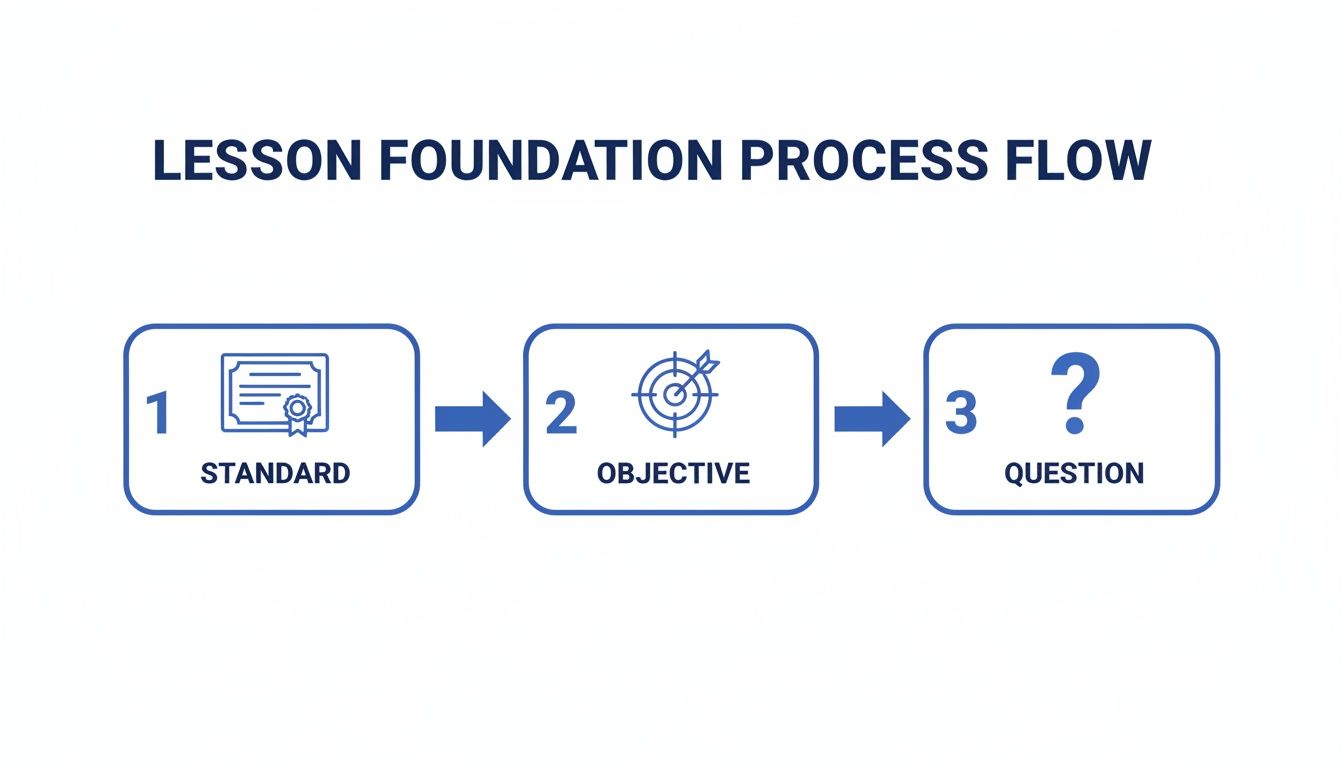
As you can see, a great activity isn't random; it flows directly from the learning goals you've already set.
Making Sense of It All in the Explain and Elaborate Phases
After students have explored, they’re ready for the Explain phase. Now it’s time to connect their hands-on experiences to the official scientific concepts and vocabulary. This is where you can bring in direct instruction, lead a class discussion, or have them read a relevant text. The new terms have something concrete to stick to.
Following the density lab, the Explain phase is when I introduce words like buoyancy, mass, and volume. We'll have a discussion where groups share their findings, and together we build a formal definition of density based on their own evidence.
But we don't stop there. The Elaborate phase pushes students to apply their new knowledge in a different context. This is what really cements their understanding. You could challenge them to design a boat from aluminum foil that can hold the most pennies or research how submarines use ballast tanks to control their density.
Let's be honest, coming up with unique, standards-aligned activities for every single lesson is exhausting. This is where a tool like Kuraplan can be a game-changer. It can suggest creative activities for any phase of the 5E model, generate diagrams to explain complex topics, or even write a full hands-on lab procedure. It literally saves hours of prep time. You can find more great ideas in these inquiry-based learning strategies.
Finally, the Evaluate phase is where you check for understanding. This doesn’t have to be a big formal test. It could be an exit ticket, a quick lab summary, or just your observations during the Elaborate activity. The goal is simply to see if they met the learning objective you started with, bringing the whole lesson full circle.
Planning for Every Student in Your Classroom
Let’s be real—no two students are the same. Our classrooms are a fantastic mix of different learning styles, speeds, and needs. That’s why a one-size-fits-all science lesson is doomed to leave some kids behind.
The best lessons are flexible, meeting students where they are and giving them the right support (and the right challenge) to grow. This is the art of differentiation.
It’s not about making a dozen different lesson plans. It’s about being smart and intentional with small adjustments to your teaching, materials, and checks for understanding. The goal is simple: give every single student a real shot at mastering the core concepts.
Strategies for Supporting Diverse Learners
Effective differentiation isn't something you tack on when a student starts struggling. It has to be baked into your plan from the very beginning. When you anticipate the roadblocks, you can build the ramps right into the lesson. It's all about being proactive.
Here are a few practical strategies you can fold into your next science lesson:
- For English Language Learners (ELLs): Don't let language be a barrier to awesome science. Visual vocabulary aids are your best friend. Think word walls with pictures and simple definitions for terms like photosynthesis or erosion. When it's lab time, offer sentence starters to help them structure their observations, like: "I observed that the ________ changed color when we added ________."
- For Students with IEPs: Small changes can have a massive impact. This could be giving them a partially completed graphic organizer for notes, offering a choice in how they show what they know (maybe a drawing instead of a written summary), or breaking down complex lab instructions into a simple checklist.
- For Advanced Learners: You've got to keep these kids hooked. The key isn't more work, but deeper work. Challenge them to design a follow-up experiment based on the day's results. Have them research a real-world application of the concept you're studying or analyze a more complex set of data.
The key to successful differentiation isn't about lowering expectations. It's about providing the necessary scaffolds so that every student can rise to meet high expectations.
Designing Tiered Assignments That Work
One of my favorite differentiation tools is the tiered assignment. The big idea here is that all students are working toward the same learning objective, but they take slightly different paths to get there based on their readiness.
Let's say your objective is for students to explain the life cycle of a butterfly. A tiered assignment could look like this:
- Tier 1: Students sequence pre-made picture cards of the life cycle and label each one using a provided word bank.
- Tier 2: Students draw and label the four main stages, then write a simple sentence describing what happens in each one.
- Tier 3: Students create a detailed diagram of the life cycle, explaining the purpose of each stage and comparing it to another insect's life cycle.
See what's happening? Every student is demonstrating their understanding of the butterfly's life cycle. The tasks are different, but the core learning goal is identical.
Checkpoints and Targeted Support
Of course, even the most perfectly planned lesson needs mid-course corrections. That's why building in frequent, informal checkpoints is non-negotiable. These are quick, low-stakes ways to see who's getting it and who might need a hand.
Simple checkpoints are the best:
- A quick think-pair-share where students explain a concept to a partner.
- An exit ticket with just one or two questions at the end of the lesson.
- The classic thumbs-up, thumbs-sideways, thumbs-down for a fast comprehension check.
When you spot students who are struggling, you can pull them into a small group for a quick re-teach while everyone else is working independently.
I get it—planning for this level of differentiation can feel like a lot, especially when your prep time is already maxed out. This is where a purpose-built AI assistant can be a lifesaver. For instance, a platform like Kuraplan can instantly suggest differentiation strategies based on your learning objective or even generate leveled reading passages about a science topic in minutes. It handles the heavy lifting so you can focus on what you do best: teaching your students.
Assessing Understanding Without Drowning in Grading
You've just wrapped up a fantastic lab. The room was buzzing with discussion, and it feels like the students got it. But how do you really know? And more importantly, how do you measure that understanding without creating a mountain of grading that swallows your weekend?
The trick is to build a smart, balanced assessment plan right into your lesson from the start. This isn't just about assigning a grade at the end; it's about gathering real-time data to inform your next move in the classroom.
The Power of Low-Stakes Formative Checks
Formative assessments are your secret weapon here. Think of them as quick, in-the-moment checks to take your students' "learning temperature." They give you a snapshot of understanding without adding a single thing to your official grade book.
I rely on these constantly to see if we need to slow down and review a concept or if the class is ready to push forward. They're low-pressure for students and incredibly informative for me.
Here are a few of my go-to formative checks:
- Exit Tickets: Before the bell rings, I'll have students jot down an answer to one simple question on a sticky note. Something like, "What's one thing you're still confused about?" or "Explain the difference between a physical and chemical change in one sentence." I can scan these in two minutes and know exactly where we stand.
- Quick Polls: This is as simple as asking for a thumbs-up, thumbs-sideways, or thumbs-down to show confidence with a new concept. It’s a super fast, visual way to gauge the whole room.
- Think-Pair-Share: This classic is perfect for checking comprehension on the fly. Pose a question, give students a quiet moment to think, have them discuss with a partner, and then call on a few pairs to share. You’ll hear misconceptions and brilliant insights pop up immediately.
Your formative assessments are the conversations you have with your students about their learning. They are diagnostic tools that tell you what to do next, making your teaching more responsive and effective.
These small, consistent checks are the backbone of great teaching. They ensure no one falls through the cracks and turn planning a science lesson into a dynamic process that truly adapts to your students' needs.
Designing Summative Assessments That Genuinely Measure Learning
While formative checks guide your day-to-day instruction, summative assessments are for measuring mastery at the end of a unit. This is where students get to show you what they can really do. A good summative assessment, however, should do more than just test vocabulary on a multiple-choice quiz.
To truly measure understanding, your summative assessment must align perfectly with your original learning objectives. If your objective was for students to "design an experiment to test a hypothesis," then a standard quiz just won't cut it. A project or a formal lab report would be a far more authentic measure of that skill.
Consider moving beyond traditional tests with assessments like these:
- Model-Building Projects: Challenge students to build a physical or digital model of a concept—like the solar system or a plant cell—and then explain how it works.
- Lab Reports: Have students follow the scientific method to conduct an experiment and formally write up their procedure, data, and conclusions. This is a core scientific skill!
- Problem-Based Scenarios: Present students with a real-world problem, like designing a water filtration system with simple materials. Then, have them apply their knowledge to create and test a solution.
Creating clear rubrics for these larger projects is non-negotiable. A solid rubric not only makes grading faster and more objective for you, but it also shows students exactly what success looks like. When I need to whip up a clear rubric fast, I use AI tools like Kuraplan. It can generate a rubric based on my learning objective in seconds, ensuring my grading is both fair and efficient.
Using AI as Your Lesson Planning Co-Pilot
Let's be honest about using AI for lesson planning. While it's tempting to throw a topic into a generic tool like ChatGPT, you often end up with more work, not less. The results can be impractical, factually wrong, or completely disconnected from your curriculum standards.
It's a bit like asking a random person on the street for directions instead of using a GPS. One might get you into the right neighborhood, but the other is built specifically for the job.
The key is to think of AI as an intelligent co-pilot, not a replacement for your professional judgment. A 2024 study found that while general AI can help with basic structure, it often creates problems like factual errors and suggestions that miss the mark on specific standards. The research confirmed that its usefulness is limited by the teacher's own expertise, making it more of an 'augmentative resource'. You can read more about it in this study on AI in lesson planning.
The Smarter AI Alternative
This is where a purpose-built educational tool completely changes the game. An AI platform like Kuraplan is different because it's trained specifically on curriculum standards and effective teaching methods.
Instead of vague ideas, it gives you a solid, reliable framework for your lesson. It can help you:
- Generate a standards-aligned lesson sequence from the ground up.
- Create differentiated materials for your diverse learners in seconds.
- Suggest relevant hands-on activities and the right safety precautions.
Using the right AI tool isn't about cutting corners—it’s about automating the tedious parts of planning so you can pour your energy into the creative, human elements of teaching that truly inspire students.
When you use an AI designed for educators, you get your time back without sacrificing quality. For a closer look, check out our guide on how to use AI effectively for lesson planning.
Common Questions About Science Lesson Planning
Even with a solid framework, you're bound to have questions. Let's tackle a few of the most common ones I hear from teachers about the nitty-gritty of science lesson planning.
How Long Should My Science Lesson Plan Be?
Honestly, there's no magic number. A great lesson plan is one that's useful to you or a substitute—so focus on clarity and function, not word count.
Some days, you might need a detailed, almost script-like plan. Other times, a simple bulleted list with your objectives, materials, and a few key questions is all it takes. The goal is a clear guide, not a novel. As long as it has the essentials and keeps your lesson on track, it's the right length.
What's the Best Way to Integrate Technology?
My rule of thumb? Use technology only when it adds value that a traditional tool can't. The goal is to deepen student understanding, not just to use a digital worksheet for the sake of it.
Here are a few ways to make tech purposeful:
- Virtual Labs: Use simulations like PhET for experiments that are too dangerous, expensive, or microscopic to do in the classroom.
- Data Analysis: Have students use sensors and simple graphing tools to collect and interpret real-time data from their experiments. It makes the abstract tangible.
- Collaborative Research: Let students use shared documents or platforms to gather and synthesize information for a project.
How Can I Plan an Engaging Lesson on a Tight Budget?
Resourcefulness is a teacher’s superpower. I’ve found that a tight budget often forces the most creative and memorable lessons. Shift your focus to phenomena students can observe in their own environment.
Everyday items are your best friend. Vinegar, baking soda, straws, and recycled materials are perfect for countless high-impact experiments. Also, lean on the incredible free resources from places like NASA, science museums, and educational creators online.
Some of my most successful lessons started with the question, "What can I demonstrate using only what's in this closet?" Constraint breeds creativity.
Stop spending your weekends wrestling with lesson plans. Kuraplan is an AI co-pilot designed by educators to help you create standards-aligned, differentiated, and engaging science lessons in minutes. Try Kuraplan and reclaim your time.