Walking into a teacher interview can feel like standing in front of your most challenging class; you need to be prepared for anything. As fellow educators, we know the pressure is real. You're not just answering questions; you're showing a hiring committee the kind of dedicated, effective, and collaborative professional you'll be for their students, families, and staff.
This guide cuts through the noise and delivers what you need to feel confident and prepared. We’ve pulled together the most common teacher interview questions and answers, complete with model responses, STAR-method examples, and insider tips. You'll find specific advice on how to tailor your answers whether you are interviewing for a role in elementary, middle, high school, or special education.
We'll break down what interviewers are really asking with each question and show you how to frame your unique experience to highlight your strengths. Many schools now use behavioral questions to see how your past performance predicts future success. For a deeper dive into that format, checking out resources on 10 Common Behavioral Interview Questions and How to Answer Them can give you a solid foundation for crafting compelling, evidence-based answers.
This article is your ultimate prep tool, giving you actionable strategies to help you articulate your teaching philosophy, classroom management style, and instructional expertise. Whether you're a first-year teacher or a seasoned veteran looking for a new opportunity, let's get you ready to shine.
1. Tell me about your approach to lesson planning and classroom organization.
This foundational question checks your ability to design effective instruction and manage the daily chaos of a classroom. Interviewers want to see that you have a thoughtful system that goes beyond just following a curriculum map. They’re looking for evidence of your organizational skills, your teaching philosophy, and your ability to create a structured yet flexible learning environment.

Why This Question Matters
Your answer reveals how you turn educational theory into practice. It shows whether you are proactive or reactive, how you prioritize student needs, and if you can handle the inevitable curveballs of a school day. A strong response connects your planning process directly to student learning and classroom efficiency.
How to Structure Your Answer
A great way to tackle this common question is to combine a proven framework with modern tools.
- Start with a Framework: Begin by mentioning a pedagogical approach like Backward Design (Understanding by Design). This shows you start with the end goal in mind: "I begin my lesson planning with the end goal, focusing on what I want my students to know and be able to do. I create the summative assessment first, then design the daily learning activities that will build toward that mastery."
- Integrate Technology: Explain how you use tech to make your planning more efficient and effective. Mentioning specific tools is key. For example, "To streamline this process, I use an AI-powered platform like Kuraplan. It helps me quickly generate standards-aligned lesson plans, differentiate activities, and create assessments, which saves a ton of time." This demonstrates your tech-savviness. You can explore a variety of options by learning more about the benefits of a digital teacher planner.
- Connect to Organization: Bridge your planning method to classroom organization. Explain that your clear, structured plans translate into a well-managed classroom where materials are ready, transitions are smooth, and instructional time is maximized.
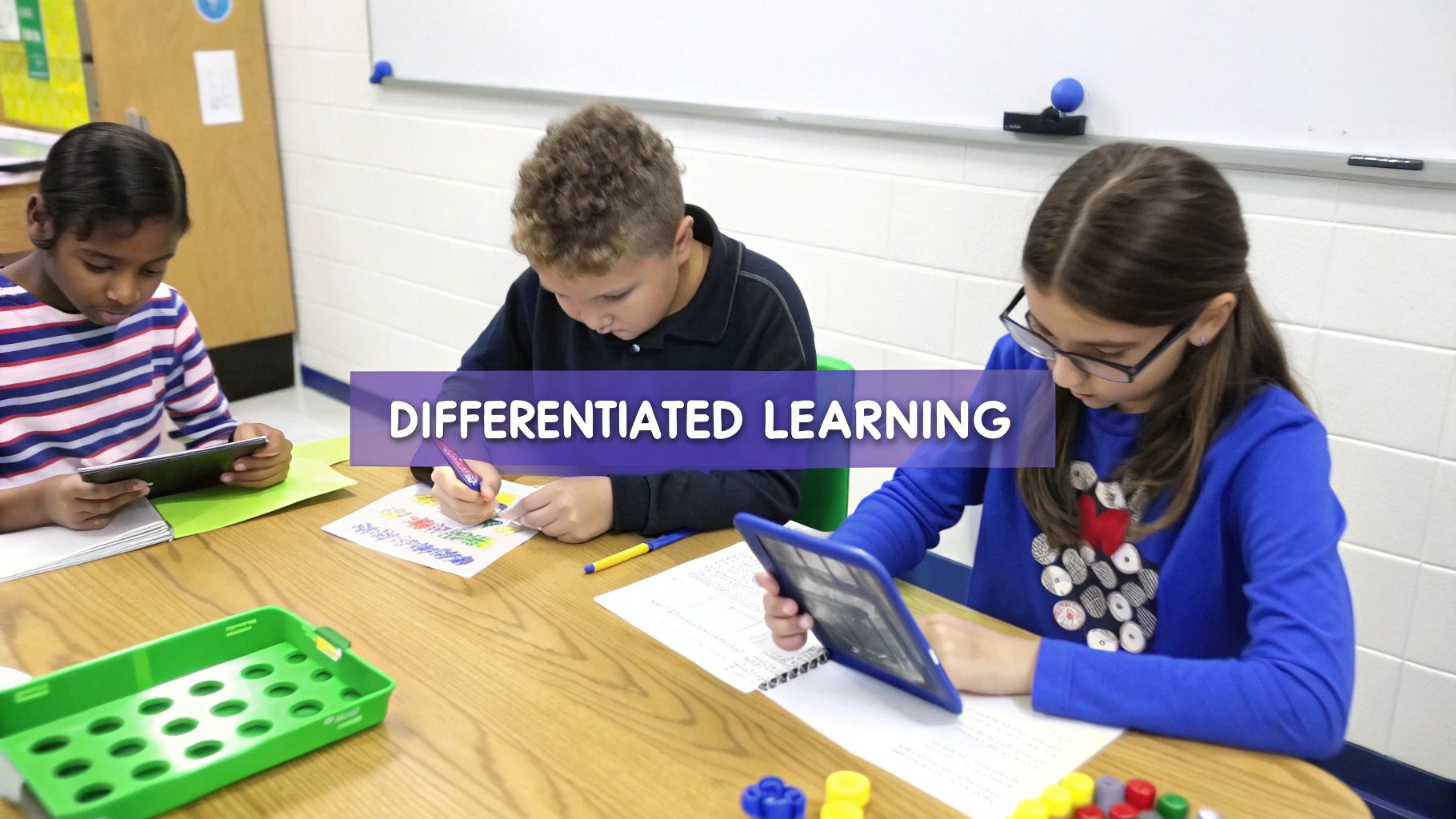
2. How do you differentiate instruction for students with varying ability levels?
This is one of the most critical teacher interview questions you can prepare for. It assesses your commitment to equity and your practical skills in meeting the needs of every student. Schools need to know you can create an inclusive environment where all learners—from those who are struggling to those who are advanced—can thrive. They want to see that you understand differentiation isn't just about accommodation but about maximizing growth for everyone.
Why This Question Matters
Your answer demonstrates your pedagogical depth and ability to manage a modern, diverse classroom. It reveals how you use data to inform instruction and whether you can be flexible and creative. A strong response shows that you see differentiation as a core, non-negotiable part of your practice, essential for fostering both academic success and student confidence.
How to Structure Your Answer
A powerful answer blends foundational theory with practical, tech-enhanced strategies.
- Start with a Framework: Begin by referencing a guiding principle like Universal Design for Learning (UDL). This shows you have a proactive, systematic approach. You could say, "My approach to differentiation is grounded in UDL, focusing on providing multiple means of representation, engagement, and expression. I aim to build flexibility into my lessons from the start rather than retrofitting accommodations."
- Provide Concrete Examples: Give specific examples of what differentiation looks like in your classroom. For instance, "In a reading lesson, I might use tiered assignments where all students work toward the same learning objective but with texts at different complexity levels. I also use flexible grouping, moving students between small groups based on formative data from exit tickets or brief check-ins."
- Integrate Technology: Explain how modern tools make sophisticated differentiation manageable. "To implement this effectively without spending all my time creating materials, I use AI-driven tools. For example, a platform like Kuraplan can automatically generate differentiated worksheets for different proficiency levels, allowing me to provide targeted support for English learners and gifted students with minimal prep time. This ensures every student receives the challenge or support they need."
3. Describe your experience with standards-aligned curriculum and how you ensure standards are met.
This question tests your understanding of the backbone of modern education: curriculum standards. Administrators need to know you can do more than just deliver engaging lessons; they need to see that your instruction is purposeful and directly tied to state or national learning requirements. This ensures equity, accountability, and prepares students for standardized tests and future academic success.
Why This Question Matters
Your answer shows your instructional maturity and commitment to accountability. It shows an interviewer that you can deconstruct complex standards into teachable learning objectives and align every part of your instruction—from activities to assessments—with those goals. A strong response proves you are a methodical educator focused on measurable student growth.
How to Structure Your Answer
A powerful answer will showcase a systematic process that combines pedagogical knowledge with modern efficiency.
- Start with the Standard: Begin by explaining that your planning process always starts with the specific standards. Name your state’s framework (e.g., Common Core, TEKS) to show familiarity. "My instructional design process is rooted in our state standards. I begin each unit by unpacking the specific standards, identifying the key skills and knowledge students need to master."
- Explain Your Alignment Process: Detail the steps you take to ensure alignment. This is the core of your answer. You could say, "From there, I create clear, measurable learning objectives for each lesson. Every activity, resource, and assessment is then intentionally selected to support those objectives, ensuring there is a direct line from the daily task back to the standard."
- Integrate Technology for Accuracy: Discuss how you leverage tools to guarantee comprehensive standards coverage. "Manually tracking which standards have been taught and assessed can be complex. I use platforms like Kuraplan, which can automatically map lessons and assessments to the correct standards. This not only saves time but also provides a clear visual dashboard of my curriculum coverage, helping me identify and fill any gaps." This highlights your tech skills and focus on precision. You can see how this works by reading more about an AI curriculum generator.
- Close with Assessment and Data: Connect standards alignment to student assessment and feedback. "Finally, I use standards-aligned rubrics for assessments. This allows me to give students and families specific feedback on their progress toward mastering each standard and helps me use the data to inform my future instruction."
4. Tell me about a time you had to adapt your lesson plan based on student performance or feedback.
This behavioral question gets to the heart of what great teaching looks like in practice. Schools want educators who are responsive and student-centered, not just presenters of pre-written material. Interviewers are looking for evidence that you can think on your feet, use formative data, and pivot your instruction to meet the real-time needs of your students.
Why This Question Matters
Your response demonstrates your flexibility, diagnostic skills, and commitment to student mastery. It shows that you view lesson plans as a living document, not an unchangeable script. A strong answer proves you are a reflective practitioner who can see when a lesson isn't landing and has the skills to correct course effectively.
How to Structure Your Answer
The best way to answer behavioral questions like this is by using the STAR method (Situation, Task, Action, Result). This framework keeps your story clear, concise, and impactful.
- Situation: Briefly set the scene. "During a unit on fractions, I was teaching my fourth-grade class how to find equivalent fractions."
- Task: Explain the goal. "The goal was for students to be able to generate and identify equivalent fractions. I checked for understanding using exit tickets at the end of the lesson."
- Action: Describe what you did. "The exit tickets revealed that over half the class was struggling with the concept. That evening, I used an AI tool to quickly generate a new set of scaffolded practice worksheets with more visual aids, like fraction bars. The next day, I started with a quick re-teach using a hands-on activity and then used the new materials for small-group intervention." This highlights your problem-solving skills and your ability to leverage modern tools for rapid differentiation.
- Result: Share the positive outcome. "By the end of the week, a follow-up assessment showed that 90% of students had mastered the concept, a significant improvement. It reinforced the importance of using formative data to drive my next-day instruction."
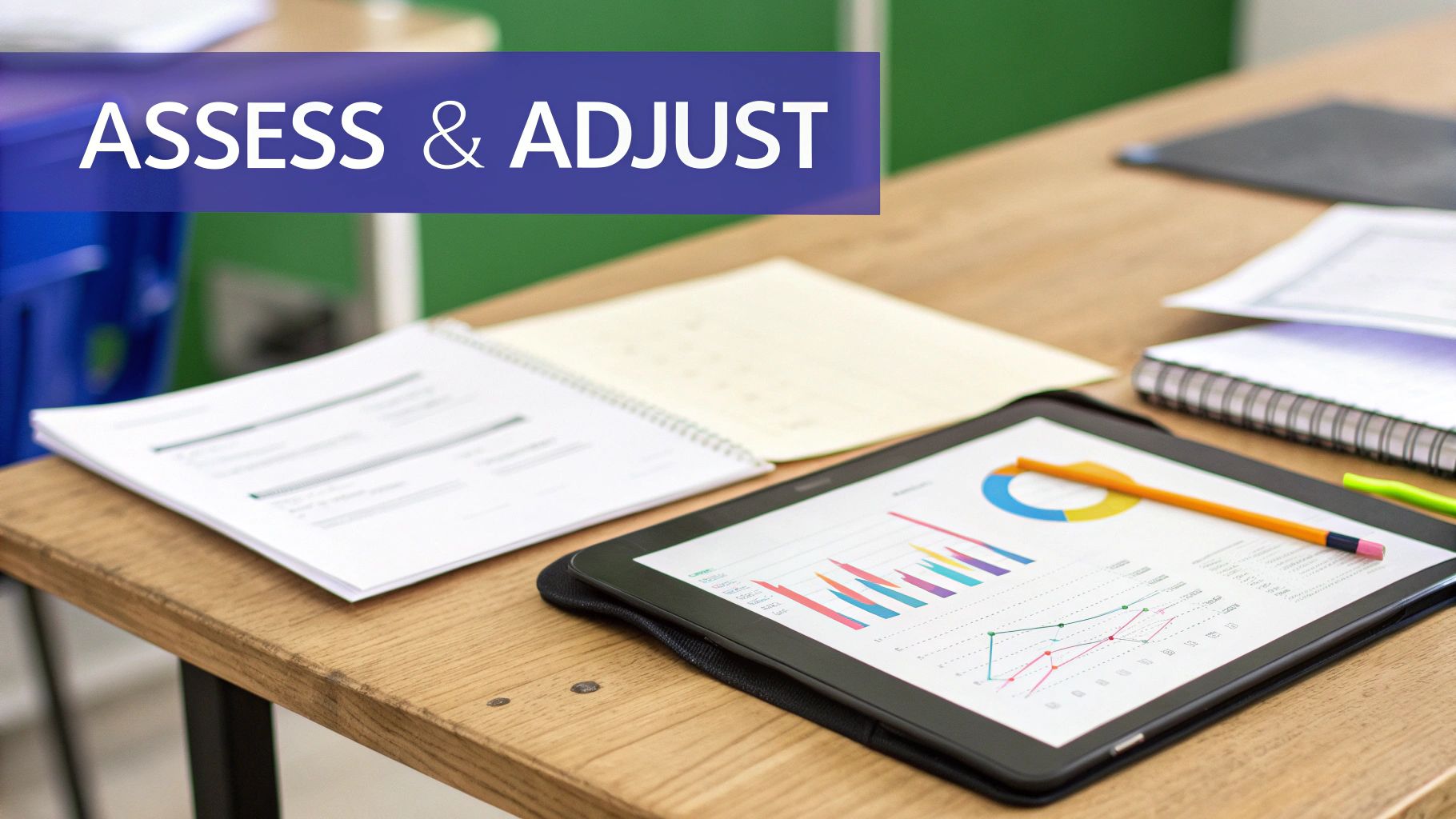
5. How do you assess student learning and use assessment data to inform instruction?
This is one of the most critical questions for a hiring committee because it gets to the heart of effective teaching. Interviewers want to know if you can go beyond simply grading papers. They’re looking for a teacher who uses a balanced assessment system to truly understand student needs and then uses that data to drive every instructional decision.
Why This Question Matters
Your response reveals your understanding of the cyclical nature of teaching and learning. It shows whether you see assessment as a final judgment or as an ongoing diagnostic tool. A strong answer shows you are a reflective practitioner who can pinpoint misconceptions, differentiate instruction effectively, and measure growth over time.
How to Structure Your Answer
A powerful response will detail your approach to both formative and summative assessment and clearly explain how data from each informs your next steps.
- Explain Your Assessment Philosophy: Start by describing your balanced approach. "I believe in using a mix of formative and summative assessments to get a complete picture of student learning. Formative checks, like exit tickets and observations, give me daily feedback to guide my immediate instruction, while summative assessments, like unit projects or exams, measure mastery of standards."
- Detail Your Data-Driven Process: Explain how you turn raw data into actionable insights. "I analyze assessment data weekly to identify trends. For instance, after a math quiz, I'll sort student performance by standard to see which concepts need reteaching. This allows me to form small groups for targeted support the next day."
- Incorporate Modern Tools: Show how technology makes your assessment process more efficient and impactful. "To manage this data cycle effectively, I use tools that allow me to build assessments with custom rubrics and then tag them to specific standards. This makes it easy to visualize student progress and generate reports, saving valuable time I can reinvest into planning responsive lessons." This shows you are adept at using technology to support student achievement.
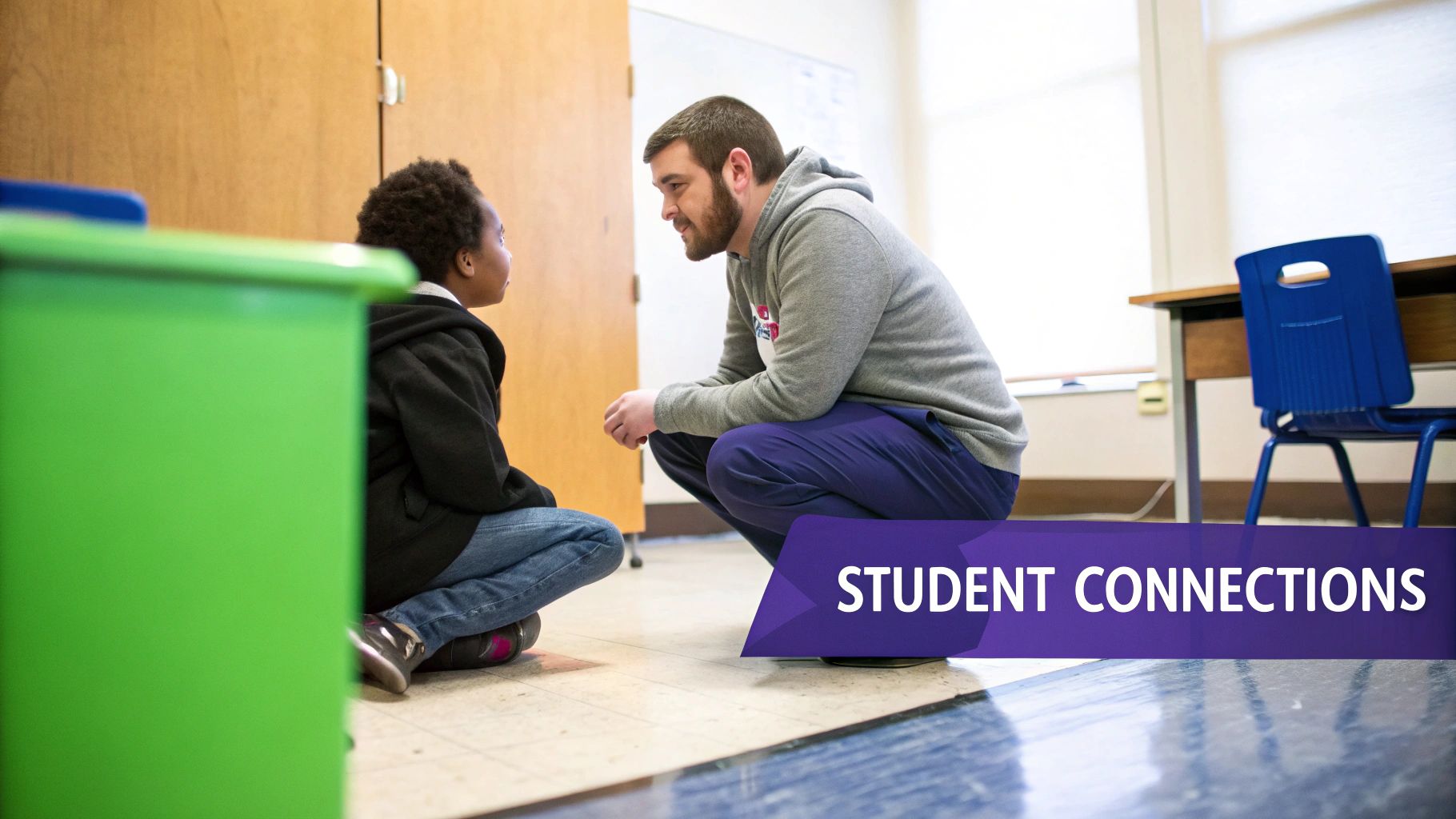
6. How do you build positive relationships with students and foster an inclusive classroom culture?
This question probes your understanding that learning is deeply relational. Interviewers want to see your social-emotional intelligence and your commitment to equity. They’re looking for specific, actionable strategies that show you can create a safe, welcoming, and culturally responsive environment where every student feels seen, valued, and ready to learn.
Why This Question Matters
Your response reveals your philosophy on classroom management and your ability to connect with a diverse student population. A strong answer shows that you see students as whole individuals and that your approach to building community is proactive, not just reactive. It's a direct indicator of your ability to support student well-being, which is a prerequisite for academic success.
How to Structure Your Answer
Ground your answer in concrete routines and a clear philosophy of inclusivity. Show them you have a multi-faceted approach to building a positive classroom community.
- Start with Proactive Strategies: Begin by describing the daily and weekly routines you use to build connections. "My approach is built on consistent, positive interactions. I start by greeting each student by name at the door every morning to check in. I also incorporate weekly 'community circles' where students can share successes and challenges, which helps build a foundation of trust and empathy."
- Emphasize Inclusivity and Representation: Explain how you ensure your classroom and curriculum reflect your students. "I make it a priority to learn about my students' interests, cultural backgrounds, and strengths through 'get to know you' surveys and family communication. I then intentionally integrate their experiences and diverse perspectives into my lessons, ensuring the materials we use are representative of all students."
- Connect to Collaborative Norms: Describe how you give students ownership over the classroom culture. "At the start of the year, we co-create a set of classroom agreements together. This process gives students a voice and a shared responsibility for maintaining a respectful and supportive environment. When conflicts arise, we refer back to our agreements to guide our restorative conversations."
7. What strategies do you use to engage parents and families as partners in their child's education?
This question probes your understanding of the critical home-school connection. Administrators know that students thrive when their families are treated as essential partners. Interviewers are looking for a proactive, consistent, and culturally responsive approach to building these vital relationships, not just a plan for when problems arise.
Why This Question Matters
Your response reveals your philosophy on family engagement and your ability to foster a supportive community around your students. It shows whether you see parents as allies with unique insights into their children. A strong answer shows you have a concrete plan for communication that builds trust, invites collaboration, and ultimately enhances student achievement.
How to Structure Your Answer
A powerful response will showcase a multi-faceted strategy that is both proactive and inclusive.
- Start with a Proactive Foundation: Emphasize consistent, positive communication. Explain that your goal is to build relationships before challenges occur. "My approach to family engagement is built on proactive, positive communication. I start the year by sending home a survey to understand each family's preferred communication method and language, and I make a point to send a positive note or email about every student within the first month of school."
- Provide Diverse Communication Examples: Show that you use a variety of methods to reach all families. "I maintain a weekly class newsletter that highlights our learning goals and suggests ways families can support at home. I also use a communication app for quick updates and utilize a translation tool to ensure all messages are accessible in each family's home language." This demonstrates your commitment to equity.
- Showcase Collaborative Partnership: Conclude by explaining how you involve families as true partners. "Beyond updates, I actively seek family partnership. During parent-teacher conferences, I structure the conversation around collaborative goal-setting. I also organize a 'Family Learning Night' where students can showcase their projects, and families can participate in activities that connect to our curriculum."
8. How do you stay current with educational research, pedagogy, and your subject matter?
This question gauges your commitment to professional growth and lifelong learning. Schools are looking for educators who are proactive, not complacent, and who actively seek out new knowledge to improve their craft. Your answer should show that you are an engaged professional who keeps pace with the evolving landscape of education.
Why This Question Matters
Education is not a static field. Your response reveals whether you view teaching as a dynamic profession that requires continuous improvement. A strong answer shows that you are intentional about your professional learning and can connect new ideas directly to improving student outcomes. It highlights your dedication to being the most effective teacher you can be.
How to Structure Your Answer
Provide specific examples of your learning habits and explain how you translate that learning into classroom practice.
- Mention Specific Resources: Start by naming the types of resources you engage with. Instead of a general statement, be specific. "I am committed to staying current and make it a point to engage with a mix of resources. I follow thought leaders like Zaretta Hammond on culturally responsive teaching, listen to podcasts like the 'Cult of Pedagogy' for practical strategies, and subscribe to journals relevant to my content area."
- Connect Learning to Action: Show the interviewer how this learning impacts your teaching. For example, "After reading research on the power of retrieval practice, I redesigned my warm-up activities to incorporate low-stakes quizzing. This small change has significantly improved student retention of key concepts, which I track through formative assessments."
- Highlight Collaboration and Innovation: Discuss how you learn from and with your colleagues. "I'm also always exploring how technology can enhance my practice. For instance, experimenting with AI tools for lesson planning has allowed me to focus more of my energy on differentiating instruction and providing individual student feedback. Using a tool like Kuraplan helps me stay current with new instructional strategies and apply them efficiently."
9. Describe your classroom management philosophy and strategies for maintaining a positive, productive learning environment.
This question is arguably one of the most critical in any teacher interview. Interviewers are looking beyond your ability to simply discipline students; they want to understand your proactive approach to creating a classroom culture where learning can thrive. Your answer should demonstrate a philosophy that is student-centered, preventative, and built on relationships rather than rules alone.
This is your chance to show you can build a community, not just control a room. A well-articulated philosophy proves you have the foresight to establish routines and expectations that minimize disruptions and maximize instructional time.
Why This Question Matters
Your response reveals your understanding of student behavior and your ability to foster a safe, respectful, and productive environment. It shows whether you see classroom management as a system of rewards and punishments or as an opportunity to teach essential life skills like self-regulation and collaboration. A strong answer connects your management style directly to student engagement and academic success.
How to Structure Your Answer
A powerful response combines a clear philosophy with concrete, actionable strategies.
- Start with Your Core Philosophy: Begin by stating your overarching belief. "My classroom management philosophy is built on the belief that a positive learning environment is created through strong relationships, clear expectations, and mutual respect. I focus on proactive strategies that prevent issues before they start, rather than reacting to them after."
- Provide Specific, Proactive Strategies: Describe the systems you put in place from day one. "On the first day, we work together to establish our classroom 'norms' or 'agreements.' This gives students ownership over our environment and turns expectations into a shared commitment. We also practice routines for everything from turning in homework to transitioning between activities."
- Explain Your Approach to Misbehavior: Discuss how you handle issues when they arise, focusing on teaching and restoration over punishment. "When a student makes a poor choice, I see it as a teaching moment. I prefer to have a quiet, restorative conversation to understand what happened and help the student identify a better way to handle the situation in the future."
- Connect to a Comprehensive Plan: Tie your strategies together by mentioning how you organize them into a cohesive system. You can see how these elements combine by reviewing a sample classroom management plan.
10. How would you handle a situation where a student is struggling academically or behaviorally?
This critical question evaluates your problem-solving skills, empathy, and your process for student support. Interviewers want to see a proactive, systematic approach rather than a purely reactive one. They are looking for evidence that you use data, collaborate with others, and are committed to ensuring every student succeeds.
Why This Question Matters
Your response reveals your ability to identify and address individual student needs, a core competency for any effective teacher. It demonstrates your understanding of differentiation, intervention strategies, and the importance of a strong home-school connection. A well-articulated answer shows you are a reflective practitioner who views challenges as opportunities for growth.
How to Structure Your Answer
A strong response outlines a multi-step process that is both compassionate and data-driven.
- Start with Identification and Data: Explain that your first step is to pinpoint the specific nature of the struggle. "When I notice a student is struggling, my first step is to gather data. I use formative assessments, classroom observations, and review past work to understand if the issue is a specific skill gap, a conceptual misunderstanding, or a behavioral pattern."
- Describe Classroom-Based Interventions: Detail the initial strategies you would implement within your own classroom. "Once I have a clearer picture, I implement Tier 1 interventions. This could involve small-group instruction, providing alternative assignments, or using a tool like Kuraplan to generate differentiated materials that target the student's specific needs and learning style." This highlights your resourcefulness.
- Emphasize Collaboration: Conclude by explaining how you involve a wider support network. "I believe in a team approach. I would communicate my concerns and my implemented strategies with the student’s family to create a consistent support plan. If the student continues to struggle, I would collaborate with school specialists, such as the special education teacher or school counselor, to explore further support options and monitor progress together."
10 Teacher Interview Q&A Comparison
| Question | Implementation complexity 🔄 | Resource requirements ⚡ | Expected outcomes ⭐📊 | Ideal use cases & tips 💡 |
|---|---|---|---|---|
| Tell me about your approach to lesson planning and classroom organization. | Medium — systematic setup with occasional tech integration | Planning frameworks, LMS/Kuraplan, prep time | ⭐ Consistent, standards-aligned instruction; 📊 measurable prep time savings | Use for unit planning or heavy standards work — balance tech with pedagogy. |
| How do you differentiate instruction for students with varying ability levels? | High — ongoing tailoring and grouping | Diagnostic data, tiered materials, Kuraplan auto-differentiation, aides | ⭐ Greater equity and access; 📊 improved growth across levels | Ideal for mixed-ability or inclusive classrooms — reference UDL and formative checks. |
| Describe your experience with standards-aligned curriculum and how you ensure standards are met. | Medium — mapping required but automatable | Standards docs, scope/sequence, curriculum-mapping tools (Kuraplan) | ⭐ Clear accountability and alignment; 📊 consistent standards coverage | Best for district reporting and auditability — explain standard→objective→assessment process. |
| Tell me about a time you had to adapt your lesson plan based on student performance or feedback. | Low–Medium — rapid, situational adjustments | Exit tickets/observations, quick resources (Kuraplan), flexible time | ⭐ Faster remediation and responsiveness; 📊 immediate improvement on weak skills | Use when formative data shows gaps — answer with STAR and concrete student impact. |
| How do you assess student learning and use assessment data to inform instruction? | Medium–High — regular cycles and analysis | Formative/summative tools, rubrics, data trackers (Kuraplan), analysis time | ⭐ Data-driven instruction and targeted interventions; 📊 measurable growth tracking | Ideal for continuous improvement cycles — involve students in data discussions. |
| How do you build positive relationships with students and foster an inclusive classroom culture? | Medium — consistent relational work and reflection | Time for check-ins, culturally responsive materials, routines | ⭐ Stronger trust and engagement; 📊 better behavior and participation | Use in diverse or high-need settings — teach routines, celebrate student identities. |
| What strategies do you use to engage parents and families as partners in their child's education? | Medium — sustained communication and outreach | Communication platforms, translated materials, family events | ⭐ Stronger home–school partnership; 📊 increased family support and student outcomes | Best when seeking family buy-in — be proactive, consistent, and culturally responsive. |
| How do you stay current with educational research, pedagogy, and your subject matter? | Low–Medium — ongoing but self-directed | PD, PLCs, journals, podcasts, conference time | ⭐ Improved instructional practice; 📊 updated strategies that benefit students | Ideal for professional growth — name resources and show applied examples. |
| Describe your classroom management philosophy and strategies for maintaining a positive, productive learning environment. | Medium — upfront investment to establish routines | Training in restorative/positive practices, time to teach expectations | ⭐ Safer, more productive classroom; 📊 fewer disruptions and more learning time | Use prevention-focused, relationship-based approaches — teach and reinforce routines. |
| How would you handle a situation where a student is struggling academically or behaviorally? | High — multi-tiered interventions and collaboration | RTI/MTSS framework, specialists, progress monitoring tools, differentiated materials | ⭐ Targeted support and improved student outcomes; 📊 tracked intervention effectiveness | Ideal for sustained intervention cases — identify, intervene, monitor, involve families/specialists. |
Your Next Steps to an Accepted Offer
Walking out of an interview feeling confident is the goal, and the prep you’ve just done is your biggest asset. You’ve explored the most common teacher interview questions and answers, deconstructed the STAR method, and considered how to tailor your responses. Now, it’s time to synthesize this into a powerful, authentic performance that showcases the exceptional educator you are.
The goal isn’t just to answer questions correctly; it's to connect your skills, experiences, and passion directly to the needs of the school. The best interviews evolve into genuine conversations between potential colleagues, where your enthusiasm for teaching shines through.
From Preparation to Performance: Key Takeaways
As you move from practice to the real thing, keep these core principles in mind. They are the bridge between knowing the answers and delivering them with impact.
Storytelling Over Scripting: You've crafted powerful examples for questions about classroom management and differentiation. Don't memorize them word-for-word. Instead, internalize the key details of your stories so you can recount them naturally. An interviewer will remember a compelling story about how you helped a struggling student long after they've forgotten a perfectly rehearsed but robotic answer.
Specificity is Your Superpower: Vague responses are forgettable. Instead of saying you "use data to inform instruction," describe the specific pre-assessment you used for a geometry unit, how the data revealed a misconception about angles, and the exact small-group activity you designed to reteach it. This level of detail demonstrates expertise.
The "Why" Behind the "What": Don't just explain what you do; explain why you do it. Your classroom management philosophy isn't just a set of rules. It’s a system built on a belief in restorative practices and fostering student autonomy. Linking your methods back to your core educational philosophy gives your answers depth and reveals you as a thoughtful, reflective practitioner.
Your Final Pre-Interview Checklist
Confidence comes from being thoroughly prepared. In the days leading up to your interview, run through this final action plan to ensure you walk in ready to excel.
Conduct Deep School Research: Go beyond the school’s homepage. Read recent newsletters, check their social media, and understand their specific mission and recent initiatives. Are they a PBIS school? Have they recently adopted a new ELA curriculum? Knowing this allows you to align your answers directly with their priorities. You can say, "I saw on your website that you've implemented a new STEM lab, which excites me because in my previous role, I developed a project-based learning unit on..."
Prepare Your Own Questions: A thoughtful question demonstrates your genuine interest. Avoid asking about salary or vacation days. Instead, ask questions that show you're thinking like a future colleague.
Example Questions to Ask Them:
- "What does professional collaboration look like among teachers at this grade level?"
- "How does the school support new teachers during their first year?"
- "What are the biggest challenges students at this school are currently facing, and how is the faculty working to address them?"
Leverage Your Portfolio and Modern Tools: When answering, don't be afraid to reference your work. Mentioning, "That approach is detailed in a unit plan I included in my portfolio," makes your claims tangible. Similarly, referencing modern tools shows you're a forward-thinking educator. You can seamlessly integrate this by saying, "For differentiation, I rely on a mix of formative data and efficient planning tools. I use AI platforms like Kuraplan to help me generate leveled reading passages and activities aligned to standards, which saves time and ensures every student's needs are met." This shows you are resourceful, tech-savvy, and focused on student outcomes.
Ultimately, this interview is your opportunity to show an administration who you are as an educator. You have the knowledge, the experience, and the passion. You have practiced the most critical teacher interview questions and answers. Now, go in there and let them see the amazing teacher you are. You've got this.
Ready to walk into your next interview with a cutting-edge advantage? Kuraplan helps you craft differentiated, standards-aligned lesson plans in minutes, giving you concrete examples of tech-integrated, efficient teaching to share. Visit Kuraplan to see how you can spend less time on paperwork and more time preparing to shine.