Here's the simple truth about what is problem based learning: it flips the traditional classroom on its head. Instead of us, the teachers, presenting facts for students to memorize, they start with a compelling, real-world problem. From there, they have to figure out what they need to learn to actually solve it.
The Big Shift from Lecturing to Problem Solving
Think of a traditional lesson like giving students a fully assembled LEGO set with step-by-step instructions. They follow the guide, and everyone ends up with the exact same model. It’s neat, predictable, and controlled.
Problem Based Learning (PBL) is the complete opposite. It’s like dumping a big, messy box of assorted LEGOs on the table and asking students to build a vehicle that can carry a small object across the room. There’s no single right answer or instruction manual to follow.
Suddenly, students aren't just following directions—they're designing, testing, collaborating, and researching what makes a structure strong or how a wheel turns. They are driving their own learning out of a genuine need to solve the challenge right in front of them.
From Sage on the Stage to Guide on the Side
This is the heart of PBL: the shift from being a passive instruction-follower to an active problem-solver. And for that to happen, our role as educators has to change, too. We move from being the primary source of information—the "sage on the stage"—to a facilitator of discovery, or the "guide on the side."
Our job becomes less about giving answers and more about helping students learn how to find them. We pose the right questions, point them toward resources, and help manage the collaborative chaos. This approach is one of many powerful active learning strategies for students that can dramatically deepen engagement and understanding.
This isn't just a niche idea; it's a model gaining serious traction worldwide. Research on PBL shows a staggering 9.42% annual growth in publications over the last decade. Countries like the USA, China, and Canada are leading the charge, contributing nearly 50% of the global research output.
The table below breaks down just how different the classroom looks and feels when you make this change.
From Traditional Teaching to Problem Based Learning
| Element | Traditional Classroom | Problem Based Learning (P-B-L) Classroom |
|---|---|---|
| Starting Point | Teacher presents content (e.g., lecture, reading). | Students are presented with an open-ended problem. |
| Student Role | Passive receiver of information; follows directions. | Active problem-solver; investigator and collaborator. |
| Teacher Role | Expert and information dispenser. | Facilitator, coach, and resource guide. |
| Learning Driver | Memorizing facts for an upcoming test. | The need to find a solution to the problem. |
| Pace of Learning | Teacher-paced; whole class moves together. | Student-paced; small groups work independently. |
| End Product | Standardized answers (e.g., correct test answers). | Diverse, unique solutions and presentations. |
As you can see, everything from the student's role to the very motivation for learning is fundamentally different.
Why This Mindset Matters
Adopting PBL is about more than just a new teaching technique. It’s about preparing students for a world that demands far more than rote memorization. They need to be able to tackle messy, unstructured problems where the "right answer" isn't waiting at the back of a textbook.
Problem Based Learning cultivates the mindset of a lifelong learner. It teaches students that knowledge isn't something to be passively received, but a tool to be actively sought and applied to solve meaningful challenges.
When we start with the problem, we give immediate context and purpose to the curriculum. Students aren't just learning about fractions; they're figuring out how to divide resources for a community garden project. This relevance is what transforms passive listeners into engaged, resilient thinkers ready for whatever comes their way.
The Core Components That Make PBL Work
So, what’s the secret sauce that makes problem-based learning so effective? It’s definitely not about just tossing a tricky question at your students and hoping for the best.
Real PBL is a carefully structured dance built on a few essential components. When they work together, they create a seriously powerful learning experience.
Understanding these elements is the key. It's how you move from just doing a fun activity to designing a genuine PBL unit that drives deep, lasting understanding. Let's break down the non-negotiables.
The Problem Is the Starting Line
The engine of any PBL unit is the problem itself. But not just any problem will do.
It needs to be authentic, messy, and what we educators call "ill-structured." This just means there isn't one clear path to a single right answer. An ill-structured problem mirrors real life—think of a city planner trying to reduce traffic or a doctor diagnosing a mysterious illness. The information is incomplete, there are multiple valid approaches, and the "best" solution is often up for debate.
This complexity is what forces students to think critically, not just remember facts. For example, asking students to calculate the area of a rectangle is a standard, structured problem. Asking them to design a community garden with a limited budget and specific vegetable requirements? That’s an ill-structured problem that ignites PBL.
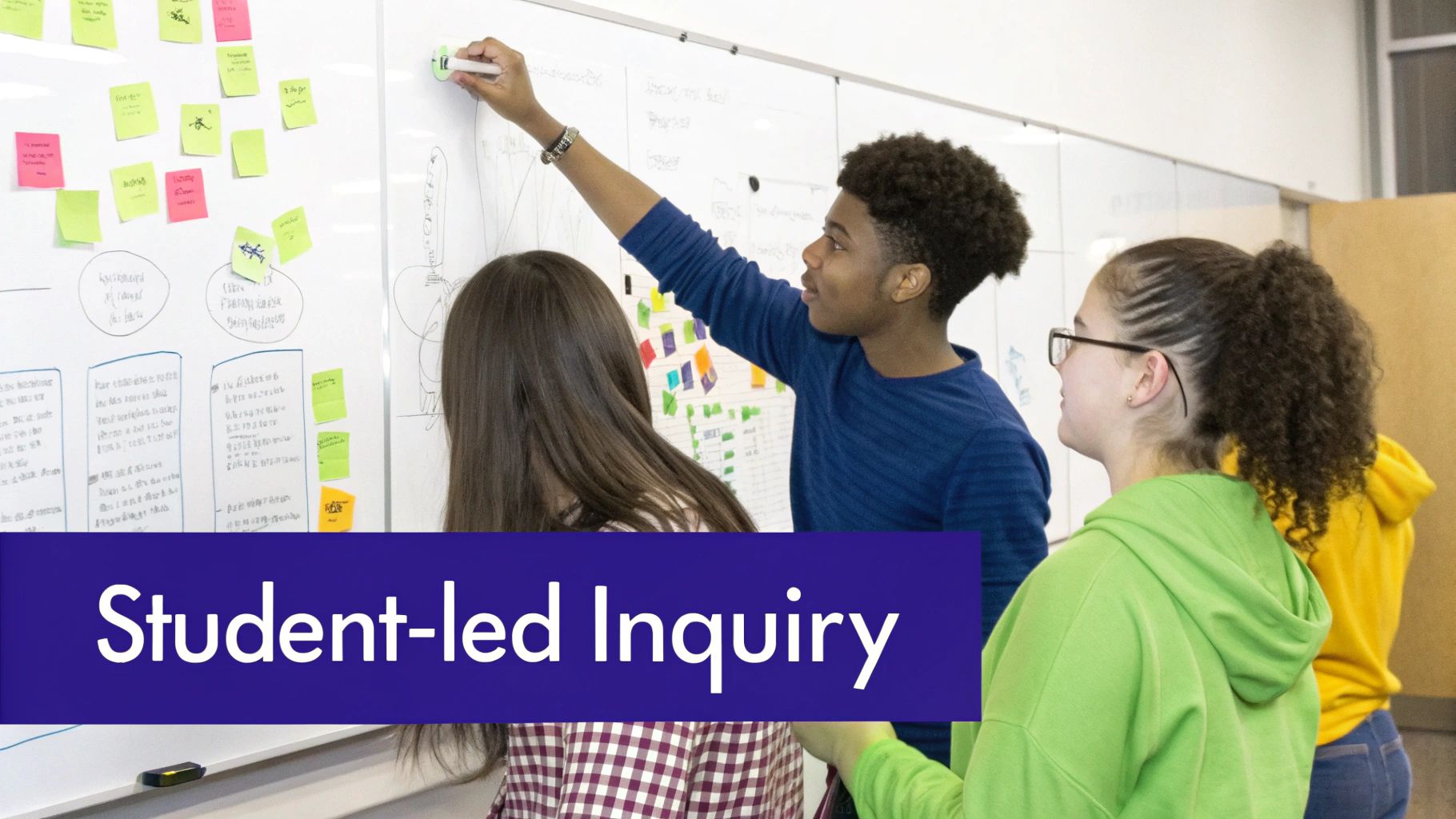
Student-Led Inquiry
Once the problem is on the table, the students take the lead. This is where the magic really happens.
They have to work together to figure out two crucial things:
- What do we already know? Students pool their existing knowledge, identifying facts, concepts, and initial ideas related to the problem.
- What do we need to know? This is the most important question. Students generate their own "learning issues"—the gaps in their understanding that they must fill to move forward.
These learning issues become their roadmap. They drive the research, discussions, and activities that follow. Our role here is to facilitate, not to provide a list of topics to study. Instead of telling them to read chapter five, we might ask, "What kind of information would help you decide which plants are best for our local climate?"
The Teacher as a Facilitator
In a PBL classroom, we step back from the spotlight. As mentioned earlier, you become the "guide on the side," a thinking coach who supports the learning process without short-circuiting it.
This can feel strange at first, especially if you're used to direct instruction. Your job isn't to give answers but to ask probing questions, challenge assumptions, and point students toward resources.
"When I stepped back and let students construct meaning from the task and review the strategies of others, our conversations completely changed. Students were defending their thinking and questioning the thinking of others."
This shift empowers students to take ownership. They learn to rely on their own reasoning and their peers' insights. This environment fosters a culture where it's safe to make mistakes and learn from them—which is far more powerful than a teacher simply correcting their work.
Collaborative Learning
Problem-based learning is almost always a team sport. Students work in small, collaborative groups to analyze the problem, conduct research, and develop solutions.
This structure is intentional and critical for a few reasons. Collaboration teaches students essential soft skills like communication, negotiation, and conflict resolution. It also exposes them to diverse perspectives, pushing them to justify their ideas and consider alternative viewpoints. PBL thrives on engaging students with complex challenges, similar to applying creative problem solving techniques in professional settings.
Getting this group dynamic right takes practice, but the payoff is huge. A well-functioning PBL group becomes a microcosm of a real-world project team, where every member's contribution is valued and necessary for success.
Why PBL Is More Than Just a Fun Activity
It’s easy to peek into a buzzing, student-led classroom and think, "This looks like fun," but then wonder if it’s truly rigorous. Does this method actually move the needle on student achievement? The evidence—and the experiences of countless teachers—points to a firm and resounding 'yes.'
Problem-based learning isn't just about making school more enjoyable; it’s about making learning stick. By anchoring abstract concepts in real-world scenarios, we give students a powerful reason to learn. Suddenly, the 'why' behind the curriculum becomes crystal clear.
This approach flips learning from a passive act of memorizing facts into an active process of discovery. Students aren't just consuming information—they're building a mental toolkit they can use to tackle unfamiliar challenges with confidence.
Cultivating the Skills That Actually Matter
When we talk about preparing students for the future, we mean more than just content knowledge. The modern world demands adaptability, critical thinking, and collaboration—skills that don't come from lectures or worksheets.
PBL is a natural incubator for these essential competencies. Every single unit requires students to:
- Think Critically and Solve Problems: They have to analyze complex information, pinpoint core issues, and develop logical, evidence-based solutions.
- Communicate and Collaborate: Working in teams is the name of the game. Students learn to share their ideas, listen to different perspectives, and work toward a common goal.
- Develop Resilience and Self-Direction: When there's no single right answer, students inevitably hit roadblocks. They learn to persevere, adapt their strategies, and take real ownership of their learning.
These aren't just happy accidents; they are direct results of the PBL process. This cycle of inquiry, failure, and discovery gives students a sandbox to practice the very skills employers consistently say they need most.
The Proof Is in the Performance
The benefits of PBL aren't just anecdotal. A growing body of research shows measurable gains in academic performance across subjects and grade levels. When students are deeply engaged in solving a problem, the content mastery follows.
For instance, a meta-analysis of 27 different studies found that PBL delivers significant boosts in academic performance and critical thinking. In some of this research, groups of students in PBL classrooms outperformed those in traditional lecture-based settings on reading proficiency assessments. You can read the full research to see how PBL impacts student outcomes for yourself.
Problem-based learning connects what students are learning to why it matters. This relevance is the key that unlocks deeper understanding, better retention, and a genuine enthusiasm for learning.
It just makes sense. When a math concept is needed to design a budget for a school event, it's no longer just a set of abstract rules. It’s a tool with a purpose.
From Planning to Practice
Designing these rich, problem-based experiences from scratch can feel like a heavy lift, especially when you're juggling curriculum standards, differentiation, and a million other classroom demands. This is where modern tools can become a game-changing partner.
An AI lesson planner like Kuraplan, for example, can help you brainstorm compelling, standards-aligned problems in minutes. It can generate guiding questions, suggest resources, and even create differentiated materials, freeing you up to focus on facilitating student discovery. Instead of spending hours on the initial architecture, you can invest that time in coaching your student teams and guiding their inquiry.
Ultimately, the 'why' behind problem-based learning is simple: it works. It builds confident, capable learners who are not just prepared for their next test, but for the complex challenges that await them outside the classroom walls.
A Practical Framework for Your First PBL Unit
Alright, you're sold on the 'why'—now for the 'how.' Bringing problem-based learning into your classroom for the first time can feel like a huge task, but it doesn't have to be. Breaking it down into a clear, step-by-step framework makes the whole thing feel manageable and, dare I say, fun.
Think of this as your playbook. It’s a sequence that helps you design a meaningful unit from the ground up, making sure you hit your curriculum standards while creating an authentic learning experience for your students. We’ll walk through the key phases, from finding the perfect problem to wrapping it all up with a powerful reflection.
Step 1: Start With The End In Mind
Before you dream up a splashy, exciting problem, ground yourself in your curriculum. What are the non-negotiable standards or learning objectives you need to cover? This is your anchor.
A common mistake is finding a cool project idea and then trying to cram the standards in afterward. It rarely works well. Instead, work backward. Pinpoint the core concepts and skills you need to teach, and then brainstorm a real-world scenario where students would naturally need to learn and apply them. This ensures your PBL unit is rigorous, not just a fluffy activity.
Step 2: Craft A Compelling Problem
This is the heart and soul of your entire unit. The problem you present needs to feel authentic, be genuinely engaging, and be "ill-structured"—meaning it lacks a single, obvious solution. Your goal is to spark curiosity.
A great problem usually has a few key ingredients:
- A Relatable Context: Connect it to students' lives, their community, or a real-world issue they care about. Instead of a worksheet on ecosystems, challenge them to design a plan to improve a local park's biodiversity.
- An Authentic Role: Ask students to take on a specific role, like city planners, museum curators, or marketing consultants. This helps them get invested in the scenario.
- A Clear End Product: What will they actually create? A proposal, a model, a presentation, a campaign? Having a tangible goal keeps everyone focused.
Crafting the perfect problem scenario can be time-consuming. This is where AI tools can be a fantastic co-pilot. An assistant like Kuraplan can generate standards-aligned problems, guiding questions, and even differentiation ideas in seconds, freeing you up to focus on the bigger picture.
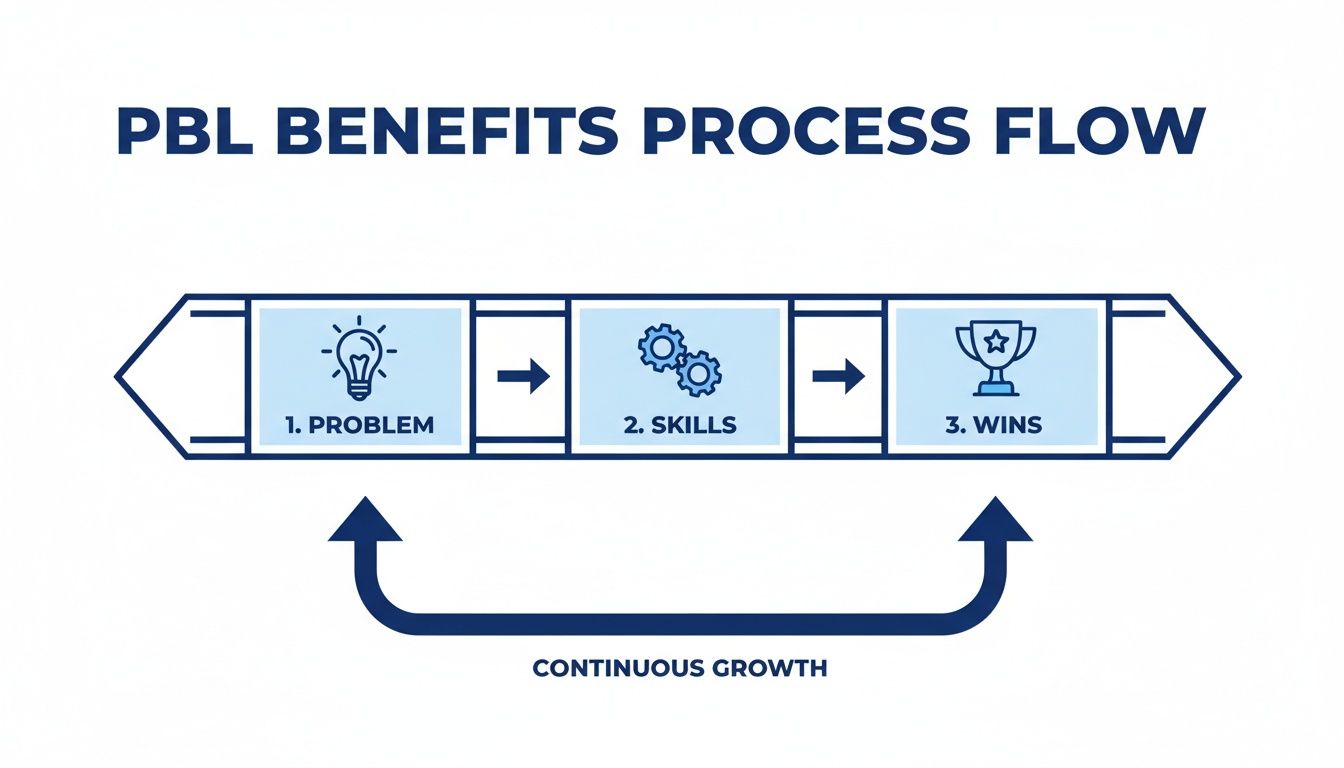
As you can see, the initial problem is the catalyst for the entire learning journey, directly leading to new skills and successful outcomes.
Step 3: Launch The Inquiry Process
Once you present the problem, the floor belongs to the students. Your role now shifts from instructor to facilitator. This launch is critical for setting the stage.
Guide them through a brainstorming session with two key questions:
- What do we already know? This activates prior knowledge and gets the initial ideas flowing.
- What do we need to know? This is where the magic happens. Students generate their own questions, which become the roadmap for their research and investigation.
These student-generated questions are the fuel for the entire unit. As they find answers, they will inevitably come up with new, more complex questions. It's a messy but beautiful process. If your students need support here, you can find helpful resources for crafting research questions to guide their inquiry.
Step 4: Facilitate And Debrief
As students work, you'll be circulating, observing, and asking probing questions. Resist the urge to give answers directly. Instead, redirect questions back to the group: "That's an interesting thought, what does your team think?" or "Where could you look to find that information?"
Finally, every PBL unit must end with a solid debrief. This is where the learning is cemented. Students present their solutions and, just as importantly, reflect on their process.
The debrief isn't just about the final answer. It's a structured conversation about the journey: What worked? What challenges did you face? What would you do differently next time?
This metacognitive step is what turns a project into a deep learning experience. It helps students connect the content they learned to the skills they developed, making them more aware and capable problem-solvers in the future.
PBL in Action Across Different Grade Levels
Theory is one thing, but seeing what problem-based learning actually looks like in a classroom is where it all clicks. The best part about this approach is its incredible flexibility—it’s not just for high school physics or gifted programs. It can bring learning to life in any subject, at any grade level.
The core idea is always the same, whether you're teaching kindergarteners or seniors. You start with a messy, real-world problem and let students take the wheel.
Let's look at a few examples to see how this plays out.
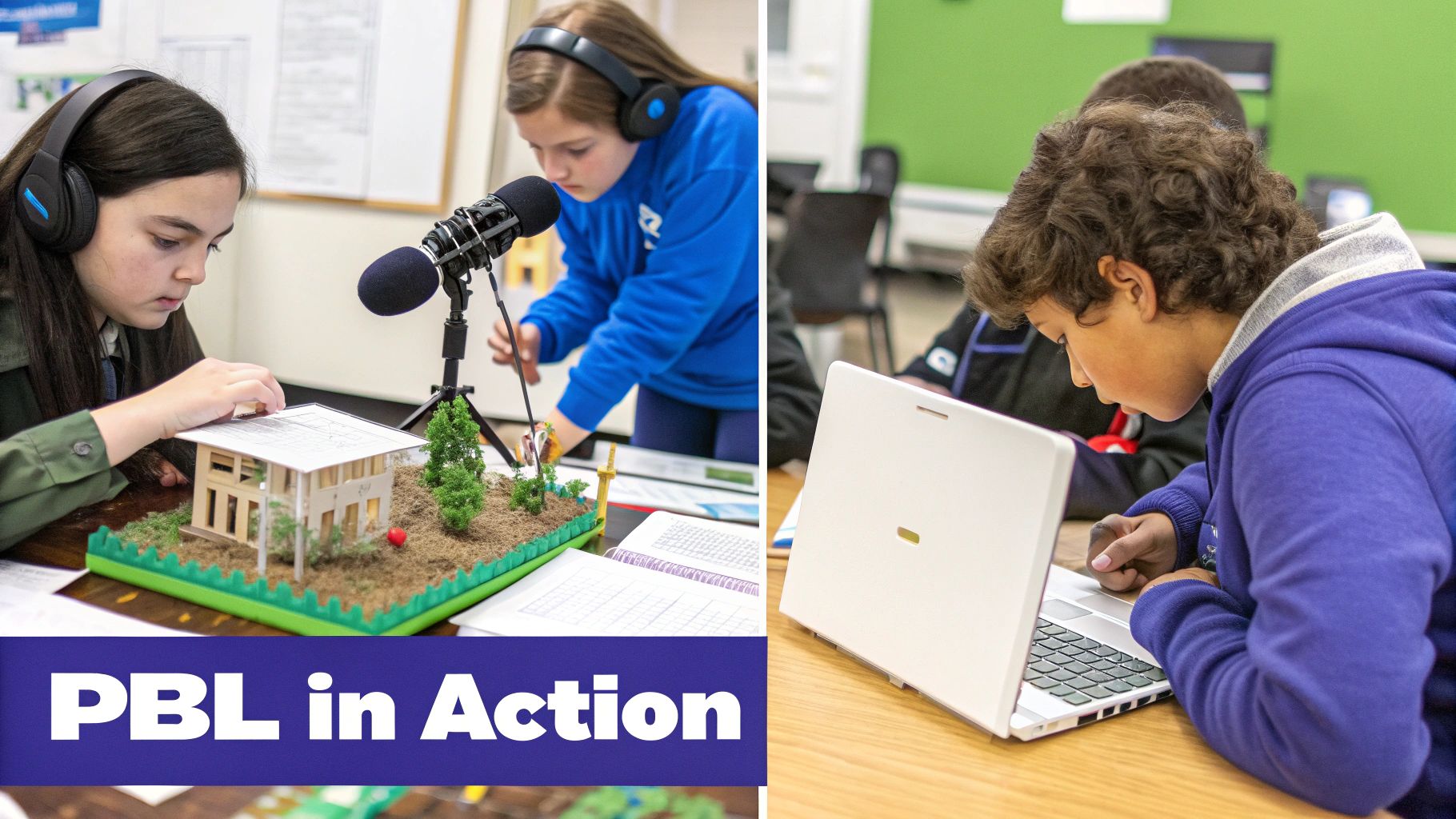
Each of these examples shows how PBL connects tough academic standards with work that students actually find meaningful.
Elementary School: A 4th Grade Science Unit
Students aren't just reading about pollution in a textbook here. They're challenged with a problem that hits close to home, turning them into community scientists on a mission.
- Driving Question: Our school produces a lot of plastic waste. How can we, as environmental engineers, design a practical solution to reduce our school's plastic footprint and convince the principal to adopt our plan?
- Core Learning Objectives: This one problem weaves together science standards on ecosystems and human impact, persuasive writing skills from ELA, and math concepts for data collection and graphing.
- Key Student Activities: Students kick things off with a "waste audit," collecting and graphing the plastic trash found around the school. They research the effects of plastic, explore solutions like recycling programs, and work in teams to design a specific, actionable plan. The unit ends with a presentation to the principal, where they use their data to make a compelling case.
Middle School: A 7th Grade Social Studies Project
Middle schoolers are often passionate about fairness and telling stories. This project taps into that energy by asking them to become historians and journalists for their own community.
- Driving Question: Our town has a rich history, but many important stories from underrepresented groups are not well-known. As podcasters, how can we create a compelling podcast series that uncovers and shares a local historical event with a new generation?
- Core Learning Objectives: Students dive deep into primary source analysis, historical research methods, narrative writing, and digital media production.
- Key Student Activities: Teams pick a local event or figure to investigate. They interview community elders, visit local archives, and analyze historical documents. They then write scripts, record audio, and edit their findings into a professional-sounding podcast episode, which gets shared on a class website for the whole community to hear. This makes history a living, breathing thing.
High School: An 11th Grade Algebra Project
That constant question in math class—"When will I ever use this?"—gets a powerful answer with a PBL unit like this one.
The use of PBL in math has exploded recently, especially as curricula shift toward more student-centered learning. A major review of 40 empirical studies found that half came from Indonesia, where national reforms pushed for methods like PBL to boost math achievement. You can discover more about how PBL is transforming math education worldwide.
- Driving Question: A local entrepreneur wants to open a new small business (like a food truck) but needs a solid financial plan. As financial consultants, how can we develop a business plan that uses algebraic models to project costs, revenue, and profitability to see if the venture is viable?
- Core Learning Objectives: This project requires students to apply their knowledge of linear equations, systems of equations, and data modeling to a real-world business scenario.
- Key Student Activities: Students research startup costs, price points, and market demand for their business idea. They create equations to model costs, project revenue, and calculate the break-even point. Their final product is a formal business plan with graphs and financial projections, presented to a panel of local business owners for feedback.
Across all these examples, you can see how the learning is interdisciplinary, collaborative, and tied to a purpose beyond the classroom walls. To make sure PBL works for everyone, especially those with unique learning needs, applying ADHD classroom accommodations can make a huge difference in student success.
How to Assess Learning in a PBL Classroom
One of the first questions teachers ask about problem-based learning is, "How in the world do I grade this?" It’s a great question. When learning gets messy, collaborative, and student-driven, a simple multiple-choice test just won't cut it. Your assessment has to match the experience.
This is where authentic assessment comes in. Instead of just asking students what they can recall, we evaluate how they apply their knowledge and skills to a real-world problem. In PBL, the final product is only part of the story; we're assessing the entire problem-solving journey.
Building Rubrics That Tell the Whole Story
A well-designed rubric is your absolute best friend in a PBL classroom. It makes grading transparent, fair, and focused on what truly matters. A great PBL rubric looks beyond just content knowledge to measure the skills at the heart of the process.
Your rubric should clearly define what success looks like in a few key areas:
- Content Mastery: Did students accurately apply core concepts to their solution?
- Critical Thinking: How deeply did they analyze the problem, weigh information, and justify their approach?
- Collaboration and Teamwork: Did students contribute fairly, listen to their peers, and work together to solve problems?
- Communication: How clearly and persuasively did they present their final solution and explain what they learned?
Building a detailed rubric from scratch for every single unit can feel like a mountain of work. This is another spot where an AI tool can save you hours. A platform like Kuraplan can generate a detailed, standards-aligned rubric for your specific project, making sure your grading is clear and perfectly matched to your goals.
The Power of Looking Along the Way
Summative assessments like a final project are important, but the real-time feedback that happens during the unit is where most of the growth happens. This is the job of formative assessment—it's less about grading and more about guiding.
Think of these as check-ins that show you where students are and what support they need next. They don’t have to be formal at all.
The most powerful assessments in a PBL unit are often the informal conversations and observations that happen every day. They give you a real-time window into student thinking and allow you to steer the learning at the moment it's needed most.
Even simple tools can make a huge impact:
- Student Journals: Ask students to briefly reflect on their progress, challenges, and new questions each day.
- Group Check-ins: Just circulate and listen in on group discussions. A few probing questions can push their thinking much deeper.
- Self and Peer Reflections: Have students periodically assess their own contributions and how well their team is working together.
These strategies give you a steady stream of information to help you adjust your instruction on the fly. To explore this further, check out our guide with more formative assessment examples you can use in your classroom.
By blending strong rubrics with ongoing formative feedback, you create an assessment system that truly reflects the deep, dynamic learning happening in your PBL classroom.
Common Questions About Problem Based Learning
As teachers, we’re naturally curious and, let's be honest, a little skeptical of new methods. So let's cut through the noise. Here are straightforward answers to the questions most of us have when we first hear about problem-based learning.
Does PBL Cover My Curriculum Standards?
Absolutely. In fact, real PBL is built directly from your curriculum standards. You start with the learning objectives you need to hit and then design a problem that guides students toward mastering them.
This ensures every single activity and every line of inquiry is intentionally aimed at the required content. PBL isn’t just another activity to squeeze in—it’s the vehicle you use to teach the curriculum itself.
Is This Only for Gifted Students?
Not at all. Problem-based learning is a fantastic framework for learners at all levels because it’s so easy to differentiate. It’s designed to give every student an entry point where they can feel successful.
For students who need more support, you can provide scaffolds, offer a variety of resources, and use flexible grouping. For those who are ready for a bigger challenge, you can offer extension opportunities to take their learning even deeper.
Will My Classroom Become Chaotic?
PBL is structured, not chaotic. While it’s definitely more student-led, the entire process is held together by clear expectations, established routines, and a teacher who is actively facilitating and guiding the work.
Think of it less as chaos and more as a "productive buzz." Students are deeply engaged in solving problems together, not just running wild. The classroom is filled with focused collaboration and rich discussion.
When I stepped back and let students construct meaning from the task and review the strategies of others, our conversations completely changed. Students were defending their thinking and questioning the thinking of others.
Getting a detailed PBL unit off the ground can take a little more time upfront. But once you get the hang of the framework, it gets much quicker. Tools can also make a huge difference here. For instance, an AI assistant like Kuraplan can help generate problems, find resources, and build rubrics, making the entire process manageable for even the busiest teachers.
Ready to reclaim your planning time and build engaging PBL units? Kuraplan is an AI-powered assistant designed for teachers, helping you create standards-aligned lessons, differentiated materials, and assessments in minutes. Discover how Kuraplan can support your PBL journey.