Sunday night. Laptop open. District template blank. Standards document in one tab, old lesson plans in another, and you're trying to figure out whether this week's lesson is aligned or just wearing the right standard code as a nametag.
That's the part nobody really warns new teachers about. Aligning lesson plans to standards can feel like paperwork disguised as instruction. You know the lesson needs an objective, activity, and assessment. You also know somebody, somewhere, may later ask whether all of it accurately matches the standard. In a busy week, it's tempting to paste in a code, keep the activity you already have, and hope it's close enough.
Usually, “close enough” is where the trouble starts.
Beyond Just Checking the Box
Most teachers have lived this cycle. You find a lesson students usually enjoy. Then you look at the standard and realize the fit is loose. The topic matches, but the thinking work doesn't. Or the task is fine, but the assessment checks recall when the standard expects explanation, analysis, or application.
That's why alignment matters more than the compliance version of it.
Why this became non-negotiable
Standards alignment didn't become central by accident. A key turning point was the 1983 report A Nation at Risk, which helped drive the accountability movement. Later, the 1994 Goals 2000 Act and the 2001 No Child Left Behind Act tied standards alignment to measurable student performance and school accountability at a national scale, not just curriculum quality, as summarized by Edutopia's overview of curriculum and standards history.
That history still shapes your planning time now. It's why administrators ask for standards in lesson plans. It's why pacing guides exist. It's why teams look at student data and ask whether instruction matched the expected skills.
But in the classroom, the practical reason is simpler. Alignment keeps you from teaching sideways.
Practical rule: If students can complete the activity but you still can't tell whether they met the standard, the lesson isn't aligned yet.
What alignment actually changes
When a lesson is aligned, three things get easier:
- Instruction gets clearer. You know exactly what students need to do, not just what topic you're covering.
- Assessment stops feeling random. The exit ticket or task becomes the natural finish line for the lesson.
- Planning gets faster over time. Once you build the habit, you spend less time hunting for “fun ideas” that don't lead anywhere.
What doesn't work is starting with the worksheet, the slideshow, or the craft and then trying to retrofit a standard afterward. Teachers do this because it's fast in the moment. It usually creates extra work later when the objective feels vague and the assessment doesn't match.
The better mindset
Treat the standard as the blueprint, not the label.
That doesn't mean writing stiff lessons or killing student engagement. It means choosing activities on purpose. A strong aligned lesson can still be creative, discussion-heavy, hands-on, and responsive to your class. It just has a visible spine running through it.
The good news is this process doesn't have to eat your entire evening. A solid workflow is usually enough to sort the standard, choose evidence of learning, and build a lesson that holds up under both real teaching and formal review.
Start with the End in Mind Unpacking Standards
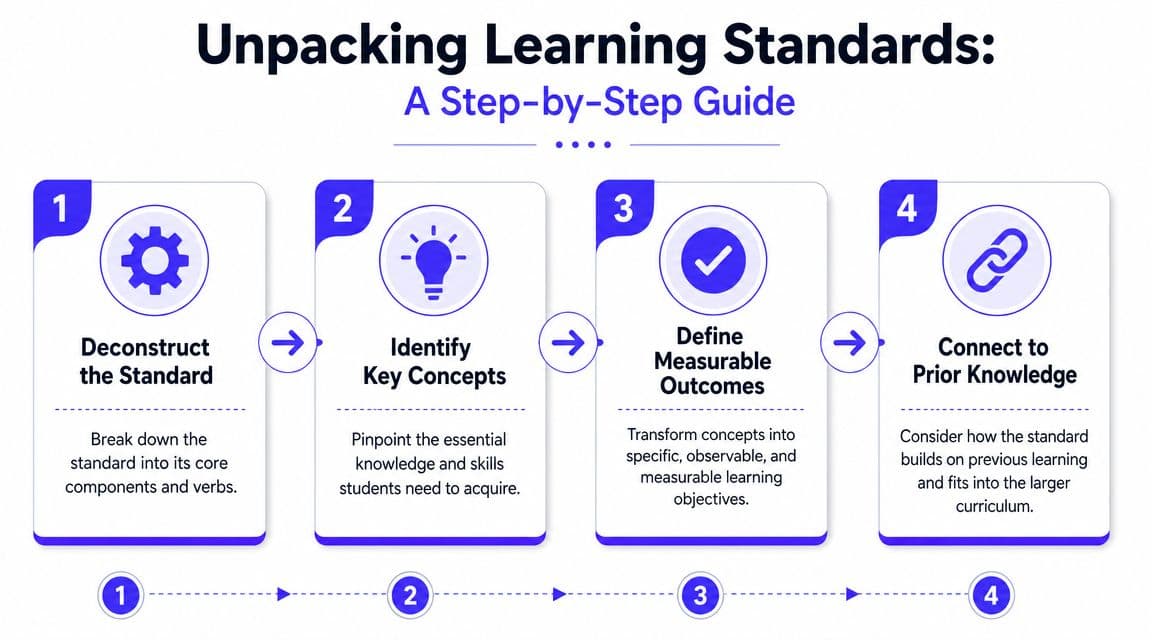
The fastest way to waste planning time is to start building activities before you've translated the standard into plain English. A lot of standards look clear until you ask, “What exactly would students need to do in order to show mastery?”
That's where unpacking matters. Not because it sounds official, but because it turns one dense sentence into teachable moves.
The three questions that keep planning honest
Carnegie Mellon's Eberly Center says learning objectives, assessments, and instructional strategies need to be “closely aligned”, and it frames planning around what students should know, how mastery will be measured, and what activities will prepare them for that evidence in its guide to instructional alignment and assessment design.
That gives you a clean planning filter:
- What should students know or be able to do?
- How will I know they can do it?
- What will I teach or assign so they can get there?
If you answer those in that order, backward design stops sounding theoretical. It becomes basic survival.
How to unpack a standard quickly
Take an example like this common type of reading standard: students identify the main idea of a text and explain how key details support it.
You don't need a giant curriculum map to begin. You need to pull out the working parts.
| Part of the standard | What to look for | What it means for planning |
|---|---|---|
| Verb | identify, explain, compare, solve, justify | This tells you what students must actually do |
| Noun or concept | main idea, details, fractions, ecosystems | This tells you the content focus |
| Conditions | in a grade-level text, using evidence, orally or in writing | This shapes task design |
| Level of thinking | recall, explain, analyze, apply | This affects rigor and assessment |
For that reading example, the verbs are identify and explain. The concept is main idea and supporting details. The likely evidence is a written or spoken explanation using text evidence. That already tells you that a coloring sheet about the topic won't be enough, and neither will a multiple-choice question that only asks students to spot a detail.
A simple teacher shorthand
When I unpack standards for planning, I usually write them in a stripped-down form:
- Skill: identify main idea
- Reasoning: explain how details support it
- Evidence: written response, discussion, annotation, exit ticket
- Watch-out: students may find the topic, not the main idea
That last line matters. It saves you from teaching the wrong thing.
If the standard expects explanation, don't stop at recognition.
This is also where longer-term planning helps. If you're working across a unit or term, it's useful to look at effective syllabus mapping strategies so you can see how a single lesson fits into the sequence instead of treating each standard like an isolated task.
What teachers often skip
The common mistake isn't failing to write down the standard. It's failing to unpack it before choosing materials.
You can spot this quickly when the lesson includes:
- Topic-level alignment only. The lesson is about the same subject as the standard, but students aren't doing the required thinking.
- Fuzzy verbs. The objective says “understand” or “learn about,” which tells you almost nothing.
- Assessment mismatch. Students are asked to define or recall something when the standard expects explanation or application.
Unpacking takes a few minutes. Rebuilding a misaligned lesson the night before observation takes much longer.
Writing Objectives and Aligned Activities
Once the standard is unpacked, the next job is to write an objective that a real person could observe. If a student meets the objective, you should be able to point to evidence and say, “Yes, that happened.”
That means dropping vague language fast.
A formula that keeps objectives measurable
A usable objective usually includes three pieces:
Students will + action verb + content/skill + method or condition
Examples:
- Students will identify the main idea of a grade-level informational text.
- Students will explain how two supporting details connect to the main idea in writing.
- Students will solve multi-step word problems using a visual model and written reasoning.
That's enough. You don't need to make objectives sound academic. You need them to be clear.
Audit the lesson before you build more
A sound alignment workflow is to start with the official grade-level standard, audit the lesson for gaps, and then revise instruction and assessments so each objective is directly taught and measured, following the backward design process described in this standards-alignment workflow video.
That audit step saves time because it helps you stop asking, “What fun thing could I add?” and start asking better questions:
- Does this activity directly teach the objective?
- Will students get to practice the exact thinking the standard requires?
- Can I measure the result with the assessment I've chosen?
If the answer is no, the activity is probably enrichment, filler, or a warm-up. That doesn't make it useless. It just means it shouldn't carry the lesson.
Build activities from the objective, not the other way around
Here's a practical sequence that works on a regular school night:
- Model the skill. Show one strong example. Think aloud. Keep it short.
- Practice together. Use one text, one problem, one lab setup, one source. Do the cognitive lift as a class.
- Release to students. Give them a task where they must produce evidence on their own.
- Check the evidence. End with something small you can scan fast.
That structure works in ELA, math, science, and social studies because it's built around the objective, not the subject label.
A planning template helps here, especially when you're trying to keep objectives, activities, and checks for understanding in one place. A structured lesson plan template for standards-based planning can cut down the back-and-forth between separate docs.
Using AI without letting it write nonsense
AI is useful at the brainstorming stage, especially when your brain is done for the day. It's less useful when teachers paste a broad prompt like “make me a lesson plan” and accept the first result.
The better move is to constrain it.
Try prompts like:
- Generate three activities for a grade 4 reading lesson where students identify the main idea and explain how details support it. Include one whole-group task, one partner task, and one exit ticket.
- Revise this objective so it is measurable and aligned to a grade-level informational reading standard.
- Create practice tasks at two support levels and one extension level for this objective.
If you use a tool built for K to 12 planning, give it the grade, subject, standard language, student needs, and available time. That's where a platform like Kuraplan fits naturally. It can generate standards-linked drafts, objectives, activities, and materials from a more specific teacher prompt, which is much more useful than a generic chatbot response.
Teacher shortcut: Don't ask AI for a finished lesson first. Ask for options, examples, and revisions you can judge quickly.
That keeps the teacher in charge of alignment.
Designing Assessments That Prove Mastery
A lesson isn't aligned because the standard appears at the top of the page. It's aligned when the assessment checks the thing the standard asks students to do.
That's the test I use when reviewing my own plans. If students score well on the assessment but still haven't demonstrated the target skill, the task was too loose.
Formative checks first
Strong aligned assessment usually starts small.
Formative assessment is the quick evidence you gather during or right after instruction. Exit tickets, whiteboard responses, short written explanations, problem solves, and discussion prompts all work if they mirror the objective. If students are supposed to compare, ask them to compare. If they're supposed to justify, ask them to justify.
A lot of teachers blur this by using easy checks that only test recognition. Those are fine for warm-ups. They're weak evidence for mastery.
For a useful classroom breakdown of formative vs summative assessment, it helps to think in plain terms: formative tells you what to fix tomorrow, summative tells you what students can now do independently.
What a good summative task looks like
Summative assessment should feel familiar to students because it's the logical outcome of your instruction.
If you taught students to identify claim and evidence through annotation, discussion, and guided writing, then the end task should ask them to identify claim and evidence in a new text and explain their reasoning. It should not suddenly ask for a poster, a skit, or a set of disconnected multiple-choice items unless those formats still capture the same skill.
A simple rubric also helps keep alignment tight.
| Criteria | Aligned question to ask |
|---|---|
| Skill match | Does the task require the exact verb from the objective? |
| Content match | Are students working with the right text, concept, or problem type? |
| Evidence quality | Will the response show thinking, not just guessing? |
| Scoring clarity | Can you describe what mastery looks like before students start? |
Rubrics save more time than they cost
Teachers often skip rubrics because they feel like extra work. In practice, even a short rubric speeds up grading and gives students a clearer target.
Keep it lean. Three or four criteria is usually enough for a lesson-level task:
- Accuracy of response
- Use of evidence or reasoning
- Completion of the required task
- Clarity of explanation
Later in your planning flow, it helps to see how another teacher explains assessment alignment in action:
When teachers use AI well here, the biggest win isn't “letting the machine grade.” It's speeding up the prep work. You can draft rubric language, generate an exit ticket in the same skill family as the objective, or turn a lesson into a printable practice page without formatting everything by hand. The key is still the same. You check that every prompt in the assessment asks students to produce evidence that matches the standard.
Reaching Every Learner with Differentiation
Differentiation gets messy when teachers confuse it with changing the standard. Most of the time, the standard stays put. What changes is the route students take to reach it.
That distinction matters. If the target is fixed, you can offer support without watering down the goal.
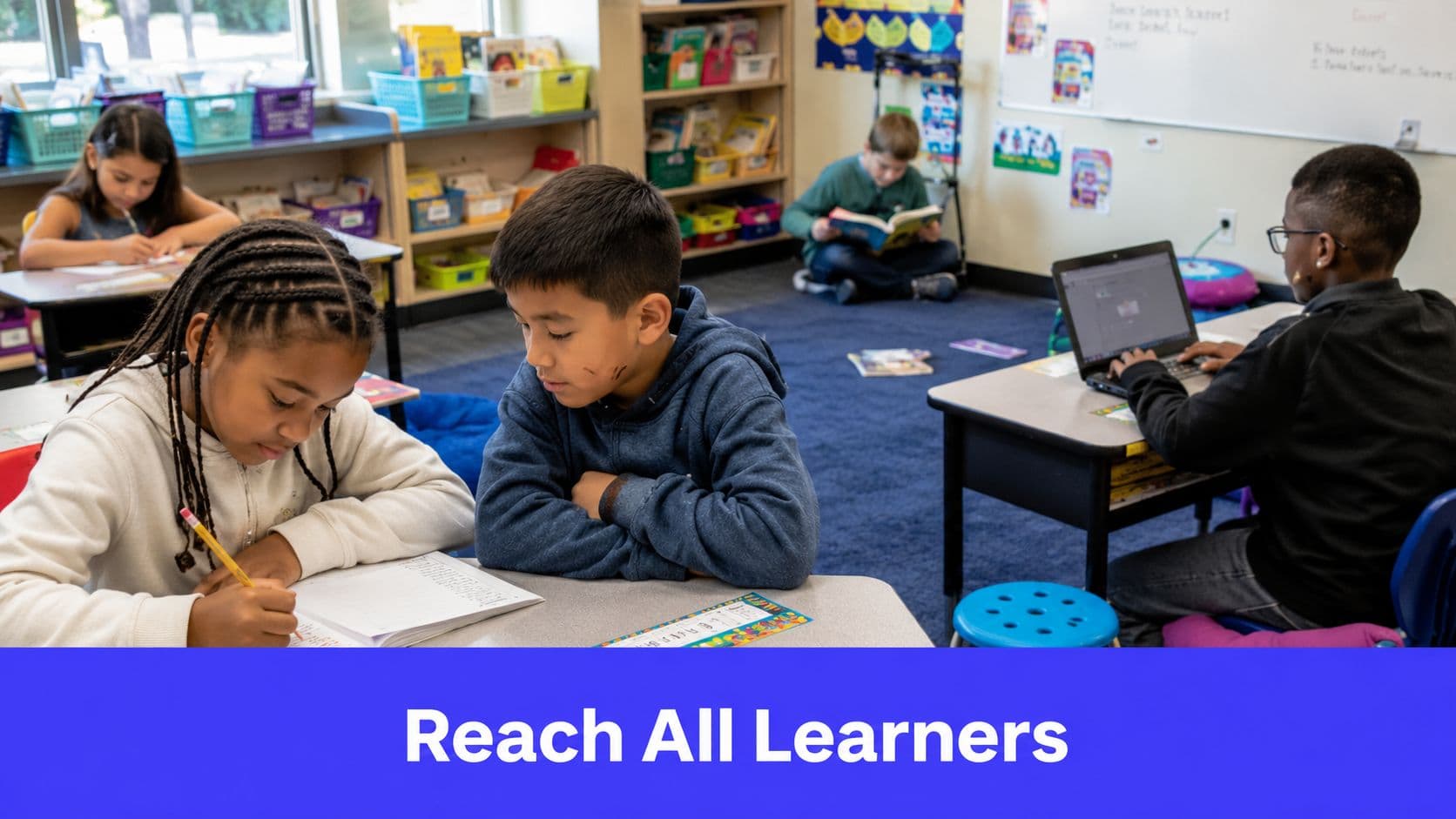
Differentiate the pathway
Three levers usually give you enough flexibility without blowing up the lesson.
Process adjustments
Change how students engage with the content.
- Chunk the task. Break the text, lab, or problem set into shorter parts.
- Add guided supports. Sentence frames, graphic organizers, worked examples, and vocabulary banks can carry students into the same skill.
- Use flexible grouping. Some students need guided practice with you. Others are ready for independent application sooner.
Product options
Keep the same learning target, but allow different forms of evidence when appropriate.
A student might explain understanding through a short written response, a recorded oral explanation, annotated work, or a teacher conference. The format can flex if the evidence still shows the standard clearly.
Challenge moves
Advanced students don't need “more work.” They need deeper work.
Ask them to defend a claim with stronger evidence, compare multiple strategies, critique an argument, or apply the concept in a less scaffolded setting. That keeps them on the standard while increasing complexity.
One lesson can have different supports and still remain tightly aligned, as long as every version asks students to work toward the same intended skill.
The rigor check teachers often miss
One of the most common gaps in alignment is rigor calibration. Guidance for educators recommends using frameworks like Webb's Depth of Knowledge or state-test expectations to avoid lessons that are technically aligned but too shallow, as explained in this article on curriculum alignment, rigor, and compliance.
This shows up all the time.
A standard may ask students to analyze, but the lesson only asks them to identify. A math standard may expect multi-step reasoning, but the practice only includes routine one-step items. A writing standard may call for evidence-based explanation, but the assignment ends at sentence completion.
A quick DOK gut check
You don't need to turn every plan into a formal framework exercise. A few questions are usually enough:
- Is this lesson asking students to recall, explain, apply, or analyze?
- Does that level match the verb and demand of the standard?
- Would this task prepare students for the kind of thinking they'll face later in the unit or on common assessments?
If the answer feels shaky, revise before teaching.
A lesson can be engaging and still too shallow. It can also be quiet, simple, and strongly aligned. Rigor isn't about making work harder for the sake of it. It's about matching the cognitive demand the standard requires.
Your AI-Powered Alignment Toolkit
By the time most teachers look for AI help, they're not asking for educational philosophy. They want the planning load to shrink without losing control of quality.
That's a fair goal.
The best use of AI in aligning lesson plans to standards is not handing over your judgment. It's cutting the repetitive parts of planning that drain time. Think drafting objectives, generating practice variations, rewriting directions for reading level, building quick checks, or producing a rubric skeleton you can edit.
Where AI actually helps
Here's the before-and-after version most teachers recognize.
| Manual planning bottleneck | AI-assisted shortcut |
|---|---|
| Searching standards documents and old files | Pull a draft from the standard language and topic |
| Rewriting the same objective three times | Generate measurable options and choose one |
| Creating support and extension tasks from scratch | Ask for leveled versions of the same target |
| Building a rubric or exit ticket late at night | Generate a draft and trim it to fit your class |
That's the core value. Less blank-page fatigue. More attention for the decisions only a teacher can make.
If you're comparing tools, it's worth reviewing practical breakdowns of AI lesson plan generators for teachers so you can separate generic text generators from tools built around classroom planning.
Prompts worth keeping in your notes app
A good prompt is specific about grade, subject, standard, and classroom reality.
Try these:
- Write three measurable objectives for a grade 5 science lesson on ecosystems. One should focus on explanation, one on classification, and one on evidence from observation.
- Create a formative check for this objective that can be completed in five minutes and scored quickly.
- Differentiate this lesson for students who need reading support and for students ready for extension, without changing the standard.
- Turn this objective into a short rubric with clear mastery descriptors.
- Suggest one direct instruction task, one collaborative task, and one independent practice task aligned to this standard.
If you want to go one step further, visual explanation can help students who don't lock in through text alone. For concept intros, recap clips, or parent-facing explainers, a cinematic AI video tool can be useful for turning ideas into short visuals that support the lesson rather than replacing it.
Keep the teacher brain in the loop
AI can draft. It can sort. It can remix. It can't know your students the way you do.
You still need to check for:
- Accuracy
- Grade-level fit
- Rigor
- Bias or awkward wording
- Whether the task is teachable in your room tomorrow
That's why the best workflow is simple. Start with the standard. Unpack it. Write the objective. Decide the evidence. Build instruction that leads there. Then use AI to accelerate the repetitive parts, not the thinking parts.
If you want one place to handle standards-aligned lesson drafts, rubrics, worksheets, and classroom visuals without piecing together multiple tools, Kuraplan is built for that workflow. It helps teachers move from standard to usable lesson materials faster, while keeping the final instructional decisions where they belong, with the teacher.