Hey teacher friends! Are you tired of that glazed-over look when you pull out another worksheet? We've all been there. We're searching for that spark—the kind of learning that sticks with students long after the bell rings. That's where Project-Based Learning (PBL) comes in. It’s not just a buzzword; it’s a game-changer for turning our classrooms into hubs of curiosity and real-world problem-solving.
But let's be honest, the biggest hurdle is often, "Where do I even start?" Finding the time to design a comprehensive project from scratch can feel overwhelming. You need concrete, ready-to-adapt ideas that work for real elementary classrooms, not just theoretical concepts. This guide is built for busy teachers like you. We're skipping the academic fluff and diving straight into a curated collection of project based learning examples elementary students will love.
We’ll break down eight distinct projects, covering everything from launching a classroom business to creating a digital citizenship campaign. For each example, you’ll get a complete blueprint including:
- Essential Questions to drive inquiry.
- Step-by-step student activities you can implement tomorrow.
- Assessment strategies and rubrics.
- Actionable differentiation tips for all learners.
My goal is to give you the tactical plans needed to bring authentic, engaging learning to your students without having to reinvent the wheel. To further explore how real-world learning transforms education, you can discover even more project-based learning examples that demonstrate these principles in action across different subjects and grade levels. Let's get started.
1. Community Garden Project
The Community Garden Project is a classic for a reason; it's one of the most effective and tangible project based learning examples elementary students can engage in. This project moves learning beyond the classroom walls, asking students to design, plant, and maintain a school garden. It’s an interdisciplinary powerhouse that connects directly to the real world.
Students don't just learn about plants; they become botanists, ecologists, engineers, and community leaders. They apply math skills to calculate garden bed area, use scientific inquiry to test soil and track plant growth, and develop literacy skills by researching plant needs and documenting their journey in journals. This hands-on experience makes abstract concepts like life cycles and ecosystems concrete and memorable.
Strategic Breakdown
- Grade Band: K-5 (Easily adaptable for all elementary levels)
- Essential Question: How can we design and grow a garden that nourishes our community?
- Learning Objectives: Students will be able to explain the plant life cycle, calculate area and perimeter, research and document information, collaborate in teams, and understand the connection between local food and community health.
- Core Subjects: Science (botany, ecology), Math (measurement, data), ELA (research, writing), Social Studies (community, food systems).
Actionable Takeaways for Your Classroom
Implementing a garden project requires careful planning, but the payoff is immense. Start by identifying your available space; even a few container gardens on a windowsill can work. For instance, when starting a new bed in your community garden, understanding how to best prepare soil for planting is crucial for success.
A key to managing this project is breaking it down into distinct phases: planning, planting, maintaining, and harvesting. Tools like Kuraplan can be invaluable here, helping you map out standards-aligned lessons for each phase, ensuring you meet curriculum requirements while students are deep in hands-on work.
Finally, focus on the community aspect. The project culminates not just in a harvest, but in sharing that harvest. Donating produce to a local food bank or hosting a "school farmer's market" gives students an authentic audience and reinforces the project's purpose, a core tenet of effective PBL. If you're new to this pedagogical approach, exploring the fundamentals can provide a strong foundation for launching projects like this one. You can learn more about the principles of problem-based learning to ensure your garden project is a rich, inquiry-driven experience.
2. Design & Build Challenge (STEM Engineering)
The Design & Build Challenge is a cornerstone of elementary STEM education and serves as a dynamic example of project based learning. This project thrusts students into the role of engineers, challenging them to solve a tangible problem by designing, building, and testing a physical solution. Whether constructing a bridge from craft sticks or programming a simple robot to navigate a maze, students engage directly with the engineering design process.
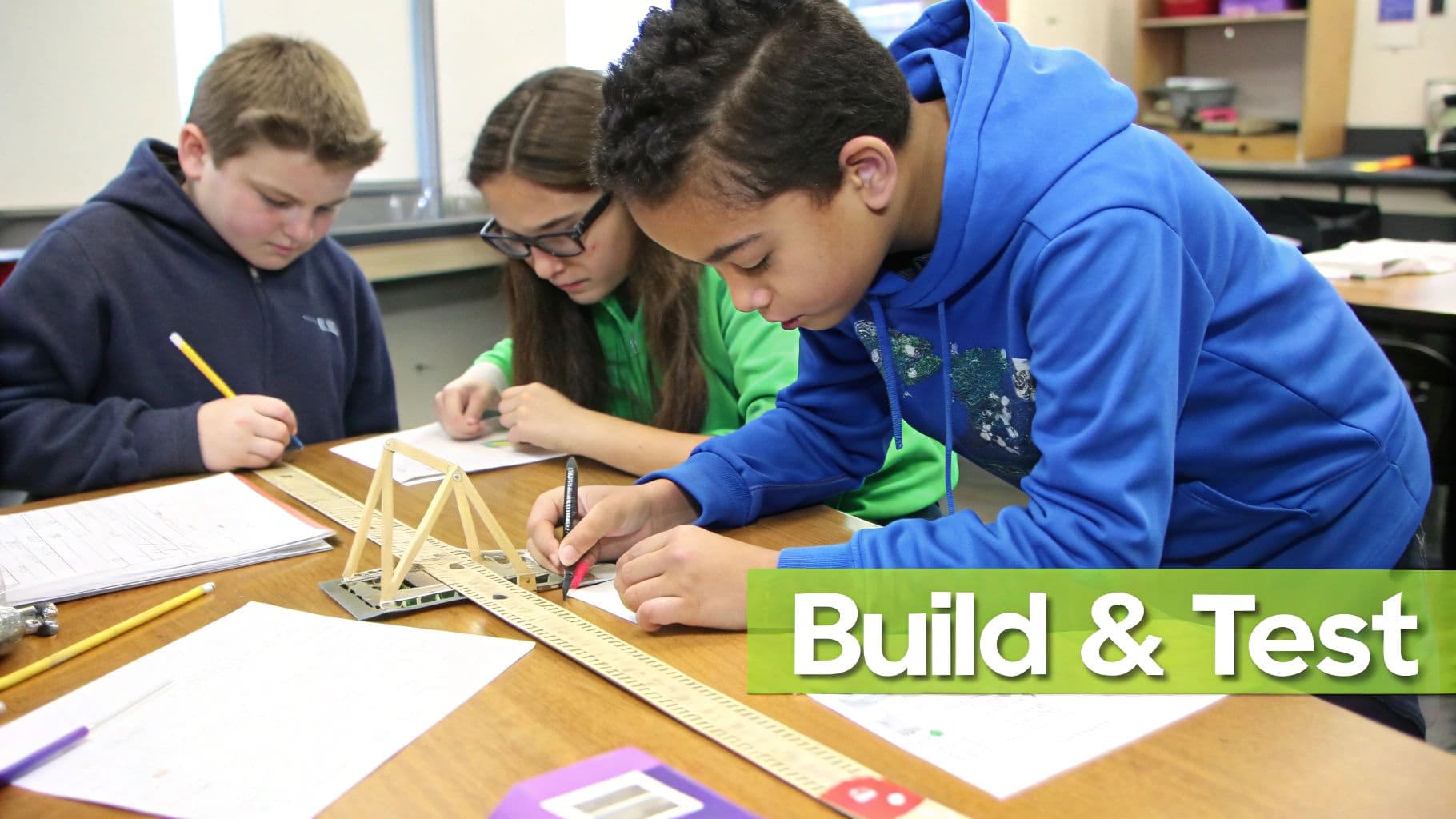
This approach makes abstract scientific principles like force, motion, and properties of materials incredibly concrete. Students don't just read about simple machines; they build them to solve a problem. They learn resilience through trial and error, developing critical thinking and problem-solving skills as they iterate on their designs to improve performance. This project transforms the classroom into a vibrant innovation hub.
Strategic Breakdown
- Grade Band: 1-5 (Scaffolding is key to adapting complexity)
- Essential Question: How can we use the engineering design process to build a solution to a real-world problem?
- Learning Objectives: Students will be able to apply the steps of the engineering design process, use measurement tools accurately, explain the scientific principles behind their design, collaborate to build and test a prototype, and communicate their findings.
- Core Subjects: Science (physical science, engineering), Math (measurement, geometry), Technology (optional coding, digital design), ELA (presenting findings).
Actionable Takeaways for Your Classroom
The success of a Design & Build Challenge hinges on a clearly defined problem and constraints. Start with a simple, relatable challenge like, "Design a container that can protect an egg when dropped from a height of six feet." Provide a limited set of materials (e.g., straws, tape, paper cups) to spur creativity.
Managing the iterative process is crucial. You can use a tool like Kuraplan to generate a standards-aligned lesson sequence that breaks down each phase of the design process, from brainstorming to the final presentation, with built-in checks for understanding. This ensures you cover curriculum goals while students are deeply engaged in hands-on work.
Finally, emphasize reflection and communication. The project shouldn't end with the final test. Have students document their process in design notebooks, present their prototypes to the class, and provide constructive feedback to peers. This builds communication skills and solidifies learning, which are key student engagement strategies for elementary classrooms.
3. Local History & Oral History Project
The Local History & Oral History Project transforms students into community historians, archivists, and storytellers. This powerful PBL example asks students to investigate their own local history, moving beyond textbooks to connect with the living memory of their community. By conducting interviews with elders, local officials, and longtime residents, students learn that history is not just a collection of dates but a tapestry of personal stories.
Students don't just memorize facts; they become primary source investigators and digital creators. They apply literacy skills to develop insightful interview questions, use critical thinking to analyze old photographs and documents, and learn modern communication skills by producing podcasts, documentary-style videos, or interactive digital timelines. This project makes history personal and immediate, showing students how their own community’s story fits into a larger historical narrative.
Strategic Breakdown
- Grade Band: 2-5 (Adaptable for younger grades by focusing on family history)
- Essential Question: How can we capture and share the stories that have shaped our community?
- Learning Objectives: Students will be able to formulate research questions, conduct structured interviews, analyze primary and secondary sources, synthesize information, and present historical findings using multimedia tools.
- Core Subjects: Social Studies (local history, civics), ELA (interviewing, research, narrative writing), Technology (digital media production), The Arts (storytelling).
Actionable Takeaways for Your Classroom
Successfully launching an oral history project hinges on structure and preparation. Begin by helping students understand their role as respectful, ethical researchers. This includes creating permission forms and practicing interview etiquette. You can use Kuraplan to generate interview protocol templates and research question organizers, ensuring students have scaffolded support as they prepare to meet with community members.
A key management strategy is to structure the project in clear stages: research, outreach, interview, production, and presentation. For the interview stage, provide students with tools for both asking questions and actively listening. After collecting stories, the focus shifts to production. Whether creating a podcast or a mini-museum, this is where students synthesize their findings into a compelling narrative for an authentic audience.
Finally, emphasize the presentation and preservation of these stories. Hosting a "Community History Night" where students share their projects with interviewees and their families provides a powerful, authentic audience. This final step validates the students' hard work and reinforces the project's purpose: to honor and preserve the unique history of their community, making this one of the most meaningful project based learning examples elementary students can experience.
4. Classroom Business & Entrepreneurship Project
Launching a Classroom Business & Entrepreneurship Project transforms students into young CEOs, marketers, and financial analysts. This is one of the most powerful project based learning examples elementary students can experience because it makes abstract economic concepts like profit, loss, and supply and demand tangible and exciting. Students work collaboratively to create and operate a real business, whether it's a bake sale, a craft shop, or even providing a digital service.
Instead of just reading about economics, students live it. They develop business plans, calculate costs and potential profits, design marketing materials, and handle real (or simulated) money. This project brilliantly integrates core subjects by requiring students to use math for financial tracking, ELA for persuasive advertising, and social studies to understand their role as producers and consumers in a market economy.
Strategic Breakdown
- Grade Band: 2-5 (Adaptable, with simpler business models for younger grades)
- Essential Question: How can we create a successful business that provides a product or service our school community wants?
- Learning Objectives: Students will be able to develop a simple business plan, calculate costs and profit, create marketing materials, work effectively in a team, and explain basic economic principles.
- Core Subjects: Math (money, computation, percentages), Social Studies (economics, community), ELA (persuasive writing, communication), Arts (design).
Actionable Takeaways for Your Classroom
The success of a classroom business hinges on authentic tasks and clear roles. Begin by having students brainstorm business ideas and vote on one, fostering immediate ownership. Define roles like CEO, Marketing Director, and Finance Manager to give students specific responsibilities and opportunities to lead.
Break the project into manageable phases: market research, product development, marketing, sales, and financial analysis. This is where a tool like Kuraplan can be a game-changer, helping you generate standards-aligned activities for each phase, such as business plan templates or worksheets for calculating profit margins. This ensures that even as students are busy being entrepreneurs, they are consistently hitting key learning targets.
Finally, the project's impact is magnified when the outcome has a real-world purpose. Students can vote on how to use their profits, perhaps to fund a class party, purchase new books for the library, or donate to a local charity. This final step teaches valuable lessons in financial decision-making and civic responsibility, completing the authentic learning cycle and making this a memorable PBL experience.
5. Digital Citizenship & Online Safety Campaign
In an increasingly digital world, this project empowers students to become proactive, responsible online citizens rather than passive consumers of media. Students research pressing online safety issues, then design and launch educational campaigns to teach peers and families about digital wellness. This is one of the most relevant and critical project based learning examples elementary classrooms can tackle today.
Instead of simply listening to a lecture about online safety, students become digital advocates and leaders. They use ELA skills to research topics like cyberbullying or misinformation, apply persuasive writing techniques to create posters and PSAs, and use technology skills to produce videos or infographics. The project addresses essential social-emotional learning competencies as students reflect on their own digital habits and learn to navigate online social dynamics safely and ethically.
Strategic Breakdown
- Grade Band: 2-5 (Adaptable for younger grades with a focus on simple rules like asking for help)
- Essential Question: How can we teach our school community to be safe, kind, and responsible online?
- Learning Objectives: Students will be able to identify key online safety risks, research and synthesize information from multiple sources, create persuasive media, and collaborate to implement a community-wide campaign.
- Core Subjects: ELA (research, persuasive writing), Technology/Digital Literacy, Health/SEL, Civics.
Actionable Takeaways for Your Classroom
This project is highly impactful because it addresses real-world challenges students face daily. Start by having students survey their peers to identify the most pressing digital concerns in your school, providing an authentic entry point. This student voice and choice are fundamental to high-quality PBL.
A great way to manage the research phase is by using a tool like Kuraplan to generate fact-checking worksheets and research organizers for different topics, such as password security or recognizing fake news. This ensures students are building strong foundational research skills. You can explore a comprehensive Digital Responsibility plan to find standards-aligned activities and resources for this project.
The final product should have an authentic audience beyond the classroom. Organize a school-wide "Digital Citizenship Week" where students present their campaigns during assemblies, display their posters in the hallways, or share their PSAs on the school's morning announcements. This real-world application transforms the assignment from a simple task into a meaningful act of community service.
6. Environmental Conservation & Citizen Science Project
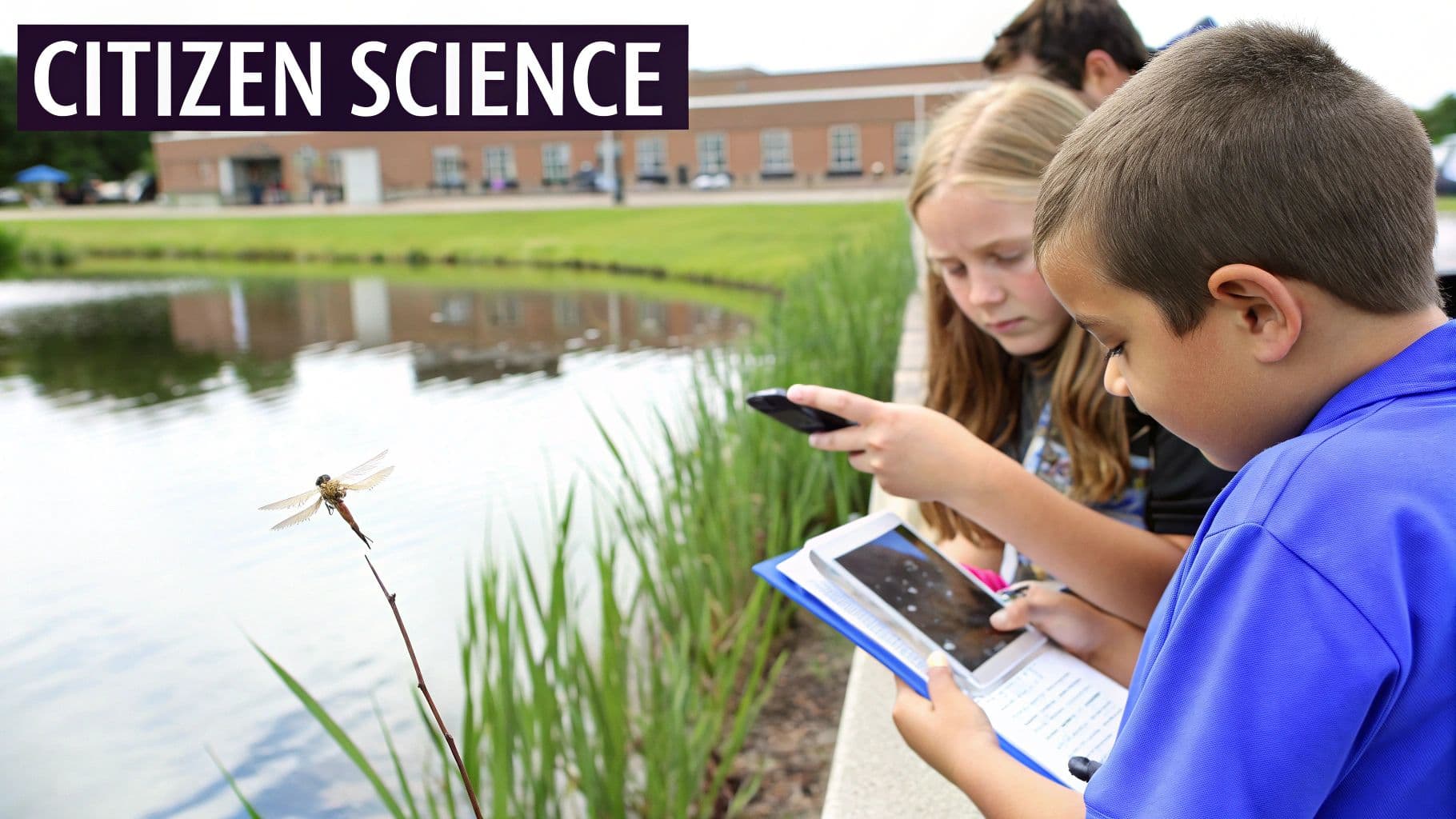
This project transforms students into real-world scientists by connecting their learning to active environmental research. Instead of just reading about ecosystems in a textbook, students participate in citizen science, collecting and submitting data on local wildlife, water quality, or plant life to global databases. It is an authentic and empowering project based learning example for elementary students that shows them their work can have a genuine scientific impact.
Students become field researchers, data analysts, and environmental advocates. They learn the scientific method not as a list of steps, but as a dynamic process of observation, data collection, and analysis. This approach makes complex concepts like biodiversity, pollution, and climate change tangible, giving students a sense of agency in addressing global challenges right in their own schoolyard or local park.
Strategic Breakdown
- Grade Band: 2-5 (Adaptable for younger grades with simplified data collection)
- Essential Question: How can we, as citizen scientists, contribute to understanding and protecting our local environment?
- Learning Objectives: Students will be able to follow a scientific protocol, collect and record accurate data, analyze and graph findings, explain local ecological concepts, and propose evidence-based conservation actions.
- Core Subjects: Science (ecology, scientific method), Math (data analysis, graphing), ELA (report writing, presenting), Social Studies (civic responsibility, environmental policy), Technology.
Actionable Takeaways for Your Classroom
The key to a successful citizen science project is choosing a protocol that is both scientifically valid and accessible for your students. Platforms like iNaturalist for species identification, eBird for bird counts, or Project BudBurst for tracking plant phenology offer established, user-friendly frameworks that welcome student contributions. Start by exploring these platforms to find a project that aligns with your local ecosystem and curriculum.
Managing the data collection and analysis is crucial. To ensure students are meeting standards, you can use a tool like Kuraplan to develop scaffolded data sheets, observation journal prompts, and graphing templates. This structures the scientific process, guiding students from raw observation to meaningful conclusion while keeping the focus on inquiry.
Finally, empower students to act on their findings. The project shouldn't end with a data chart; it should culminate in a presentation of their results and a proposed action plan. Whether it's creating posters to educate the school about an invasive species they discovered or writing a letter to a local official about water quality findings, this final step connects their scientific work directly to civic engagement and reinforces the real-world purpose of their learning.
7. Cultural Heritage & Diversity Storytelling Project
This project transforms the classroom into a vibrant tapestry of personal histories and global cultures, making it one of the most powerful project based learning examples elementary students can experience. It asks students to become family historians and cultural anthropologists by researching their own heritage, interviewing family members, and sharing their unique stories. The project fosters empathy, self-awareness, and a deep appreciation for the diversity within the classroom and the world.
Instead of just reading about different cultures in a textbook, students live the learning. They practice interviewing skills, engage in primary source research by talking to relatives, and synthesize information into compelling narratives. This deeply personal work makes abstract social studies concepts like "culture," "tradition," and "identity" tangible and meaningful, while building crucial social-emotional skills.
Strategic Breakdown
- Grade Band: 2-5 (Adaptable for younger grades with a focus on family traditions rather than deep historical research)
- Essential Question: How do our family stories and cultural traditions shape who we are and connect us to others?
- Learning Objectives: Students will be able to conduct interviews, research and synthesize information about a specific culture, write a personal narrative, and present information clearly while demonstrating respect for diverse backgrounds.
- Core Subjects: Social Studies (culture, family systems, history), ELA (narrative writing, research, listening/speaking), Arts (visual/performance), Social-Emotional Learning (identity, empathy).
Actionable Takeaways for Your Classroom
A successful cultural heritage project begins with creating a safe and inclusive classroom environment. Start with explicit lessons on respectful representation and the dangers of stereotyping. Provide multiple entry points for family participation, recognizing that every family structure is different; options can include interviews, sharing a family recipe, or lending a cultural artifact for a classroom museum.
To streamline the research phase, provide students with structured organizers. You can use Kuraplan to generate family interview guides with age-appropriate questions or create cultural research templates that guide students to find information on traditions, foods, and celebrations. This ensures students gather relevant details for their final presentations.
The project's culmination should be a celebration, not just a presentation. Hosting a "Cultural Heritage Fair" where students share their findings, display artifacts, and even offer food samples gives them an authentic audience. This final event reinforces the project's core purpose: honoring every student's story and building a stronger, more connected classroom community.
8. Documentary Filmmaking & Media Production Project
The Documentary Filmmaking & Media Production Project transforms students into modern storytellers, empowering them to explore a real-world topic through a digital lens. This project moves beyond traditional reports, asking students to research, script, film, and edit a short documentary or multimedia presentation. It’s an engaging and highly relevant example of project based learning for elementary students, building critical 21st-century skills.
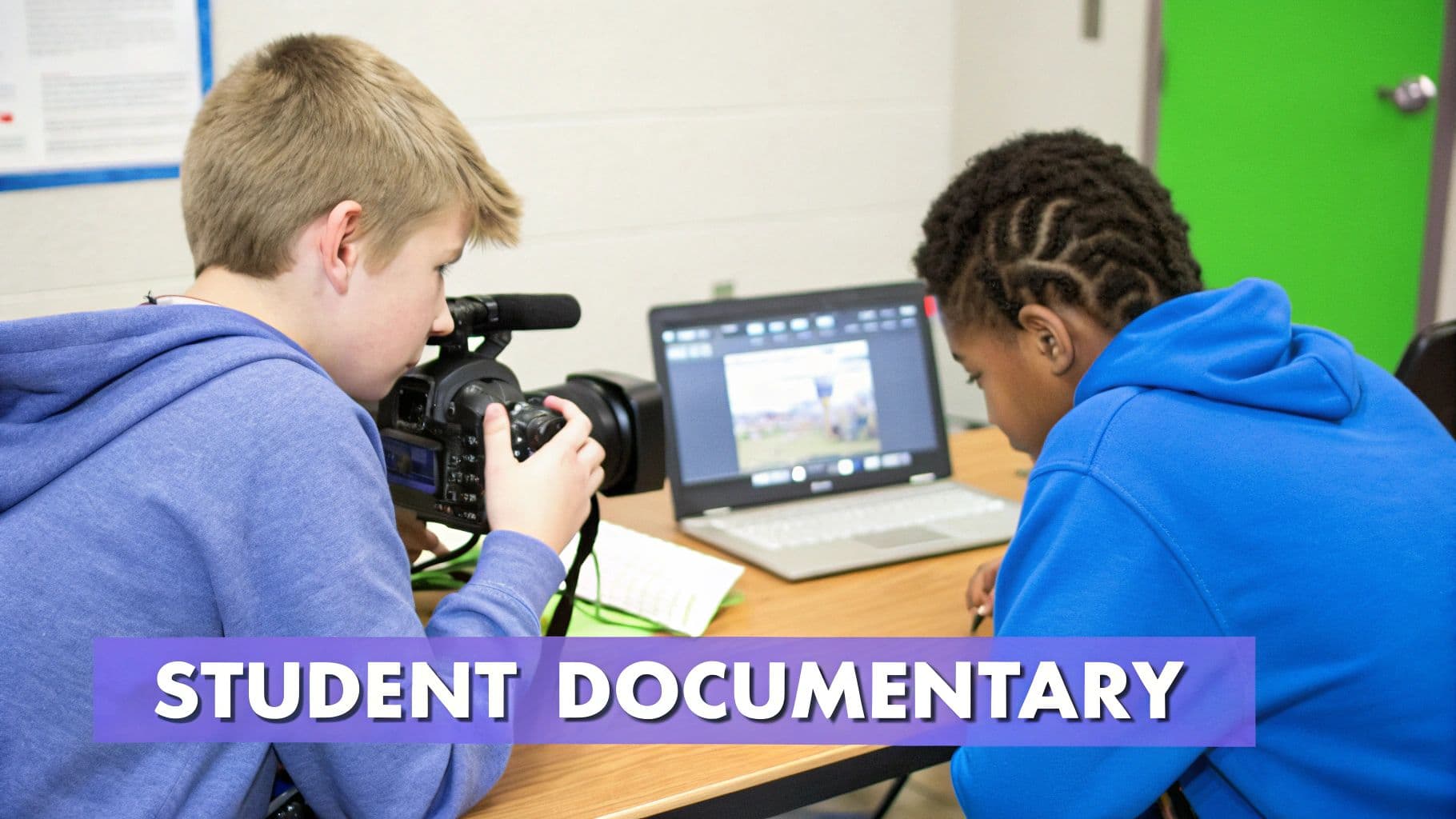
Students become researchers, journalists, directors, and editors as they investigate topics like local community heroes, environmental concerns, or school culture issues. They apply literacy skills to scriptwriting and narration, develop social studies understanding through interviews and perspective-taking, and master technology tools for production. This hands-on process makes abstract concepts of narrative structure, evidence-based claims, and digital citizenship concrete and purposeful.
Strategic Breakdown
- Grade Band: 2-5 (Adaptable, with scaffolding for younger grades)
- Essential Question: How can we use media to tell a powerful story that informs and inspires our community?
- Learning Objectives: Students will be able to conduct research using multiple sources, develop a clear narrative structure, write and deliver a compelling script, use digital tools to edit video and audio, and present their findings to an authentic audience.
- Core Subjects: ELA (research, writing, speaking), Social Studies (civics, community issues), Technology (digital literacy, media production), The Arts (storytelling, visual composition).
Actionable Takeaways for Your Classroom
Implementing a filmmaking project feels ambitious, but it’s manageable when broken into clear production phases: pre-production (research, storyboarding), production (filming, interviews), and post-production (editing, feedback). Start by focusing on topics students are passionate about; their natural curiosity will drive the inquiry.
A key to success is providing structured supports. For example, using a tool like Kuraplan can help you generate grade-appropriate research organizers, interview question templates, and storyboard planners. These resources provide the necessary scaffolding for young students to tackle complex tasks like organizing a narrative and planning their shots, ensuring they stay on track without stifling creativity.
Finally, emphasize the power of an authentic audience. The project should culminate in a screening event for families, other classes, or community members. This gives students a real purpose for their work, reinforcing the project's goal of communicating an important message. Incorporating peer feedback sessions using a simple "two stars and a wish" protocol during the editing phase also enhances collaboration and elevates the quality of the final product.
8 Elementary PBL Projects Compared
| Project | 🔄 Implementation Complexity | ⚡ Resource Requirements | ⭐📊 Expected Outcomes | 💡 Ideal Use Cases | ⭐ Key Advantages |
|---|---|---|---|---|---|
| Community Garden Project | 🔄🔄 — Moderate planning, seasonal maintenance | ⚡⚡ — Outdoor space, tools, soil, volunteers, minimal tech | ⭐⭐⭐📊 — Plant growth data; environmental & nutritional learning | K–5 science units; service-learning; sustainability education | Hands-on interdisciplinary learning; community engagement; measurable growth |
| Design & Build Challenge (STEM Engineering) | 🔄🔄🔄 — Iterative prototyping, safety oversight | ⚡⚡⚡ — Materials, prototyping tools, storage, supervision | ⭐⭐⭐📊 — Engineering design skills; problem-solving; prototypes | STEM units, maker spaces, competitions | Mirrors real engineering process; builds resilience and creativity |
| Local History & Oral History Project | 🔄🔄 — Coordination with community, ethical protocols | ⚡⚡ — Recording devices, access to archives, scheduling | ⭐⭐📊 — Research & interviewing skills; archival products | Social studies; civics; community-engagement projects | Authentic audience; preserves local narratives; develops perspective-taking |
| Classroom Business & Entrepreneurship Project | 🔄🔄 — Planning, approvals, ongoing management | ⚡⚡ — Start-up funds, transaction tools, possible food safety needs | ⭐⭐⭐📊 — Financial literacy; measurable profit/loss; leadership | Economics/financial literacy units; real-world math application | Tangible outcomes; practical life skills; strong student motivation |
| Digital Citizenship & Online Safety Campaign | 🔄 — Low–moderate coordination; content guidelines required | ⚡ — Devices, internet access, content moderation | ⭐⭐📊 — Digital literacy; peer education; reusable resources | Media literacy lessons; school-wide awareness campaigns | Highly relevant; empowers student voice; scalable materials |
| Environmental Conservation & Citizen Science Project | 🔄🔄🔄 — Protocol training; field coordination | ⚡⚡⚡ — Outdoor access, sensors/apps, specialist guidance | ⭐⭐⭐📊 — Authentic data contributions; scientific inquiry skills | Ecology units; semester-long monitoring; community science | Real research impact; develops stewardship and data literacy |
| Cultural Heritage & Diversity Storytelling Project | 🔄🔄 — Sensitive facilitation; variable family involvement | ⚡⚡ — Family interviews, recording tools, materials | ⭐⭐📊 — Identity affirmation; empathy; narrative skills | SEL, multicultural curriculum, family engagement events | Validates student identities; strengthens family–school ties |
| Documentary Filmmaking & Media Production Project | 🔄🔄🔄 — Script-to-edit workflow; copyright considerations | ⚡⚡⚡ — Cameras/devices, editing software, time for post-production | ⭐⭐⭐📊 — Media literacy; polished portfolio pieces; storytelling skills | Media literacy units; capstone projects; digital portfolios | High engagement; professional-quality student artifacts; collaboration |
Making PBL Work for You (Without Losing Your Weekends)
After exploring these project based learning examples elementary students can thrive on, one thing is clear. The magic isn't in a specific activity, but in the shift from passive learning to active doing. The best projects are built on genuine curiosity, a connection to the community, and the chance for students to create something real for a real audience.
Whether it’s the STEM Design Challenge or the Classroom Business Project, all these ideas share a common DNA. They empower students to take ownership, collaborate on tough problems, and use their academic skills in a context that actually matters to them. It’s the difference between learning about something and learning by doing it.
Deconstructing the PBL Blueprint: Key Takeaways
The goal isn't to copy-paste an idea but to understand the principles that make them work so you can adapt them for your own classroom. Here's what the most successful projects have in common:
- Anchor in Authenticity: Every great project starts with a real-world problem or a genuine question. The Environmental Conservation project wasn't just about ecosystems; it was about investigating a local pollution issue. Your first step is always to find that authentic hook.
- Student Voice is Non-Negotiable: Notice how each project gives students meaningful choices. In the Cultural Heritage project, they chose which stories to tell. In the Classroom Business project, they designed their own products. This agency is the engine of engagement.
- Integrate, Don't Isolate: PBL shouldn't be an "add-on." The best units, like the Local History project, seamlessly weave together reading, writing, social studies, and technology standards. Always look for those natural cross-curricular connections.
- The Final Product Drives the Process: A clear, tangible outcome gives the work purpose. Knowing they were creating a safety campaign for their school or a documentary for their families gave students a reason to revise, collaborate, and push through challenges. Always begin with the end in mind.
Your Action Plan for Getting Started
Reading about these project based learning examples elementary is one thing; launching your own is another. The idea can feel daunting, but you don't have to overhaul your entire curriculum overnight. Start small, stay organized, and use the right tools to make your life easier.
Here’s how to begin:
- Identify a "PBL-Ready" Unit: Look at your curriculum map. Is there a unit on community, economics, or life cycles that could be transformed from worksheets into a project? Start there.
- Co-Create the Essential Question: Instead of handing them a question, brainstorm with your students. A question like "How can we create a product to solve a problem at our school?" is far more powerful when it comes from them.
- Map the Milestones, Not Every Minute: Don't try to plan every single lesson. Instead, map out the major project milestones: the research phase, the creation phase, the revision phase, and the public presentation. This gives you a flexible structure to guide student work.
The secret to sustainable, high-quality PBL is knowing you don't have to create every single resource from scratch. This is where modern tools can be a teacher's best friend.
AI-powered platforms like Kuraplan are designed to manage the complexity of PBL. You can generate standards-aligned lesson sequences, create differentiated rubrics for a complex project, or find leveled reading materials for the research phase in minutes. It isn't about replacing your professional judgment; it's about amplifying it, letting you focus your energy on guiding students instead of getting bogged down in paperwork.
By embracing these strategies, you can move from admiring great projects to creating them, building a classroom where students don't just learn content but become historians, scientists, entrepreneurs, and active citizens.
Ready to stop dreaming about PBL and start building it? Kuraplan is the AI-powered lesson planning assistant that helps you design incredible, standards-aligned project based learning units in a fraction of the time. Visit Kuraplan to see how you can generate everything from essential questions and rubrics to differentiated activities, so you can reclaim your weekends and focus on what you do best: inspiring students.