You're probably looking at your first-grade math block and feeling two pressures at once. One group of students still counts every object one by one, and another is already solving problems in their heads. Meanwhile, the standards are sitting there like a long checklist that somehow has to fit into one school year.
That's where Common Core math in 1st grade gets misunderstood. It isn't asking children to memorize disconnected facts faster. It's asking teachers to build thinkers. Students need to understand what numbers mean, how operations work, and why a strategy makes sense before speed becomes useful.
The good news is that the standards are much more manageable when you stop treating them like a script and start treating them like a map. In a real classroom, that means choosing solid models, using clear routines, and knowing when to push for fluency and when to slow down for understanding. That's the difference between a child who can recite an answer and a child who can solve a new problem independently.
Navigating Your First Year with Common Core Math
The first time many teachers read the first-grade standards, they focus on the volume. There's addition, subtraction, place value, data, measurement, shapes, time, and early fraction language. It can feel like everything matters at once.
What helps is remembering that Common Core math 1st grade is built around a few major understandings, not a pile of isolated skills. When a child solves a word problem with cubes, explains why 34 becomes 44 when you add ten, or tells you that a triangle is still a triangle when it's turned sideways, that child is demonstrating the principles of the standards.
What new teachers often get wrong
A common mistake is to chase worksheets before meaning. Kids can fill in blanks and still have no idea what the numbers represent. Another mistake is assuming fluency means timed tests first. In first grade, speed without understanding usually creates fragile learning.
Practical rule: If a student can get an answer but can't show it with objects, drawings, words, or an equation, the learning isn't secure yet.
I've seen first-grade classrooms make huge gains when teachers narrow the focus. Instead of asking, “How do I cover all of this?” ask, “What idea are students developing today?” That one shift changes planning.
What actually works in the room
A strong first-grade math block usually includes:
- Concrete models first: Counters, connecting cubes, ten frames, base-ten blocks, clocks, and pattern blocks give students something to think with.
- Brief teacher modeling: Show one strategy clearly instead of five at once.
- Math talk every day: Students need chances to explain, compare, and defend their thinking.
- Targeted practice: Practice should match the strategy you taught, not just the answer range.
- Small-group follow-up: Some children need reteaching with simpler numbers. Others need richer tasks, not more of the same page.
That's the practical lens for the rest of the year. The standards matter, but daily decisions matter more.
The Four Critical Areas of First Grade Math
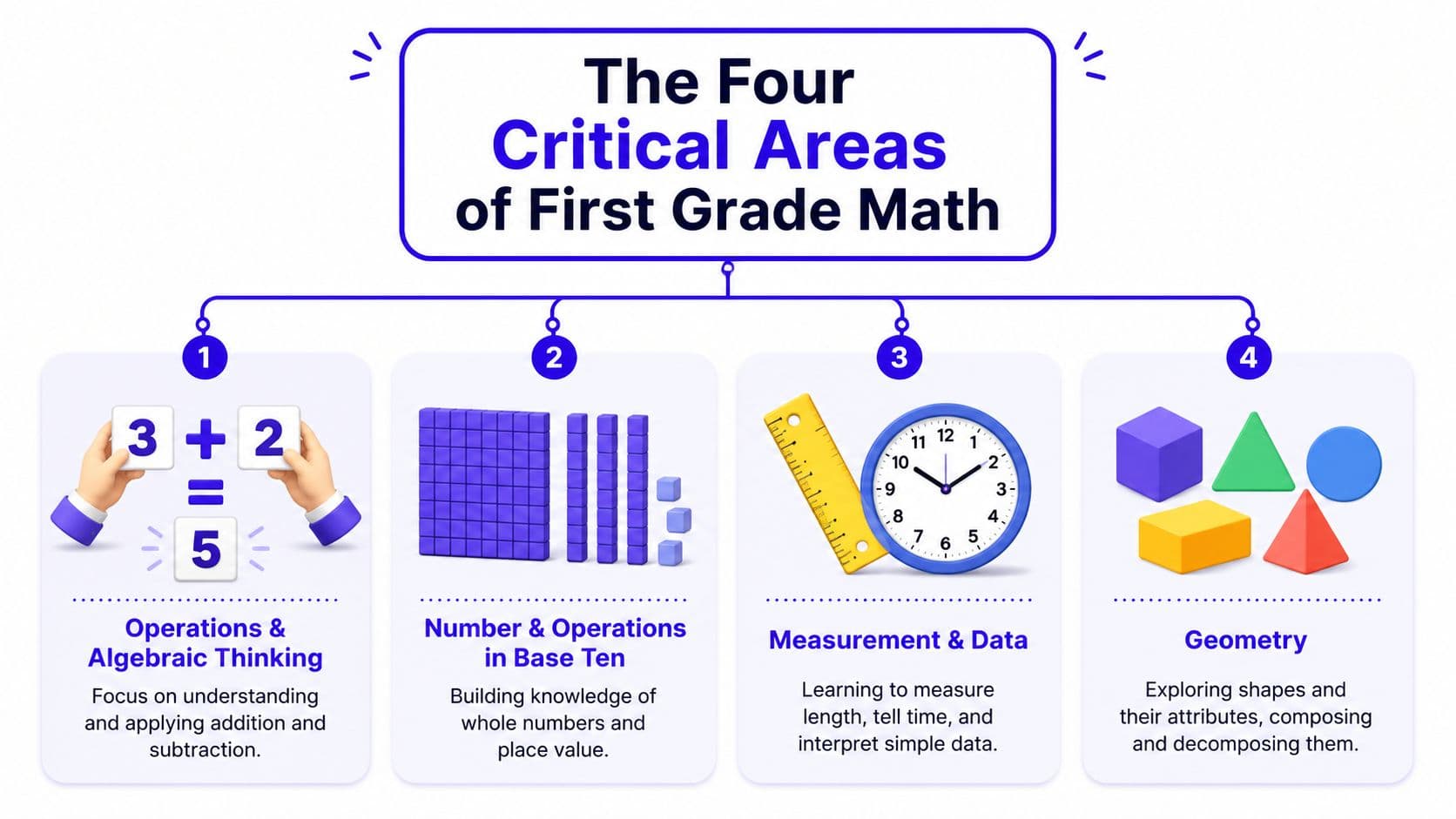
The easiest way to organize Common Core math 1st grade is around the four critical areas. According to the Grade 1 Common Core standards overview, instructional time in Grade 1 must focus on four critical areas, with the primary area being developing understanding of addition and subtraction strategies within 20, including solving word problems involving adding to, taking from, putting together, taking apart, and comparing with unknowns in all positions.
Operations and Algebraic Thinking
This is the heart of first grade. Students learn to make sense of addition and subtraction, not just compute. They solve story problems, represent unknowns, and begin to see equations as models of situations.
Children who understand problem structures are less likely to panic when the unknown moves. A student who can solve 8 + ? = 11 is doing more than finding a missing number. That student is learning how relationships between quantities work.
Number and Operations in Base Ten
This domain turns counting into place value. Students build understanding of tens and ones, extend the counting sequence, and use number structure to reason about larger numbers.
That shift is huge. Counting every object one by one may work for small sets, but it won't support efficient thinking later. Base-ten understanding is what helps a child see that 42 is not “4 and 2,” but four tens and two ones.
Measurement and Data
This area is often treated like an extra. It shouldn't be. Measuring with equal-sized units, comparing lengths, telling time, and sorting data all build mathematical reasoning.
Students learn that units matter, that comparisons must be consistent, and that information can be organized and discussed. Those are habits of mind they'll use far beyond first grade.
Geometry
Geometry in first grade is about attributes, structure, and composition. Students sort shapes by defining features, build larger shapes from smaller ones, and begin using words like halves and fourths when partitioning circles and rectangles.
Geometry gives many children an entry point into math that feels less intimidating than computation. It also strengthens language, observation, and spatial reasoning.
| Critical area | What students do | Why it matters |
|---|---|---|
| Operations | Solve addition and subtraction problems | Builds strategy and problem-solving |
| Base ten | Group numbers into tens and ones | Creates place value understanding |
| Measurement and data | Measure, compare, tell time, sort data | Connects math to daily life |
| Geometry | Describe and compose shapes | Develops visual reasoning |
If your plans keep those four areas visible, the year becomes much more coherent.
Operations and Algebraic Thinking in Action
The fluency debate commonly emerges in discussions around Common Core. Some people hear “Common Core” and assume it downplays basic facts. It doesn't. It changes the order. Students build efficient strategies first, and fluency grows from those strategies.
According to the Grade 1 mathematics introduction from the Common Core standards, first-grade instruction prioritizes developing fluency in addition and subtraction within 20, building on prior fluency within 10, because that progression supports solving word problems with unknowns in all positions.
Understanding before speed
If a child solves 8 + 5 by saying, “I made ten. I moved 2 from the 5 to the 8, so now it's 10 + 3,” that's strong first-grade math. It may not sound as fast as memorization, but it's more durable.
Students need repeated work with strategies such as:
- Counting on: Start with the larger number and count forward.
- Making ten: Break apart a number to complete a ten.
- Using doubles or near doubles: Use known facts like 6 + 6 to solve 6 + 7.
- Acting out story problems: Use counters, drawings, or fingers when needed.
What doesn't work well is handing out pages of mixed facts before students have a strategy. Some children will memorize. Many will guess, count inefficiently, or shut down.
When a student relies on a strategy, that isn't a sign they're behind. It's a sign they're building the path to fluency.
A mini-lesson for unknowns in all positions
Try a short lesson with a problem like: “Sam has 8 stickers. He gets some more. Now he has 11. How many did he get?”
Use this sequence:
- Read the problem aloud twice.
- Act it out with cubes or counters.
- Ask students what is known and what is missing.
- Model 8 + ? = 11 with a drawing or equation.
- Invite multiple strategies. One student may count on from 8. Another may build to 11 with cubes.
- Compare methods. Ask which strategy was efficient and why.
That comparison piece matters. It helps students see math as reasoning, not answer collecting.
Practice that matches the standard
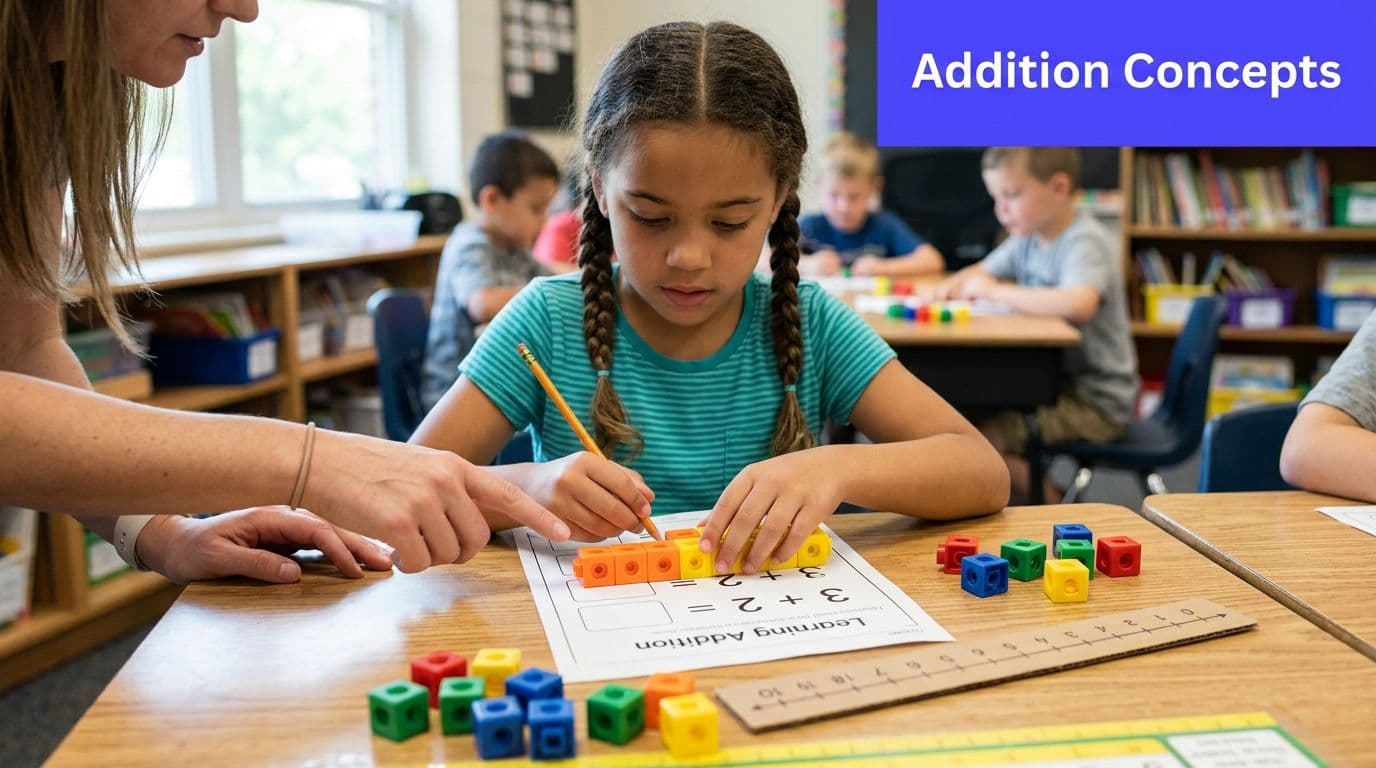
A number talk, a story problem routine, and one focused game will usually teach more than a packet of random problems. If you want printable practice tied to one strategy, first-grade addition worksheets can save planning time when you need targeted pages rather than generic drill.
Later in the week, this kind of visual support can help students connect classroom modeling to written work:
Keep the routine simple. Teach one structure well, revisit it often, and don't confuse activity with understanding.
Building Number Sense with Base Ten and Measurement
Place value is where many first graders either level up or stay stuck in counting mode. If students don't understand tens and ones, every later number task gets harder than it needs to be.
The standards expect students to count beyond 100, work with place value, and reason with two-digit numbers. They also need to connect number sense to measurement and time, which is where math starts to feel useful instead of abstract.
Teaching tens and ones so it sticks
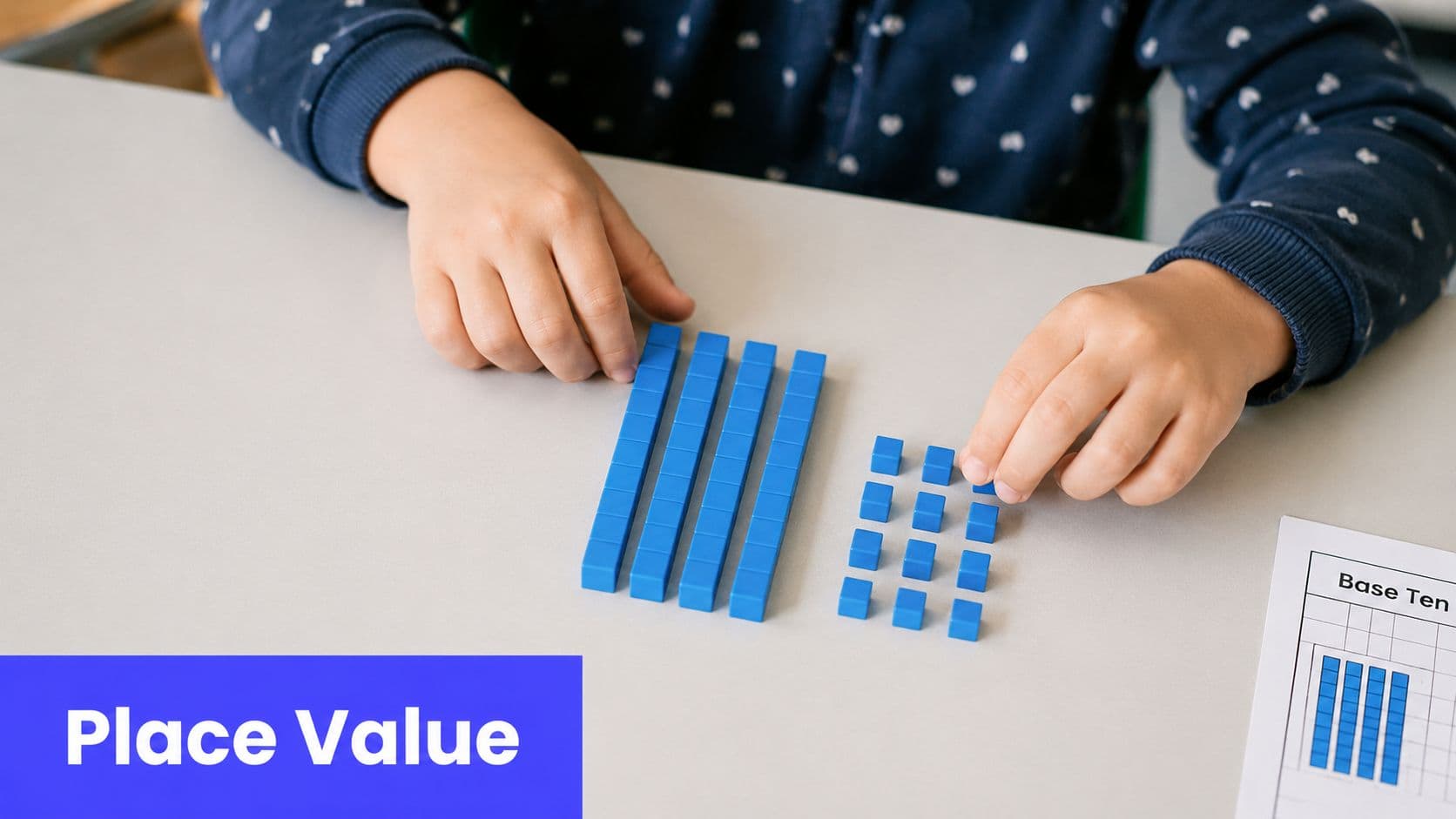
Don't start with worksheets that ask students to circle tens and ones. Start with objects they can physically group. Bundled straws, linking cubes, and base-ten blocks all work because students can see that a ten is made of ten ones.
A solid sequence looks like this:
- Count loose objects first: Let students count a group one by one.
- Create bundles of ten: Tie or group sets of ten so children see efficiency.
- Name the structure: Say “3 tens and 4 ones” before saying “34.”
- Match representations: Connect objects, drawings, number words, and numerals.
- Use place value language daily: “What changed, the tens or the ones?”
One helpful follow-up is using number bond teaching ideas to show how numbers can be composed and decomposed. That supports both place value and later addition strategies.
The 10 more and 10 less idea
This is one of the cleanest tests of place value understanding. If students know that adding ten changes the tens digit and keeps the ones digit the same, they're starting to think structurally.
I don't teach this with tricks. I teach it with base-ten blocks and place value charts. Students physically swap in another ten rod and describe what happened. After enough repetition, the mental jump becomes natural.
Classroom shortcut: Ask, “Did the ones change?” before asking for the answer. That question keeps students focused on place value instead of counting.
Measurement and data in real classroom routines
According to the Grade 1 standards from CCSSO, first graders must measure lengths indirectly by iterating equal-sized length units and understand indirect comparison, while also telling and writing time to the hour and half-hour on analog and digital clocks.
That sounds formal, but it's very teachable.
Use paper clips, cubes, or craft sticks to measure classroom objects. The key is consistency. Students need to place equal-sized units end to end without gaps or overlaps. For time, move back and forth between real schedules and clock models. “Lunch starts at the half-hour” means more when it's attached to their day.
A simple class survey also covers useful data work. Ask a question with up to three categories, such as favorite recess game or favorite fruit. Then have students sort responses and answer questions about which category has more, less, or the same.
| Routine | Math idea |
|---|---|
| Measuring a book with cubes | Equal units and length comparison |
| Daily schedule on clocks | Hour and half-hour time |
| Class graph survey | Organizing and interpreting data |
These lessons don't need to be fancy. They need to be concrete and repeated.
Making Geometry Fun and Accessible
Geometry tends to wake up students who don't always see themselves as “math kids.” Put pattern blocks on a table, and suddenly everyone has something to say. That's part of why geometry matters in first grade. It builds vocabulary, attention to detail, and confidence.
The standards are more specific than many teachers realize. The Common Core Grade 1 math overview on Education.com notes that students must distinguish defining attributes of shapes, such as a triangle being closed and three-sided, from non-defining attributes like color or orientation, and they must compose two-dimensional shapes such as rectangles, squares, and trapezoids to create composite shapes.
The triangle lesson every first-grade teacher needs
A classic moment happens when you show children several triangles and one is turned upside down. A few students will insist it isn't a triangle anymore. That's where the key lesson begins.
I usually put up a mix of shapes. Some are triangles in different sizes and positions. Some are not triangles because they're open or have too many sides. Then I ask, “Which ones belong together?” Students argue in productive ways, and their language gets sharper fast.
What they need to learn is simple:
- Defining attributes matter: Number of sides, closed figure, straight edges.
- Non-defining attributes don't: Color, size, direction, whether it's “pointing up.”
- Careful looking beats guessing: Children should justify, not just identify.
A shape doesn't stop being itself because it was rotated, stretched larger, or colored blue.
Composition is where geometry gets interesting
Flashcards alone won't get students there. Give them pattern blocks, cut paper shapes, or even sticky notes. Ask them to build a rectangle from two smaller shapes, or make a larger shape from several pieces and describe what they used.
That kind of task does two useful things at once. It develops spatial reasoning, and it pushes students to use mathematical language in a natural way.
Try prompts like these:
- Build and describe: “Use two shapes to make a rectangle. What did you use?”
- Sort and defend: “Put these shapes into groups and explain your rule.”
- Find the error: “Which shape is not closed? How do you know?”
- Compose and compare: “Can two different combinations make the same larger shape?”
Early fraction language through partitioning
First grade also introduces equal shares. Students partition circles and rectangles into halves and fourths, and they learn that more equal shares means smaller shares.
That work should stay visual and hands-on. Fold paper rectangles. Cut play-dough circles. Shade equal parts on whiteboards. Keep bringing students back to the word equal. Without that idea, halves and fourths turn into random slicing.
Geometry works best when students touch, build, rotate, sort, and explain. Once that happens, shape work stops feeling like a side topic and starts feeling like real math.
Differentiating for Every Learner in Your Classroom
This is the part most resources skip. They list first-grade standards, hand you a few practice pages, and act like every child in the room is starting from the same place. That's not real teaching.
The gap is especially obvious with word problems and place value. As noted in Third Space Learning's discussion of first-grade math problems, existing content often lists topics but doesn't answer how teachers can differentiate instruction for students who enter first grade with kindergarten-level readiness or more advanced skills while still meeting Common Core expectations.
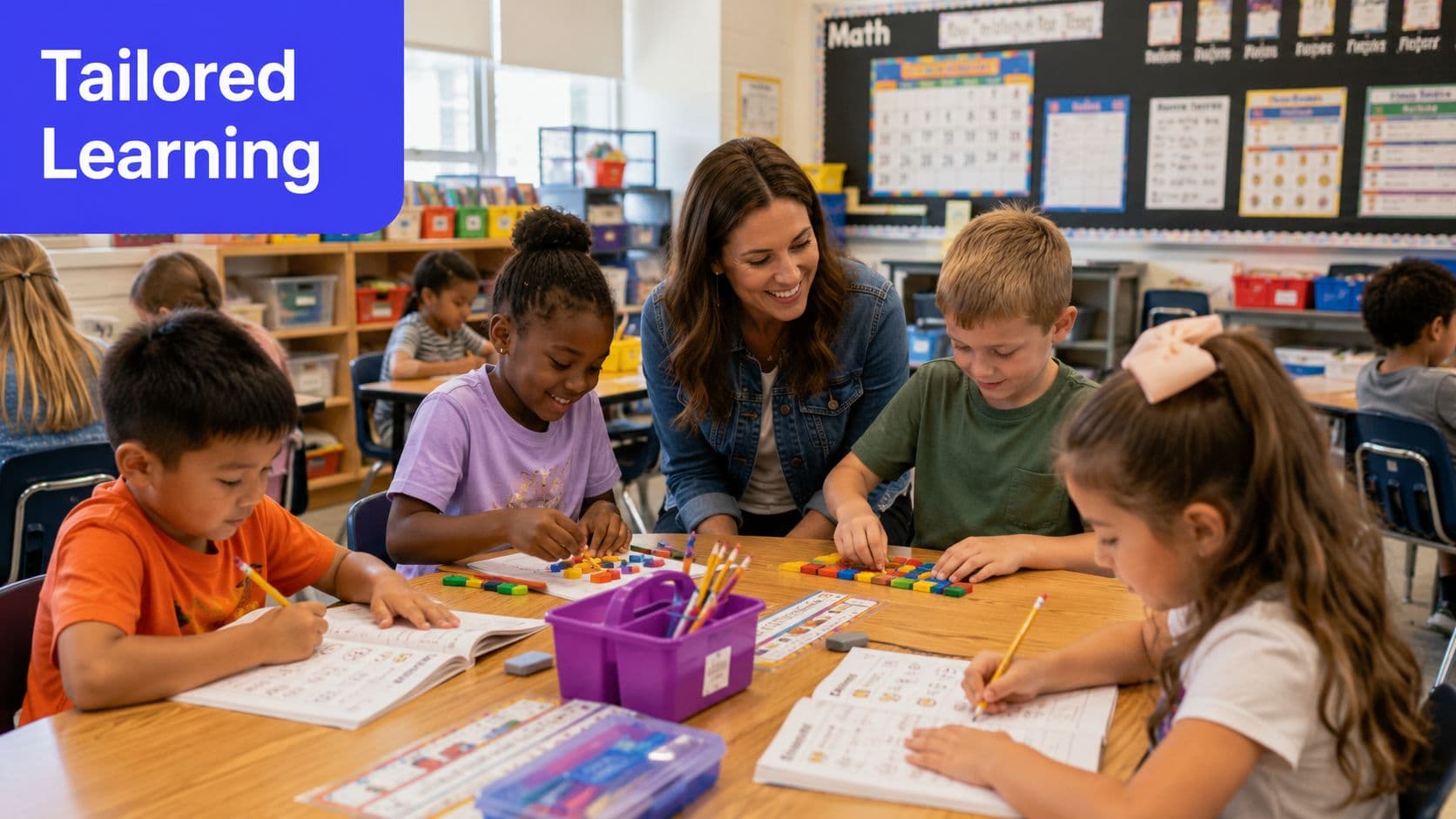
What struggling students actually need
Students who are behind usually don't need more problems. They need fewer barriers.
For word problems, these supports help:
- Read aloud and retell: Let students hear the problem, then say it back in simple language.
- Use concrete models before equations: Counters, cubes, and drawings reduce language load.
- Keep the structure, lower the demand: Use smaller numbers while teaching the same problem type.
For place value, the scaffolds are different:
- Build numbers physically: Tens and ones have to be seen and touched.
- Limit visual clutter: Too many boxes, arrows, and icons can bury the math.
- Ask one thinking question at a time: “How many tens?” works better than a multi-step prompt.
What advanced students need instead
Fast finishers don't automatically need second-grade worksheets. They often need richer first-grade tasks.
Give them open questions:
- Multiple methods: “Show two ways to solve this.”
- Missing information: “What number could go in the box? Is there more than one answer?”
- Justification tasks: “Which strategy is more efficient and why?”
- Shape challenges: “Can you build the same composite shape in two different ways?”
That keeps them inside grade-level ideas while raising the level of reasoning.
A practical way to plan differentiated materials
The hard part isn't knowing differentiation matters. The hard part is making three useful versions of one lesson before tomorrow morning.
That's where tools can help if you use them carefully. A planning tool like Kuraplan's differentiation teaching strategies guide is useful for generating multiple versions of practice from one objective, such as a version with visual supports for emerging learners and a version with extension prompts for students ready to explain and generalize. The value isn't automation for its own sake. The value is getting materials that match the learners in front of you.
Instructional reminder: Differentiate the access point, not the expectation that students think.
That's the mindset that makes Common Core math 1st grade work in a mixed-readiness classroom. Some students will use counters longer. Some will move quickly to mental strategies. Some will need sentence frames to explain a shape. Others will debate efficient methods. Your job isn't to force them into the same path. It's to keep them moving toward the same mathematical ideas with the right support.
If you're trying to make first-grade math planning more manageable, Kuraplan is worth a look. It's built for teachers who need standards-aligned lessons, differentiated worksheets, and classroom-ready visuals without spending all evening formatting materials by hand.