You're in the middle of a lesson. A few students are with you right away. A few are hanging on. One is staring at the page because the reading level is too high. Another could do the work, but not in English yet. Another understands the concept and is already bored.
That moment is where equity in education stops being a slogan and becomes a daily professional decision.
Most teachers don't need another lecture about fairness. They need practical ways to respond when student readiness, language, background knowledge, confidence, and access are all different at once. They need approaches that help without adding two more unpaid hours to planning. They need school systems that stop talking about equity in broad terms and start supporting it in lesson design, assessment, staffing, and resource use.
Why Equity in Education Matters More Than Ever
In most classrooms, the gap shows up long before it appears in a spreadsheet. You see it in who starts quickly, who asks for help hesitantly, who never turns work in because they've already decided they can't do it, and who has learned how to sound capable while missing the foundation underneath.
That isn't just about effort. It's often about access, support, prior opportunity, and whether the school is set up to respond to real student differences.
Across OECD countries, socio-economically advantaged students scored 93 points more in mathematics than disadvantaged students, and that gap was higher than 50 points in 22 countries while staying 50 points or less in only 13 countries, according to the OECD's overview of education equity. The same OECD summary also notes that increased funding per student is consistently associated with better educational outcomes, which matters because schools can't equalize opportunity with good intentions alone.
What this means on a Tuesday morning
Teachers usually inherit the consequences of inequity before they get the tools to address it. The result is familiar. One assignment lands very differently across the room because students aren't starting from the same place.
Practical rule: If a task works well only for students who already have strong reading, stable support, and confidence at school, the task may be rigorous, but it isn't equitable.
That's why the conversation has to move beyond identical treatment. Schools that are serious about access usually do the slower, less glamorous work of adjusting instruction, providing support early, and building structures that help students participate fully. A useful starting point is understanding inclusive learning environments, because inclusion and equity overlap in the places teachers feel most every day: belonging, access, and participation.
Why the urgency feels different now
The pressure on schools has changed. Teachers are serving students with wider academic ranges, more varied language needs, and very different levels of outside support. At the same time, schools are still judged by outcomes.
That's exactly why equity matters more now. It isn't an extra initiative. It's the condition for meaningful learning in a mixed-readiness classroom.
Equity vs Equality What It Really Means in the Classroom
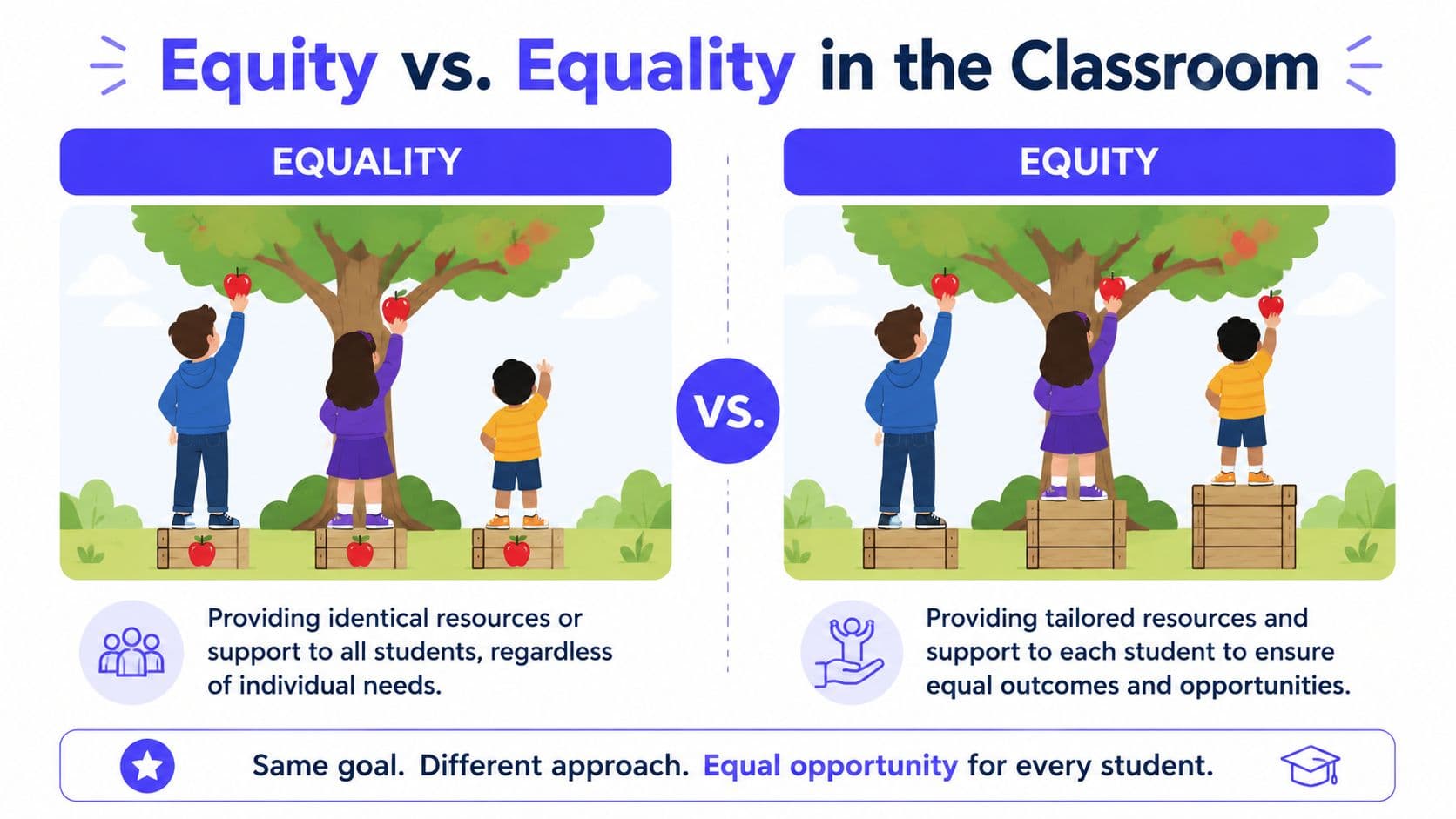
Teachers hear these terms constantly, but they get blurred together in practice. Equality means giving every student the same thing. Equity means giving each student what they need to reach the goal.
That sounds simple until you're planning for tomorrow.
The fence analogy still works
The classic image is three people trying to see over a fence. Equality gives each person the same box. Equity gives different supports so each person can see.
In class, equality is handing out the same article, the same directions, the same time limit, and the same product format. Equity is asking whether each student can access the task. One student may need text read aloud. Another may need chunked directions. Another may need a more complex extension task because the standard has already been met.
What it looks like in real classrooms
Here's a straightforward comparison:
| Classroom decision | Equality | Equity |
|---|---|---|
| Reading assignment | Everyone gets the same text | Students get versions or supports that keep the same goal but improve access |
| Discussion | Same question for all | Different entry points so more students can participate meaningfully |
| Assessment | One product format | Multiple ways to show learning |
| Teacher support | Attention goes to the loudest needs | Support is planned based on who needs what, not who asks first |
The mistake schools make is treating sameness as fairness. It isn't. Sameness often protects the students who were already positioned to succeed.
A frequently overlooked angle in equity discussions is the lack of individualized, AI-driven lesson differentiation that directly closes socioeconomic achievement gaps through daily instruction. While tutoring is proven to reduce socioeconomic gaps in achievement gains, most equity frameworks focus on broad resource allocation or later interventions rather than the daily pedagogical moment, as discussed in this research on tutoring, AI, and instructional differentiation.
The trade-off teachers feel
Differentiation is the right move, but it can also become unsustainable if every lesson requires manual rewriting. That's where many teachers get stuck. They understand equity perfectly well. They just can't redesign everything from scratch every night.
Sometimes the clearest classroom conversations about fairness come from social studies and civics work. A lesson like this 14th Amendment and equality resource can help students wrestle with the same distinction between equal treatment and equitable access in a concrete way.
Equity doesn't lower the bar. It changes the path so more students can reach it.
The Data and Signs of Educational Inequity
The broad data matters because it tells us what to stop calling isolated problems. When the same patterns repeat across systems, the issue isn't one struggling student or one ineffective teacher. The issue is structure.
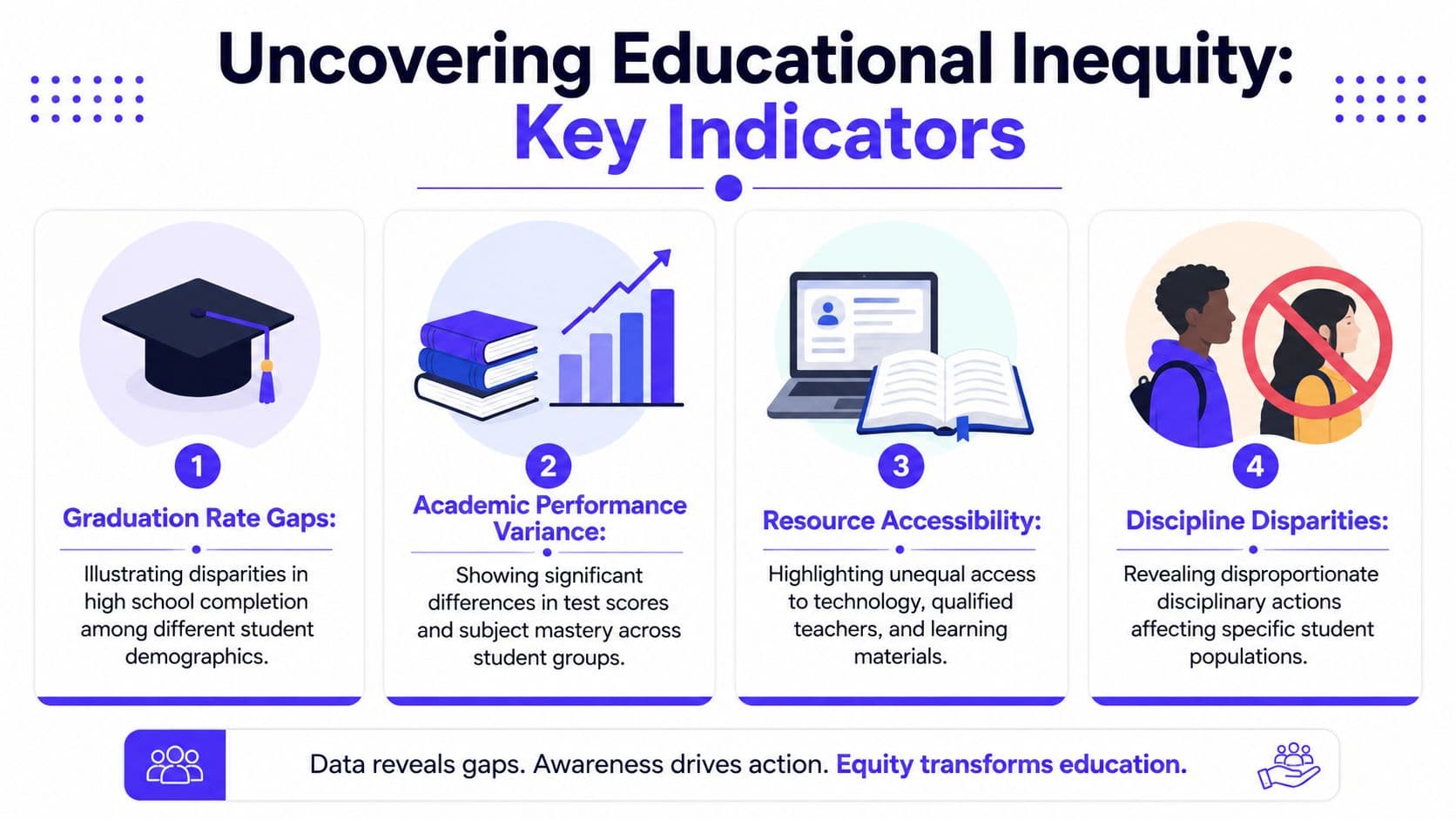
Across OECD countries, disadvantaged students attending advantaged schools score 78 points higher on average than disadvantaged students attending disadvantaged schools, based on the OECD publication on equity in education and school composition. That matters because it shows school context changes outcomes even when student background does not.
Signs schools can actually look for
You don't need a research team to spot inequity. Most schools already have the clues. The problem is that they often look at each clue in isolation.
Watch for patterns like these:
- Course access gaps: Which students consistently appear in advanced coursework, enrichment, student leadership, or high-visibility opportunities?
- Intervention patterns: Who gets support only after failing, instead of before the struggle hardens into disengagement?
- Instructional inconsistency: Are some classrooms rich with scaffolds, visuals, and flexible assessment while others rely on one text and one task?
- Participation gaps: Who speaks, who avoids risk, who is absent more often, and who disappears during independent work?
- Family navigation burden: Which families can work the system because they know how schools operate, and which families need the school to be clearer and more proactive?
What the data often looks like locally
In practice, inequity often hides inside routine school processes. It can show up in who gets the experienced teacher, who has access to strong intervention, whose IEP or language supports are implemented consistently, and which students are expected to “catch up” without adjusted instruction.
A useful test is this: if two students have the same potential but one needs a lot more luck to succeed in your school, there's an equity problem.
Schools often call these differences “student factors” when they're really design factors.
The long-term consequences become visible later. Barriers to college access don't begin in twelfth grade. They start much earlier, especially for students navigating financial, legal, or documentation challenges. Counselors and secondary teams doing equity work should know where to direct families, including practical guides like these college resources for undocumented students, because access depends on information as much as aspiration.
What not to do with inequity data
Don't reduce equity review to a yearly compliance slide deck. Don't stop at average scores. And don't treat subgroup gaps as unfortunate but inevitable.
Useful data work asks tougher questions:
- Where are the gaps widest?
- Which students get the strongest teaching conditions?
- Which policies are creating friction for the same groups over and over?
- What changes can staff make this term, not just next year?
That last question is where schools usually either make progress or stall out.
Actionable Strategies for Building an Equitable Classroom
Teachers don't need abstract commitments. They need moves they can use tomorrow, next week, and during the part of the year when everyone is tired.

The biggest shift is this: stop treating equity as something you add after the lesson. Build it into the lesson from the start.
Start with access, not rescue
A lot of well-meaning classrooms run on rescue. The teacher gives one version of the lesson, watches some students struggle, then tries to patch the problem in real time. That's exhausting for everyone.
A better approach is planning for variability up front.
- Clarify the essential goal: Decide what students must learn. Then separate that from how they'll access the content or show understanding.
- Remove avoidable barriers: If reading complexity isn't the standard, don't let it become the gatekeeper.
- Offer more than one route: Build options for reading, discussion, writing, visuals, and demonstration of learning.
That's the practical core of Universal Design for Learning. It isn't a poster. It's a planning habit.
Use small forms of differentiation that are sustainable
Teachers often hear “differentiate” and picture three full lesson plans for every class. That's not workable. The better question is: what are the smallest adjustments with the biggest payoff?
Try this checklist:
- For directions: Provide a written version, a spoken version, and a model example.
- For reading: Chunk longer texts, pre-teach key vocabulary, and give sentence stems before discussion.
- For output: Let students explain through writing, speaking, labeled diagrams, or guided response formats when the standard allows it.
- For pacing: Build one extension task and one support task instead of trying to individualize every minute.
A practical overview of differentiation teaching strategies can help teachers tighten these choices without turning planning into a second job.
Teach culturally, not just efficiently
Equity isn't only about scaffolds. It's also about whether students can recognize themselves in the curriculum and whether classroom norms reward only one way of speaking, participating, or showing intelligence.
That means asking better planning questions:
| Planning question | Inequitable version | More equitable version |
|---|---|---|
| Whose knowledge counts? | Only textbook examples | Examples connect to multiple communities and lived experiences |
| What does participation look like? | Fast verbal response only | Turn-and-talk, written reflection, visual response, partner rehearsal |
| What gets praised? | Compliance and speed | Growth, reasoning, collaboration, revision, and persistence |
Research shows that states rewarding schools for equity measures can improve outcomes for underserved youth, but the gap in many schools is translating those goals into lesson-level assessments and differentiation strategies, where teachers have the most impact, as noted by the Learning Policy Institute's work on advancing educational equity for underserved youth.
After you've thought through those classroom moves, it helps to see a concrete explanation of the mindset behind them:
Build support into assessment, not just instruction
Some classrooms are supportive during teaching and then become rigid during assessment. That undercuts the whole effort.
Better practice looks like this:
- Use clear success criteria: Students should know what counts before they begin.
- Check understanding early: Catch confusion in the first ten minutes, not after the grade goes in.
- Analyze who misses what: If one group consistently misses the same type of item, that's instructional feedback, not just student error.
- Revise after evidence: Equity includes second chances when the goal is learning, not sorting.
The fairest classroom isn't the one with the same pathway for everyone. It's the one where support is planned, visible, and normal.
How School Leaders Can Champion and Implement Equity
Classroom effort matters, but teachers can't carry systemic inequity by themselves. If leaders want equity in education to last, they have to build it into staffing, schedules, resource allocation, professional learning, and accountability.
The clearest sign that a school is serious about equity is not the mission statement. It's what the principal protects when time and budget get tight.
Start with an honest equity audit
Most schools already have enough information to begin. They just haven't organized it around equity questions.
Look at:
- Who teaches which students: Are novice teachers concentrated with the highest-need groups?
- Who gets access: Which students enter advanced courses, intervention blocks, specialized supports, and enrichment?
- Where resources land: Are strong materials, technology, and instructional coaching distributed where need is highest?
- How policies function: Which attendance, grading, discipline, or placement practices create barriers for the same students repeatedly?
This review has to be specific. “All students deserve excellence” doesn't help a leadership team decide whether multilingual learners have consistent access to grade-level content with appropriate support.
Fund what changes opportunity
The hard trade-off is that every budget reflects priorities. If a school says equity matters but protects every legacy expense before student support, the message is clear.
The verified evidence base is blunt on this point. Higher student-teacher ratios, reduced funding per capita, and limited access to advanced courses correlate with negative educational outcomes, while increased funding and lower ratios improve graduation rates and post-graduation employment metrics in the UNESCO higher education global data working document. That same document notes that enrolment gaps in higher education between the poorest and richest populations can reach 60 percentage points or more, including Bolivia at 1% for the poorest versus 66% for the richest.
Those are higher education figures, but K-12 leaders should read them as a warning. The conditions that shape those access gaps start much earlier with coursework, counseling, expectations, stability, and school quality.
Don't outsource equity to a committee
Schools sometimes create an equity team and unintentionally isolate the work. The committee becomes responsible while the rest of the system continues as usual.
A stronger leadership approach looks different:
- Make equity part of instructional leadership. Classroom walkthroughs should look for access, participation, task quality, and responsiveness, not just pacing and compliance.
- Make it part of team planning. Departments and grade-level teams should examine which students are thriving, which are not, and how the lesson design contributed.
- Make it part of hiring and retention. Schools need staff who can teach diverse learners well, and they need structures that keep those staff members.
- Make it part of principal messaging. What leaders praise gets repeated. If leaders only celebrate test movement and calm hallways, teachers get that message.
Give teachers usable support
Teachers don't need one inspirational workshop in August. They need time, models, coaching, and planning structures that help them turn equity goals into daily instruction.
That means professional learning should include things like common protocols for analyzing subgroup performance, examples of scaffolded grade-level tasks, and collaborative planning routines that reduce the burden on individual teachers.
Leadership sets the conditions. Teachers do the daily work inside those conditions.
If leaders want better outcomes, they have to make equitable instruction easier to do consistently, not harder.
Measuring What Matters for Lasting Educational Equity
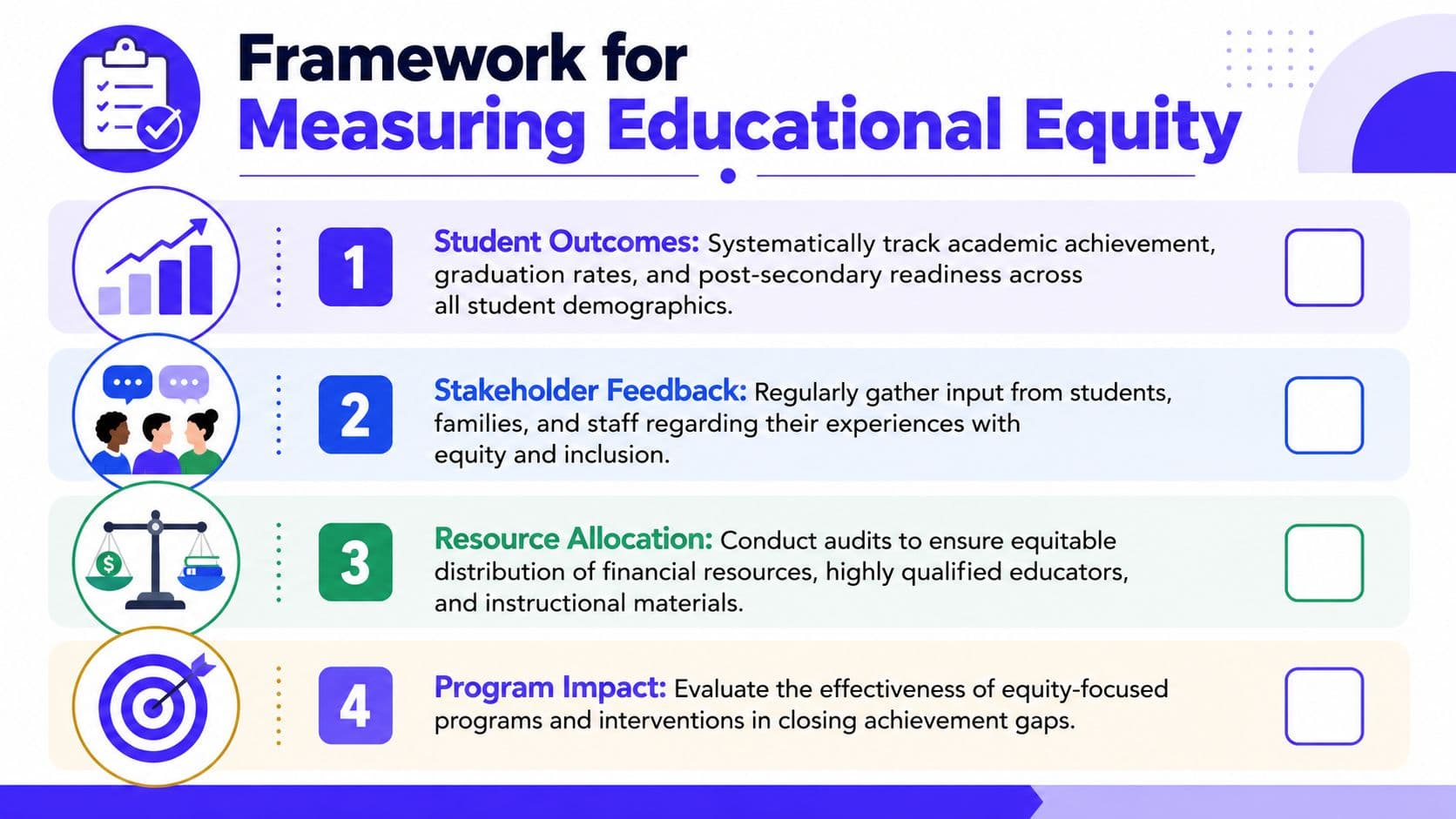
Schools lose momentum on equity when they measure only what is easiest to count. Test scores matter, but they don't tell the whole story. A school can raise scores in one area and still leave large groups of students feeling excluded, underestimated, or cut off from meaningful opportunity.
A better approach tracks both outcomes and conditions.
Measure the student experience, not just the result
Start with the basic question: what would you expect to see in an equitable school if it were effectively working?
You'd expect students from different groups to have real access to strong instruction, timely support, challenging coursework, and adult relationships that help them persist. You'd also expect fewer patterns where the same students repeatedly carry the burden of weak systems.
A useful school dashboard usually includes both quantitative and qualitative indicators.
| What to track | What to ask |
|---|---|
| Academic outcomes | Which groups are mastering standards, and where do gaps remain? |
| Access indicators | Who gets advanced coursework, interventions, leadership opportunities, and experienced teachers? |
| Climate and belonging | Do students feel known, challenged, and safe taking academic risks? |
| Instructional quality | Are students regularly getting accessible, rigorous, responsive tasks? |
Use classroom evidence more seriously
Schools often collect broad climate data but miss the lesson-level evidence that predicts whether equity work will hold. That evidence includes assignment quality, participation patterns, re-teaching decisions, and whether assessments allow students to show what they know.
Understanding formative vs summative assessment becomes useful. If schools rely only on end-point measures, they learn too late. Formative checks show whether the instruction itself is widening or narrowing access while there's still time to respond.
Questions that keep the work honest
Teams doing this well return to a small set of recurring questions:
- Who is succeeding, and in what conditions?
- Who is being asked to adapt to the school, rather than the school adapting to support them?
- Which supports are dependable, and which depend on an individual teacher's goodwill or extra time?
- What changed in classroom practice after the school adopted an equity goal?
Notice that last question. Equity work becomes performative when adult practice never changes.
If your equity plan can't be seen in tomorrow's lesson, students won't feel it.
Keep the cycle tight
The strongest schools don't wait for annual review cycles to notice problems. They create shorter loops.
That can mean monthly team reviews of participation and assessment patterns, quick student listening sessions, regular audits of intervention access, and structured walkthroughs focused on instructional access. The point isn't to create more paperwork. It's to create faster feedback.
Lasting equity in education depends on that discipline. Schools improve when they check whether the students they most want to serve are experiencing better teaching, better access, and better chances to succeed.
Kuraplan helps schools turn equity goals into daily practice. Teachers can use Kuraplan to build standards-aligned lessons, differentiated materials, worksheets, visuals, and assessments without spending hours reworking everything by hand. For leaders, that means equitable instructional support becomes more consistent across classrooms. For teachers, it means the right supports are finally realistic on a busy week.