You know the feeling. You build a multiple choice quiz, the class takes it, and the score sheet comes back looking neat enough to file away, but the results don't tell you what you needed to know. Some students guessed well, some missed for reasons you can't quite trace, and the whole thing starts to feel more like a sorting device than a teaching tool.
That mismatch is the core problem with many classroom quizzes. The format exists because it can be scored efficiently at scale, not because it automatically measures understanding well. Multiple-choice testing grew in popularity in the mid-20th century when optical scanners and data-processing machines made large-scale grading practical, and the format later moved into computers in 1982 when Christopher P. Sole created the first multiple-choice examinations for computers on a Sharp Mz 80 computer, according to the history summarized on Wikipedia's multiple-choice overview. The legacy still shows up in classrooms now, where a quiz can be easy to administer and still fail to measure the thing you care about.
One reason this happens is simple. A multiple choice quiz always includes a guessing component, so the quality of the distractors and the scoring logic matter far more than is often considered. If you're also trying to anticipate who's ready for the next skill, a useful companion is predict candidate performance, because the same basic issue shows up there too, raw completion doesn't always equal valid measurement.
Why Your Multiple Choice Quiz Might Be Failing Its Purpose

A student can get through a quiz by using test-wise habits rather than real understanding. I've seen answer patterns, elimination tricks, and clue spotting carry a score farther than the content itself. The paper gets completed, but the result still does not tell you what students know.
That failure usually shows up in the item design, not just in the students. A multiple choice quiz can be scored quickly, which is why it stays popular, but quick scoring does not diagnose learning by itself. If the options are careless, the score mostly reflects format habits, not mastery.
Efficiency came before pedagogy
The multiple choice quiz solved a grading problem first. It let schools assess many students quickly and consistently, which is useful, but that same strength can hide weak measurement when teachers reuse the format without revising the items. The quiz then becomes easy to mark and hard to read.
Practical rule: if a question can be answered by spotting a pattern instead of thinking through the content, it is probably measuring the wrong thing.
Item quality matters more than item count. A stack of weak questions does not improve the evidence, it just produces more paper or more clicks. Fewer well-built items give you a clearer view of what students can do, especially when you are trying to separate content knowledge from guessing or routine test behavior.
Guessing can blur what scores mean
Multiple-choice items always leave room for random success. In a 4-option item, a student has a 25% chance of being correct on any single question by guessing. In a 6-question quiz with 5 answer choices and one correct answer, the probability of getting every item right by random guessing is (1/5)^6 = 0.000064, or about 0.0064% (algebra.com probability example). Those figures do not remove the guessing problem. They show how quickly probability can affect your interpretation of a score.
Weak distractors make that problem worse. Unequal answer lengths, grammar clues, and obvious throwaway wrong answers let students answer without pulling the target knowledge from memory. The quiz result can still look tidy while the learning picture stays blurred.
A better item design also gives you diagnostic value. Well-written distractors show which misunderstanding a student is carrying, and that matters more than a superficial check of whether the bubble is filled in. If you want the same kind of reasoning focus in another assessment context, the same logic behind predict candidate performance applies here too, completion alone does not prove understanding.
Kuraplan's multiple choice question guidance follows the same basic principle, build items that reveal thought, not just completion.
The Stepwise Workflow for Writing Effective Items
Strong items come from a workflow, not from inspiration. Start with one clear learning objective, then build a stem, the correct answer, and distractors that reflect how students think (expert guidance). That sequence keeps the question tied to the outcome instead of drifting into trivia or trickery.
A real classroom example makes the point clear. If the goal is to check whether students can apply a rule, the item should ask them to do that work directly. If the stem only asks them to recognize vocabulary, the quiz may look polished while missing the skill you meant to measure.
Start with one objective, not a topic list
A weak prompt often begins with, “What can I ask about this chapter?” A better prompt is, “What should students prove they can do here?” That small shift changes the quiz from a content sampler into an assessment of a specific skill.
A focused stem should stand on its own. It should not depend on a tangled paragraph or hide the task inside awkward wording. If the stem forces students to decode the language before they can think about the content, the item is already compromised.
Build one best answer, then write believable alternatives
A strong item has one indisputably correct answer and distractors that are plausible enough to reveal thinking, not just catch the careless. University guidance converges on three to five alternatives, with many experts preferring three well-crafted options because extra distractors often add little discrimination while increasing writing burden (Evidence Based Education, University of Connecticut guidance). The trade-off is practical, more options are not automatically better.
| Format | Writing Effort | Guessing Probability | Practical Use |
|---|---|---|---|
| 3 options | Lower | Higher than longer formats | Best when distractors are strong and time is tight |
| 4 options | Moderate | 25% on a single item by guessing | Common classroom default |
| 5 options | Higher | Lower guessing pressure per item | Useful only when all distractors are strong |
| 6 options | Much higher | Lower still, but harder to write well | Often too costly for little added value |
Review before you administer
Good items are not finished the moment you type them. They need a final check for clarity, bias, and alignment, then a post-administration review based on how students performed (PMC guidance). Look for overlapping choices, negative wording, or any clue that makes one option stand out for the wrong reason.
Rule of thumb: if the wrong answers are easy to eliminate without knowing the content, the item is testing tactics, not understanding.
Writing Distractors That Reveal Student Thinking
A quiz can look polished and still tell you very little about what students understand. The answer choices matter as much as the stem, because the distractors reveal what a student almost has right, what they confuse, and what pattern of error is showing up again and again.
A strong distractor is never random. It reflects a common mistake, a partial rule, or a misconception you have already seen in student work. The American Chemical Society is direct about this, implausible distractors weaken both reliability and validity because they stop doing measurement work (ACS guidance).
Make every wrong option mean something
If a student selects a distractor, that choice should give you useful information. In math, it might show they used the right procedure on the wrong value. In science, it might show they confused a definition with an example. In language arts, it might show they noticed a detail but missed the main claim.
That is why I like to build distractors from the same kinds of errors that appear in notebooks, exit tickets, and class discussion. The quiz then becomes a check for misconceptions, not just a score sheet. A clear overview of multiple choice question design helps here, because the point is not only to write an answer key, but to write options that separate genuine understanding from partial understanding.
Avoid the shortcuts that hide thinking
The shortcuts are tempting because they are easy to write and easy to grade. They also weaken the item. Guidance from teaching centers and university assessment sources warns against “all of the above”, “none of the above”, overlapping alternatives, and grammar clues that give away the answer (Waterloo guidance, Washington University summary).
“Write the wrong answers so that a thoughtful student could plausibly choose them.”
That rule holds up in real classrooms. If a distractor is obviously silly, students do not have to think. If it is too clever, the item turns into a trick question and the score stops reflecting the content. The best distractors sound like common-error language, not test-writer theater.
A better alternative to gimmicky options
Instead of “all of the above,” use a stem that asks students to identify the best explanation, the strongest evidence, or the most likely next step. Instead of “none of the above,” make every option substantive enough to deserve consideration. That keeps the item focused on reasoning, which is the primary purpose of the quiz.
The goal is to preserve diagnostic value. A well-written set of distractors shows where students are stuck, what they are confusing, and which misconception needs attention next.
Beyond Recall Multiple Choice for Higher-Order Reasoning
A multiple-choice quiz can do more than check memorization. When the stem is written with care, it can measure analysis, evaluation, and application without turning the task into a long written response. Washington University's guidance points in the same direction, effective items avoid tricky wording and ask students to use the same kinds of thinking they need outside the test.
That matters in real classrooms because strong MCQs can probe understanding without adding unnecessary marking time. A geometry item can ask students to reason through angle relationships in a diagram. A science item can ask which explanation best fits a scenario. A math item can ask what changes when a familiar idea is used in a new context.
A bad item only checks whether a student recognized a term. A better one asks them to make a judgment.
Use scenarios, not just definitions
A recall item asks for a label. A reasoning item asks for a decision.
That shift changes what the quiz measures. Instead of asking students to name a vocabulary term, present a short classroom, lab, or problem-solving situation and ask which principle applies. In STEM subjects, that works especially well because the correct answer depends on how students connect ideas, not on whether they memorized a phrase. If you want a quick way to build items like that, a quiz maker built for classroom use can help you draft scenario-based stems faster, then you can refine them for your own students.
Make the stem do more work
A strong reasoning item gives enough context to require thought, but not so much text that the task gets buried. Students should have to compare options, interpret evidence, or evaluate relationships. The best stems feel like small decisions with real stakes, not scavenger hunts for a keyword.
NCERT exemplar material explicitly uses multiple-choice questions in mathematics assessment, and geometry collections often use diagram-based reasoning around complementary, supplementary, and linear-pair relationships. That shows the format can support deeper cognition when the item is written to ask for it (NCERT-related exemplar reference).
Keep the cognitive load fair
Reasoning items should be demanding for the right reason. Washington University's guidance makes that practical point clearly, tests need to be difficult enough to matter, but not so hard that fewer than about 80% of students can pass. If an item is too difficult because the wording is tangled or the logic is opaque, it measures confusion more than learning. In that case, the score may be clean, but the information is not.
Well-written distractors help here too. They should reflect likely misconceptions, so the answer choice a student picks tells you what kind of thinking is breaking down. That is the primary value of higher-order multiple choice. It does not just sort right from wrong, it shows whether students can apply the idea, and where they are still guessing.
Accessibility and Differentiation in Quiz Design
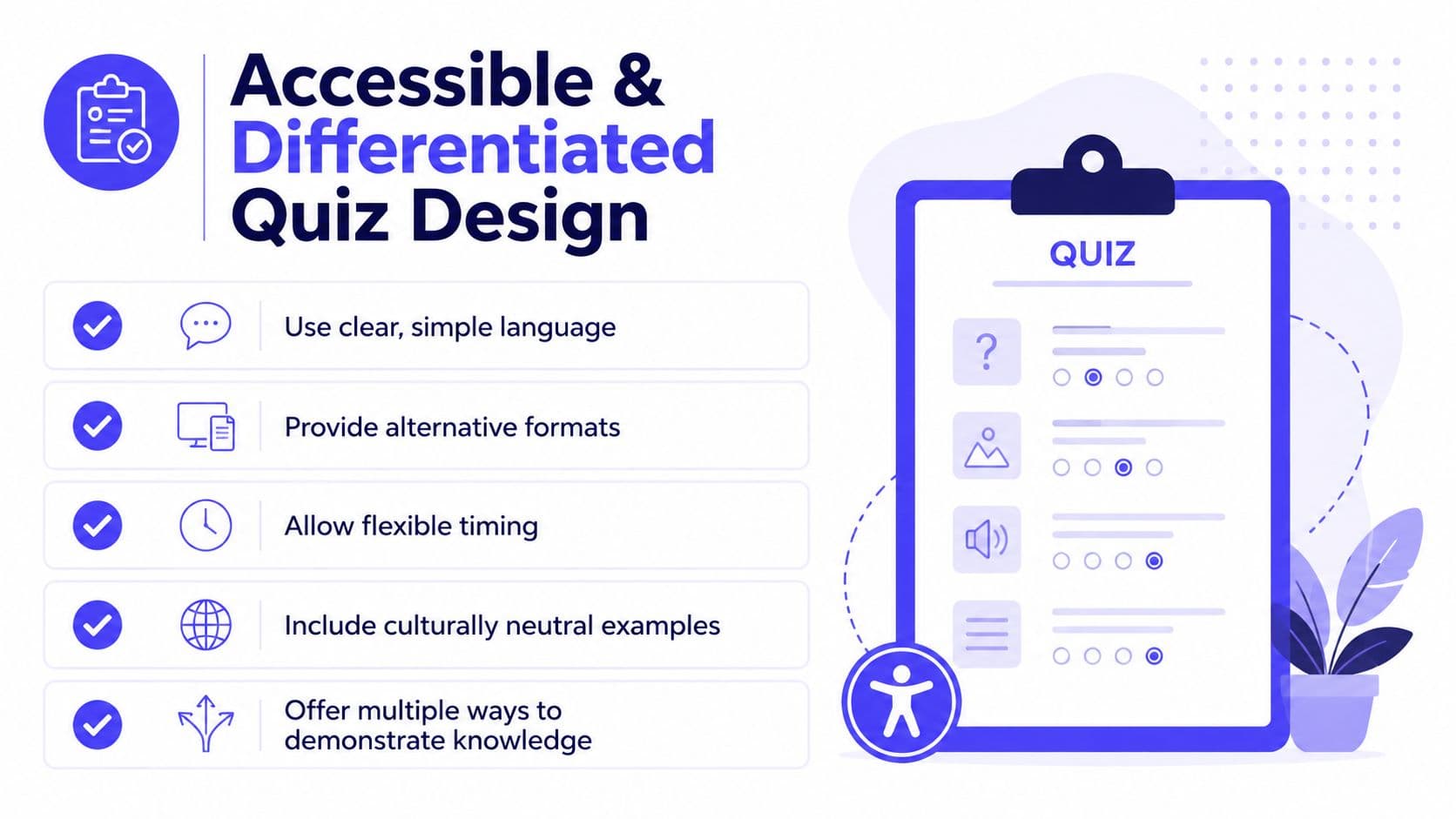
A quiz that only works for confident readers isn't a good quiz. It creates a measurement problem and an equity problem at the same time. Students with different reading levels, language backgrounds, and access needs all deserve a chance to show the same understanding without fighting hidden barriers.
Remove barriers that have nothing to do with the skill
Dense stems, long negative phrasing, and culturally loaded examples can distort results. The question may appear rigorous while testing whether the student can decode the teacher's wording. That's not a meaningful trade-off.
A cleaner stem, simpler syntax, and culturally neutral examples usually help everyone. Students who need support get access, and students who don't need support still benefit from clearer language.
Accessibility check: if a student with the right knowledge could still miss the item because of wording alone, revise the wording.
Differentiate without building a separate test
You don't need a parallel assessment for every learner profile. You can scaffold the same concept by adjusting the complexity of the context, the length of the prompt, or the amount of text the student must process. For some learners, a visual organizer before the quiz helps them map the content before they answer.
The goal is not to make the quiz easier in a blanket way. It's to make sure the item measures the target skill and not a hidden reading obstacle.
Use tools that help you review the design fast
Planning tools can save time, especially when you're trying to audit a whole assessment for barriers. Kuraplan, for example, generates standards-aligned lesson and worksheet materials and can produce multiple-choice items as part of that workflow, which makes it easier to move from objective to draft without starting from scratch every time. Used well, that kind of support frees you to spend more time checking clarity, bias, and alignment.
The point is simple. Differentiation should improve access without weakening the measurement. If it does both, the quiz is doing real work.
Streamlining Creation with AI Lesson Planning Tools
Writing a solid multiple choice quiz takes time, especially when you're doing it carefully. AI tools can help with the first pass, but they should never replace your judgment about content, difficulty, or misconception quality. The right role for AI is draft generation, not final authority.

Use AI for speed, then edit for accuracy
The smartest workflow is usually this, give the tool a learning objective, grade level, and skill focus, then review the generated items with your classroom knowledge. A tool such as Kuraplan's quiz maker can draft multiple-choice questions with answer options, which gives you a practical starting point instead of a blank page.
That draft still needs human editing. You'll want to check whether the stem is focused, whether the distractors reflect real student misconceptions, and whether the item fits the lesson objective.
Turn lesson plans into assessments faster
The time saver is when the lesson and the assessment live in the same planning flow. Instead of inventing a quiz after the lesson is already built, you can align the items with the objective while the content is still fresh. That keeps the assessment from drifting away from what you taught.
This is especially useful for formative checks. If a lesson needs a quick comprehension check at the end, an AI-assisted draft can get you there faster, and your expertise can handle the final polish.
Keep the workflow teacher led
The best AI use case here is not automation for its own sake. It's reducing the mechanical work so you can spend your energy on the parts that matter, alignment, clarity, and diagnostic value. If the quiz reflects your expectations and your students' actual errors, the tool has done its job.
That balance matters more than speed alone. A fast weak quiz still wastes time, but a fast draft that you revise carefully can save hours across a unit.
From Formative Checks to Summative Assessments
A multiple choice quiz can serve very different purposes depending on when you use it. In a formative check, the goal is quick evidence. In a summative assessment, the goal is defensible measurement. The same format can work for both, but the item quality should rise when the score carries more weight.
Formative quizzes can be lighter, not lazy
A short exit ticket or practice check does not need the same level of validation as a final exam, because the teacher is using it to adjust instruction in the moment. Even so, the items still need to be clear and aligned. A sloppy formative quiz gives you noisy data, and noisy data leads to wrong decisions.
Good formative questions tell you who needs help, what misconception is showing up, and whether the class is ready to move on. That is the value of a multiple choice quiz done well. In practice, the best quick checks still use distractors that reflect common student errors, because those wrong answers show you more than a right answer alone.
Summative quizzes need tighter control
When the quiz affects grades, placement, or reporting, the item-writing standard has to rise. The full workflow matters, objective, stem, best answer, plausible distractors, review, and then post-administration analysis. Because these scores can affect grades or placement, the design must be cleaner.
That is also when guessing and distractor quality matter most. If the options are weak, the score can overstate understanding or understate it for the wrong reasons. A well-built summative item should make students show the thinking tied to the standard, not just pick the first answer that looks familiar.
Use the results to do something specific
A quiz result should change instruction, not just generate a mark. If several students choose the same distractor, that is a signal to reteach the underlying misconception. If one group misses the same item because of reading load, the issue may be access rather than content.
For classroom systems, it helps to connect quiz data with broader assessment planning. The distinction between quick checks and unit-level measures is laid out clearly in Kuraplan's formative vs summative assessment guide, and that distinction is worth keeping in mind whenever you build a quiz bank. It keeps the quiz from being treated as a single tool with one purpose, when the actual purpose changes with the decision you need to make.
If you also want a way to keep the feedback loop moving after the quiz is done, Tutorbase features are useful to review alongside your own classroom process, especially when you are deciding how to communicate results and follow-up support.