If you're standing at the board, a fifth grader just said 18 for an expression that should've landed somewhere else, and three other kids are nodding like it makes perfect sense, you already know the problem isn't effort. It's the way order of operations for 5th grade has been handed to them, usually as a chant instead of a meaning.
That's why PEMDAS keeps causing trouble. Students memorize the letters, then they overapply them, especially when they think multiplication always beats division or subtraction always has to wait its turn. I've had plenty of fifth graders who can recite the acronym but still solve mixed expressions as if the page were a sequence of random rules instead of a set of consistent decisions. If attention is part of the issue in your room, these actionable focus tips for students can help you support the working habits that make multi-step computation less chaotic.
Why Order of Operations Trips Up So Many Fifth Graders
The hardest part is that a wrong answer can sound confident. A student looks at 8 - 2 × 3 and says 18 because they multiplied first, then subtracted in the order that felt familiar from a memory trick. They did not forget math. They followed the shortcut they were taught, and the shortcut set a trap.
The acronym is not the concept
Many children hear PEMDAS as a ladder, not a system. That is where the confusion starts. They see the letters and start hunting for a rule to apply in sequence, instead of reading the expression as a set of grouping decisions that guide what happens first and what stays attached.
What I see in classrooms is simple. Students are usually not resisting the rule, they are misreading what the rule means. They hear “M before D” and assume multiplication always wins, then they carry that mistake into every mixed expression they touch. The same issue shows up in studies of adults and older students, where literal acronym use and left-to-right errors keep appearing, which tells us the trouble begins with how precedence gets explained in the first place.
Practical rule: Stop treating PEMDAS like a script to chant. Treat it like a decision path, and make the path visible every time students work.
That mindset matters because fifth graders need more than a quick chant. They need to read an expression, see which parts are grouped, decide what changes first, and explain why the answer makes sense. If attention is part of the issue in your room, these actionable focus tips for students can help you support the working habits that make multi-step computation less chaotic.
What Fifth-Grade Standards Expect
Grade 5 is where many students meet order of operations in a formal way, but the standards are narrower and more precise than the acronym posters suggest. The Common Core standard 5.OA.A.1 asks students to use parentheses, brackets, or braces in numerical expressions and evaluate expressions that contain those symbols. The companion standard 5.OA.A.2 asks students to write simple expressions that record calculations and interpret numerical expressions without evaluating them (Common Core 5.OA).
That matters because fifth grade is not just about getting answers. It is about reading and writing expressions as mathematical language. Students need to see why grouping symbols change the sequence and how an expression tells a story about the work that is happening.
Where the boundary line sits
New York State is especially clear here. Its Grade 5 math snapshot says NY-5.OA.1 is the first formal experience with order of operations and explicitly says there is no expectation of nested bracket problems or problems involving exponents at this level. That gives teachers a clean boundary. Fifth graders should work with grouping symbols, but they do not need the deeper bracket nesting or exponent-based complexity that shows up later.
Some state guidance also connects the topic to broader computation. Georgia's Grade 5 unit on Order of Operations and Whole Numbers ties it to MCC5.OA.1 and MCC5.OA.2, along with whole-number work like paper-and-pencil multiplication algorithms and the effects of powers of 10. Washington State's Grade 5 standards place order-of-operations thinking alongside fluency with multi-digit multiplication, whole-number quotients, and decimal operations to hundredths, which shows this topic sits inside the larger computation block, not in isolation (Washington Grade 5 standards, Georgia unit guidance).
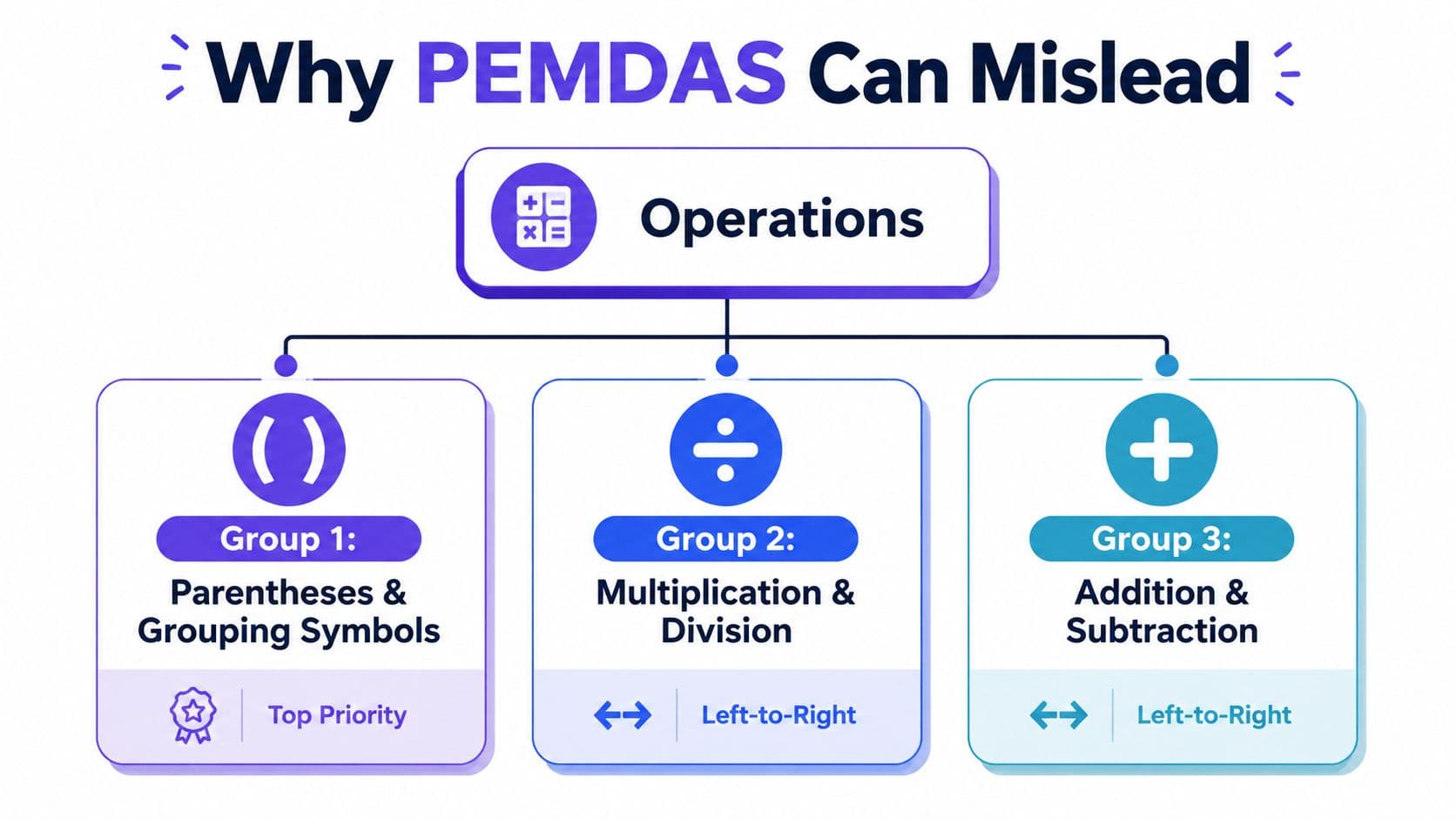
A clean way to frame it for students is this. First, solve what is inside grouping symbols. Then work across the expression from left to right within the same level. That is the language they need, not a rigid chant that sounds more precise than it really is.
PEMDAS Is a Teaching Trap and What to Teach Instead
PEMDAS sounds tidy, but in fifth grade it can send students in the wrong direction. The acronym makes it easy to hear the letters as a fixed ranking, so children assume multiplication always beats division and addition always beats subtraction. The problem is not the math. The problem is the way the shortcut gets interpreted.
Teach levels, not a ladder
Start with tiers. Grouping symbols come first. Then multiplication and division sit on the same level, and addition and subtraction sit on the same level. Inside each level, students read left to right. That is the part worth repeating, because it clears up the common “M before D” and “A before S” misunderstandings before they harden.
Curriculum guidance for Grade 5 points teachers toward that left-to-right reading within a level, and it warns that acronym language can steer students toward the wrong procedure. ScienceDirect makes that point directly in its discussion of precedence. Put this on the board instead, multiplication and division share a level, addition and subtraction share a level, and within each level students read left to right.
Teacher language that works: “Same level means same priority. If two operations are on the same level, I read from left to right.”
That framing matters because students should treat the rule as a way to keep answers consistent, not as a slogan to recite before they think. The acronym feels neat, but neat is not the same as clear. Fifth graders usually do better when the rule sounds like a procedure they can apply, not a chant they hope will save them.
If you want a compact comparison while planning, Kuraplan's BODMAS guide is a useful reference for seeing how acronym-based wording lines up with the underlying math.
What to say at the board
Use three short prompts:
- What's grouped?
- What's on the same level?
- What comes first from left to right?
Those questions slow the class down before anyone grabs a calculator or starts calling out answers. They push students to notice the structure of the expression first, then compute. That habit matters in fifth grade because many errors come from skipping the structure check and jumping straight to the arithmetic.
Three Worked Examples From Simple to Tricky
Students don't learn this by watching you talk through one neat example. They learn it by seeing the same decision pattern repeated with slightly different structures. The trick is to start simple, then add one layer of complexity at a time.

Example 1, grouping symbols only
Take (6 + 4) × 3. A lot of students want to multiply first because they see a “bigger” operation sitting outside the parentheses. The correct move is to solve 6 + 4 first, then multiply by 3, which gives 30.
The mistake to listen for is 30 + 4 or 6 + 12. Those answers usually show that the student treated the expression as separate pieces instead of one grouped calculation. Ask, “What does the parentheses tell you to do first?”
Example 2, mixed multiplication and addition
Now try 8 + 2 × 5. A student who works left to right without thinking may get 50. A student who overvalues multiplication may still get the right answer here, but for the wrong reason.
The correct order is multiplication first, then addition, so the answer is 18. The useful question is, “Which operations are on the same level, and where do you start reading?” That question exposes whether the student understands the rule or just remembers a sound.
Example 3, two operations inside grouping symbols
Now use 12 - (3 + 1) × 2. First simplify inside the parentheses, so 3 + 1 = 4. Then the expression becomes 12 - 4 × 2, and now multiplication comes before subtraction, giving 12 - 8 = 4.
A common wrong answer is 16 from subtracting before multiplying, or 14 from doing the subtraction inside the parentheses and then stopping. If a student loses track, have them rewrite the expression on the next line after each step. That simple move keeps the work clean and reduces copying errors. A practice set like Kuraplan's distributive property worksheet can also help if you want students to see how grouping and rewriting affect the structure of an expression.
A reliable classroom move: Rewrite the expression after every step. Fifth graders who keep the original problem visible usually make fewer copying mistakes than the ones who try to hold the whole expression in their head.
The Four Misconceptions You Will See This Year
The same four errors show up again and again in fifth grade, and they're worth naming directly because once you name them, you can fix them faster.
Misconceptions and quick fixes
| Misconception | What Students Think | Quick Fix |
|---|---|---|
| Ignoring parentheses | “They don't really change anything.” | Have students circle the grouped part before they compute. |
| Treating multiplication as always beating division | “M always comes before D.” | Ask them to solve the two operations from left to right when they're on the same level. |
| Computing strictly left to right no matter what | “Just start at the beginning every time.” | Use a finger-trace routine, then pause at grouping symbols before moving across. |
| Dropping or duplicating terms while rewriting | “I can copy the expression from memory.” | Require a fresh rewrite on the next line after each step. |
What each mistake is really about
Ignoring parentheses usually means the student doesn't yet see grouping symbols as instructions. They treat them like decoration. A pencil bracket around the inside of the expression helps because it makes the structure visible before the computation starts.
The multiplication-over-division mistake is the acronym problem in disguise. Students have internalized a chant instead of a rule. Left-to-right practice on expressions like 12 ÷ 3 × 2 makes the equality of the operations much clearer.
The left-to-right-everywhere error comes from overgeneralizing a simple strategy. It feels safe because it's orderly, but it breaks as soon as grouping symbols or mixed-priority operations appear. A quick pause before calculating helps students ask, “Am I reading or solving right now?”
Copying mistakes are the most annoying because the math may be understood, but the work still falls apart. I like to have students cover the solved step with a scrap of paper and rewrite the next line cleanly. That small routine prevents the lost-number problem that eats points on otherwise solid work.
Classroom Activities and Differentiation That Work
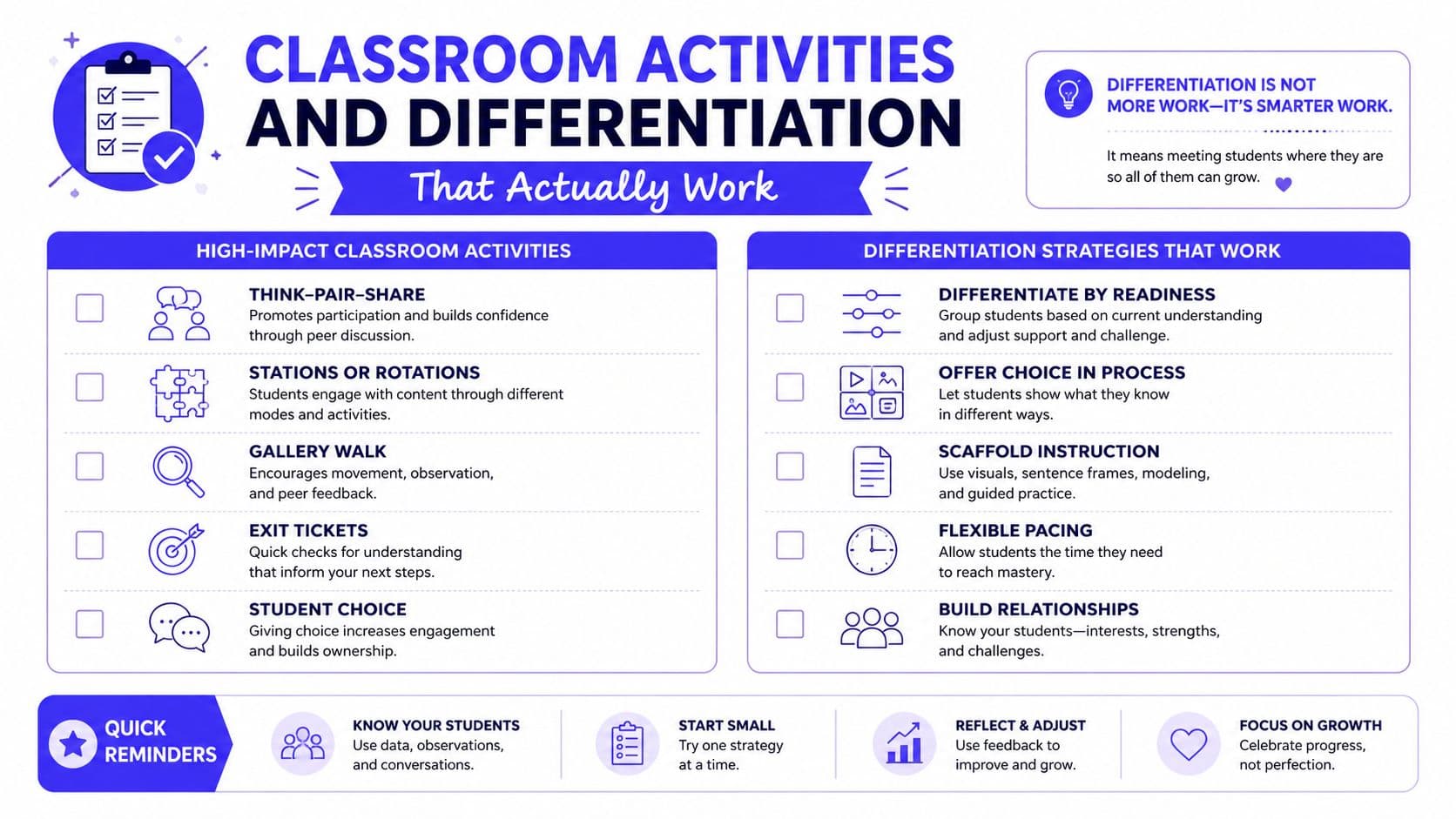
I've had better results with tasks that make students do more than compute. When they write expressions, explain choices, and compare papers with a partner, the misconceptions show up fast, and the lesson gets much more honest.
A few routines that hold up
Start with a short rewrite task. Give students a plain-language calculation, then ask them to add grouping symbols that change the order in a meaningful way. That pushes them to connect the expression form with the computation, which lines up with what Grade 5 standards ask students to do in writing and interpreting expressions.
A partner dictation works well too. One student reads an expression, the other solves it, then they compare steps. That back-and-forth shows the exact moment left-to-right thinking breaks down, which is more useful than waiting for the quiz to reveal it.
For stations, split the work between expression writing and computation. One station can ask students to evaluate expressions. Another can ask them to create an expression that matches a short story. That keeps the focus on both halves of the standard instead of only the answer.
Georgia's Grade 5 unit on Order of Operations and Whole Numbers connects these ideas to broader computation work, including paper-and-pencil multiplication algorithms and the effects of powers of 10. That is a good reminder that order of operations belongs inside a larger computation block, not as a one-day side topic.
If you're building leveled practice quickly, Kuraplan's differentiation teaching strategies fit here as a planning aid because they support branching practice, and Kuraplan can generate printable worksheets from the same lesson plan. I'd use that kind of tool for your confidence level group, your on-level group, and your stretch group without rebuilding the whole lesson three times.
A Teacher's Quick Checklist and What Comes Next
A fifth grader stares at 8 + 4 × 2 and says, “Do I add first because I read left to right?” That moment is the whole issue in one sentence. The fix is not more chanting. It is a tight routine, clear grouping, and repeated practice with the same kind of decision at the same time.
Keep the checklist simple. Check the grade 5 boundary, teach tiers instead of acronyms, and have students say what comes first within a level. Then hit the four common mistakes on purpose and include one activity where they both write and evaluate expressions.
As noted in the state snapshot, NY-5.OA.1 is the first formal experience with order of operations. That boundary matters because fifth grade is about a clean first pass, not a smaller version of middle school algebra. Students are not expected to wrestle with nested bracket problems or exponents at this stage.
If students can tell you why the work moved the way it did, they're learning the concept. If they can only chant the acronym, they're memorizing a shortcut that will break later.
The next move is more structure, more rewriting, and more chances to explain left-to-right decisions inside the same level. That is the version of order of operations that sticks, because it matches what students see on the page and what they need to say out loud while solving.
If you want a faster way to build standards-aligned lessons, worksheets, and visuals for this topic, Kuraplan can turn your plan into printable practice and differentiated materials in minutes. Visit Kuraplan to build a stronger order of operations lesson set for your fifth graders and save yourself the late-night worksheet scramble.