At 8:30 on Monday morning, you hand every student the same reading, give the same directions, and start the same timer. One student finishes before you've reached the second paragraph. Another is still decoding the first page. A third understands the ideas but can't organize a written response, while a fourth is ready to challenge the author's argument and has nowhere to go.
That's not a classroom failure. It's a predictable result of asking learners with different readiness levels, language experiences, disabilities, interests, and executive-function skills to use one route to reach one destination. A single pair of shoes handed out at the door technically gives everyone footwear, but the fit can still ruin the day.
Differentiated instruction isn't a special-needs extra or an enrichment bonus. It's the mainstream teacher's response to learner variability from the first minute of planning. The practical question is how to make it manageable: how to protect a shared academic goal, adjust access and support, challenge high achievers, include students with disabilities, and avoid creating several entirely separate lessons.
The case begins with equity data, then moves through inclusion, high-achiever enrichment, Universal Design for Learning, tiered tasks, assessment, and the workload problem teachers face. By the end, you'll have a repeatable way to plan one rigorous lesson with flexible paths instead of rebuilding your curriculum for every student.
The Classroom Moment That Makes Differentiation Necessary
The problem with a one-size-fits-all lesson isn't that it's simple. Simplicity can be useful at 8:30 a.m. The problem is that the lesson often assumes everyone has the same prior knowledge, vocabulary, confidence, processing speed, and way of demonstrating understanding.
In that Monday reading lesson, one student may need a vocabulary preview and a short model of annotation. Another may need the text chunked into manageable sections and a chance to talk before writing. A third may benefit from a more complex question that asks them to compare the author's reasoning with another perspective. They're working toward the same essential understanding, but they don't need identical conditions to get there.
Start with the destination
Differentiation works best when you define the learning goal before you choose the pathway. “Students will understand ecosystems” is too broad to guide a useful adjustment. “Students will explain how a change in one population affects an ecosystem, using evidence from a model” gives you something concrete to preserve.
From there, ask three practical questions:
- Access: What might prevent a student from understanding the content?
- Participation: What might prevent a student from engaging with the task?
- Evidence: What different forms could show genuine mastery?
You might keep the same objective while offering a diagram, a vocabulary bank, guided questions, flexible grouping, or an oral response option. None of those choices automatically lowers the standard.
Practical rule: Change the route before you change the destination.
Differentiation is often treated as something a teacher adds after a student struggles. In reality, learner variability is present before the lesson begins. Planning for it early helps students stay connected to core instruction instead of waiting to be pulled aside after they've already fallen behind.
A useful differentiation plan doesn't promise a perfect fit for every child. It gives students more than one sensible way to enter the work, practice the skill, and show what they know. That's the difference between a classroom that merely distributes the same materials and one that deliberately designs access.
The Equity Case Backed by Hard Data
Socioeconomic background shapes what students may bring to a lesson, from prior knowledge and vocabulary exposure to quiet study time and familiarity with academic tasks. We cannot remove those differences at the classroom door. We can decide whether instruction assumes a shared starting point or provides routes into the work.
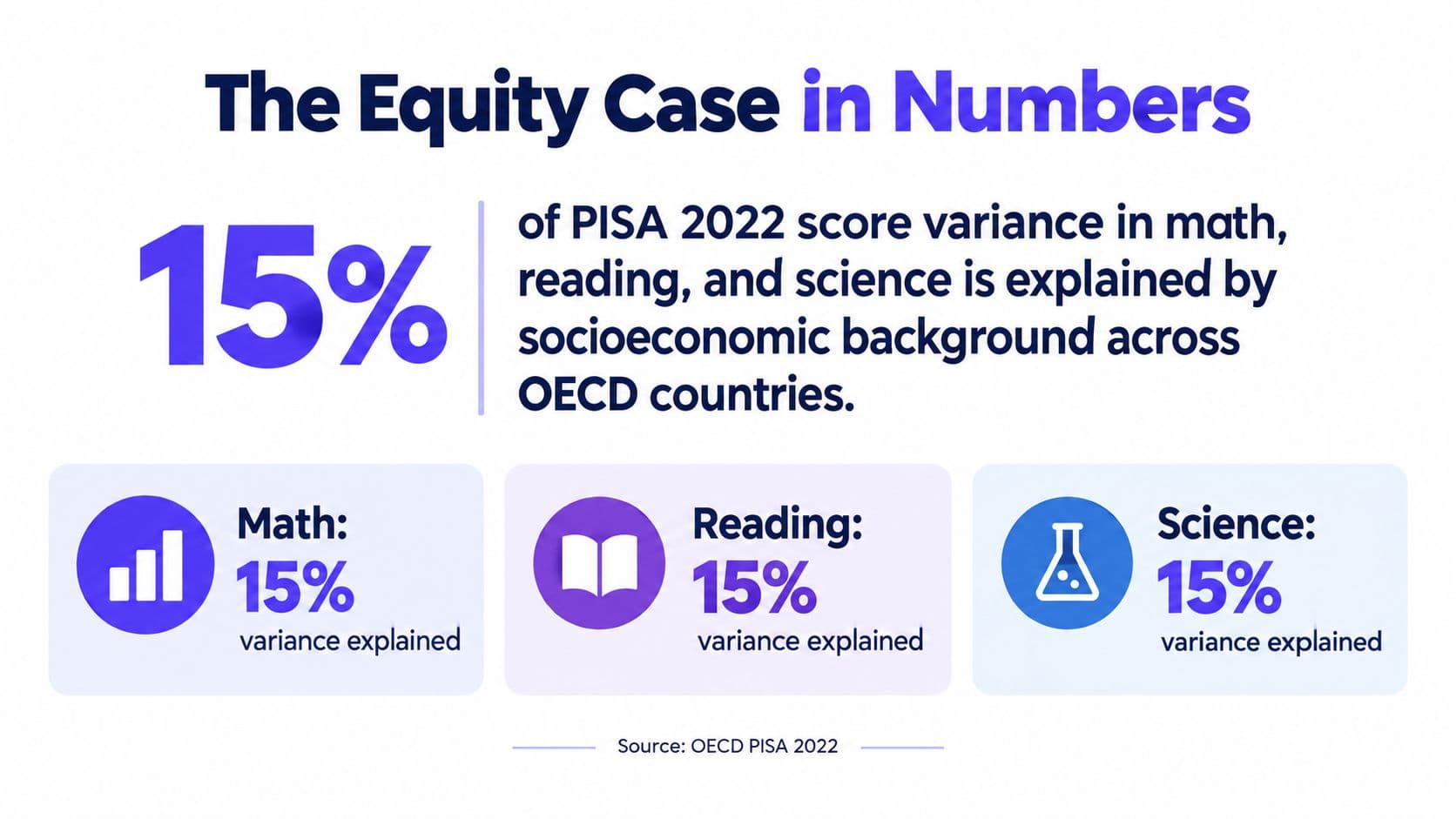
OECD PISA 2022 data found that socioeconomic status explained approximately 15% of the variation in mathematics performance across OECD countries. Economically, socially, and culturally advantaged students scored 93 points higher in mathematics than disadvantaged students on average. Socioeconomic background also accounted for about 13% of variation in reading and 14% in science. OECD PISA 2022 equity data
What the numbers look like in a classroom
A percentage describing variation can feel distant while you plan tomorrow's lesson. At 8:30 a.m., it may look like one student recognizing the background knowledge in a science passage while another is learning the vocabulary, context, and new concept at the same time. One student knows how to study from notes because those routines have been modeled repeatedly. Another is still learning how to begin.
The relationship also differs across education systems. In eight of the 80 participating countries and economies with available data, socioeconomic status explained at least 20% of mathematics-performance variation. Internationally, each one-unit increase in the PISA socioeconomic-status index was associated with an average increase of 39 mathematics points. The relationship reached 53 points in the Slovak Republic and 51 points in the Czech Republic, Israel, and Singapore. These comparisons help show why the same lesson can place very different demands on students.
The classroom response is practical. If every task assumes the same foundation, existing differences can grow. A teacher can interrupt that pattern with varied explanations, scaffolds, examples, practice levels, grouping arrangements, and ways to demonstrate learning.
Differentiation is an equity strategy expressed through ordinary choices about texts, prompts, models, timing, feedback, and assessment. It does not promise identical outcomes. It gives more students a fair opportunity to reach a demanding goal without requiring the teacher to create an entirely separate curriculum for each learner. AI planning tools can help organize those tiers and scaffolds, but the teacher still decides which differences matter for the lesson and which support preserves the intellectual demand.
How Universal Design for Learning Builds Differentiation Into Planning
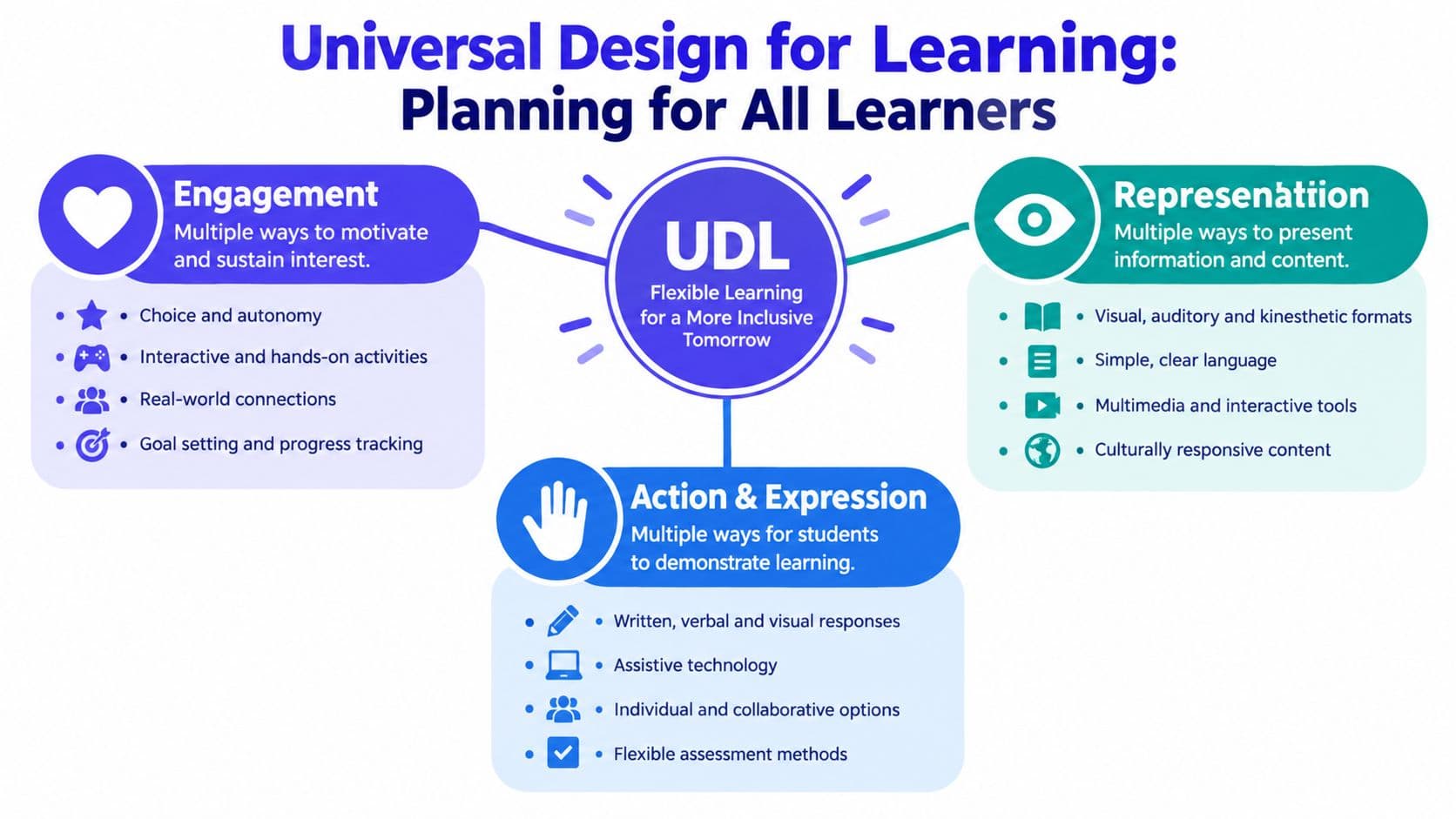
Teachers often hear “differentiate” and picture a planning spreadsheet with a separate lesson for every student. Universal Design for Learning, or UDL, offers a more workable structure. CAST organizes the framework around engagement, representation, and action and expression, with learners varying in interest, persistence, language processing, comprehension, physical access, and executive-function skills. CAST's UDL framework
Engagement asks why students will persist
Engagement concerns the reasons students participate and continue when work becomes difficult. In a history lesson, you might connect a constitutional debate to a school policy students recognize, offer a choice of issue to investigate, or build in structured partner talk before independent writing.
Choice should have boundaries. “Do anything you want” usually creates uncertainty, not motivation. A short menu of meaningful options gives students ownership while keeping the lesson coherent.
Representation asks how students access meaning
Representation is the way content reaches learners. A teacher might combine a concise explanation with a timeline, a labeled image, a vocabulary preview, a worked example, and a short demonstration. These aren't different learning-style assignments. They're multiple ways to make the same concept visible and understandable.
For visually complex material, resources about 3D animation in education can help teachers think about how motion, models, and spatial relationships support explanation. In everyday planning, a simple diagram or teacher-modeled process may be enough.
Action and expression asks how students show mastery
Students may demonstrate understanding through a written explanation, oral response, labeled model, presentation, or another product that meets the same success criteria. The format can change, but the evidence must still answer the objective.
For example, in a lesson on argument, students might submit a paragraph, record a structured oral explanation, or annotate a claim-evidence-reasoning organizer. A differentiated text tool from Kuraplan can support the preparation of varied text versions while the teacher keeps the central concept and success criteria aligned.
The IRIS Center at Vanderbilt makes an important distinction here. There's no evidence that assigning each learner one supposed learning style produces faster or better learning. Its UDL guidance supports using multiple paths based on the content, task, and learner circumstances, not labeling a child as permanently visual, auditory, or kinesthetic.
A useful planning prompt is simple:
- Engagement: How can students connect with or persist in this work?
- Representation: How can they access the explanation and key information?
- Action and expression: How can they demonstrate the intended learning?
One rigorous objective can travel through all three. You aren't writing seven lessons. You're designing a lesson with enough flexibility that students don't have to overcome an unnecessary barrier before they can show what they understand.
The Question Most Articles Skip About High Achievers
At 8:30 a.m., a student finishes the assigned problems while classmates are still working through the first example. Handing over another worksheet keeps the room quiet, but it rarely creates better learning. Differentiation must also serve students who reach the target quickly.
A systematic review indexed by ERIC examined 49 studies and found predominantly positive effects of differentiated instruction on high-achieving students' academic achievement and motivational-affective outcomes. It also reported that teachers did not usually differentiate proactively or regularly for these students, despite teachers and students viewing the approach as valuable.
More work isn't the same as more challenge
Consider a middle-school ecosystems unit. One group might build a closed terrarium with a partly completed observation chart and teacher prompts. A student ready for greater independence could design a research question about invasive species, choose evidence that would address it, and defend the limits of the proposed method.
Both students are doing serious science. The teacher changes the degree of independence, complexity, pacing, and decision-making while keeping the intellectual work meaningful. The goal is not to give one student “easy work” and another “hard work.” It is to give each student a worthwhile next problem.
Useful enrichment can take several forms:
- Greater complexity: Ask students to weigh competing explanations or constraints.
- Accelerated pacing: Reduce repetition after evidence shows the skill is secure.
- Open-ended inquiry: Let students form questions, select evidence, or defend a method.
- Intellectual risk: Invite a justified interpretation when no single answer is predetermined.
A high achiever should not become an unpaid teaching assistant whenever classmates need help. Peer support can build community, but it does not replace work that stretches the student's own reasoning.
If a differentiation system only scaffolds down, it isn't yet a differentiation system.
School leaders can review advanced-learning opportunities with the same seriousness given to interventions. Which students receive more complex texts? Who gets opportunities to work independently? Who receives feedback on the quality of reasoning rather than praise for completing extra tasks? The answers show whether enrichment is part of classroom design or depends on a teacher having spare planning time.
Differentiation as the Engine of Real Inclusion
At 8:30 a.m., a fourth-grade science class begins investigating changes in matter. One student with a processing difference receives a lab sheet divided into short steps, a visual sequence, and time to discuss observations with a partner before writing. Another records findings in a captioned video instead of handwriting every response. Both students examine the same scientific idea and contribute evidence.
Physical presence does not guarantee access to learning. Inclusion means students can participate, communicate, use materials, work with peers, and demonstrate growth within the shared classroom. Differentiation supplies the practical design choices that make those forms of participation possible.
UNESCO reports that children and young people with sensory, physical, or learning disabilities are 2.5 times more likely than their peers never to attend school. Its account of the 1994 Salamanca Statement identifies a major milestone in the principle that schools should educate children together while adapting teaching methods, curricula, and learning environments to individual needs. UNESCO also notes that laws in 25% of countries provide for educating children with disabilities in separate settings, rising to more than 40% in Asia and Latin America and the Caribbean. UNESCO's overview of inclusion in education
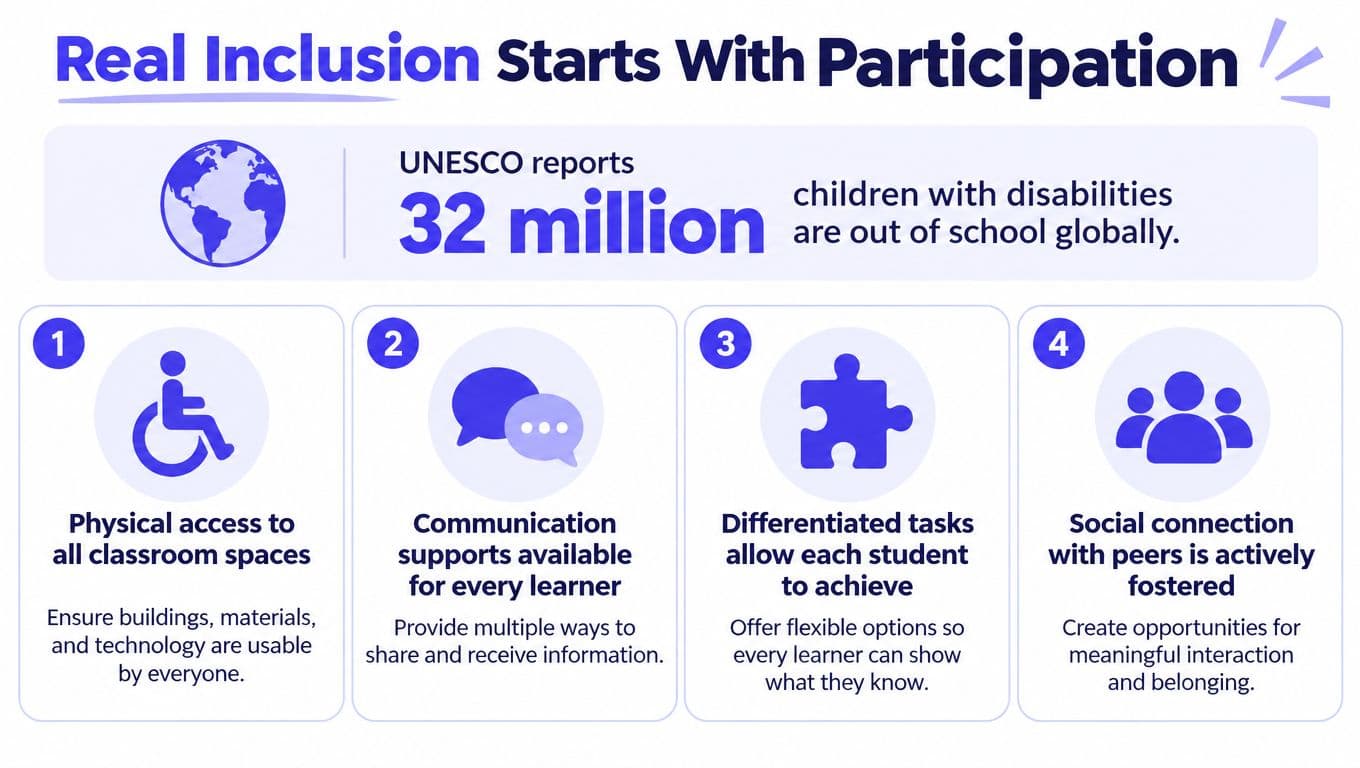
A lesson becomes more inclusive through ordinary, deliberate choices:
- Accessible directions: Pair spoken instructions with visuals, models, or concise written steps.
- Flexible responses: Accept an oral explanation, labeled model, typed response, or demonstration when it provides valid evidence.
- Assistive technology: Use tools that support communication, reading, writing, hearing, vision, or motor access.
- Flexible expectations: Adjust the amount or complexity of a product when appropriate, while keeping the learner's individual goals in view.
- Social access: Assign partners and group roles so every student has a meaningful way to participate.
These adjustments belong inside lesson design, not in a last-minute rescue plan. They also require coordination. School teams may need specialist input and family communication, while teachers must follow local special education procedures and professional guidance. FriendlyABA school support services offers context on practical support beyond classroom planning.
Differentiation cannot remove every structural barrier. It can stop the daily worksheet, discussion, lab setup, or response format from creating another one. AI planning tools can help teachers prepare several access routes without rebuilding every lesson by hand, making inclusive design more sustainable during a busy week. The test is simple: can each student take part in meaningful work and show what they understand?
Tiered Tasks and Assessments That Actually Work
A tiered task starts with one objective, not three unrelated assignments. Take a middle-school argument-writing lesson with the objective: Students will make a claim and support it with relevant evidence and reasoning.
The class can work toward that same outcome through different levels of support:
- Scaffolded pathway: Students read a shorter, clearly structured source, use highlighted evidence, and complete a claim-evidence-reasoning frame with sentence starters.
- On-level pathway: Students read the core sources, select relevant evidence, and write an organized paragraph using a planning organizer.
- Extension pathway: Students compare conflicting sources, address a counterclaim, and defend why their chosen evidence is stronger.
The teacher isn't assigning a fixed ability identity. A student can move between pathways as formative evidence changes. A learner who needs a sentence starter today may not need it next week, while a student who usually works independently may need temporary support with an unfamiliar text type.
Assess the target, not the packaging
Assessment should flex with the task. Use a common rubric for claim quality, evidence relevance, reasoning, and communication, then allow an appropriate response format. A written paragraph and a recorded oral explanation can both provide evidence if the objective concerns argument, not handwriting stamina.
In science, one group might receive a partially completed diagram, a word bank, and teacher modeling. Another group might independently construct and explain a model of the same concept. CAST's guidance recommends defining a specific, challenging objective first, then selecting supports that reduce barriers while keeping intellectual demand high. CAST's full UDL guidelines
Use a quick decision table before you create materials:
| If the student needs... | Adjust this first | Keep the same |
|---|---|---|
| Help entering the content | Vocabulary, examples, visuals, or chunking | The essential learning objective |
| More independence or challenge | Complexity, choice, pace, or open-ended reasoning | The success criteria and intellectual purpose |
| A different way to communicate | Response format, assistive technology, or recording method | The evidence required to demonstrate mastery |
For a practical collection of classroom approaches, differentiation teaching strategies can help you build a reusable menu rather than inventing each adjustment from scratch.
Formative checks keep tiers responsive. After students annotate a source, ask them to identify the strongest piece of evidence and explain why. Their responses tell you whether to remove a scaffold, add one, regroup students, or pause for another model.
The repeatable structure is:
- Define one demanding objective.
- Identify the barrier or challenge level each student may need.
- Prepare two or three pathways with shared success criteria.
- Check understanding during the work.
- Adjust the pathway, not the standard.
That structure is small enough to use on a busy Monday and strong enough to carry across a unit.
Making Differentiation Sustainable Without Burning Out
At 8:30 a.m., differentiation becomes unsustainable when one teacher is expected to write several complete lessons, assessments, and sets of feedback for every class period. Teachers do not abandon student needs. They run out of planning time.
Research on implementation supports that concern. A review of 28 U.S. P–12 studies found that teachers' perceptions of time, resources, control, and ambiguity shaped how differentiated instruction was implemented. Another review found that teachers often value differentiation but use it inconsistently when preparation and institutional support are limited. The implementation review in the Journal of Advanced Academics
A workable system starts with materials that can serve more than one lesson. Keep a bank of scaffolds, extension prompts, visuals, and response options organized by subject. Reuse common criteria while changing the route students take. Store adaptable resources where colleagues can find them.
The planning load also becomes more manageable when feedback is narrow and useful. A framework for feedback that improves performance can help teachers point students toward a next action instead of marking every surface error.
AI planning tools can support this system while the teacher retains responsibility for the objective, content, and final judgment. Kuraplan can connect one standard with scaffolded activities, visual supports, varied question types, printable worksheets, and assessment rubrics tied to the same objective. Its weekly planner gives teachers a place to organize sequential lessons and revisit materials rather than rebuild them each evening.

Use generated materials as a first draft. Check the accuracy of the text, confirm that a scaffold preserves the thinking students must do, and make sure an extension increases complexity rather than workload. Before adopting a tool, verify where student data is stored and whether generated materials can be edited before use.
The sustainable goal is simple: build one strong instructional core, then adjust access, challenge, and response without creating a separate course for every learner. That approach protects teacher judgment while making differentiation possible on an ordinary school day.
Putting It All Together This Week
Start with one lesson, not your entire curriculum. Write one shared objective, prepare two flexible pathways, add one meaningful enrichment option, include one accessibility adaptation, and plan a short formative check before students begin independent work.
Save the materials in a reusable structure. A standards-aligned tool such as Kuraplan can help generate differentiated worksheets and visual supports tied to the same objective, so you're not spending Sunday rebuilding every page.
The reason differentiated instruction is important is practical as much as philosophical. It responds to unequal starting points, makes inclusion participatory, challenges advanced learners, and gives teachers a system instead of another impossible expectation. Differentiation isn't about doing more for its own sake. It's about designing access into the lesson so every student can meet the same high bar through a path that fits.
Kuraplan helps K–12 teachers create standards-aligned lesson plans, tiered worksheets, visual supports, and assessment rubrics from a shared learning objective. Visit Kuraplan to explore a more sustainable way to plan differentiated instruction without lowering the bar.