MathematicsFreePrintable

Exploring Angle Relationships

A free mathematics worksheet ready for your classroom. Open in Kuraplan to grab the print-ready PDF, customize it for your students, or generate a fresh version in seconds.
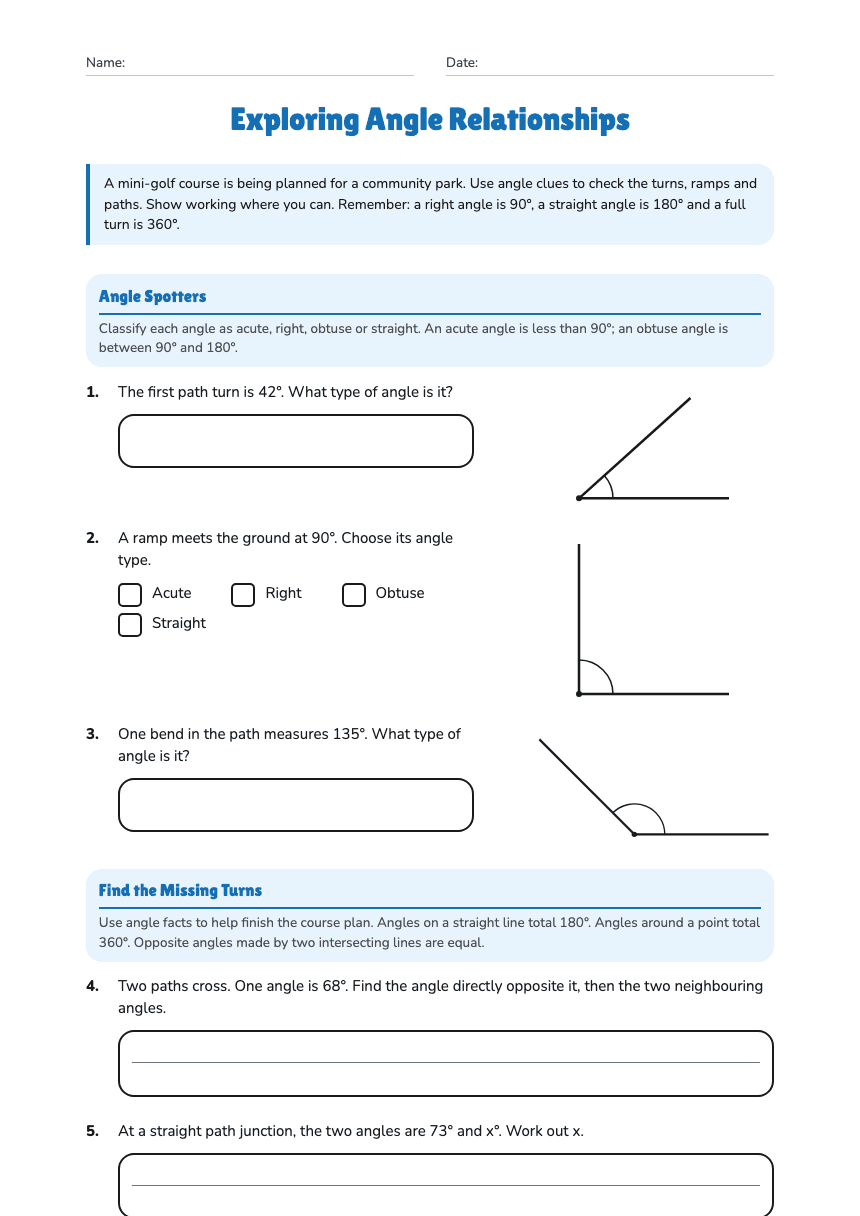
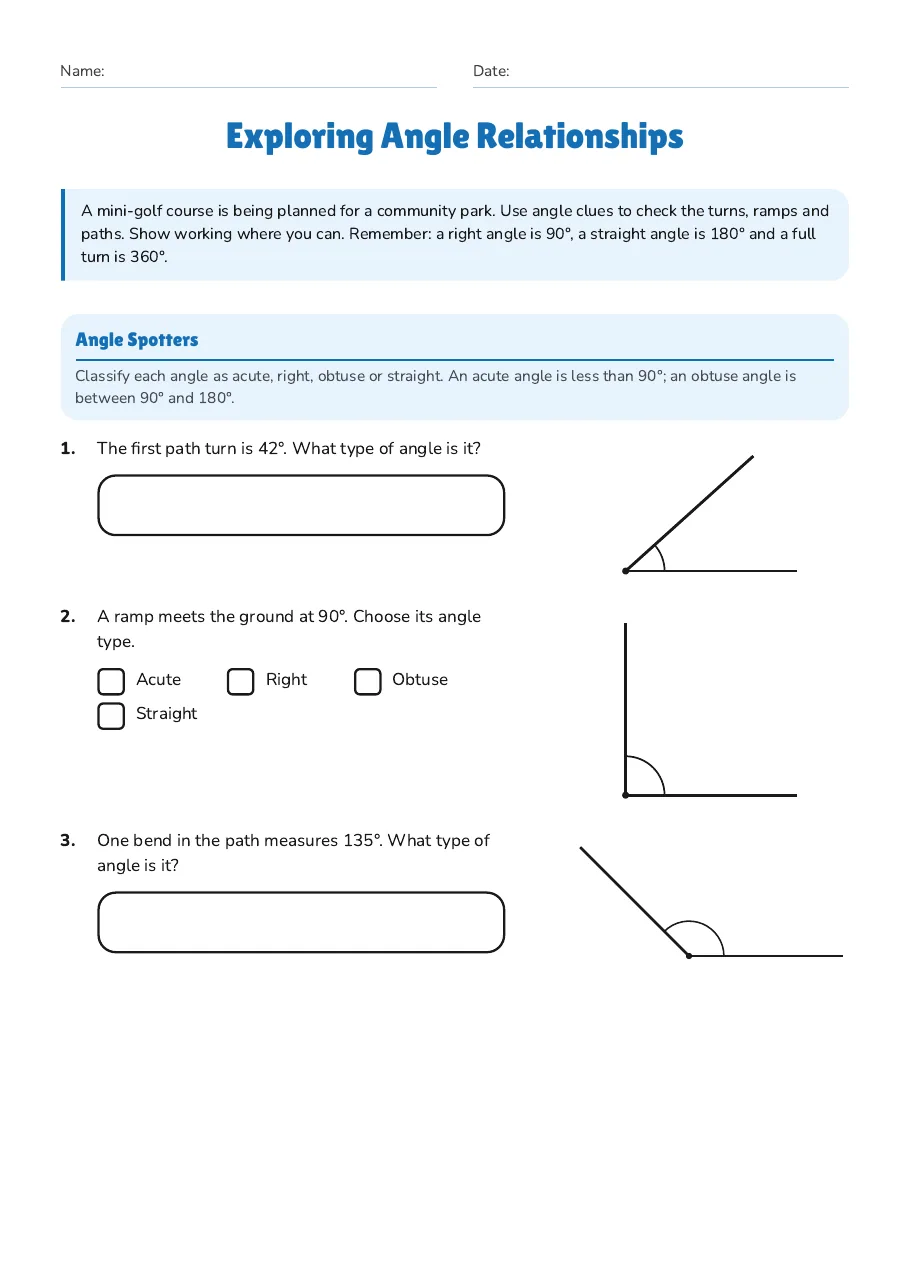
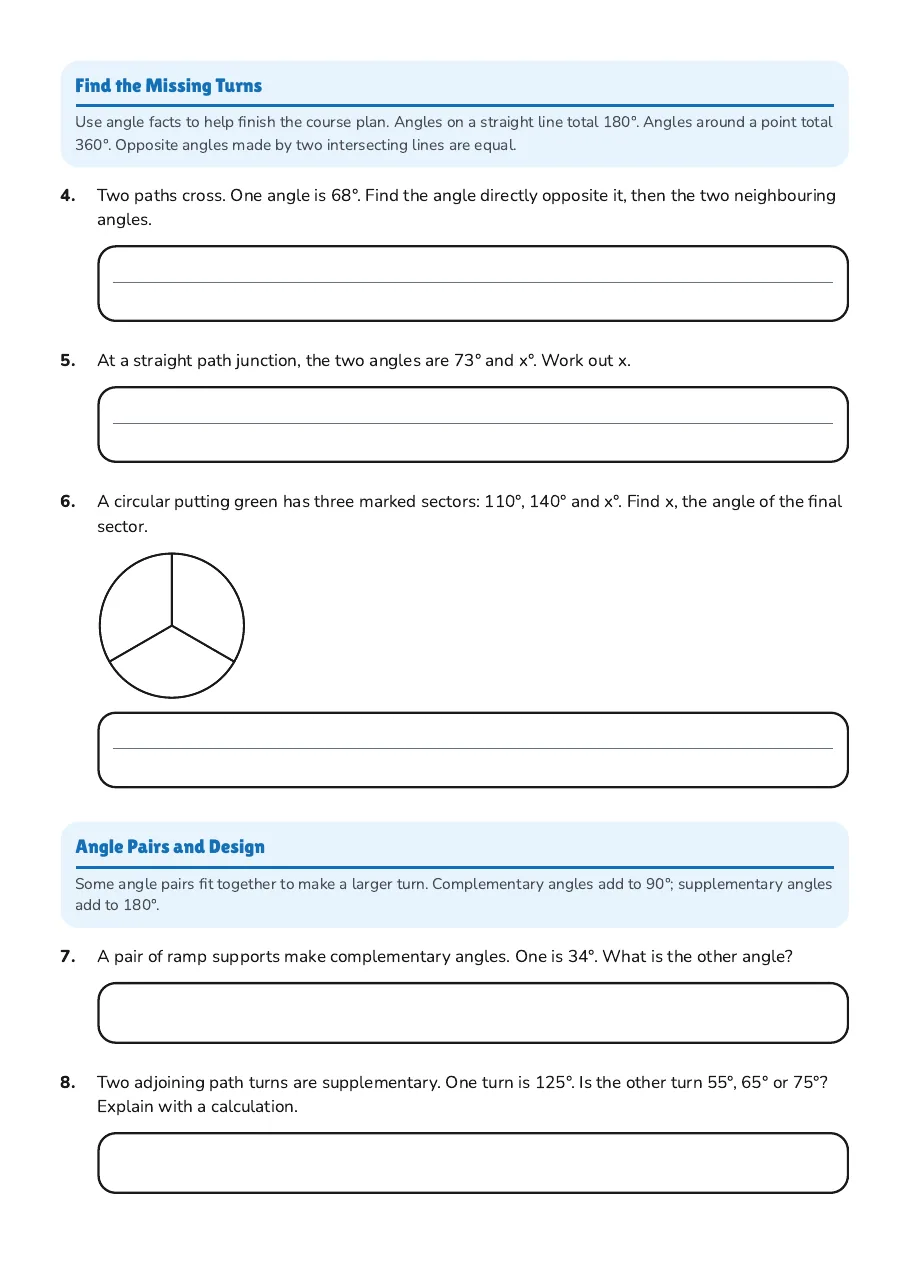
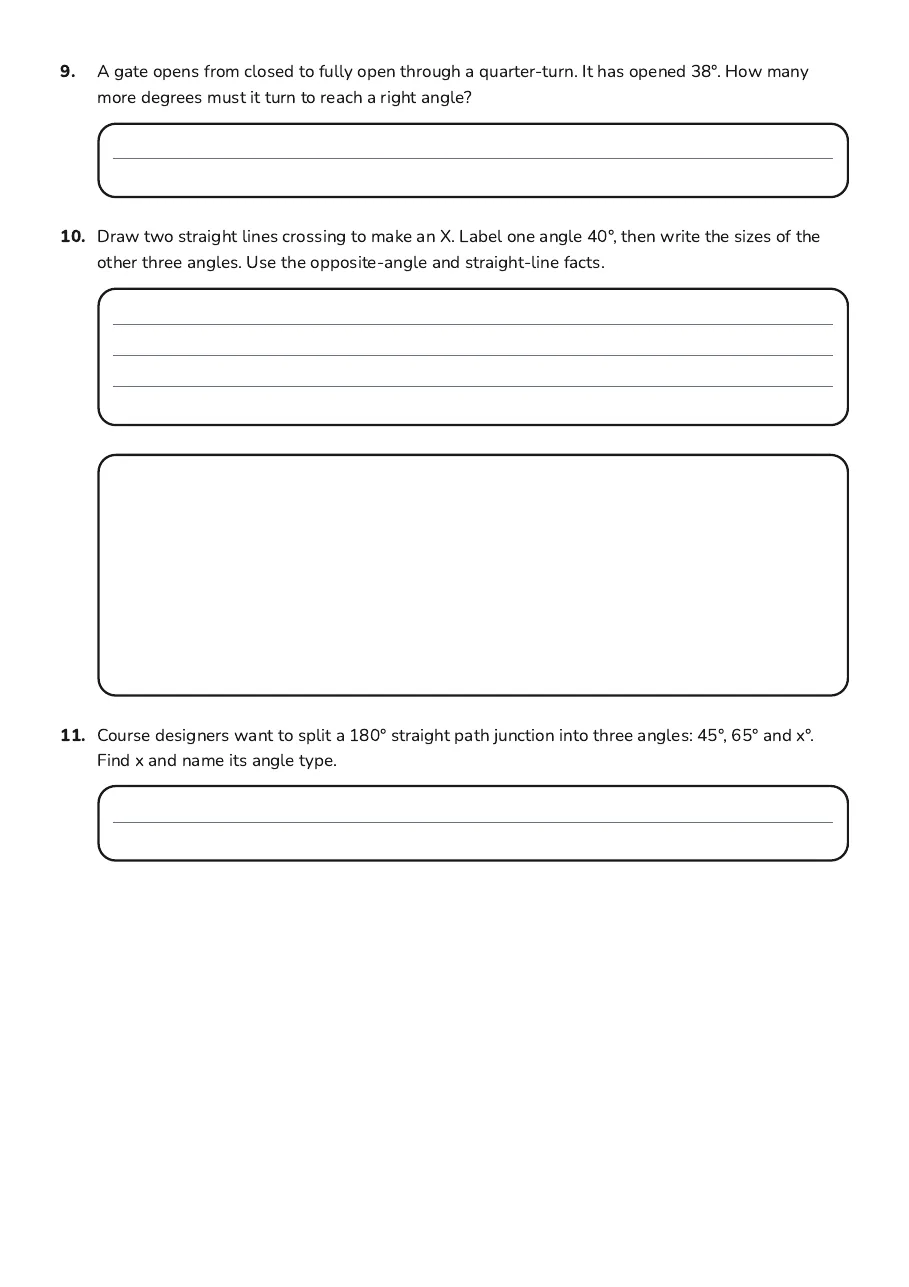
Exploring Angle Relationships worksheet preview

Exploring Angle Relationships

Protractor and angles illustration

📐 Part 1: Angle Classification and Estimation

1. Look at each angle and classify it. Circle the correct answer:

Angle A: 45°

Acute

Right

Obtuse

Straight

Angle B: 120°

Acute

Right

Obtuse

Straight

2. Without using a protractor, estimate the size of this angle: ∠ABC = _______°

Now measure with a protractor. Actual measurement: _______°

Difference between estimate and actual: _______°

3. Which strategy did you use to estimate the angle? Tick all that apply:

Compared it to a right angle (90°)

Used my arms to mimic the angle

Looked for half or quarter turns

Other: ___________________

🔄 Part 2: Angle Relationships

4. Two intersecting lines create four angles. If one angle measures 65°, what do the other three angles measure?

Angle opposite to 65°: _______°     The other two angles: _______° each

5. Complete these angle relationships:

a) Two angles are complementary if they add up to _______°

b) Two angles are supplementary if they add up to _______°

c) If one complementary angle is 35°, the other angle is _______°

d) If one supplementary angle is 110°, the other angle is _______°

6. Look at angles on a straight line. If three angles on a straight line measure 45°, 65°, and x°, find the value of x.

x = _______°

🧩 Part 3: Problem Solving

7. In the drawing space below, sketch two intersecting lines and label all four angles. Mark one angle as 40° and calculate the other three angles.
8. Real-world angles: A door opens from 0° (closed) to 90° (fully open). If the door is opened to 35°, how many more degrees does it need to open to be fully open?
9. Explain in your own words: Why do angles on a straight line always add up to 180°? Use an example in your explanation.
10. Challenge: If you fold a piece of paper to create an angle, then fold it again to make the angle smaller, what type of angle relationship are you creating? Explain your reasoning.

About This Worksheet

Free in Kuraplan

Sign up free, grab the PDF, and customize it for your class.

Print-Ready

Formatted for standard paper. Clean layout, easy to read.

AI-Generated

Created with Kuraplan's AI, designed for real classroom use.

For Teachers & Parents

Use in classrooms, for homework, tutoring, or homeschool.

Need a custom version of this worksheet?

Kuraplan's AI generates custom worksheets in seconds — differentiated for every learner, aligned to your curriculum.

Generate Custom Worksheets — Free
No credit card Curriculum-aligned Under 60 seconds