A great lesson plan for 2nd grade is way more than just a schedule. It's a roadmap that has to capture that unique, buzzing energy of seven and eight-year-olds. The best ones are structured but flexible, academic but playful, and they turn abstract standards into concrete, hands-on learning moments that actually stick.
Building the Foundation of Your Lesson Plan
Before you jump into the fun activities, every solid lesson plan needs a strong foundation. This is where you connect your big ideas to the specific skills your students need to master. It’s the behind-the-scenes work that makes the classroom magic happen and ensures every minute is purposeful.
Think of it as drawing the map before you start the journey.
Let's break down the core components that turn a basic outline into an effective teaching tool. These are the non-negotiables that I make sure are in every plan I write.
Core Components of an Effective 2nd Grade Lesson Plan
| Component | What It Means for a Teacher | Example for a 2nd Grade Math Lesson |
|---|---|---|
| Clear Learning Objective | Translate the "teacher talk" of a standard into a kid-friendly, measurable goal. What will they be able to do? | Students will be able to create a bar graph with a single-unit scale representing a data set with up to four categories. |
| Engaging Hook | A quick, compelling activity (the "anticipatory set") that grabs attention and connects to prior knowledge. | Ask a poll question like, "What's the best recess activity?" and tally the votes, creating a "problem" the graph will solve. |
| Guided Practice ("I Do, We Do") | Model the new skill and then practice it together with the class, offering support and immediate feedback. | Model creating a graph axis and labels on the board. Then, have students help you graph the recess data as a class. |
| Independent Practice ("You Do") | An opportunity for students to apply the skill on their own while you circulate and check for understanding. | Students survey their tablemates on a favorite color and create their own bar graph on a worksheet. |
| Assessment | A quick, clear way to see who "got it." This could be an exit ticket, a review of their independent work, or a short quiz. | Use a simple rubric to check if students' graphs have a title, labeled axes, and accurately plotted data. |
| Differentiation | Built-in supports for struggling learners and extensions for those who are ready for a challenge. | Provide a pre-labeled graph template for students who need support; challenge others to create a pictograph of the same data. |
Having these pieces in place ensures your lesson is not just an activity, but a complete learning cycle that meets the needs of all your students.
Starting With Standards and Clear Objectives
Let’s be real—sometimes the standards can feel a bit dry. But they are our non-negotiables, the "what" behind our teaching. The first step is to translate that academic language into a kid-friendly, measurable goal.
Vague goals just don't cut it. "Learn about graphs" is too broad and doesn't give you a clear target to aim for. We need something concrete and actionable.
A much stronger objective would be:
"Students will be able to create a bar graph with a single-unit scale to represent a data set with up to four categories."
This is specific, measurable, and directly tied to a standard like U.S. Common Core Math Standard 2.MD.D.9. It’s also a critical skill—recent data shows that only about 65% of U.S. 2nd graders have mastered this concept, highlighting a key area where focused instruction can make a huge impact. You can read more about data representation standards on S2TEMSC.org.
If you ever feel stuck trying to rephrase standards into clear objectives, using one of these free lesson plan templates for teachers can provide a helpful structure to get you started.
Creating an Irresistible Hook
You have about three minutes to grab a second grader's attention before their minds wander to recess, their loose tooth, or that cool bug they saw on the way to school. The "hook," or anticipatory set, is your secret weapon. It’s a short, punchy activity at the very beginning that sparks curiosity and connects the new topic to their world.
A great hook should always:
- Activate Prior Knowledge: Link what they're about to learn with something they already know.
- Build Excitement: Make them want to find out what's next.
- Set the Context: Give them a real-world reason for the lesson.
For our bar graph lesson, you could kick things off with a simple question like, "Which is the best recess activity: swings, the slide, or tag?" Take a quick show-of-hands vote, draw messy tally marks on the board, and say, "Hmm, it's hard to see which one won. I wish there was a better way to show our class's favorite..."
Instantly, you’ve created a problem they want to solve.
Structuring Your Lesson for Maximum Engagement
The flow of your lesson is everything, especially with second graders. A solid structure is like a roadmap, smoothly guiding students from a brand-new idea to trying it out on their own. This is where the classic "I Do, We Do, You Do" model really proves its worth.
This simple rhythm keeps the lesson from feeling choppy and holds your students' focus right where you need it. Nailing this pacing is the secret to a smooth, effective, and much less stressful lesson for everyone. Of course, this all works best when you're also focused on creating a positive learning environment where kids feel safe to participate.
The I Do Mini-Lesson
The "I Do" part is your time to be direct and crystal clear. This is your mini-lesson, and the key word here is mini. For second graders, you want to aim for no more than 10-15 minutes of direct instruction. Any longer, and you’ll start seeing the wiggles and wandering eyes.
Your goal isn't to explain every single detail. It’s to model the main skill with energy and clarity.
The best "I Do" is a short, punchy demonstration. Think aloud as you work, make a few intentional mistakes and then correct them, and show them exactly what success looks like. This isn’t a lecture; it's a performance.
This modeling sets the stage perfectly for the next phase, where the kids get to jump in. And remember, those objectives you wrote earlier are your north star here. If you need a refresher, check out our guide on how to write objectives for lesson plans.
The We Do Guided Practice
Now it's time to share the spotlight. The "We Do" portion is all about collaboration and interaction—and honestly, it's one of the most critical parts of any lesson plan for 2nd grade. This is where you work through examples with your students, asking for their ideas and solutions along the way.
Think of this phase as your diagnostic tool. It's your chance to spot misunderstandings and fix them in the moment before they turn into bad habits.
- Use Turn-and-Talks: Have students quickly discuss a step with a partner before sharing with the whole class.
- Whiteboard Practice: Give each student a mini whiteboard to solve a problem and hold up their answers. It's a quick, visual check for understanding.
- Think-Pair-Share: Pose a question, give them quiet "think time," let them share with a partner, and then call on a few pairs to share with the group.
The You Do Independent Practice
The final step is the "You Do," where students get to fly solo and apply their new skills. This shouldn't be busywork; it needs to be a meaningful task that lets them practice the skill from your objective. This is also your golden opportunity to pull a small group for some targeted support or reteaching.
For those moments when you're drawing a blank on fresh, standards-aligned activities, an AI tool like Kuraplan can be a real game-changer. You can just plug in your objective and get differentiated worksheets or activity ideas generated in seconds, giving you back that precious planning time.
Practical Differentiation Strategies for Real Classrooms
Let’s be real for a second: the thought of creating 25 different versions of a single lesson plan for 2nd grade is a one-way ticket to burnout. Effective differentiation isn’t about piling on more work; it’s about working smarter. The goal is to build flexibility right into your lesson from the get-go, creating a space where every student feels seen, challenged, and set up for success.
It’s all about moving away from that one-size-fits-all approach and instead offering different paths to the same learning destination.
Low-Prep Strategies That Make a Big Impact
You don't need to reinvent the wheel to differentiate well. Small, intentional tweaks can make a huge difference for your second graders. The secret is having a few go-to strategies in your back pocket that you can pull out for any lesson.
Here are a few of my favorites that are high-impact but low-prep:
- Choice Boards: Think of a simple 3x3 grid, like a Tic-Tac-Toe board. Fill each square with a different activity that practices the same skill. Students just have to complete three in a row. You can easily vary the complexity, from drawing a picture to writing a sentence or tackling a challenge problem.
- Tiered Assignments: This is my absolute go-to for independent practice. I just create two or three versions of the same worksheet. Tier 1 might have more scaffolding (like sentence starters), Tier 2 is the on-level task, and Tier 3 offers a trickier problem for those who finish early.
- Flexible Grouping: Your groups shouldn't be set in stone. Use them strategically! Sometimes you’ll want to group students with similar needs for a quick, targeted mini-lesson. Other times, mixed-ability groups are perfect for collaborative projects where students can learn from each other.
The most powerful differentiation happens when students feel a sense of ownership over their learning. Offering simple choices empowers them and naturally increases their engagement and effort.
Scaffolding and Extending Learning
Building in flexibility means planning for students at both ends of the learning spectrum right from the start. For kids who need a little extra support, simple scaffolds can be a game-changer. Think visual aids like anchor charts, offering sentence starters for writing, or even giving them a partially completed graphic organizer.
And for the students who catch on quickly? The goal is to deepen their thinking, not just give them more of the same. Extension activities should demand higher-order thinking. So, instead of ten more math problems, maybe you ask them to create their own word problem for a friend to solve.
I know what you're thinking—creating all these different materials sounds time-consuming. This is where technology can be a massive help. When I’m planning tiered activities or need a quick extension task, I often turn to Kuraplan. It can generate differentiated worksheets and activities from a single objective in just a couple of minutes, which saves me a ton of prep time. That way, I can focus my energy on actually teaching, not just on making materials.
Putting It All Together: A Sample Math Lesson Plan
Theory is great, but seeing a lesson plan come to life is where the magic happens. Let's walk through building a complete math lesson plan for 2nd grade from the ground up. We'll zero in on data and graphing, specifically hitting the Common Core standard 2.MD.D.10, which is all about drawing picture and bar graphs.
First things first, we need a hook. Something to grab their attention right away. Forget abstract ideas—second graders connect with what’s real and exciting to them. A quick class survey about favorite pets is the perfect way in. It's fun, relatable, and gives us an instant, authentic set of data to play with.
The Lesson Flow: I Do, We Do, You Do
Once we have our "favorite pets" data, we can slide right into the lesson.
I Do (Modeling): I'll kick things off by showing them how to organize our survey results. I’ll pull up the whiteboard and create a simple tally chart, thinking out loud as I work. "Okay, four students chose 'dog,' so I'll make four tally marks. Remember how the fifth one always goes across?" This quick, clear demonstration sets the stage perfectly.
We Do (Guided Practice): Next up, we build a class pictograph together. I’ll draw the axes and turn it over to them for input. "What should our title be? What picture should we use for each vote?" We'll work as a team to place the symbols on the graph, reinforcing that one-to-one correspondence and letting me check for understanding as we go.
You Do (Independent Practice): Finally, it’s their turn to fly solo. Students will survey their table groups on a new topic—like favorite colors—and use a worksheet to create their very own bar graphs. This is their chance to apply the skills on their own while I circulate to offer a helping hand where needed.
To make sure every student can find success, it's crucial to build in different ways for them to show what they know. This simple process gives you a few powerful ways to differentiate your lesson materials.
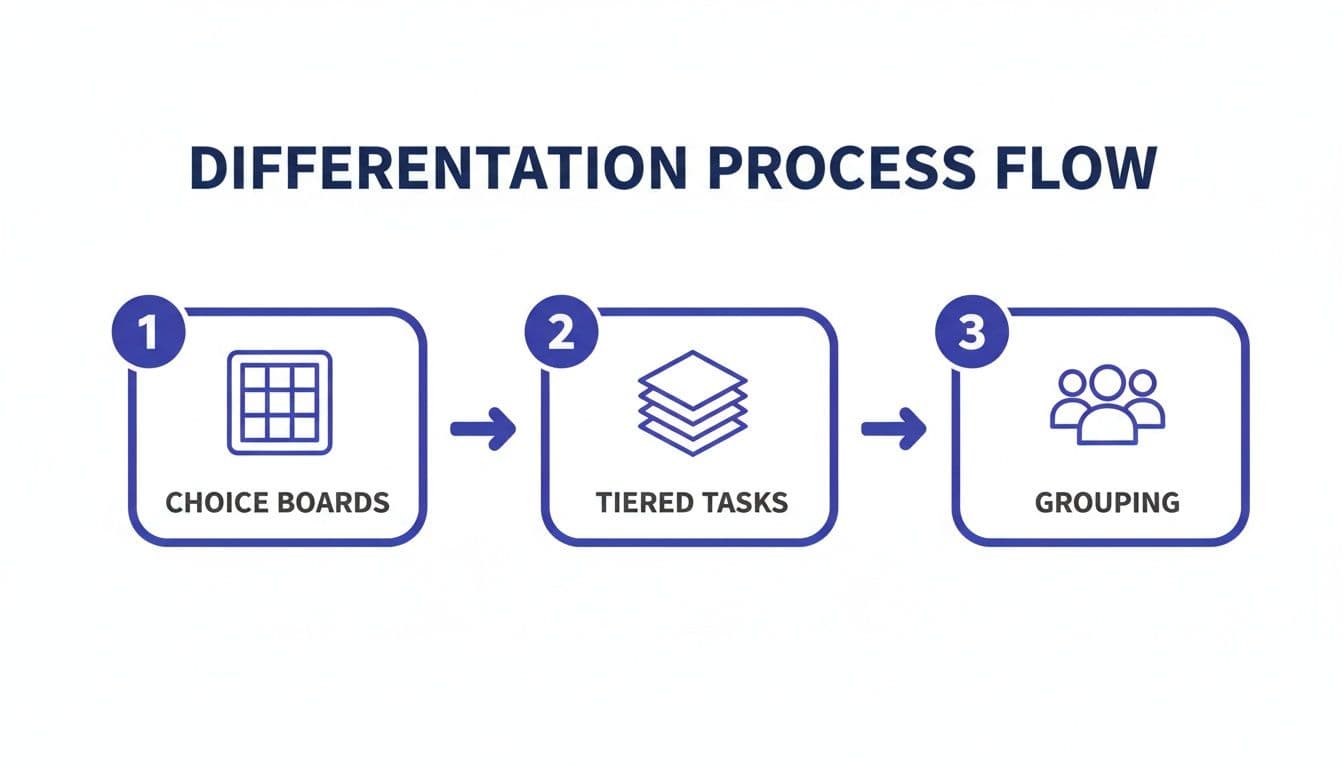
As you can see, offering things like choice boards, tiered tasks, and flexible grouping are all fantastic ways to meet the diverse needs in your classroom.
Generating Materials and Assessing Understanding
Let’s be real: creating all these materials—the survey sheet, the graphing worksheet, the rubric—can eat up your entire prep period. This is where a tool like Kuraplan is an absolute lifesaver. You can plug in your standard (2.MD.D.10) and objective, and it generates a complete, illustrated worksheet and a simple rubric in minutes. It can even create tiered versions for differentiation, giving you hours of your time back.
Hands-on activities like this really work. One study found that hands-on data collection actually boosted comprehension scores by 18%, and using tally charts helped 78% of students quickly compare quantities. You can dig into the research over on HMHCo.com.
When it’s time to assess, a simple rubric is your best friend. I'll just check for three key things:
- Does the graph have a title and labeled axes?
- Is the scale correct (e.g., counting by ones)?
- Does the data in the graph actually match their survey results?
This quick check gives me a clear snapshot of who’s got it and who might need a bit more practice with me in a small group tomorrow.
Using AI Tools to Simplify Your Planning
Let's be honest, the biggest hurdle every teacher faces is time. There’s never enough of it. When you’re juggling grading, parent emails, and the actual teaching, the hours spent building a quality lesson plan for 2nd grade from the ground up can feel endless.
The good news is that technology is finally catching up with the real needs of the classroom. AI-powered tools are here, and they're getting remarkably good at handling the heavy lifting of lesson creation.
This isn’t about replacing your professional judgment or creativity. Not at all. It's about automating the most tedious parts so you can pour your energy into what actually matters: connecting with your students and making your lessons shine.
Your New Lesson Planning Assistant
Think of these tools as a smart, tireless assistant who's always ready to help. Platforms like Kuraplan were built for exactly this. Imagine plugging in your state standard and a clear learning objective—like our graphing lesson—and getting a complete, high-quality lesson outline in seconds.
These tools can generate all the key components you need in just a few minutes:
- Differentiated Activities: Instantly get tiered worksheets or activities that give extra support to students who need it and offer a challenge for those who are ready to fly.
- Assessment Tools: Need a quick exit ticket, a short quiz, or a simple rubric that ties directly back to your objective? Done. This takes all the guesswork out of checking for understanding.
- Custom Visuals: Trying to find a kid-friendly diagram of the water cycle? Or maybe an illustration of a plant cell? AI can create custom, age-appropriate images to make your materials pop.
The real game-changer here is that AI gives you back your most precious resource: time. By handling the structure and materials, it frees you up to focus on the art of teaching.
Making Technology Work for You
Getting started is surprisingly simple. Many tools, including Kuraplan, have a straightforward interface. You just input your grade level, subject, and learning objective, and you're off. From there, you can tweak and refine everything to perfectly match your teaching style and your students' personalities. For creating other kinds of engaging, interactive lesson materials, especially if you're collaborating with other teachers, a tool like Lumi H5P Cloud for interactive content is another great option to explore.
The goal is to blend technology with your expertise. The AI provides a solid, standards-aligned foundation, and you bring the heart. We dive deeper into this partnership in our guide on how to use AI to do lesson planning for teachers. It's a powerful combination that can seriously cut down on planning stress and help you walk into your classroom feeling more prepared and energized than ever before.
Common Questions About 2nd Grade Lesson Planning
When you’re deep in the trenches of creating a lesson plan for 2nd grade, it’s easy to get stuck on the little details. I get it. After years of teaching, I’ve seen the same questions pop up time and again from fellow teachers.
Let's tackle a few of those common sticking points with some clear, practical advice straight from the classroom.
How Long Should Each Part of a 2nd Grade Lesson Be?
With this age group, snappy pacing is everything. Keep things moving. Long stretches of any single activity will lead to wiggles, lost focus, and classroom chaos. The key is to break your lesson block into manageable chunks. This keeps their energy high and their minds engaged.
Here's a rhythm that has always worked well for me:
- The Hook: 5-7 minutes to grab their attention.
- Direct Instruction: 10-15 minutes of modeling. Keep it short and sweet.
- Guided Practice: 15-20 minutes of working together. This is where the magic happens.
- Independent Work: 15-20 minutes for them to try it solo.
- Wrap-up/Exit Ticket: 5-10 minutes to quickly check for understanding.
And don't forget to sprinkle in quick brain breaks! A 60-second stretch or a silly song can work wonders to reset the room.
What Is the Best Way to Assess Learning Without a Formal Test?
Forget long, formal tests. Seriously. In second grade, your best friend is the formative assessment—those quick, in-the-moment checks for understanding. These give you a powerful snapshot of where your students are without the stress of a big test.
"Turn and talk" is one of the most effective and low-prep assessment tools out there. Having a student explain a new concept to their partner gives you a crystal-clear, immediate view of their comprehension.
Exit tickets with a single, simple question are also fantastic. Or, as students work independently, just circulate with a clipboard and a simple checklist. You'll gather all the data you need to plan your next steps.
How Can I Make Planning Faster Without Cutting Corners?
Batching your planning is a total game-changer. Instead of planning day-by-day (which is exhausting), try to map out the entire week or even a whole unit at once. This helps you see the bigger picture and create a much more cohesive flow for your students.
And please, don't be afraid to lean on technology. This is where tools designed for teachers can make a huge difference. Using an AI-powered platform like Kuraplan can drastically slash the time it takes to create materials. You can generate standards-aligned activities, worksheets, and rubrics in minutes, freeing you up to focus on the creative, high-impact parts of your lesson.
Ready to stop spending your weekends planning? See how Kuraplan can help you create amazing, standards-aligned lesson plans in a fraction of the time. Get started for free at Kuraplan.com.