Let's be real: the perfect, quiet classroom is a myth. But a well-managed one? That is totally achievable. Whether you're a first-year teacher staring down a roster of 30 energetic third-graders or a veteran high school educator trying to keep seniors engaged, a solid classroom management plan is your lifeline. It’s not about control; it’s about creating a predictable, safe, and respectful environment where actual learning can happen.
A great plan sets the tone from day one, minimizing disruptions and maximizing instructional time. It transforms a chaotic space into a thriving community. Of course, this goes beyond just behavior. Getting organized for the new year is a huge piece of the puzzle, and it helps to learn how teachers can prepare for back to school with smart systems. But a strong behavioral framework is the foundation.
Forget the generic advice and abstract theories. I’ve gathered 8 distinct samples of classroom management plans, broken down by grade level and philosophy. We’ll dissect what makes each one work, how to adapt them for your unique students, and where you can find tools to get started tomorrow.
We'll look at everything from PBIS and Restorative Justice to plans tailored for inclusive and even hybrid classrooms. Each example includes a breakdown of its core components and actionable takeaways you can implement immediately. Think of this as your personal playbook, curated by teachers, for teachers. Let's dive in.
1. Positive Behavioral Interventions and Supports (PBIS) - Elementary Focus
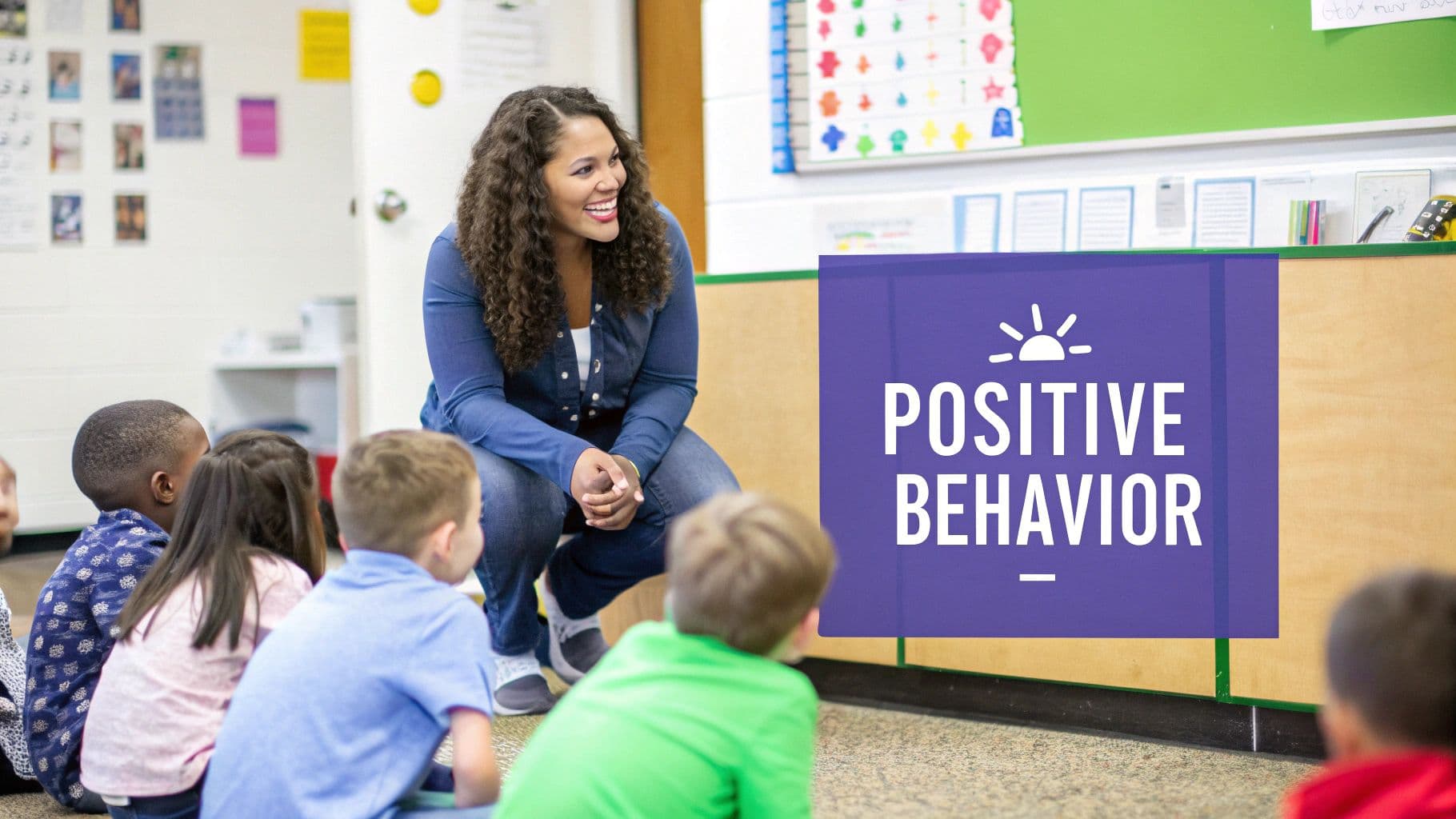
Positive Behavioral Interventions and Supports (PBIS) is a proactive framework designed to improve student outcomes by teaching and reinforcing positive behavior. Instead of reacting to misbehavior, PBIS creates a school-wide culture where expectations are explicitly taught, modeled, and acknowledged. For elementary settings, it's one of the most effective samples of classroom management plans out there.
The core of PBIS is a tiered system. Tier 1 provides universal support for all students by establishing 3-5 clear, positively-stated expectations, like “Be Respectful, Be Responsible, Be Safe.” These rules are applied consistently everywhere, from the classroom to the playground.
Strategic Breakdown
PBIS isn't just a set of rules; it's a data-driven system. Schools that really commit to it see significant results—some report a 58% reduction in office discipline referrals. The framework integrates behavior management with social-emotional learning, helping students develop self-regulation and interpersonal skills. By focusing on prevention, it frees up valuable instruction time. This approach is highly compatible with activities that build empathy and self-awareness; you can find great ideas in this guide to social-emotional learning activities.
Actionable Takeaways for Your Classroom
- Establish Clear Expectations: Define 3-5 simple, positive rules. Instead of "No running," use "Walk safely in the hallway."
- Create a Reinforcement System: Use a token economy (like tickets or points) to acknowledge students demonstrating the target behaviors. Rewards should be meaningful and accessible.
- Teach and Practice: Dedicate time to explicitly teach what each expectation looks like in different settings. Use role-playing and visual aids.
- Use Data to Guide Decisions: Track minor and major behavior incidents to identify patterns. This data tells you which students need more targeted Tier 2 or Tier 3 support.
- Integrate with Your Tools: A tool like Kuraplan can help embed these behavioral expectations directly into your daily lesson plans, creating a seamless connection between academic learning and positive behavior.
2. Love and Logic Classroom Management - Middle School Application
Developed by Jim Fay and Foster Cline, Love and Logic is a philosophy that centers on maintaining student dignity while establishing firm boundaries through empathy and logical consequences. This approach gives students control over their own decisions, making it one of the most effective samples of classroom management plans for middle school. Instead of punishment, teachers offer guided choices, allowing students to experience the natural outcomes of their actions in a supportive environment.
The core of Love and Logic is shared control. By offering choices within firm limits, teachers avoid power struggles and empower students to develop problem-solving skills and self-discipline. This is especially effective for adolescents who are naturally seeking more autonomy.
Strategic Breakdown
Love and Logic isn't about being nice; it’s a strategic framework for turning misbehavior into a learning opportunity. Teachers who use it often see a 30-40% reduction in classroom management issues because students learn to own their problems. The method relies on the teacher remaining calm and using empathetic statements like, "This is so sad," before presenting enforceable choices. This transfers the responsibility for solving the problem from the teacher to the student, fostering genuine accountability. This philosophy pairs well with other strategies; you can learn more about effective disciplinary approaches by understanding discipline choices.
Actionable Takeaways for Your Classroom
- Offer Enforceable Choices: Give students choices where you are happy with either outcome. Instead of "Stop talking," try "Would you rather work on this quietly here or by yourself at the back table?"
- Use Empathy Before Consequences: Start your response with a sincere empathetic phrase like, "That's a bummer" or "How sad." This de-escalates the situation and shows the student you are on their side.
- Delay the Consequence: When you're emotional or unsure how to respond, say, "I'm going to have to do something about this, but not now. I'll think about it and get back to you." This gives you time to calm down and formulate a logical consequence.
- Let Consequences Do the Teaching: The consequence should be directly related to the misbehavior. If a student damages a book, the logical consequence is to have them repair it or contribute to its replacement cost.
- Plan with Kuraplan: You can embed Love and Logic language and choices directly into your lesson plans using Kuraplan. Note potential choices for behavior during transitions or group work, ensuring you are prepared to respond effectively and consistently.
3. Restorative Justice and Circles - High School Implementation
Restorative justice shifts the focus from punishment to repairing harm and rebuilding relationships. Instead of asking what rule was broken, who broke it, and what the punishment should be, this framework asks what harm was done, who was affected, and how the community can make things right. For high school settings, this approach fosters maturity and accountability, making it one of the most transformative samples of classroom management plans.
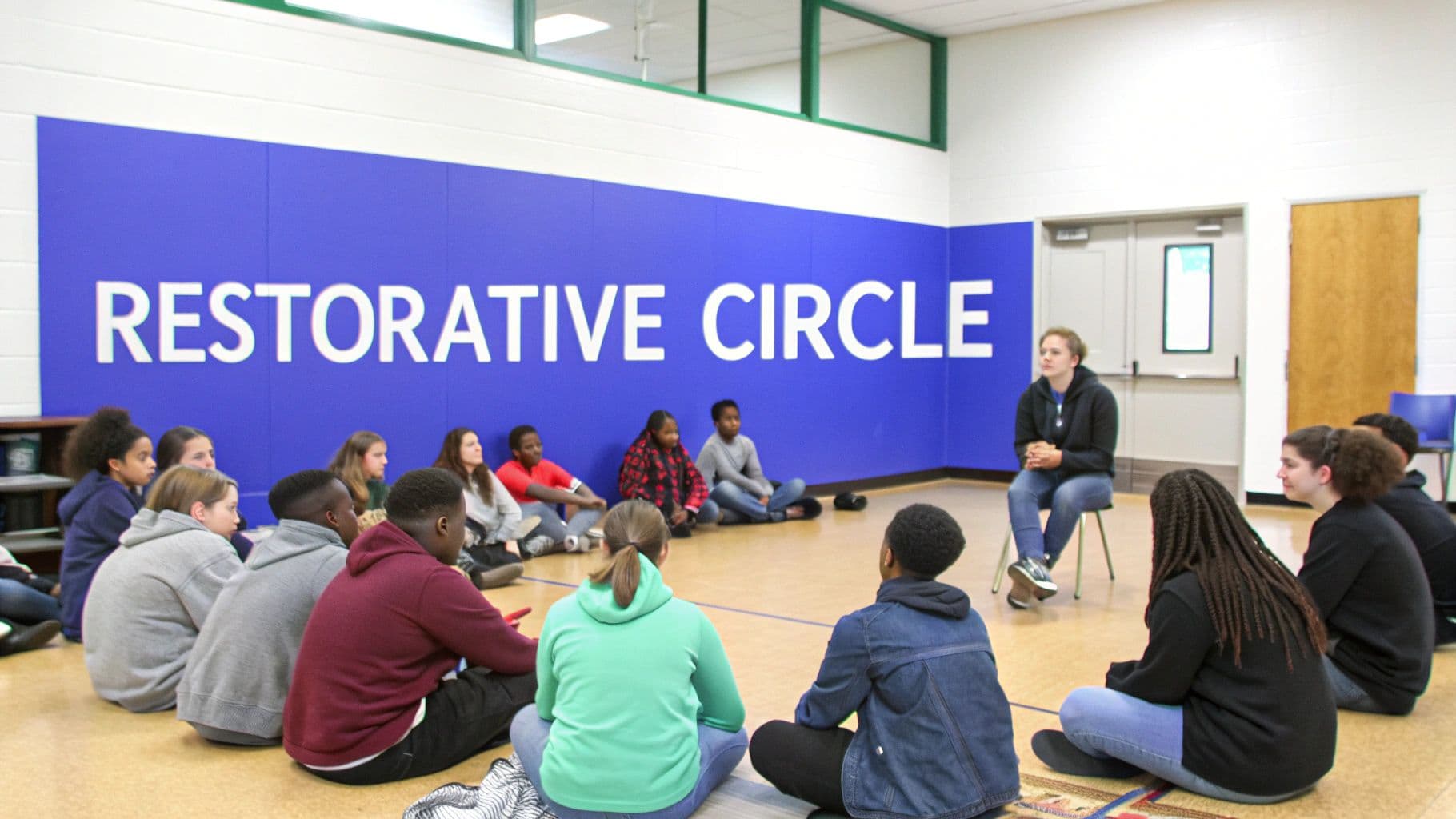
This model uses community-building circles, peer mediation, and restorative conferences to address conflict and misbehavior. It empowers students to resolve issues through dialogue and mutual understanding, building a stronger, more empathetic school culture. The goal is to reintegrate students into the community rather than excluding them through suspension or expulsion.
Strategic Breakdown
Restorative justice is a proactive and reactive system that builds social capital and addresses the root causes of conflict. School districts like Oakland Unified have seen a 30% reduction in suspensions after implementing these practices. This approach doesn't just manage behavior; it teaches critical life skills like conflict resolution, active listening, and empathy, which are essential for post-secondary success. By reducing punitive measures, schools can significantly improve attendance and academic performance.
Actionable Takeaways for Your Classroom
- Start with Community-Building Circles: Begin with low-stakes circles to build trust and practice communication skills. Use a talking piece to ensure everyone has a voice.
- Establish a Clear Referral Process: Work with administration to define which incidents are appropriate for a restorative conference versus traditional discipline. This clarity is key to consistent implementation.
- Train Student Mediators: Empower student leaders by training them as peer mediators. They can facilitate circles for minor conflicts, which builds their leadership skills and makes the program more sustainable.
- Integrate Restorative Language: Use "I-statements" and focus on the impact of actions rather than on blame. You can embed these language prompts into your daily lesson plans.
- Plan and Document: Use a tool like Kuraplan to schedule regular community-building circles and document the outcomes of restorative conferences, ensuring the process is integrated into your classroom's fabric.
4. Responsive Classroom Management - Primary Elementary (K-2) Focus
The Responsive Classroom approach is an evidence-based method that integrates academic and social-emotional learning into daily routines. It's built on the belief that a positive community is the foundation for effective teaching and learning, making it one of the most powerful samples of classroom management plans for K-2 students who are building their foundational social skills.
At its core, the approach focuses on proactive strategies like the Morning Meeting, student-generated rules, and logical consequences. These practices help create a classroom environment where students feel safe, valued, and empowered to take academic risks. The emphasis is on teaching how to behave rather than just reacting to misbehavior.
Strategic Breakdown
Responsive Classroom is more than just a set of activities; it's a philosophy for creating an engaging and respectful learning environment. Research shows schools using this approach report a 30-50% reduction in discipline referrals and significant improvements in students' social skills and academic achievement. By investing time in community-building routines at the start of the day and year, teachers establish a positive classroom culture that prevents many common behavior issues before they start. This focus on building a strong community is a cornerstone of effective teaching, and you can explore more strategies for creating a positive classroom culture to complement this approach.
Actionable Takeaways for Your Classroom
- Implement Morning Meetings: Dedicate 15-20 minutes each morning for a structured meeting that includes a greeting, sharing, a group activity, and a morning message. This routine builds community and sets a positive tone for the day.
- Co-Create Classroom Rules: In the first week of school, guide students in generating their own classroom rules based on their hopes and goals for the year. This gives them ownership and a deeper understanding of expectations.
- Use Logical Consequences: Instead of punitive measures, use consequences that are relevant, respectful, and realistic. For example, a student who misuses art supplies helps clean them up.
- Practice Routines and Transitions: Explicitly teach, model, and practice routines for everything from lining up to turning in work. Make the first month of school a "boot camp" for these procedures.
- Plan with Community in Mind: Use a tool like Kuraplan to structure your daily lesson plans around Responsive Classroom components. You can create templates that include slots for your Morning Meeting message, transition cues, and closing circle, ensuring these vital community-building practices are never skipped.
5. Structured High School Classroom Management (Secondary Focus)
Structured classroom management for high school focuses on creating a predictable, efficient, and academically-focused learning environment through clear systems and consistent routines. This approach, heavily influenced by figures like Harry Wong and Fred Jones, recognizes that adolescents thrive when expectations are explicit and accountability is logical. It establishes a framework for everything from entering the classroom to submitting assignments, making it one of the most reliable samples of classroom management plans for secondary education.
The core of this model is proactive organization. By establishing non-negotiable procedures for common classroom activities like bell-work, transitions, and homework submission, the teacher minimizes downtime and opportunities for disruption. This structure provides a sense of security and fairness, allowing students to focus their energy on learning rather than navigating ambiguous rules.
Strategic Breakdown
A highly structured environment isn't about rigid control; it's about maximizing instructional time and fostering student responsibility. High schools that implement consistent, structured systems across classrooms report significant improvements in on-task behavior and reductions in tardiness and hall pass usage by 25-35%. The predictability of the routine reduces student anxiety and cognitive load, which is especially beneficial in demanding courses like AP or CTE. This model empowers students by making the path to success clear and achievable.
Actionable Takeaways for Your Classroom
- Establish a Bell-Work Routine: Have a meaningful academic task ready for students the moment they walk in. This should be a consistent, non-negotiable part of every class period.
- Create a Syllabus Summary: Condense your most important policies (late work, grading, behavior) onto a single, easy-to-read page that both students and parents sign.
- Use Strategic Seating: Arrange seating charts to facilitate your teaching style and minimize distractions. Change them periodically to keep the classroom dynamic fresh.
- Teach Your Procedures: Dedicate the first few days of school to explicitly teaching and practicing every routine, from how to ask a question to where to turn in work. Revisit these after long breaks.
- Communicate Proactively: Send an email to parents at the beginning of the year outlining your core expectations and policies to build a strong home-school partnership.
- Integrate with Your Tools: Use a planner like Kuraplan to embed your structured routines directly into your lesson plans. You can pre-schedule bell-work, transition times, and reminders for procedures, ensuring consistency is built into every lesson.
6. Special Education and Inclusive Classroom Management - Multi-Grade Application
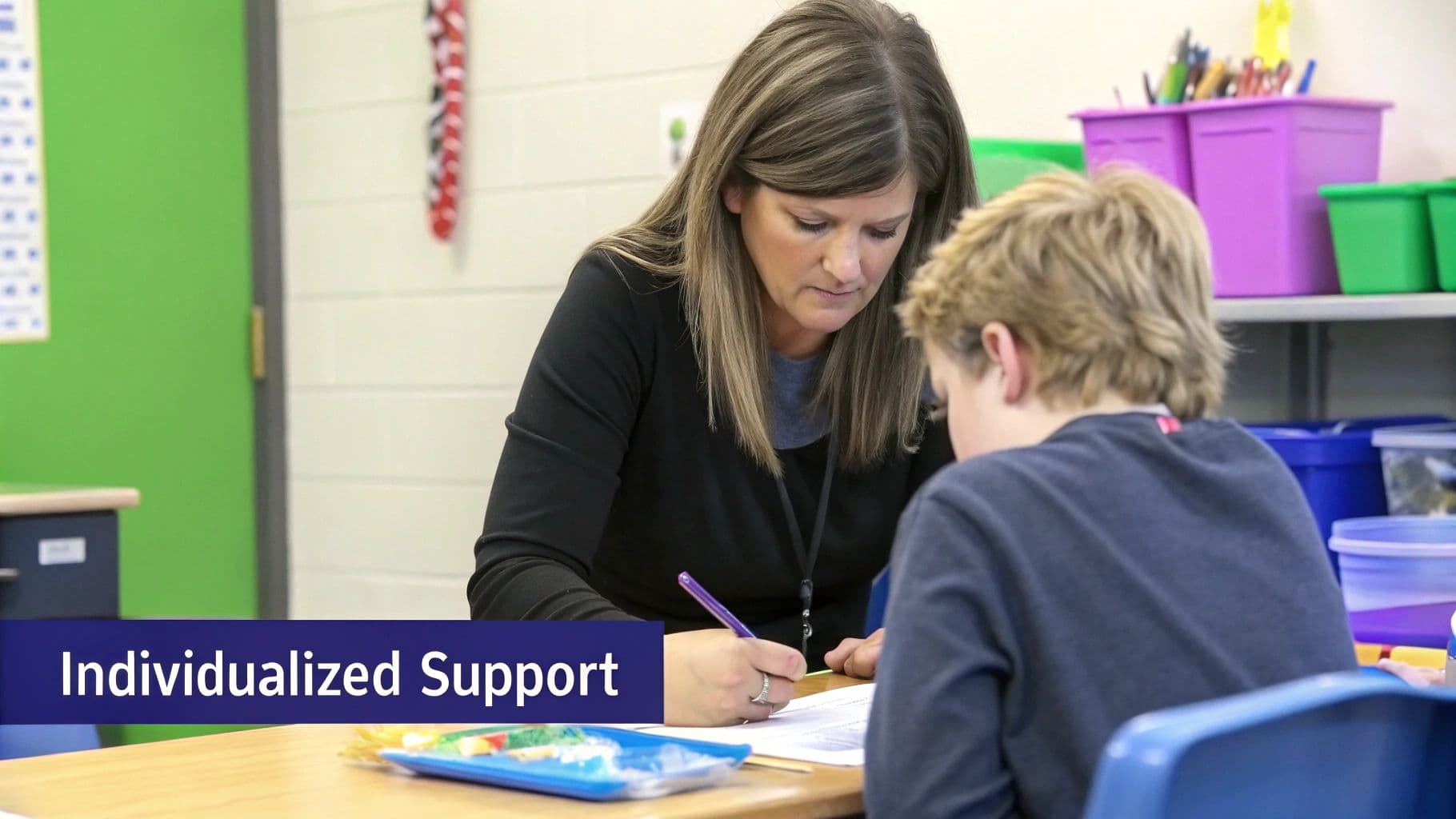
This specialized approach addresses the complex needs of inclusive and self-contained special education classrooms where students have diverse behavioral, sensory, and academic challenges. It moves beyond a one-size-fits-all model, combining evidence-based practices like positive behavioral supports, visual aids, individualized behavior plans (BIPs), and differentiated reinforcement. The core philosophy is to view behavior as a form of communication, focusing on addressing the underlying need rather than simply managing the surface-level action.
This model is a critical component of any comprehensive list of samples of classroom management plans because it emphasizes proactive, individualized support. Instead of waiting for a problem to occur, this framework uses tools like Functional Behavior Assessments (FBAs) to understand the "why" behind a student's behavior and build a supportive environment that prevents escalations and promotes student success.
Strategic Breakdown
This isn't a single plan but a highly adaptable framework that demands data-driven decision-making and strong collaboration. Schools that effectively implement function-based interventions often report a 40-60% reduction in significant behavior problems. The strategy hinges on consistency and understanding that progress can be incremental. Every staff member interacting with the student, from the general education teacher to the paraprofessional, must be trained on the specific plans and interventions to ensure fidelity. By integrating visual schedules, sensory breaks, and explicit social skills instruction into the daily routine, educators create a predictable and safe learning environment where all students can thrive.
Actionable Takeaways for Your Classroom
- Prioritize Visual Supports: Use visual schedules, first-then boards, and timers to make transitions and expectations clear and predictable for all students.
- Integrate Sensory Breaks: Proactively schedule brain breaks or sensory activities into your daily routine to help students self-regulate before they become overwhelmed.
- Develop Collaborative BIPs: Create Behavior Intervention Plans with the full team: special education staff, families, general educators, and, when appropriate, the student. A plan developed in isolation is less likely to succeed.
- Track Data Consistently: Use simple charts or digital tools to track data on target behaviors weekly. This data is essential for knowing when to adjust an intervention.
- Celebrate Small Victories: Acknowledge and reinforce small steps of progress. For students with significant challenges, these small wins are the foundation for larger growth.
- Leverage Technology for Differentiation: If you're looking for AI tools to help with this, Kuraplan can be a lifesaver. It can help embed differentiated academic goals alongside behavioral supports in your lesson plans, ensuring a cohesive and individualized approach.
7. Blended Digital and Traditional Management - Remote/Hybrid Elementary Setting
As learning environments evolve, a blended management approach combining traditional in-person strategies with robust digital protocols is essential for consistency in remote and hybrid classrooms. This model addresses the unique challenge of managing student behavior across both physical and virtual spaces. It's one of the most relevant samples of classroom management plans for modern educators, ensuring that expectations, routines, and community are maintained regardless of where learning happens.
The core of this approach is creating a single, unified classroom culture. Digital citizenship expectations are taught with the same rigor as hallway procedures, and the Learning Management System (LMS) becomes a central hub for communication, assignments, and reinforcement, mirroring the role of the physical classroom whiteboard or bulletin board.
Strategic Breakdown
A blended management plan is more than just posting rules online; it's a systematic integration of digital tools with proven pedagogical strategies. Districts that effectively merge their LMS protocols with in-person structures have seen a 30-40% reduction in missed assignments because expectations are clear and accessible 24/7. The plan focuses on proactive communication and predictable routines, which helps young learners feel secure and connected, whether they are at their school desk or their kitchen table. By treating the digital space as an extension of the classroom, teachers can foster strong peer relationships and sustain a positive learning community.
Actionable Takeaways for Your Classroom
- Establish Clear Digital Expectations: Define 5-7 explicit rules for the virtual space, such as "Mute your microphone when not speaking" and "Use the chat for questions about the lesson." Teach and model these just as you would in-person rules.
- Unify Your Routines: Create parallel routines for in-person and remote sessions. Have a consistent "Do Now" activity, a structured transition signal, and a closing ritual that can be done both online and offline.
- Leverage Your LMS for Communication: Use the announcement feature on Google Classroom or Canvas for daily agendas, positive shout-outs, and important reminders. This creates a predictable source of information for students and families.
- Prioritize Connection: Schedule regular one-on-one or small-group check-ins with students, particularly those who seem disengaged online. Use this time to connect personally and address any barriers to their learning.
- Integrate Your Plan with Your Tools: Use a tool like Kuraplan to embed your digital expectations and routines directly into your lesson plans. This ensures that every lesson, whether delivered in-person or remotely, reinforces your unified management system.
8. Montessori-Influenced Management - Primary Elementary (3-6 years)
A Montessori-influenced approach adapts the principles of student-centered learning and self-discipline for a variety of classroom settings. Instead of a teacher-led, compliance-focused model, this plan emphasizes intrinsic motivation by creating a "prepared environment" where students can exercise choice, learn from peers, and experience natural consequences. This method is one of the most transformative samples of classroom management plans for fostering independence and self-regulation in young learners.
The core of this philosophy is that the classroom environment itself is the primary tool for management. By carefully designing the space with accessible, self-correcting materials and clear, structured routines, the teacher guides students toward purposeful work. This shifts the focus from managing behavior to facilitating engagement, as misbehavior is often seen as a sign of an unmet need or a lack of appropriate challenge.
Strategic Breakdown
This approach is powerful because it builds executive function skills from a very young age. When students learn to choose an activity, gather their materials, complete the task, and clean up independently, they are practicing planning, sequencing, and self-monitoring. Public schools with Montessori-influenced classrooms report significant gains in student engagement and a reduction in behavior referrals because children are empowered and respected as capable learners. The emphasis is on freedom within limits, giving students agency while maintaining a calm, orderly, and productive atmosphere.
Actionable Takeaways for Your Classroom
- Create a Prepared Environment: Organize your classroom into distinct learning areas (e.g., literacy, math, practical life). Use low shelves and clear bins so children can access and return materials independently.
- Teach Routines Explicitly: Model every routine, from how to unroll a work mat to how to ask for help without interrupting. Break down each step and have students practice.
- Offer Structured Choices: Instead of a free-for-all, provide a curated set of activities that align with learning objectives. A student might choose between three different math activities, ensuring they are engaged in meaningful work.
- Use Natural Consequences: If a child spills water, the natural consequence is getting a cloth and cleaning it up. This teaches responsibility without shame or punishment.
- Observe Before Intervening: Watch students closely. Their actions will tell you if an activity is too easy, too hard, or if they need a new social skill modeled for them.
- Integrate with Your Tools: Use Kuraplan to design lesson plans that build in student choice and independent work periods. You can schedule specific times for demonstrating new materials and for observation, ensuring your management and instructional goals are perfectly aligned.
8-Model Classroom Management Comparison
| Approach | 🔄 Implementation Complexity | ⚡ Resource Requirements | ⭐ Expected Outcomes | 💡 Ideal Use Cases | 📊 Key Advantages |
|---|---|---|---|---|---|
| Positive Behavioral Interventions and Supports (PBIS) - Elementary Focus | Moderate–High; multi-year, system-wide rollout and ongoing fidelity work | Training, data systems, acknowledgment supplies, leadership team | 20–58% reduction in referrals; improved climate and equity | K–5 whole-school frameworks; districts seeking scalable prevention | Predictable, scalable, data-driven improvements across school settings |
| Love and Logic Classroom Management - Middle School Application | Moderate; requires teacher mindset shift and consistent practice (6–8+ weeks to see change) | Professional development, time for practice; low material costs | ~30–40% reduction in classroom issues; stronger teacher-student relationships | Grades 6–8; autonomy-seeking adolescents; relationship-focused settings | Reduces power struggles; builds responsibility and self-regulation |
| Restorative Justice and Circles - High School Implementation | High; extensive initial training (40+ hrs) and skilled facilitation required | Time-intensive circles/conferences, staff training, administrative buy-in | 20–50% reduction in suspensions; increased belonging, student voice | High schools seeking alternatives to punitive discipline and community repair | Addresses root causes; increases accountability, empathy, and reduced repeat offenses |
| Responsive Classroom Management - Primary Elementary (K-2) Focus | Moderate; daily routines (morning meetings) and strong teacher consistency | PD, prep time, materials for routines, family communication | 30–50% reduction in referrals; improved SEL, engagement, and academic readiness | K–2 classrooms building foundational social-emotional routines | Builds classroom community; integrates SEL with academic preview and routines |
| Structured High School Classroom Management (Secondary Focus) | Low–Moderate; clear systems are straightforward but require consistent enforcement | Planning time, documentation systems, behavior contracts, parent outreach | 25–35% reduction in tardies/hall passes; higher time-on-task and predictability | Traditional high schools, large classes, content-focused courses | Efficient, predictable, scalable for multiple periods and large cohorts |
| Special Education and Inclusive Classroom Management - Multi-Grade Application | High; individualized assessment and iterative plan development required | Specialized staff, FBA/BIP training, materials, frequent data collection | 40–60% reduction in target behaviors; improved inclusion and academic outcomes | K–12 inclusive settings and self-contained special education classrooms | Data-driven individualized supports addressing root causes; collaborative team model |
| Blended Digital and Traditional Management - Remote/Hybrid Elementary Setting | Moderate; dual protocols for in-person and virtual environments | LMS, reliable tech, staff training, family tech support | 15–40% improvement in engagement/assignment completion; continuity of community | K–5 hybrid or remote programs; schools maintaining flexible learning models | Continuity across modalities; real-time monitoring and documentation trail |
| Montessori-Influenced Management - Primary Elementary (3–6 years) | Moderate–High; classroom reorganization and teacher role shift needed | Prepared materials, classroom layout investment, teacher facilitation training | Reduced behavior issues; stronger independence and executive function (qualitative gains) | Primary settings (early childhood/K-2) emphasizing autonomy and intrinsic motivation | Fosters intrinsic motivation, independence, calm prepared environments |
From Plan to Practice: Making Your Management System Stick
We’ve journeyed through a diverse landscape of classroom management philosophies, from the structured routines of a PBIS-focused elementary room to the student-led accountability of a high school restorative justice circle. Each of the samples of classroom management plans explored here offers more than just a template; they provide a strategic lens through which to view student behavior and classroom culture.
The bottom line is clear: there is no one-size-fits-all solution. A strategy that creates harmony in a first-grade Responsive Classroom might fall flat in a structured high school setting. The goal isn't to adopt one of these plans verbatim but to become an architect of your own system. Your most effective plan will be a mosaic, borrowing elements that resonate with your teaching philosophy and, most importantly, serve the specific needs of the students in front of you.
Synthesizing the Strategies: Key Takeaways
Across all the models, several universal truths emerge. Effective management is proactive, not reactive. It is built on relationships, not just rules. And it is a living document, designed to evolve alongside your students.
Here are the most critical takeaways to guide your next steps:
- Proactivity Over Reactivity: The strongest plans, like PBIS and Responsive Classroom, dedicate 80% of their effort to front-loading expectations, teaching routines, and building community. This proactive investment drastically reduces the need for reactive discipline.
- Relationships are the Foundation: Models like Love and Logic and Restorative Justice are built on a foundation of mutual respect and empathy. Without a strong teacher-student connection, even the most well-designed consequence system will feel punitive.
- Consistency is Your Superpower: Whether you are implementing a visual schedule in an inclusive classroom or a clear procedure for turning in digital work, consistency is what turns a plan into a predictable and safe environment. Students thrive when they know what to expect.
Your Actionable Next Steps
Seeing these samples of classroom management plans is inspiring, but turning inspiration into implementation is where the real work begins. Avoid the temptation to overhaul your entire system overnight. Instead, focus on incremental, sustainable change.
- Conduct a Self-Audit: Which part of your current day causes the most friction? Is it transitions? Independent work time? Start there. Find one strategy from the samples that directly addresses that pain point.
- Choose One New Routine: Select a single, high-impact routine from one of the plans. Perhaps it's the morning meeting from Responsive Classroom or a simple "reset and reflect" corner inspired by restorative practices.
- Commit for Three Weeks: Implement that one new routine with absolute fidelity for the next three weeks. This gives you and your students enough time to internalize it and for you to see a tangible impact.
- Leverage Technology to Streamline: The administrative side of management can be draining. If you find yourself spending too much time drafting parent emails or creating visual aids, it’s a sign to seek support. This is another area where AI tools can be a huge help. For instance, you could use Kuraplan's AI assistant to generate a tiered system of interventions based on the PBIS model or create a customized daily schedule for a student with specific needs.
Ultimately, your classroom management plan is the invisible architecture that supports every single learning moment. It’s the framework that allows academic risks to be taken, curiosity to flourish, and a true community of learners to form. The time you invest in refining this system is a direct investment in your students' success and your own professional well-being. Start small, stay consistent, and build the classroom you’ve always envisioned.
Feeling inspired but need help putting these ideas into a polished, actionable document? Kuraplan uses AI to help you build a comprehensive classroom management plan from the ground up, incorporating principles from all the models we've discussed. Generate routines, communication templates, and behavioral strategies in minutes at Kuraplan.