ScienceFreePrintable

Atomic Structure and Bonding

A free science worksheet ready for your classroom. Open in Kuraplan to grab the print-ready PDF, customize it for your students, or generate a fresh version in seconds.
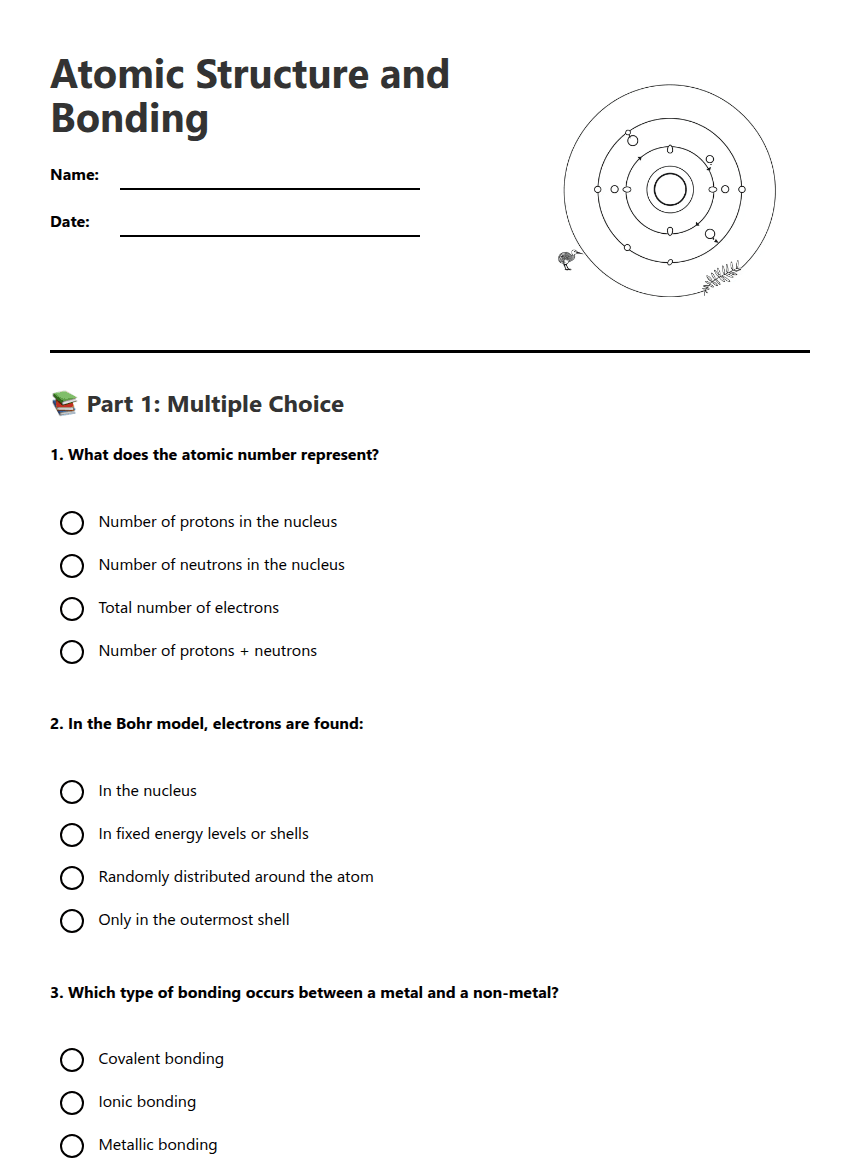
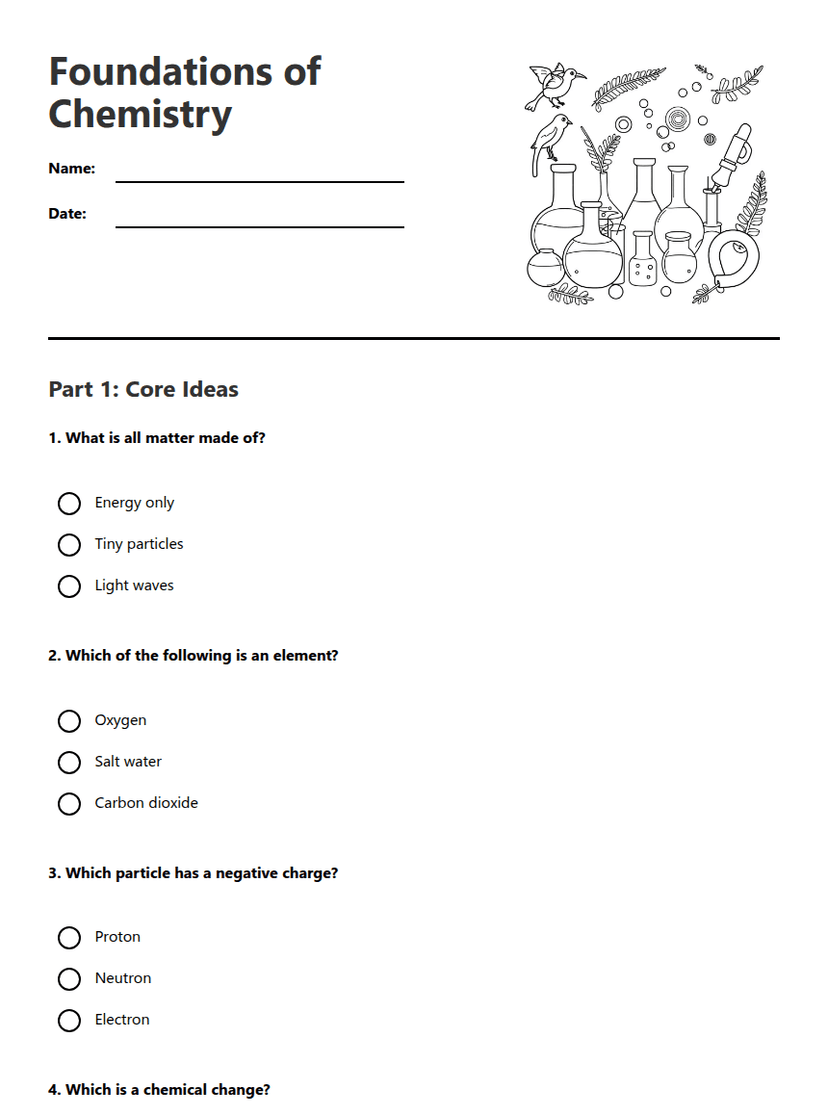
Atomic Structure and Bonding worksheet preview

Year 10 Science Assessment
                         Matter

Part 1: Multiple Choice

1. What does the atomic number represent?

Number of protons in the nucleus

Number of neutrons in the nucleus

Total number of electrons

Number of protons + neutrons

2. In the Bohr model, electrons are found:

In the nucleus

In fixed energy levels or shells

Randomly distributed around the atom

Only in the outermost shell

3. Which type of bonding occurs between a metal and a non-metal?

Covalent bonding

Ionic bonding

Metallic bonding

Hydrogen bonding

4. Which of the following are characteristics of covalent bonding? (Select all that apply)

Electrons are shared between atoms

Occurs between non-metals

Forms molecules

Electrons are transferred from one atom to another

 Part 2: Short Answer Questions

5. An atom has an atomic number of 17 and a mass number of 35. Calculate:

a) Number of protons: ___________

b) Number of electrons: ___________

c) Number of neutrons: ___________

6. Explain the difference between ionic and covalent bonding in terms of electron behaviour.
7. Draw the electron structure diagram (Bohr model) for a sodium atom (Na, atomic number = 11).
8. Complete the following table:

Element: Oxygen (O)

Atomic number: 8

Mass number: 16

Number of protons: ___________

Number of electrons: ___________

Number of neutrons: ___________

Electron configuration (shells): ___________

 Part 3: Application

9. Predict the type of bonding that would occur between the following pairs of elements and explain your reasoning:

a) Sodium (Na) and Chlorine (Cl): ________________________

b) Carbon (C) and Hydrogen (H): ________________________

10. Draw a simple diagram showing the formation of an ionic bond between sodium (Na) and fluorine (F). Show the electron transfer and the resulting ions.

About This Worksheet

Free in Kuraplan

Sign up free, grab the PDF, and customize it for your class.

Print-Ready

Formatted for standard paper. Clean layout, easy to read.

AI-Generated

Created with Kuraplan's AI, designed for real classroom use.

For Teachers & Parents

Use in classrooms, for homework, tutoring, or homeschool.

Need a custom version of this worksheet?

Kuraplan's AI generates custom worksheets in seconds — differentiated for every learner, aligned to your curriculum.

Generate Custom Worksheets — Free
No credit card Curriculum-aligned Under 60 seconds