ScienceFreePrintable
Buoyancy and Density Comparison
A free science worksheet ready for your classroom. Open in Kuraplan to grab the print-ready PDF, customize it for your students, or generate a fresh version in seconds.
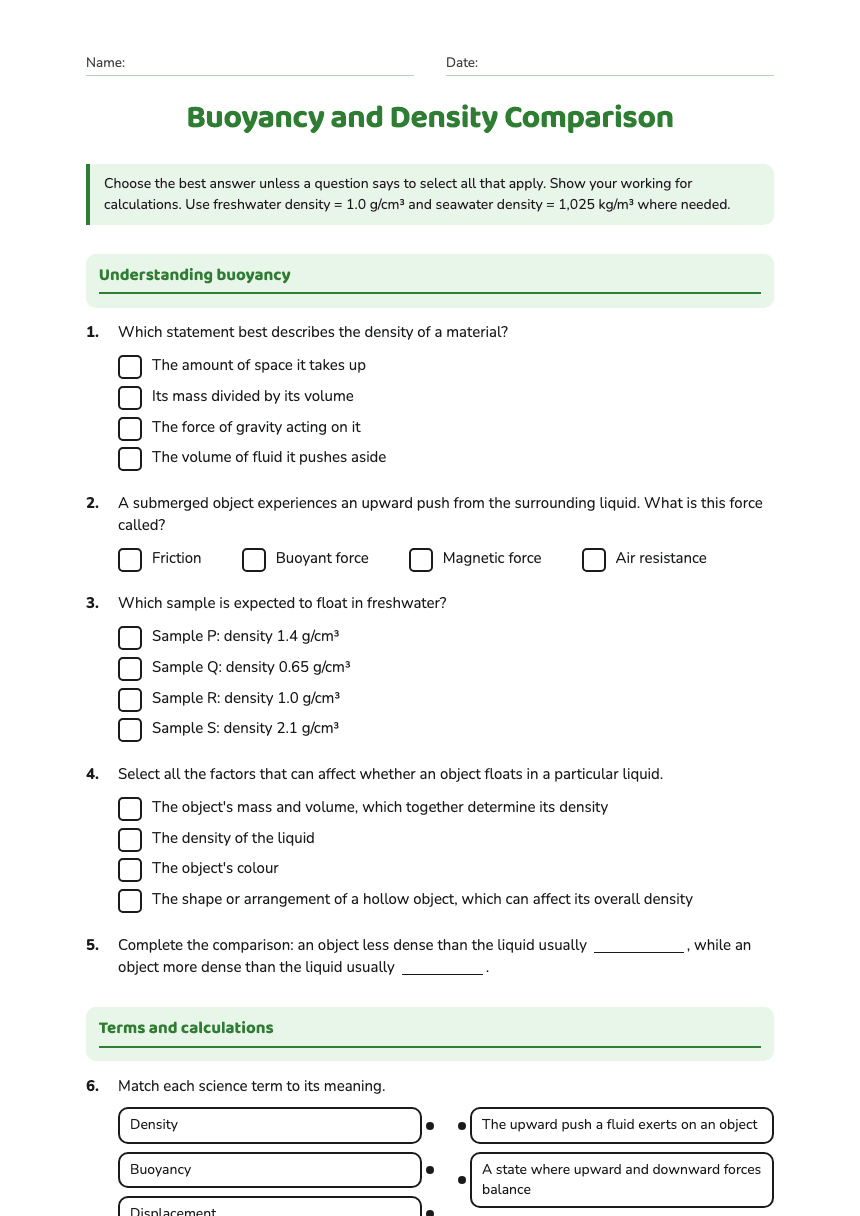
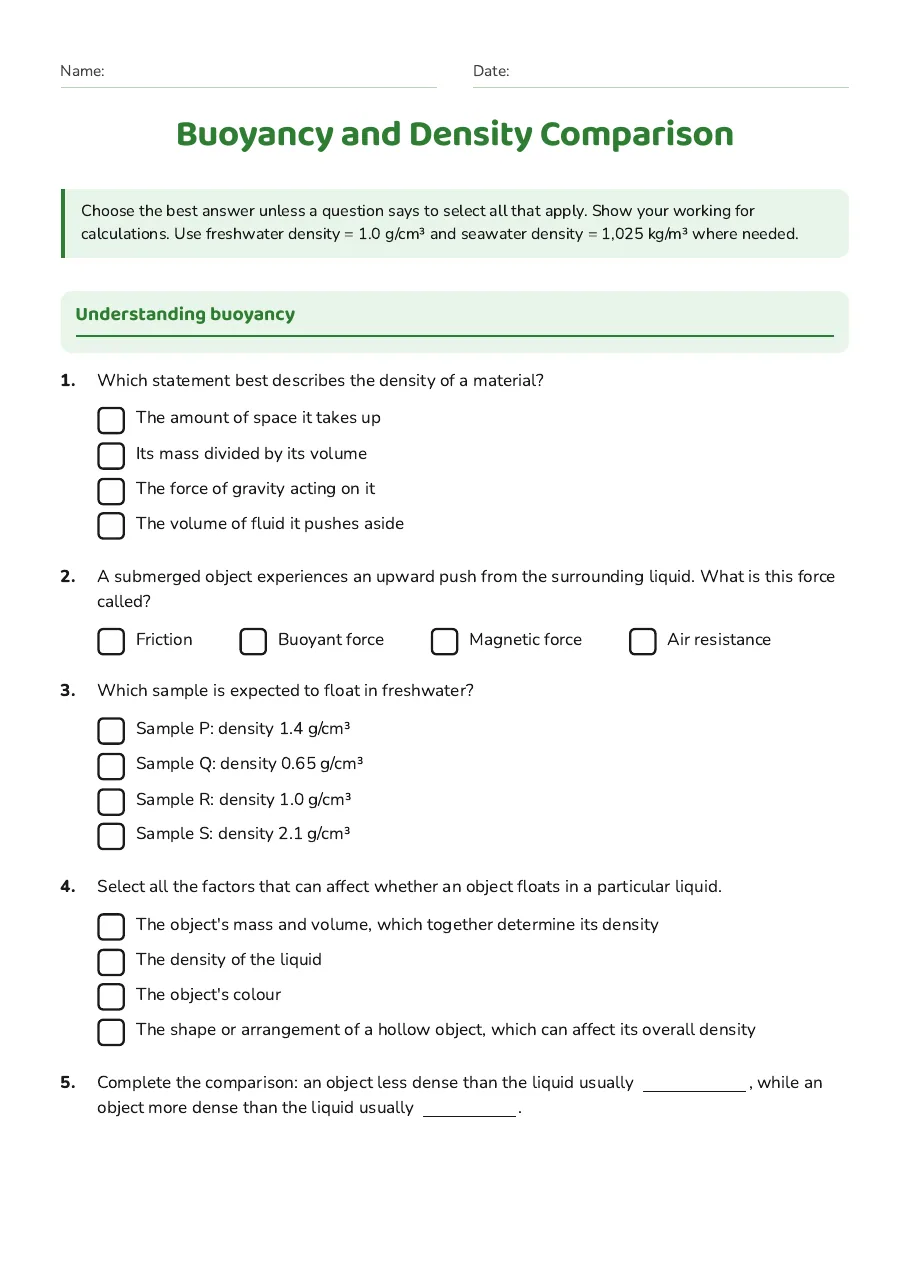
Name:Date:
Buoyancy and Density Comparison
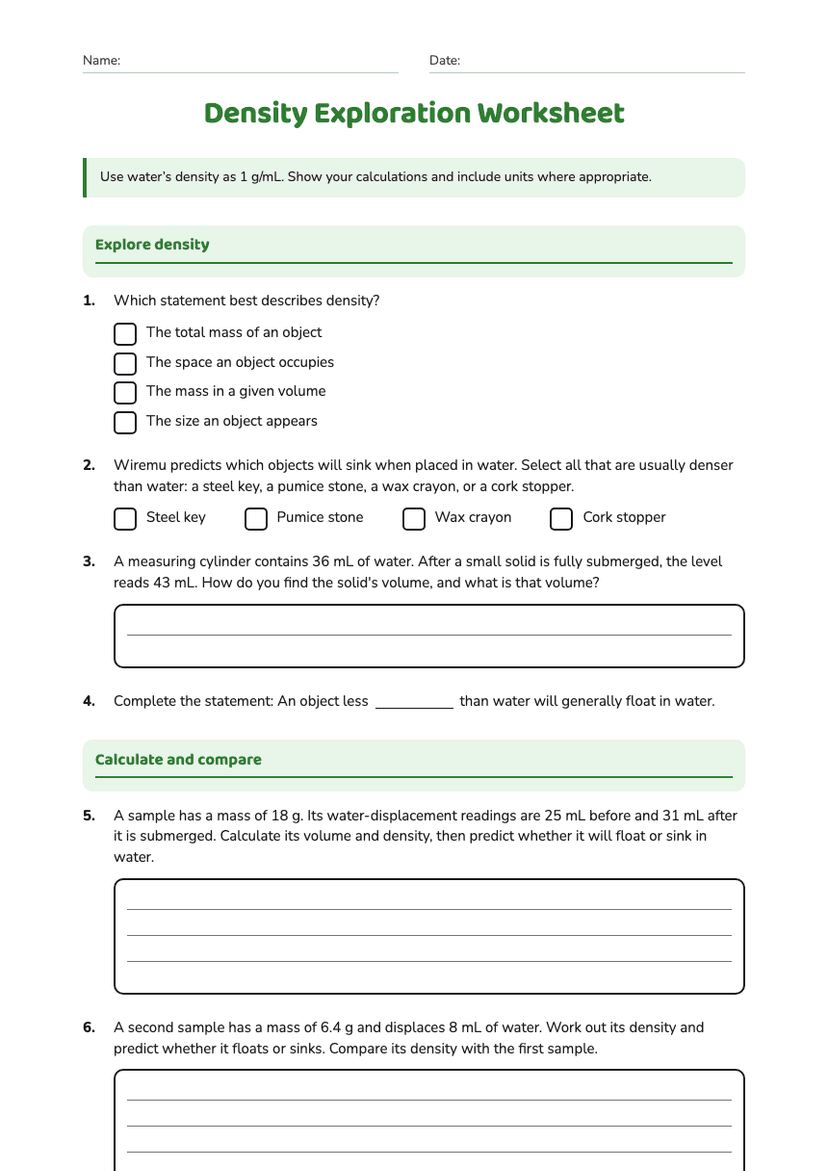
Choose the best answer unless a question says to select all that apply. Show your working for calculations. Use freshwater density = 1.0 g/cm³ and seawater density = 1,025 kg/m³ where needed.
Understanding buoyancy
1.Which statement best describes the density of a material?
- The amount of space it takes up
- Its mass divided by its volume
- The force of gravity acting on it
- The volume of fluid it pushes aside
2.A submerged object experiences an upward push from the surrounding liquid. What is this force called?
- Friction
- Buoyant force
- Magnetic force
- Air resistance
3.Which sample is expected to float in freshwater?
- Sample P: density 1.4 g/cm³
- Sample Q: density 0.65 g/cm³
- Sample R: density 1.0 g/cm³
- Sample S: density 2.1 g/cm³
4.Select all the factors that can affect whether an object floats in a particular liquid.
- The object's mass and volume, which together determine its density
- The density of the liquid
- The object's colour
- The shape or arrangement of a hollow object, which can affect its overall density
5.Complete the comparison: an object less dense than the liquid usually , while an object more dense than the liquid usually .
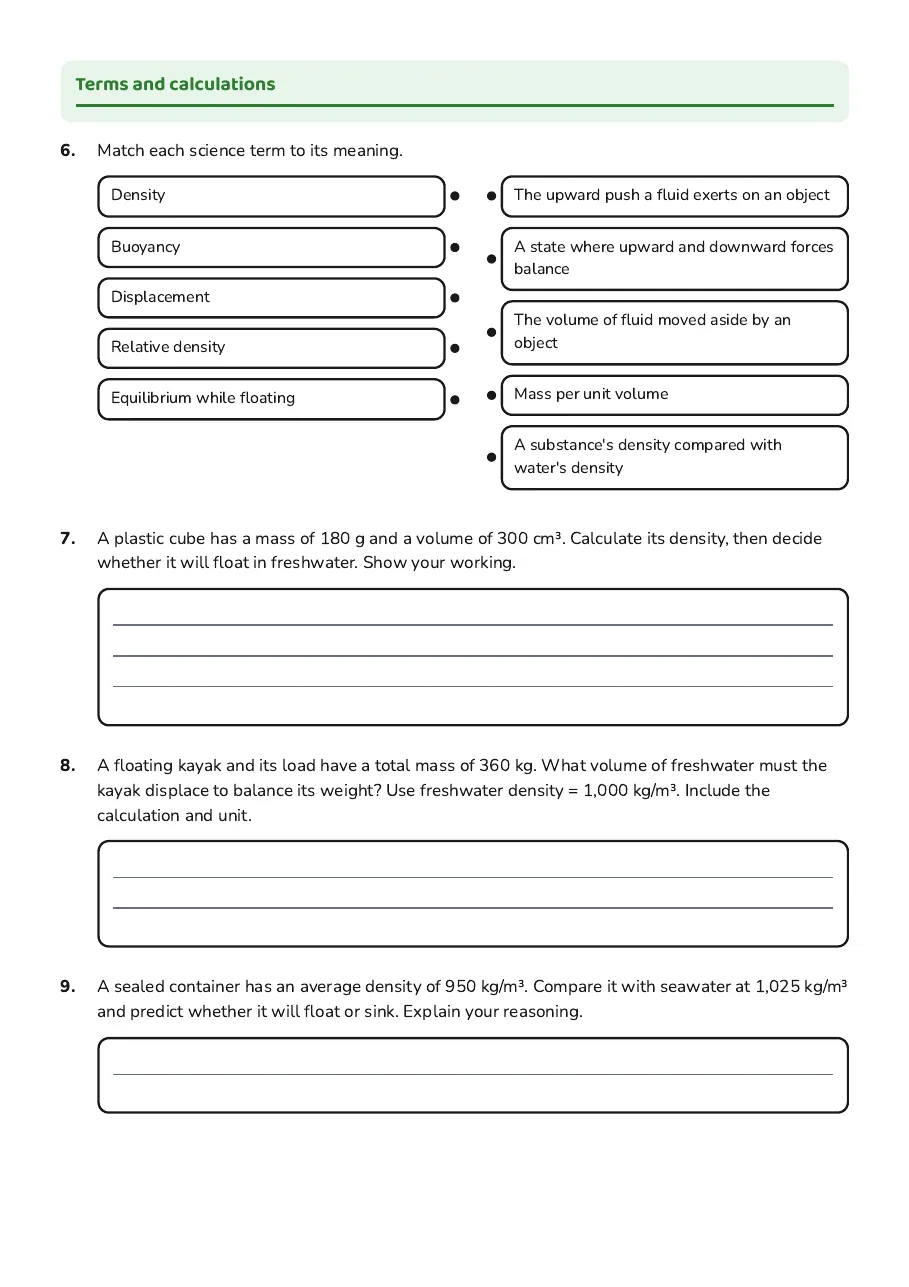
Terms and calculations
6.Match each science term to its meaning.
- Density
- Buoyancy
- Displacement
- Relative density
- Equilibrium while floating
- The upward push a fluid exerts on an object
- A state where upward and downward forces balance
- The volume of fluid moved aside by an object
- Mass per unit volume
- A substance's density compared with water's density
7.A plastic cube has a mass of 180 g and a volume of 300 cm³. Calculate its density, then decide whether it will float in freshwater. Show your working.
8.A floating kayak and its load have a total mass of 360 kg. What volume of freshwater must the kayak displace to balance its weight? Use freshwater density = 1,000 kg/m³. Include the calculation and unit.
9.A sealed container has an average density of 950 kg/m³. Compare it with seawater at 1,025 kg/m³ and predict whether it will float or sink. Explain your reasoning.
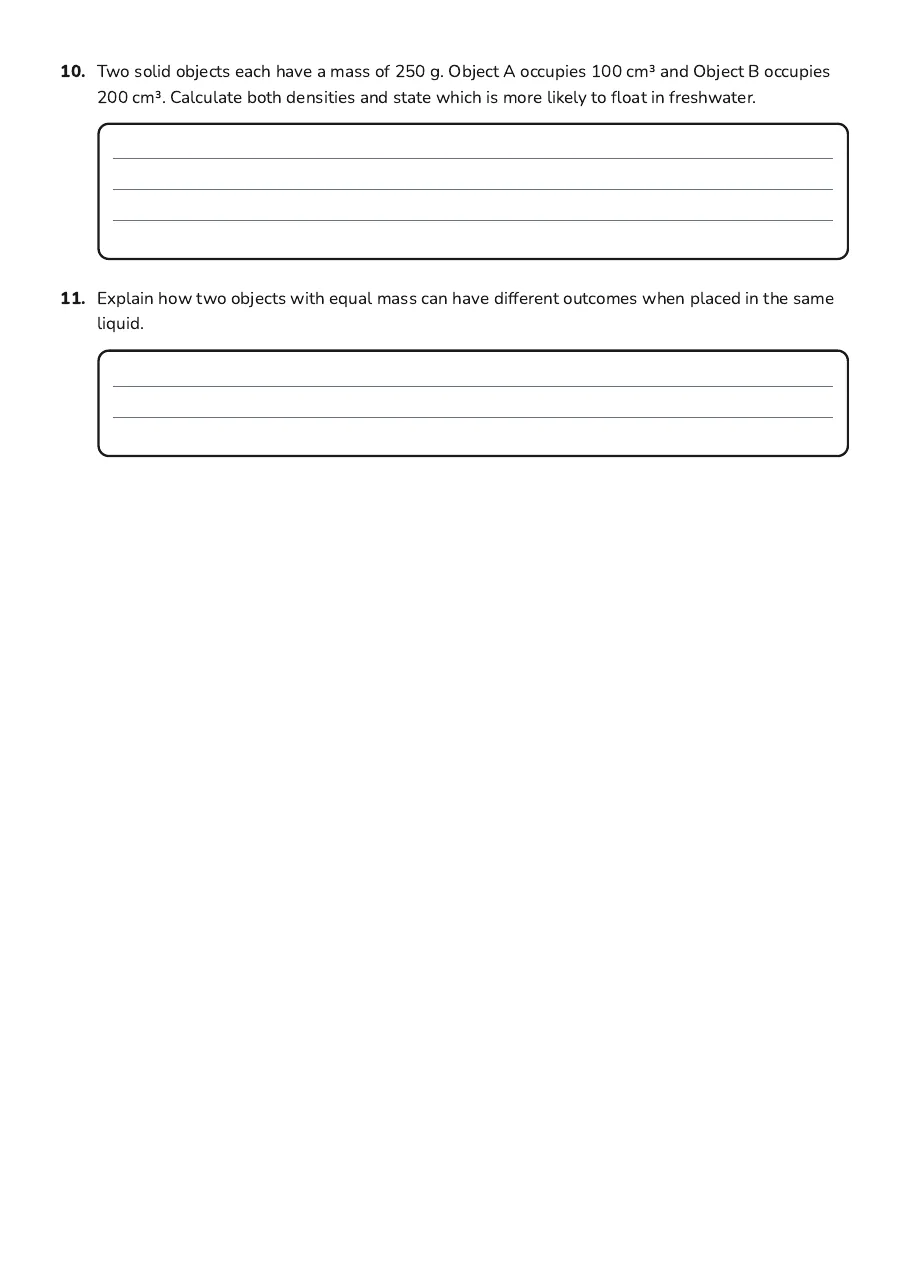
10.Two solid objects each have a mass of 250 g. Object A occupies 100 cm³ and Object B occupies 200 cm³. Calculate both densities and state which is more likely to float in freshwater.
11.Explain how two objects with equal mass can have different outcomes when placed in the same liquid.
3 printable pages
Page 1
Page 2
Page 3
About This Worksheet
Free in Kuraplan
Sign up free, grab the PDF, and customize it for your class.
Print-Ready
Formatted for standard paper. Clean layout, easy to read.
AI-Generated
Created with Kuraplan's AI, designed for real classroom use.
For Teachers & Parents
Use in classrooms, for homework, tutoring, or homeschool.
Need a custom version of this worksheet?
Kuraplan's AI generates custom worksheets in seconds — differentiated for every learner, aligned to your curriculum.
Generate Custom Worksheets — Free No credit card Curriculum-aligned Under 60 seconds