EnglishFreePrintable

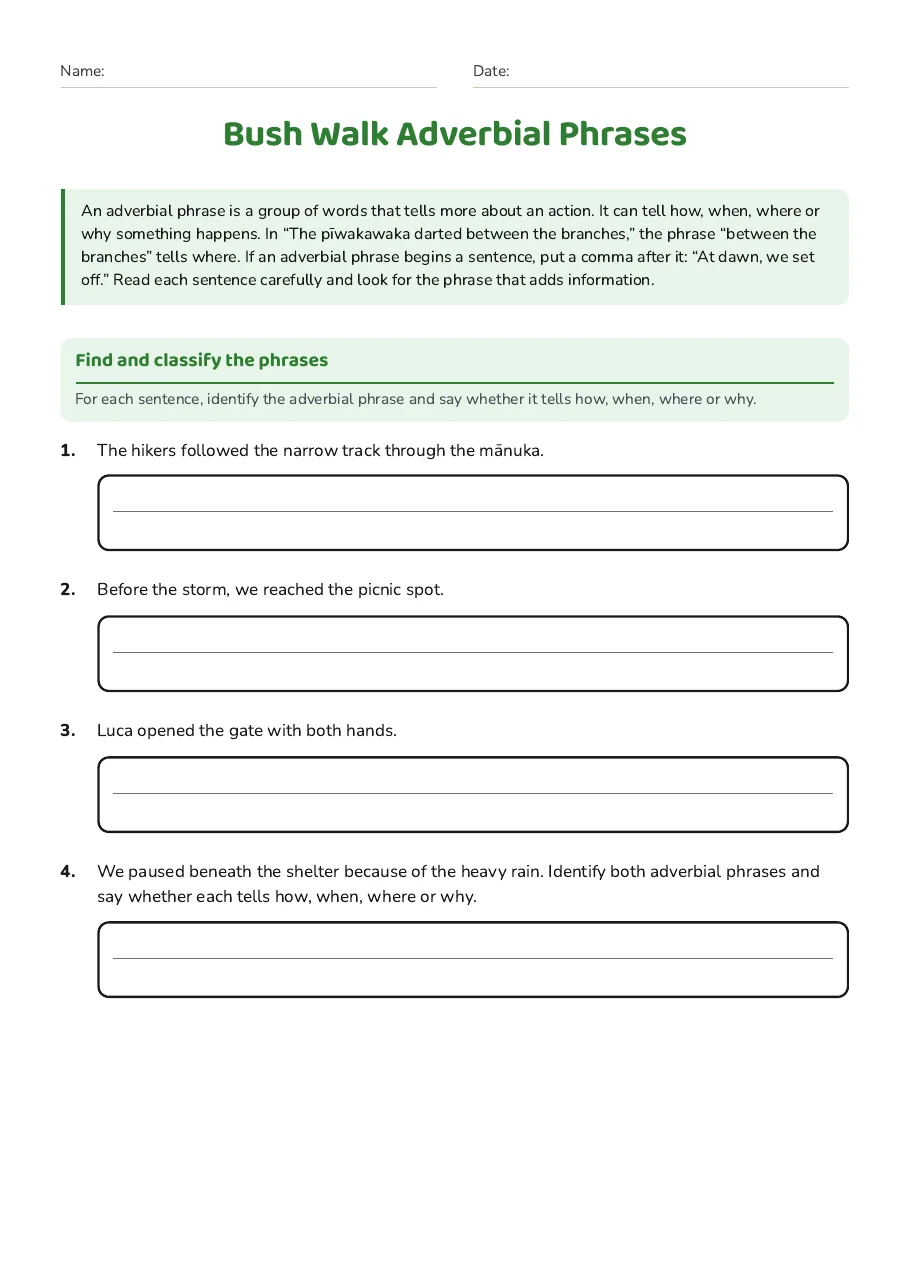
Bush Walk Adverbial Phrases

A free english worksheet ready for your classroom. Open in Kuraplan to grab the print-ready PDF, customize it for your students, or generate a fresh version in seconds.
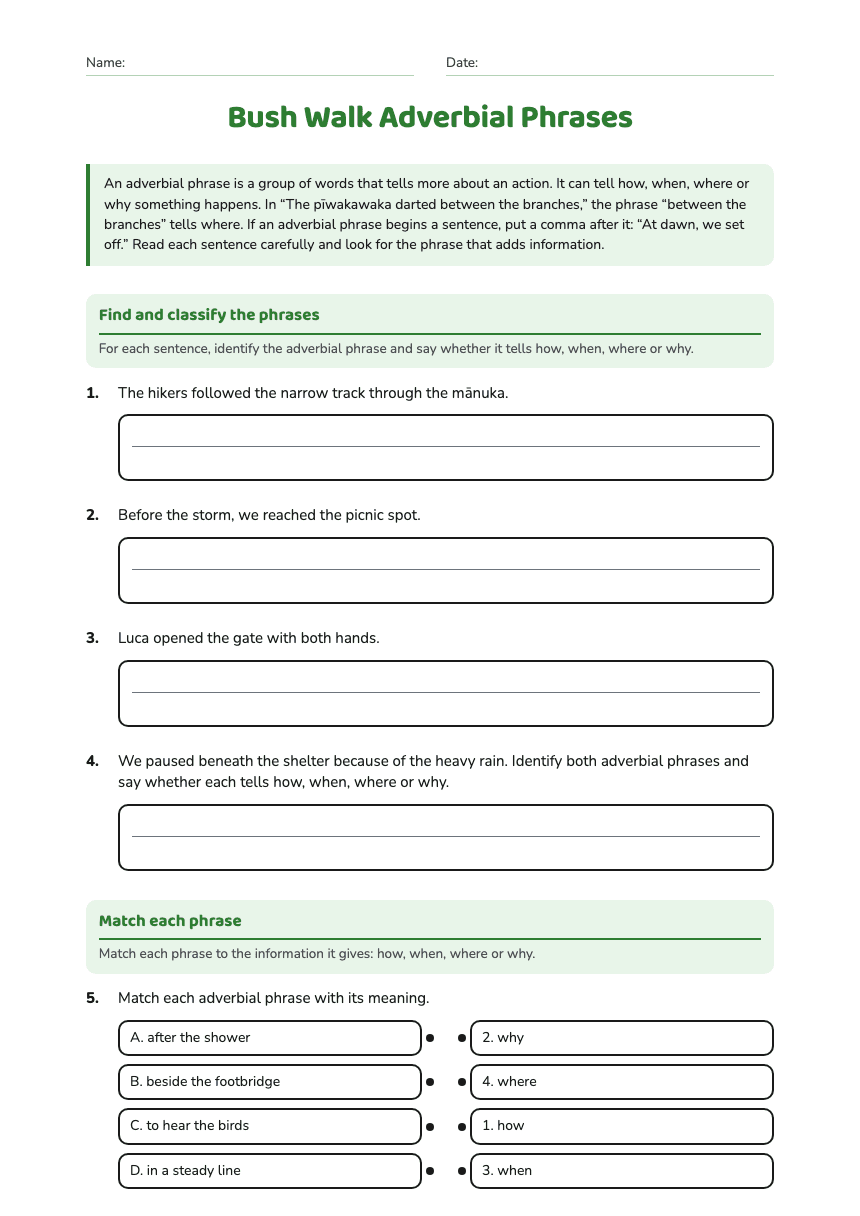
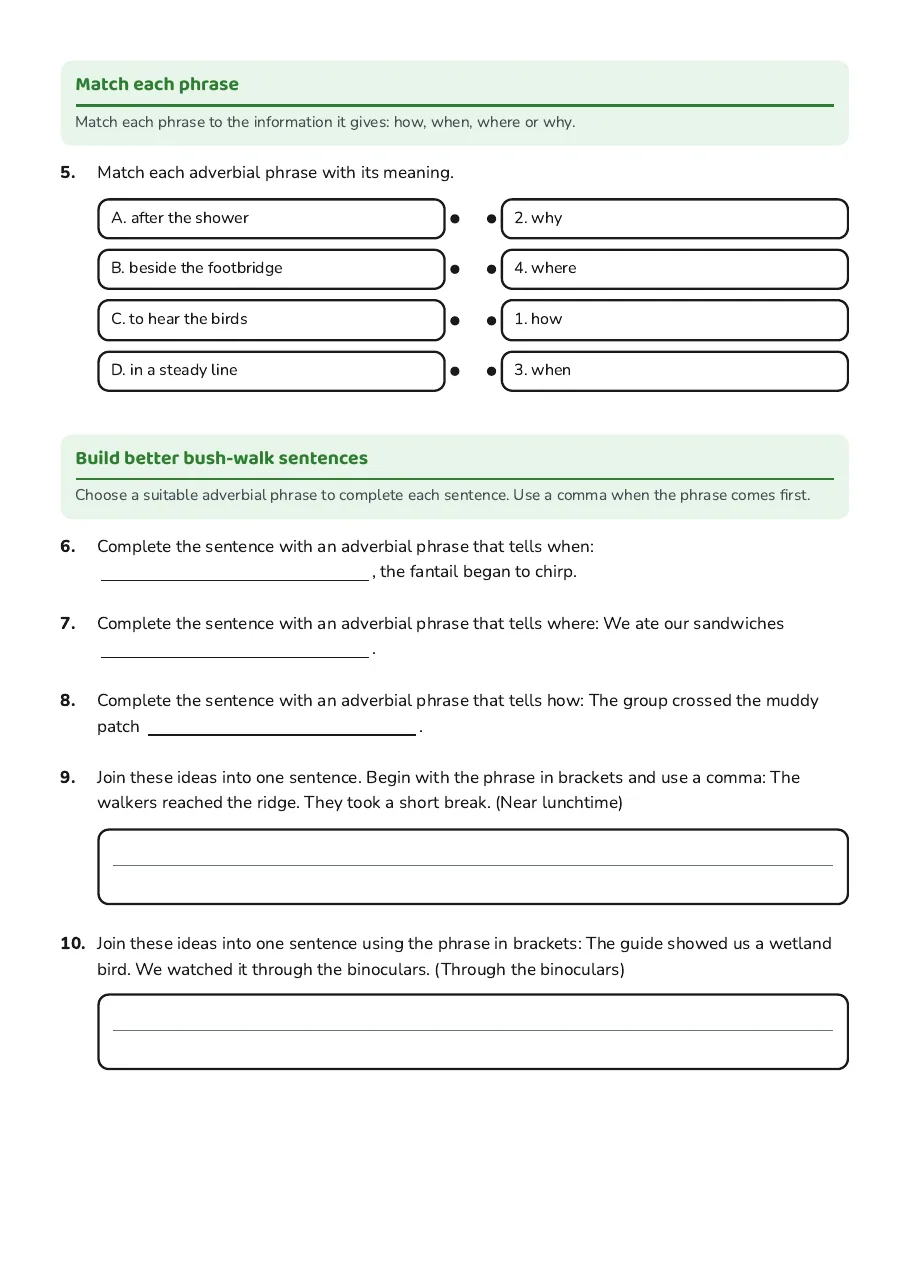
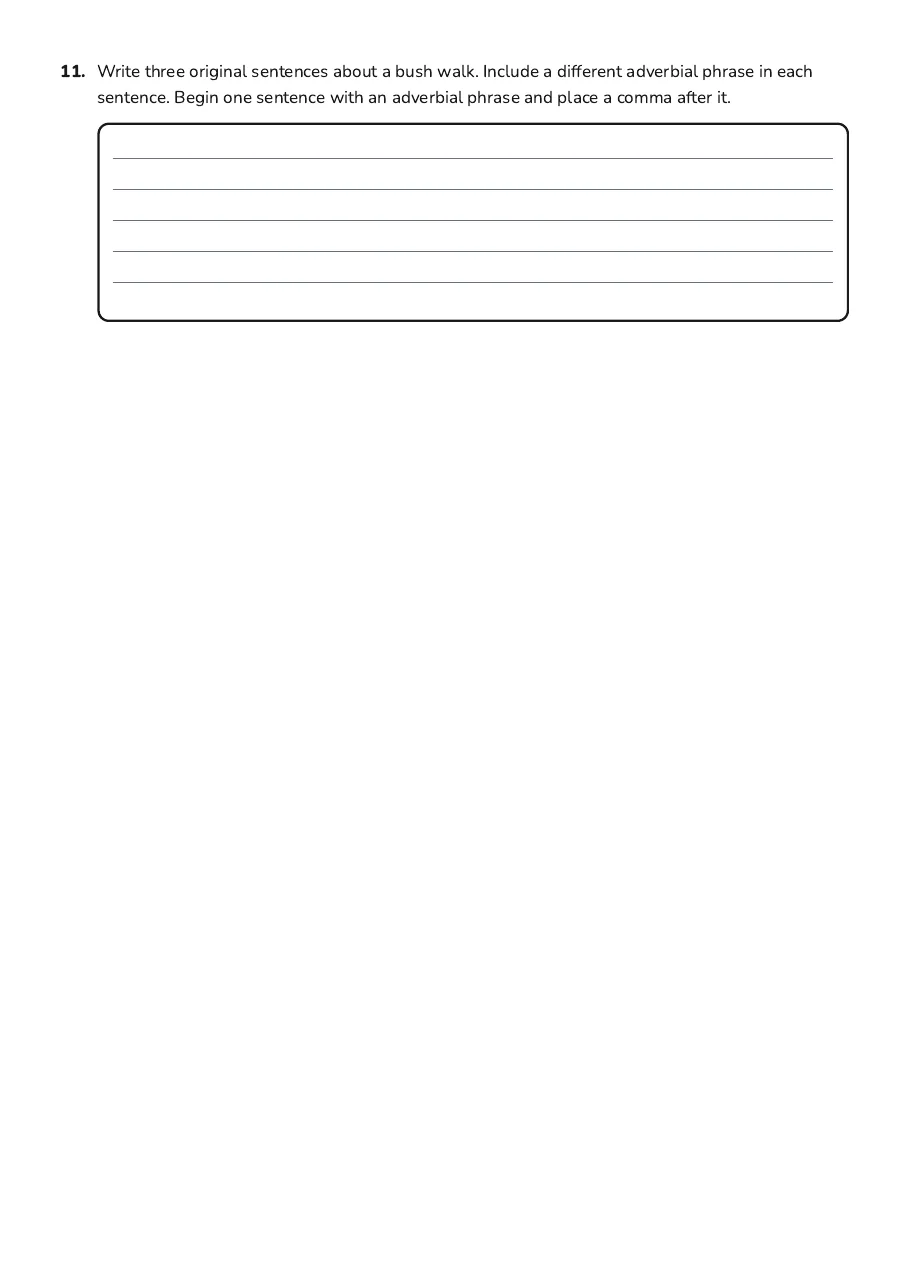
Bush Walk Adverbial Phrases worksheet preview

Bush Walk Adverbial Phrases

📚 Learn About Adverbial Phrases

WALT: We Are Learning To expand sentences with adverbial phrases and use commas correctly.

Success criteria:

✓ I can find an adverbial phrase in a sentence.

✓ I can explain whether a phrase tells how, when, where, or why.

✓ I can add an adverbial phrase to make a sentence more interesting.

✓ I can use a comma after an adverbial phrase at the beginning of a sentence.

An adverbial phrase is a group of words that adds information about how, when, where, or why an action happens.

Example: The tūī sang from a high branch. The phrase tells us where the tūī sang.

When an adverbial phrase comes at the beginning of a sentence, use a comma after it.

Example: Before sunrise, we started our bush walk.

Bush-walk word bank: quietly  |  near the stream  |  before sunrise  |  because it was raining  |  through the ferns  |  with great care  |  after lunch  |  to spot a kererū

1. Underline the adverbial phrase in each sentence. Then write H (how), WN (when), WR (where), or WHY beside it.

a) We walked through the ferns. ______

b) After lunch, we explored the track. ______

c) Mia held the binoculars with great care. ______

d) We wore raincoats because it was raining. ______

2. Match each adverbial phrase to the type of information it gives.
A. quietly
B. before sunrise
C. near the stream
D. to spot a kererū
1. Why?
2. Where?
3. How?
4. When?

Answers: A–____   B–____   C–____   D–____

✏️ Build Better Bush-Walk Sentences

3. Add a suitable adverbial phrase from the word bank to complete each sentence. Add a comma if it belongs at the beginning.

a) ____________________, the ruru called from the trees.

b) We crossed the bridge ____________________.

c) The children moved ____________________ so they would not frighten the birds.

4. Combine each pair of simple sentences into one sentence using the adverbial phrase in brackets. Remember your comma.

a) We reached the lookout. We stopped for a drink. (At midday)

b) The ranger pointed to a nest. We could see it clearly. (With her telescope)

5. Write three original bush-walk sentences. Use a different adverbial phrase in each sentence. Start one sentence with an adverbial phrase and use a comma.

Check: Did I include information about how, when, where, or why? Did I use a comma after my introductory phrase?

✅ Answer Key

1. a) through the ferns – WR; b) After lunch – WN; c) with great care – H; d) because it was raining – WHY.

2. A–3; B–4; C–2; D–1.

3. Possible answers: a) Before sunrise, the ruru called from the trees. b) We crossed the bridge near the stream. c) The children moved quietly so they would not frighten the birds.

4. Possible answers: a) At midday, we reached the lookout and stopped for a drink. b) With her telescope, the ranger pointed to a nest we could see clearly.

5. Answers will vary. Check that each sentence has an adverbial phrase and that a comma follows an introductory adverbial phrase.

About This Worksheet

Free in Kuraplan

Sign up free, grab the PDF, and customize it for your class.

Print-Ready

Formatted for standard paper. Clean layout, easy to read.

AI-Generated

Created with Kuraplan's AI, designed for real classroom use.

For Teachers & Parents

Use in classrooms, for homework, tutoring, or homeschool.

Need a custom version of this worksheet?

Kuraplan's AI generates custom worksheets in seconds — differentiated for every learner, aligned to your curriculum.

Generate Custom Worksheets — Free
No credit card Curriculum-aligned Under 60 seconds